Psychosis spectrum test: What it screens for and how it works
A psychosis spectrum test is a short clinical screening tool that checks for hal...

Last Updated: Oct 5, 2026
A self-regulation questionnaire measures how well a person sets a goal, monitors progress, and follows a plan through. The template here is the 63-item Self-Regulation Questionnaire (SRQ) from Brown, Miller and Lawendowski. It sits in the public domain, so you can copy it and use it with patients without paying a license fee.
Twenty-six of the 63 items are reverse-scored before you add them up. Skip that step and a patient can land in the wrong interpretation band. Totals run from 63 to 315, and three published bands say what the number means. Get both parts right and the second administration tells you whether treatment is working.
A print-ready copy of the 63-item Self-Regulation Questionnaire, with a name and date header and all 63 numbered statements. Each item carries the five-point agreement scale, and the last page holds the reverse-scoring key, a total score line, and the interpretation bands.
Download template
The template on this page is the 63-item Self-Regulation Questionnaire from Brown, Miller and Lawendowski, which is in the public domain.
Patients rate every statement from 1 to 5, and 26 of the 63 items are reverse-scored before you add the responses together.
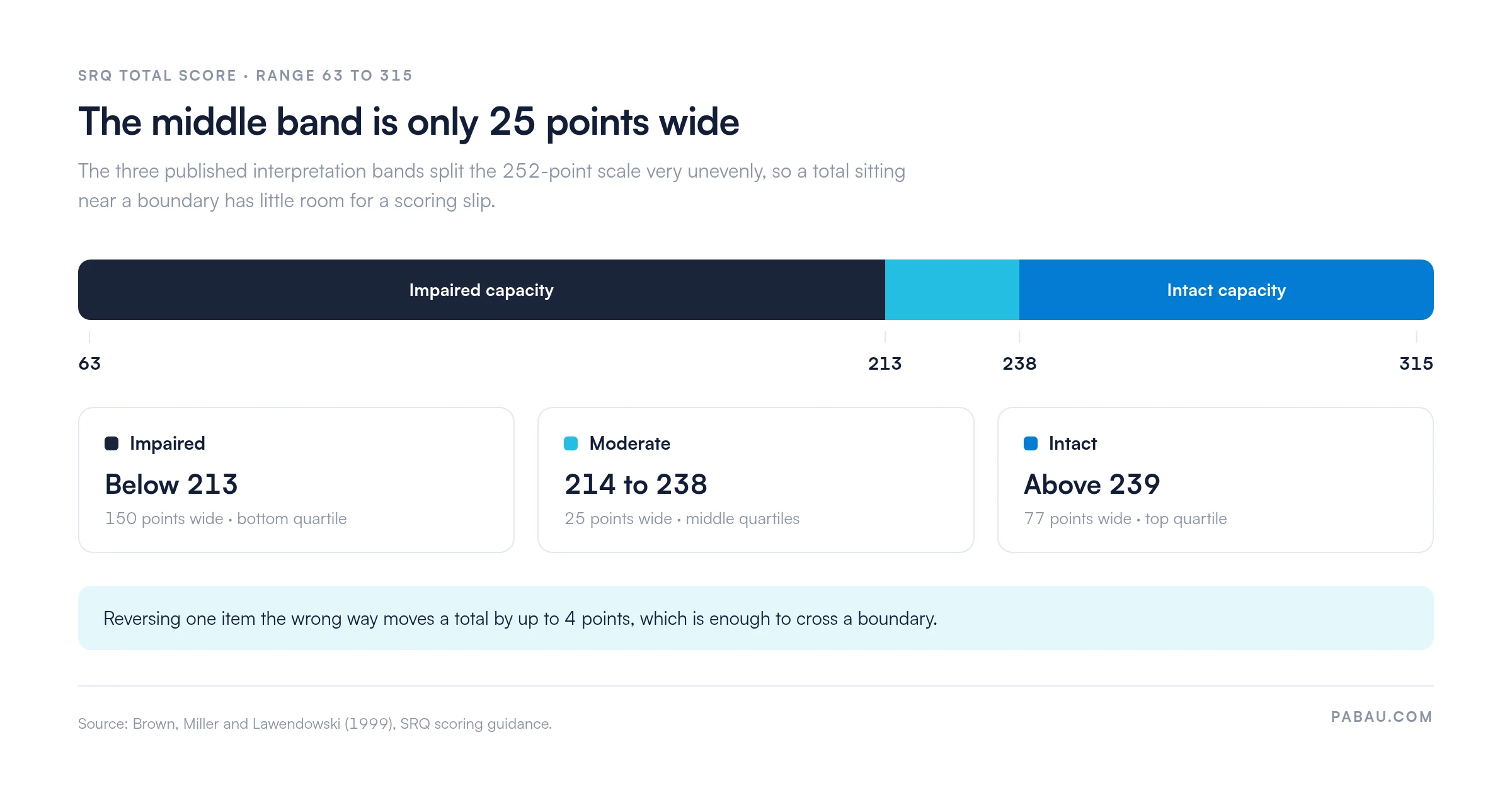
Totals run from 63 to 315, with scores above 239 read as intact capacity and scores below 213 read as impaired capacity.
The middle band spans only 25 points, so one mis-reversed item can move a patient across a boundary.
Practice management software like Pabau sends the questionnaire before the appointment and files the completed answers into the client record.
A self-regulation questionnaire measures a person’s ability to steer their own behavior toward a chosen outcome. The SRQ samples seven linked capacities. They run from noticing relevant information and judging it against a standard, through planning and carrying the plan out, to checking whether it worked.
Two instrument families share the name, and mixing them up produces scores that cannot be compared. Settle which one you are holding before you administer it.
This template is a capacity measure. If your clinical question is about the reasons behind a patient’s behavior, the self-determination theory family is the better fit. The comparison table further down shows which version covers which setting.
The download is a print-ready clinical form. The item set, the response scale, and the scoring key all sit on one document, so there is no worksheet to assemble before a session.
Those seven capacities come from the Miller and Brown (1991) seven-step model of self-regulation, which the questionnaire was built to sample.
The steps run in order: receiving information, evaluating it, triggering change, searching for options, planning, implementing, and assessing the result. Assessment then feeds back into the first two steps.
Every item is a first-person statement, and the patient rates how far it describes them. Roughly 40% of the statements are worded negatively, which is why the reverse-scoring step exists at all.
Several items reference consumption directly, which reflects the instrument’s development inside alcohol research. Item 15 asks whether the respondent finds it hard to notice when they have had enough alcohol, food, or sweets.
Scoring produces a single total between 63 and 315. There are no subscale means to calculate and no normative tables to look up. A completed form can be scored by hand in a few minutes.
Work from this list rather than from memory, and tick each item off as you flip it. The numbers are grouped in twenties purely to make the check faster.
Three bands carry the interpretation, and each one maps onto a position in the sample the instrument was validated against.
Plotted on the scale itself, those bands are far from even. The middle one covers 25 points out of 252, which is the practical reason a scoring slip matters so much.
Reliability supports reading the total rather than the parts. Internal consistency for the full scale is high (alpha = .91), and total scores were stable across a two-day retest (r = .94). Lower totals also tracked with heavier drinking and more alcohol-related consequences in the validation samples.
Take a completed form with a response on all 63 items. Added up exactly as the patient marked them, the responses come to 198. That figure is not the score yet, because the 26 flagged items still carry the wrong direction.
Those 26 items add up to 70 as marked. Flipping each one (6 minus the marked value) lifts their combined total to 86. The other 37 items contribute 128, so the corrected total is 214.
Notice what the reversal did. The uncorrected 198 would have been filed as impaired capacity, while 214 sits in the moderate band by a single point. Two very different notes, from one arithmetic step.
Store completed questionnaires and scoring worksheets alongside the patient’s clinical notes. Digital forms software lets your team send the questionnaire electronically and keep the completed answers in the client file. That spares you a scanning step later.

The 63 items were assigned to seven subscales of nine items each, one per step of the model. The authors are explicit that these subscales are for research purposes only.
Factor analyses found one broad factor rather than seven distinct ones, so separate subscale scores should not be interpreted clinically.
Use the subscale structure to talk through a result with a patient, not to report seven numbers. Pointing at the specific items a patient endorsed gives a consultation something concrete to work on, which the total score on its own does not.
Three options come up most often when clinicians go looking for a measure of self-regulation, and they answer different questions. The table sets out what each one covers and when it is the right choice.
The SSRQ shares its heritage with the template here. It was drawn from the same 63 items and correlates almost perfectly with the full scale (r = .96). That makes it a fair substitute when 63 items is too many to ask for.
The self-determination theory questionnaires are a separate family with a separate scoring method. Each version averages the autonomous items and the controlled items into two subscale scores.
Some studies then subtract one from the other to form a relative autonomy index. The learning version (SRQ-L) has 14 items, and the treatment version (TSRQ) is reworded for whichever health behavior is being studied.
The SRQ was developed and validated with adults, mainly college students and adults in alcohol treatment, so it suits adult and older adolescent caseloads.
Mental health practitioners, occupational therapists, and behavioral health teams use psychology practice management software to store results next to treatment outcomes.
For children, use the academic version from the self-determination theory family instead. It was written for late elementary and middle school students and uses a four-point response scale, because younger respondents handle fewer options better.
A questionnaire earns its keep once it is tied to a decision. That takes clear administration rules, secure storage, and a booked point where the score gets read again.
Teams running software for therapy practices usually build those three steps into the appointment itself. The sequence below does the same on paper.
Most of the trouble with this form starts before the patient picks up a pen. Five quick checks head it off.
Treated as a one-off intake formality, the questionnaire produces a number and little else. The value sits in the second administration, where the change in total either supports the current treatment plan or argues for a different one.
One practical warning on repeat testing. Patients who have seen the form before tend to recognize the negatively worded items. Keep the interval long enough that the retest reflects change rather than recall.
Self-regulation and emotional regulation are related but distinct constructs, and they are often assessed together. Knowing the difference keeps you from answering the wrong clinical question with the wrong instrument.
The two often need assessing together. A systematic review found emotion regulation difficulties in roughly 34% to 70% of adults with ADHD.
A patient can also land in the impaired band for emotional reasons rather than organizational ones. A second measure picks that up. An emotion regulation questionnaire is the quickest way to separate the two explanations.
Where both are in play, clinicians pair mental health EMR tools with interventions aimed at each construct separately. Planning support addresses the self-regulation side, while DBT skills or mindfulness work addresses the emotional side.
The instrument and its scoring guidance are published in full and free to access. Every figure in this article can be checked against the source.
Practices that assess adults for ADHD often collect this questionnaire alongside executive function measures. Reading the two together separates a planning problem from an attention problem, which changes what you offer the patient next.
In a lot of practices this form still travels as a PDF. Reception emails it out or prints it for the waiting room, and the patient hands it back on paper. Someone scores it by hand, types the total into a note, then scans and files the sheet. Retest comparisons usually break down at that point, because nobody can find last quarter’s total quickly.
Practice management software like Pabau moves the whole sequence into the patient’s file. Digital forms go out with the appointment confirmation, and the patient completes the questionnaire on their phone before they arrive. The answers land in their client record automatically, so consultation time goes on the discussion rather than on data entry.
Because the record holds every completed form with its date, the retest in step five stops depending on anyone’s memory. You can see the earlier total next to the current one, and automated reminders prompt the patient when the review point arrives. The outcome is a documented change score instead of an isolated intake number.

Pabau sends self-regulation questionnaires before the appointment and files completed answers into the client record. Every dated result stays in one place, so retest comparisons take seconds.

The self-regulation questionnaire earns its place at intake because it is free, public domain, and scored with one addition rather than a licensing agreement. Download it, apply the reverse-scoring key exactly as published, and record the total with its date.
The trade-off is worth remembering. Sixty-three items buy you one reliable total, and the seven subscales add no clinical detail on top of it. Treat a low score as a prompt to ask better questions, not as a finding you can put in a diagnosis.
What turns the score into clinical information is the second one. Book the retest at the same time you file the baseline, and the questionnaire starts telling you whether the treatment plan is working. Book a demo to see how Pabau sends assessments before the visit and keeps every dated result in the client record.

Need to tell a planning problem from an emotional one? Emotion regulation questionnaire gives you the second measure this article recommends pairing with the SRQ.
Want to check attention and planning separately? Executive function assessment covers the screening that sits alongside a low SRQ total in an ADHD workup.
Assessing motivation rather than capacity? Readiness for change questionnaire asks why a patient acts, which is the question the SRQ deliberately leaves alone.
Working in an addiction or alcohol service? AUDIT alcohol screening test pairs naturally with the SRQ, which was developed inside alcohol research.
Tracking whether treatment is moving the needle? Outcome rating scale (ORS) is a short session-by-session measure for the review points between SRQ retests.
You can, because the instrument is in the public domain. The published bands only apply to the full 63-item version, though, so a trimmed form no longer maps onto them. Use the validated 31-item SSRQ if you need something shorter.
Whoever scores it needs the reverse-scoring key, so keep it with the team. Patients who score their own form see which items are reversed, and that knowledge can shape how they answer at retest.
Yes. Brown, Miller and Lawendowski ask users to acknowledge the source, even though no permission or fee is required. A line in your assessment notes or a citation in a report is enough.
No. The SRQ was never validated as a predictor of attendance or dropout. Lower totals did track with heavier drinking and more drinking consequences, so read a low score as a reason to plan more between-session support.
Yes, and public domain status makes that straightforward. Keep the item wording, the order, and the five-point scale exactly as published, otherwise the bands stop applying. Digital delivery also timestamps each submission, which helps at retest.