Fair fighting rules worksheet
A fair fighting rules worksheet is a therapy handout that sets out ground rules ...

3
Last Updated: Oct 21, 2026

The opposite action worksheet walks a client through naming an emotion, checking the facts, and choosing a behavior that opposes the urge.
Opposite action only applies when the emotion does not fit the facts, or when acting on the urge would cause harm.
The worksheet maps five core emotions to their typical urges and the opposite action that counters each one.
Practice management software like Pabau delivers the worksheet digitally, tracks completion, and files the result in the client record.
A ready-to-use clinical tool covering emotion identification, urge analysis, fact-checking, and structured opposite action planning for DBT emotion regulation sessions.
Download templateThe opposite action worksheet turns a core skill from dialectical behavior therapy (DBT) into five steps on one printable page. The client names the emotion, names the urge it carries, and checks whether the emotion fits the facts. If it doesn’t, they choose a behavior that opposes the urge and commit to it fully.
Psychologist Marsha Linehan developed opposite action as part of DBT’s emotion regulation module. It applies when an emotion is unjustified by the circumstances, or when acting on the urge would cause harm. The worksheet gives that principle a shape you can use in session and send home as homework.
It works in individual therapy, group DBT skills training, inpatient units, and community practice. Adolescents, adults, and older adults can all use it. It sits alongside the rest of the emotion regulation module, next to the check the facts worksheet and the PLEASE skills checklist.
Understanding the mechanism helps you introduce the worksheet with confidence. The process runs in five clear steps.
This structure turns an abstract skill into a repeatable protocol. Clients can work through the sheet alone or with guidance, which makes it useful as both a session tool and a homework assignment.
The worksheet earns its place through concreteness. Emotion-specific examples anchor an abstract skill to behavior a client can picture. The table below maps five core emotions to their typical urges and the opposite action that counters each one.
These pairings are not exhaustive. Clients often feel two emotions at once, or need a variation that fits their own situation. Treat the table as a starting point and adapt the wording with each client.
Opposite action does not suit every emotion, so the first job is telling justified feelings from unjustified ones. Fear in the face of genuine danger is appropriate. Fear of a presentation you have prepared for is not.
Sadness after a loss is healthy. Sadness that has not shifted after weeks of support may point to depression, which needs more than a skill.
The sequence below shows where that decision sits, and what to do when the emotion turns out to fit the facts after all.
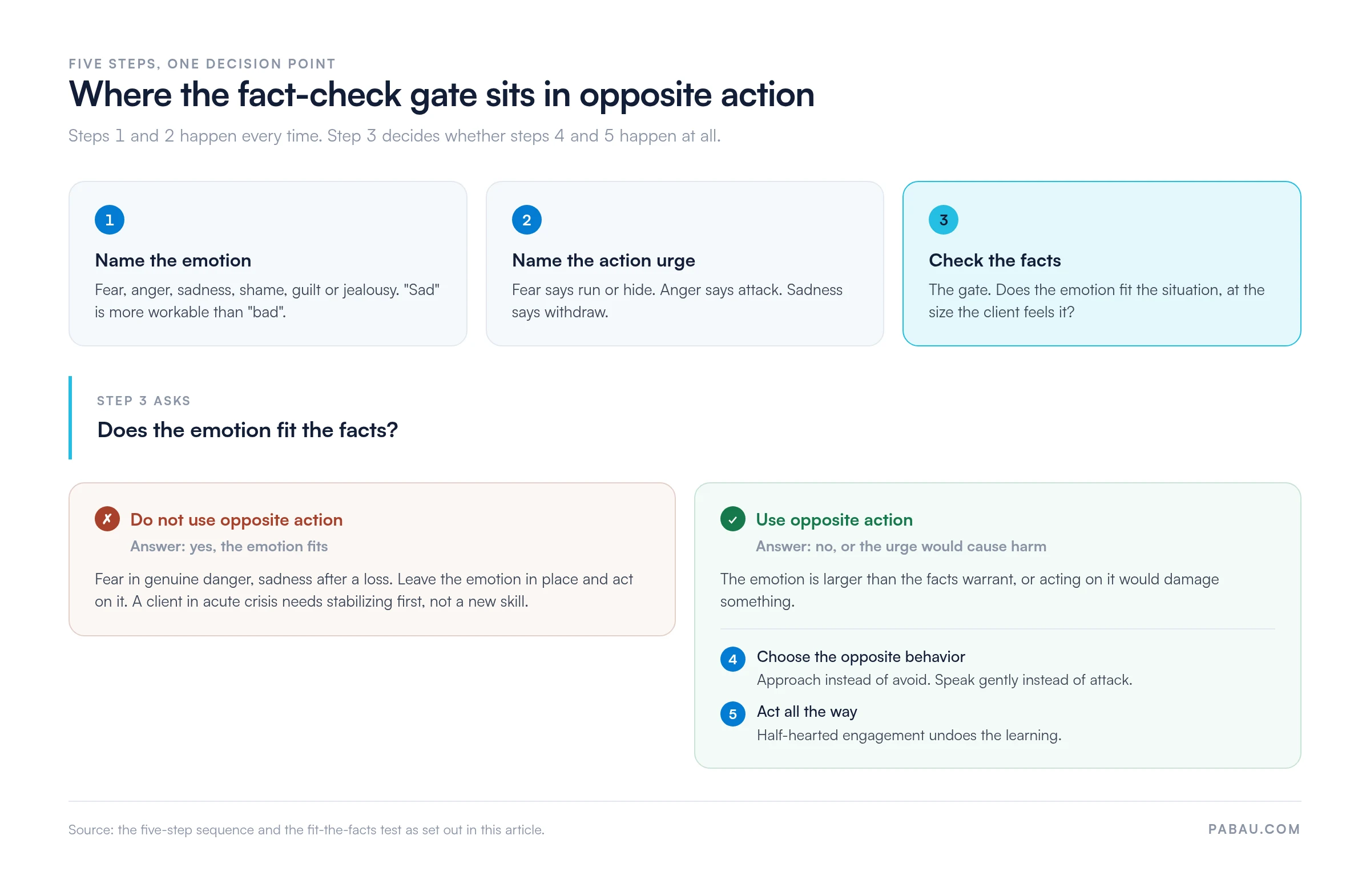
This distinction protects against misuse. Run the fact check before you reach for behavioral change, and say out loud why the emotion does not fit the situation.
Introducing the worksheet follows a clear sequence. Start with psychoeducation: Explain why opposite action works, since it interrupts the loop where urge-driven behavior feeds the emotion back. Then normalize the awkwardness. Many clients need permission to feel fake at first, and that discomfort is usually a sign the skill is landing.
Then model it. Narrate one of your own examples aloud, so the client hears the steps applied to an ordinary situation rather than a clinical one.
When you fill the sheet in together, work field by field. Spend time on the emotion and the urge before you touch the fact check, because a vague emotion produces a vague opposite action. Then ask whether the circumstances justify what the client feels.
Brainstorm the opposite actions together once the fact check is done. The client’s own suggestions usually carry more weight than the ones you propose.
Between sessions, clients can log practice attempts and outcomes in digital therapy forms that come back to you before the next appointment. That gives you a record of skill development instead of a memory of it.
Returned forms land next to the client’s chart in software for therapy practices, so your progress note and the homework record stay together.
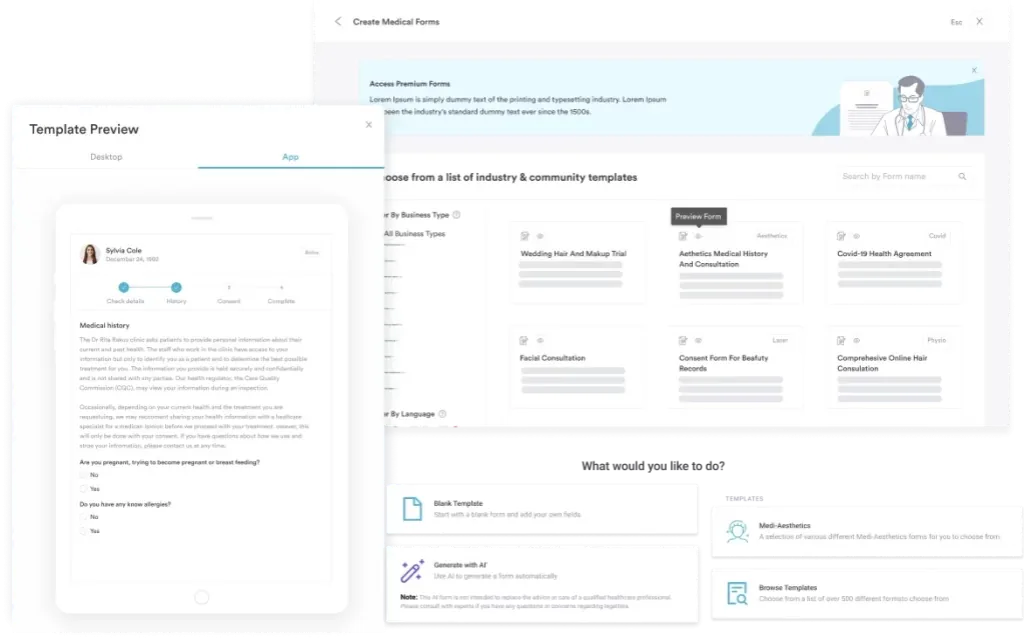
Documentation matters here. Record which emotion was targeted, which opposite action the client practiced, and what they learned from it. That shows a supervisor or an auditor that the skill was taught, not just handed over.
Depression is the hardest case, because the urge to withdraw, sleep, and avoid feels protective while it feeds the cycle. The opposite action for sadness is behavioral activation. The client schedules a valued activity and engages with it fully, whether or not the motivation shows up.
Forced cheerfulness is not the goal. What matters is committed engagement despite the low mood. A dedicated behavioral activation worksheet gives that its own columns for the activity, the schedule, and the mood rating afterward.
Clients often report that the mood lifts after the activity rather than before it. Point that sequence out explicitly. You do not wait to feel motivated, because the motivation tends to follow the action.
For clients with chronic depression, this is the skill that connects the session to the rest of the week. It produces numbers you can review together: activities completed, mood tracked, urges resisted.
A few guardrails keep the worksheet from misfiring. Give the client enough psychoeducation first. A client who does not understand the rationale either abandons the sheet, or applies it to situations it was never meant for.
Scaffold the difficulty. Start with lower-stakes emotions and situations before you move to the clinical material that brought the client in.
Normalize the discomfort of a new behavior. Clients who report feeling inauthentic are describing a brain learning a new response, not a skill that has failed.
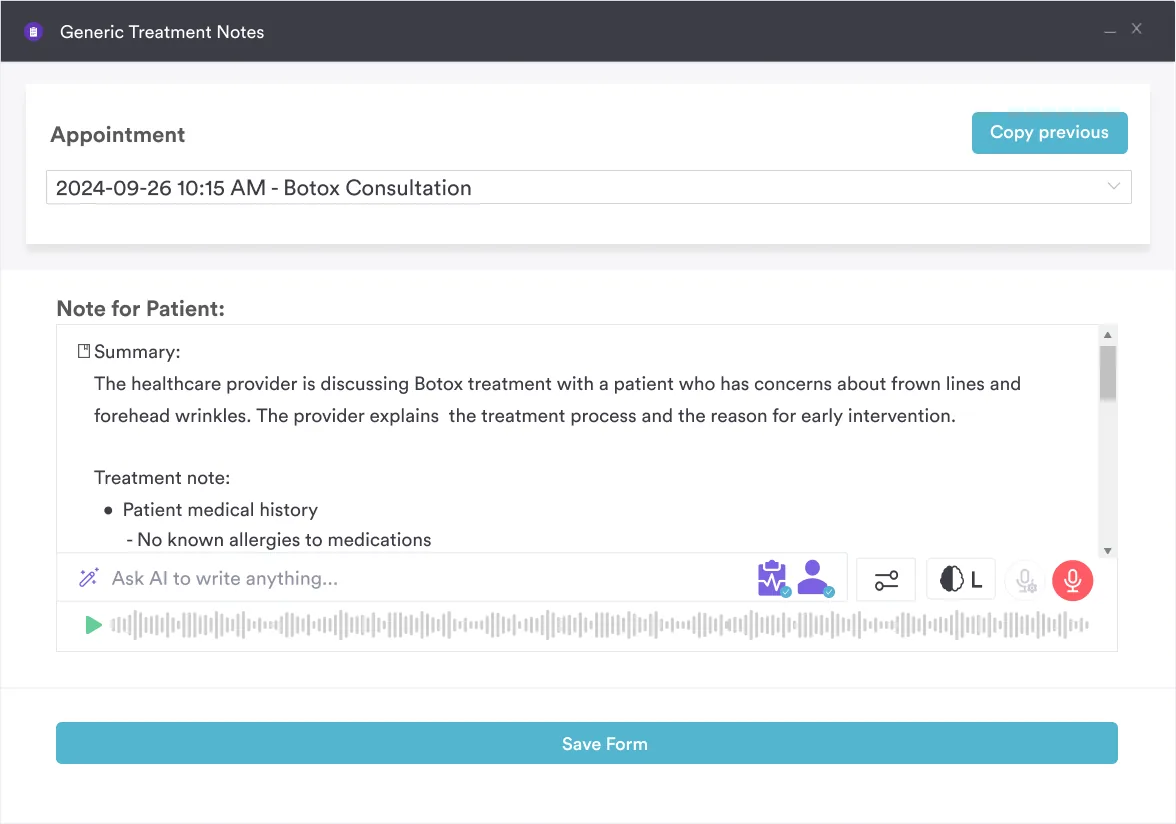
Keep the record longitudinal. An AI medical scribe can draft the session note while you teach. Over a course of therapy those notes show which emotions you targeted and how the client’s practice changed.
Finally, connect the sheet to the client’s values. Opposite action is a practice in living the way they want to live, not only a way to reduce a symptom. Clients who see connection, integrity, or courage in the exercise stay with it longer.
Most practices hand the worksheet over on paper at the end of a session. It goes home in a bag and comes back unfinished, or not at all. The outcome then lives in whatever the clinician remembers to type up later.
Practice management software like Pabau closes that loop. You build the worksheet once as a digital form and send it through the client portal. It arrives back in the client record when the client is done, and a mental health EMR keeps it beside the progress note.
So the next session opens with the client’s own words in front of you. You can see which emotion they worked on, which opposite action they tried, and how it went, without asking them to remember.
Group skills training gets the same treatment. Send the sheet to every member of the group at once. Track who returned it, so the next group opens on the practice they brought back.

Send the worksheet through the client portal, take it back as a digital form, and file the result in the client record. Your notes and your homework tracking stay in the same place.

Use the worksheet as a fact-checking instrument first and a behavior-change instrument second. The fastest way to discredit opposite action with a client is to apply it to a feeling that was justified all along.
Print it and use it in your next skills session, then keep the completed sheets where your notes live. Opposite action asks a client to do the least appealing option in front of them. A record of what they tried last time is what makes the next attempt negotiable.
Book a demo to see how Pabau sends DBT worksheets to clients and files the completed ones in the client record.

Teaching the wider DBT skill set? DBT therapy worksheet covers the four modules in one printable pack you can pull from session to session.
Client in crisis rather than skill practice? DBT distress tolerance skills explains what to reach for when opposite action is the wrong call.
Need a quicker check between sessions? Emotional regulation checklist gives clients a short self-assessment they can complete without a full worksheet.
Working on the vulnerability factors underneath? ABC PLEASE handout covers the sleep, food, and exercise habits that make emotions harder to regulate.
Opposite action is an emotion regulation skill from DBT. The client names an emotion, checks whether it fits the facts, and then deliberately behaves in a way that opposes the emotion’s usual urge. That breaks the loop where acting on the urge feeds the emotion.
Suppression pushes the emotion away, or pretends it is not there. Opposite action names the emotion, tests it against the facts, and then chooses a behavior that does not match it. The feeling is acknowledged rather than denied.
Yes. For the depressive urge to withdraw and isolate, the opposite action is engaging in valued activities and reaching out despite low motivation. Clinicians call this behavioral activation, and it is a core part of depression treatment in both DBT and CBT.
Any emotion that fits the facts, and any situation where acting on the urge is the correct response. Fear in genuine danger and sadness after a loss should not be opposed. A client in acute crisis needs stabilizing before new skill work.
Committing fully to the opposite behavior, with no half-measures. If the opposite action for social anxiety is attending an event, acting all the way means holding conversations. Sitting silently at the edge of the room does not count.