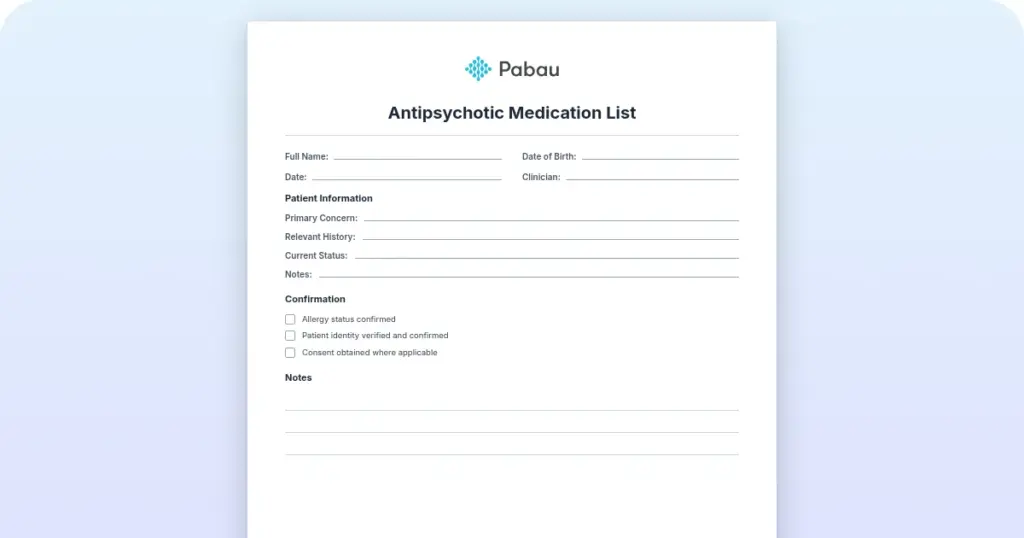
Antipsychotic medication list
An antipsychotic medication list is a structured reference that organizes psychi...

2
Last Updated: Oct 13, 2026

A DBT diary card is a self-monitoring form. Clients use it to track emotions, urges, target behaviors, and the skills they practiced each day.
The therapist reviews the completed card at the start of every individual session, and what it shows sets the agenda for that hour.
The four core tracking categories are emotional intensity, urges to act on problem behaviors, target behaviors, and which DBT skills were used.
Practice management software like Pabau keeps completed cards in the client record and sends skill reminders between sessions.
A weekly self-monitoring grid with rows for emotional intensity, urges, target behaviors, and the four DBT skill modules. It prints on one page, covers all seven days, and leaves space for the therapist’s session-start notes.
Download templateDialectical behavior therapy (DBT) works because clients pay attention to their own experience between sessions. The DBT diary card is the form that makes that attention concrete.
Every DBT client fills one in daily or weekly. They record emotional states, urges to self-harm, the target behaviors they are working to change, and which skills they actually used. The therapist reads the card at the start of the next session and uses it to decide what to work on.
This guide covers what the card measures and how to walk a client through completing it. It also shows how digital versions fit into a therapy practice management workflow. The template above is free and ready to print or send.
A DBT diary card is a self-monitoring form that clients complete daily or weekly. It tracks specific emotions, urges, behaviors, and skill use. The format comes from Marsha Linehan’s DBT protocol, developed to treat borderline personality disorder (BPD) and chronic suicidality.
The card does two jobs at once. It asks the client to notice what they felt and did while the day is still fresh. It also hands the therapist a week of behavioral data to open the session with, instead of a summary reconstructed from memory.
A mood journal is narrative and open-ended. The card is a structured grid of ratings and checkmarks, which makes it faster to complete and far easier to compare week to week. That structure also suits clients who find a blank page overwhelming.
The card sits at the center of DBT’s model of change. Skills practice happens at home, and the card is the evidence that it happened. It makes the client’s week outside the office visible inside the therapy room.
A standard card tracks four core categories, each covering a different part of the week:
Some practices add columns for sleep, substance use, medication adherence, or homework completion. The four categories above are always there. Most cards use a weekly grid so all seven days fit on one page, which keeps the form portable.
A validated measure can sit alongside the daily ratings when one emotion dominates the case. A clinical anger scale gives you a scored baseline to check the client’s own anger ratings against.
Clients bring the completed card to every session, and the therapist reviews it in the first 5-10 minutes. That routine tells the client that what happens between appointments is the actual subject of the work.
Completing a card takes two to three minutes a day. Here is how to walk a client through it.
Most clients say the tracking itself helps. Noticing that anxiety spikes every time they open an ex’s social media turns a vague bad week into one specific thing to work on.
Clients who struggle with routines need a cue. A phone alarm or a digital form that opens at the same time each evening lifts completion rates more than another reminder in session does.
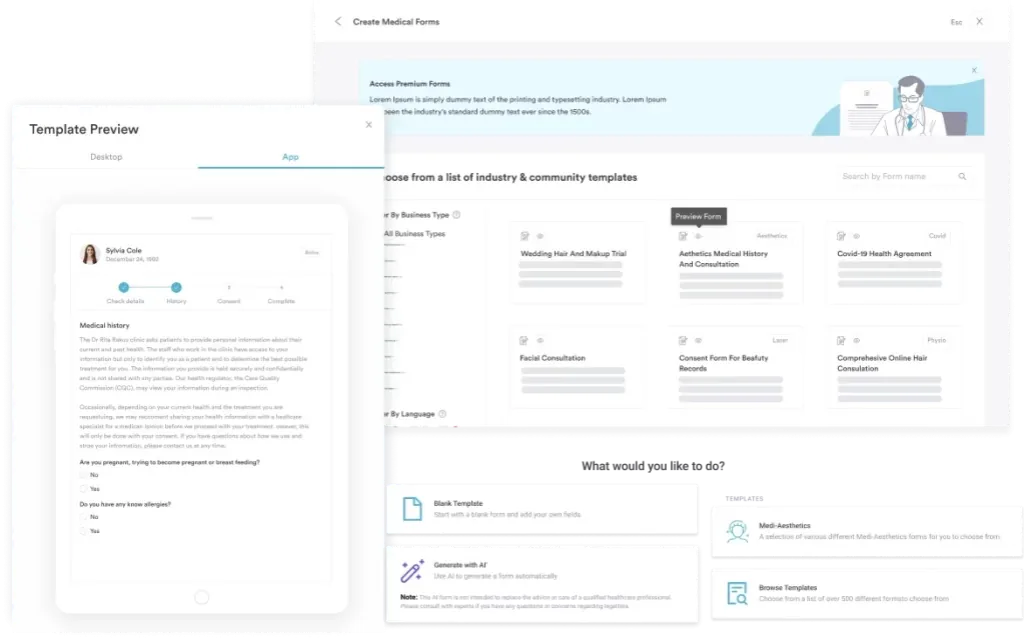
Psychologists often assign tools like this through psychology practice software, tracking completion between sessions.
The card is a clinical data source, and it shapes what happens in the room. Here is what therapists do with it.
High ratings are information, not a failure to be corrected. They let the therapist ask a sharper question, such as why anger was lowest on the days the client practiced mindfulness.
Where the same thought pattern keeps driving the urges, a negative self-talk worksheet gives the client something concrete to take home. A self-control worksheet works the same way for impulsive target behaviors.
Comparing cards across a full caseload takes organized documentation. Practices with digital records and patient compliance workflows can pull up three months of history in seconds. A paper file takes far longer.
Practices running DBT programs lose most of their admin time on logistics. Cards go into a folder, reviews depend on someone remembering, and caseload-wide progress is hard to see. Practice management software like Pabau.
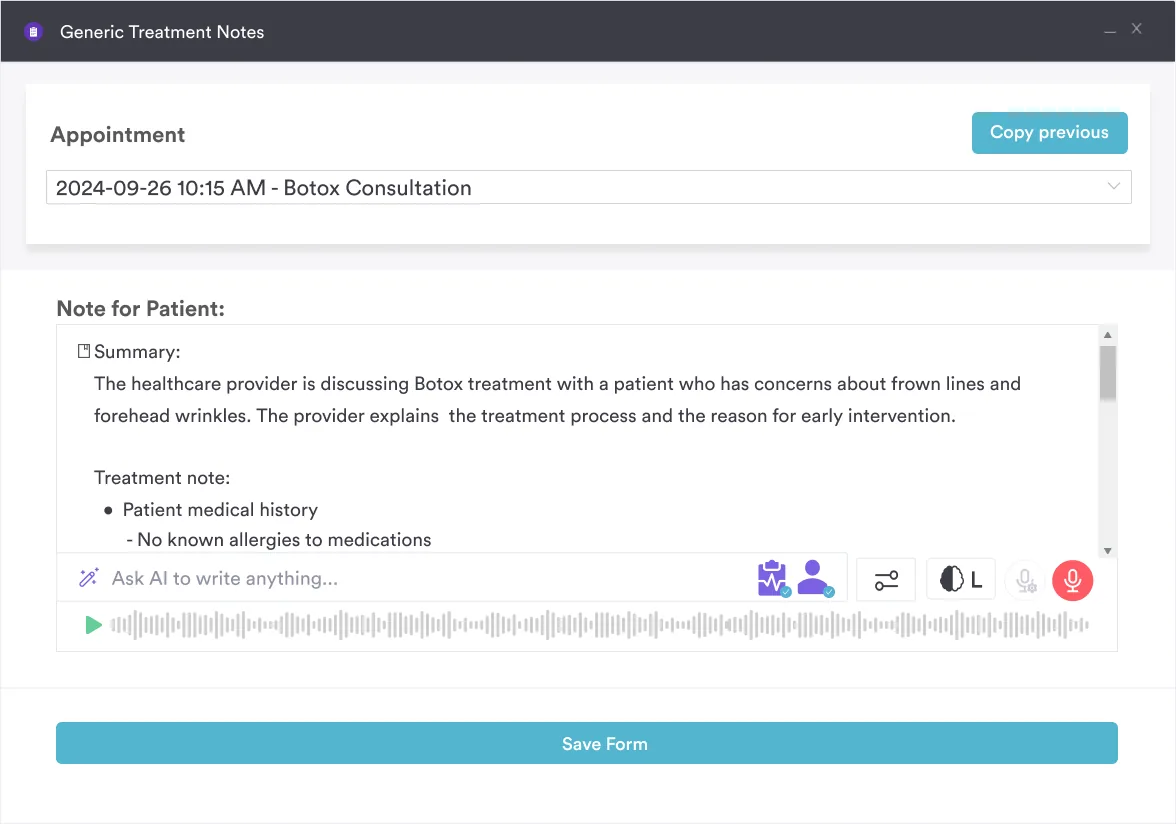
Completed cards attach to the client’s record, so a therapist can open three months of them without leaving the chart. Urge trends and skill milestones reach the note without being retyped after the client leaves.
Between-session contact is a DBT cornerstone. Pabau’s automated workflows send SMS or email skill reminders on a schedule you set once. Clients get a nudge to try TIPP when a hard evening lands, and nobody on the team has to remember to send it.
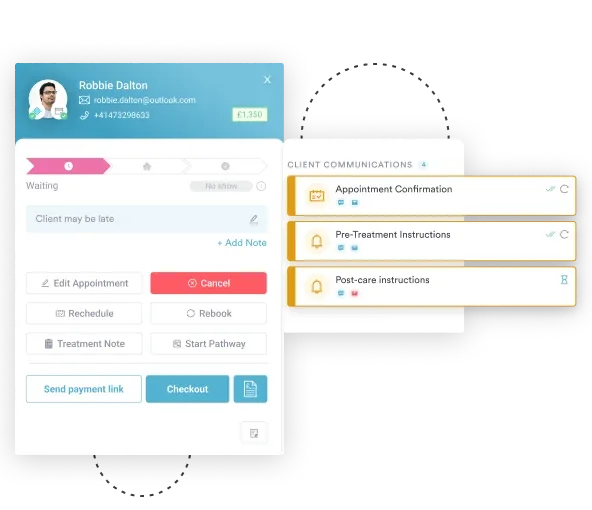
Comprehensive DBT runs four things at once: individual therapy, skills training, phone coaching, and consultation team meetings. Pabau’s multi-location and team scheduling tools keep all four on one calendar.

Pabau stores completed diary cards in each client’s record, sends skill reminders between sessions, and drafts your session notes for you. Your caseload’s progress stays visible without a second spreadsheet.

The diary card earns its place because it makes a week of behavior legible. A client who reports a bad week gives you one thing. A card showing anger at 9 on Thursday gives you somewhere to start.
If your practice still collects cards on paper, the cost shows up later. It shows up in the cards that never come back, and in reviews done from memory because last month’s card is in a filing cabinet. The trade-off is worth naming: paper is easier to hand out, and much harder to learn anything from.
Standardize one card across the whole team first, then decide where the completed ones live. Book a demo to see how Pabau stores diary cards, automates skill reminders, and keeps DBT progress visible across your caseload.

Helping clients put a name to what they feel? Gottman feelings wheel gives clients a printable wheel of feeling words to use during session.
Want a simple gratitude exercise for clients? Gratitude jar worksheet gives clients a printable jar page, a word bank, and 30 prompts to build the habit.
Working on reframing fixed thinking with a client? Growth mindset worksheet compares fixed and growth mindsets with reframing prompts and a five-step session plan.
Explaining your approach to a new client? A counseling theories chart sets DBT next to the other modalities on one page.
Stuck on what a client is working toward? A life values inventory helps you turn vague goals into target behaviors worth tracking.
A DBT diary card is a structured self-monitoring form. Clients use it to track emotional intensity, urges to self-harm, target behaviors, and DBT skills use. The therapist reviews the completed card at the start of every session to guide treatment and spot patterns.
Most clients complete the card daily, usually in the evening, on a single weekly sheet. The frequency depends on the client’s stability and the therapist’s judgment. Newly admitted or high-risk clients track daily, while more stable clients may track weekly.
The four core categories are emotional intensity, urges, target behaviors, and DBT skills used. Emotional intensity and urges are each rated on a 0-10 scale. Target behaviors are marked present or absent, and skills are checked off by module.
Yes. Digital cards can be completed as PDF forms, in a mobile app, or inside a practice management system. Digital versions are easier to store, compare over time, and pull into clinical notes. Some clients still prefer paper for the grounding effect of handwriting.
Therapists review the card at session start to find target areas, such as high urges on specific days. Falling ratings over time get named as progress. High emotion regulation urges prompt extra work on that module, and few skill checks suggest the client needs help spotting the moment to use one.
Have them complete it from memory at the start of the session, using the past week as a reference. That is less reliable than same-day entries, but the data is still worth having. Phone reminders or digital prompts prevent most missed cards.