Facial skin treatment consent form template: Microneedling and phi-ion
A facial skin treatment consent form is the signed proof that a patient was scre...

2
Last Updated: Oct 21, 2026

The elbow flexion test assesses ulnar nerve entrapment at the cubital tunnel. The patient holds full elbow flexion for three minutes while you watch for tingling in the ring and little fingers.
A positive result is reproduction of tingling or numbness in the ulnar nerve distribution. It points to possible cubital tunnel syndrome and warrants nerve conduction studies, EMG, or imaging.
Accuracy depends on the variant used. A five-second hold caught 25% of cases in Ochi’s 2012 series, while the shoulder internal rotation version reached 87%. Specificity stayed at 98% or above.
Cubital tunnel syndrome is coded in the G56.2- family, not G54.2. The fifth character carries laterality, so G56.21 is the right arm and G56.22 the left.
Practice management software like Pabau stores the assessment form, the test findings, and the code in one patient record.
A ready-to-use clinical assessment form capturing patient details, elbow flexion test procedure checklist, positive sign findings, and ICD-10 coding for cubital tunnel syndrome documentation.
Download templateThe elbow flexion test for cubital tunnel syndrome is a clinical examination that reproduces symptoms of ulnar nerve entrapment at the elbow. The clinician asks the patient to flex the elbow fully and hold that position for three minutes. Buehler and Thayer’s original protocol allowed up to five minutes before the test was called negative.
If tingling or numbness appears in the ring and little fingers, the test is positive. Those two digits carry the ulnar nerve’s sensory supply. Physical therapy, orthopedics, sports medicine, and chiropractic all use the test to raise suspicion for cubital tunnel syndrome and justify nerve conduction studies.
Whatever the setting, the record has to show what you did and what the patient reported. A physical therapy EMR makes it easy to capture the hold time, the result, and the next diagnostic step. That record is what an auditor and the next clinician both read.
Cubital tunnel syndrome occurs when the ulnar nerve becomes compressed or irritated as it passes behind the medial elbow. The nerve travels from the neck, down the arm, and into the hand. This is the second most common peripheral nerve compression syndrome after carpal tunnel.
The ulnar nerve controls sensation and motor function in the ring and little fingers. Compression there causes paresthesias (tingling or a pins-and-needles feeling), numbness, weak grip, or clumsiness during fine motor tasks.
Risk factors include repetitive elbow bending (assembly line work, throwing athletes), direct pressure (leaning on the elbow), or anatomical variations at the cubital tunnel. Early diagnosis prevents permanent nerve damage and guides appropriate conservative or surgical intervention.
The procedure is simple, reproducible, and requires no equipment. Follow this sequence:
If no symptoms appear by three minutes, some protocols extend the hold to five minutes before recording a negative result. Note in the record which hold time you used, because the timing changes how the result should be read.
Record both the result and the clinical context. Was the patient symptomatic at baseline? Did symptoms reproduce in the expected distribution, and how quickly did they resolve after the elbow was released?
A positive result is reproduction of paresthesias in the ring or little fingers, which is the ulnar nerve distribution. The symptoms should match the patient’s chief complaint and settle shortly after the elbow is released.
Timing matters. Symptoms that start within the first 30 seconds are more specific to ulnar nerve involvement than symptoms that appear only near the three-minute mark.
A positive elbow flexion test raises clinical suspicion for cubital tunnel syndrome, but it is not diagnostic on its own. Say so to the patient before they leave. Confirmation still requires nerve conduction studies and electromyography ordered by a physician or specialist.
Track when symptoms start during the three-minute hold, not just whether they appear. Onset inside the first 30 seconds points more strongly to ulnar nerve compression than onset near the end of the hold. Record the time in seconds so the next clinician can compare it on the follow-up visit.
Published accuracy figures for the elbow flexion test vary widely, and the hold time explains much of the spread. A five-second hold and a three-minute hold are not the same test. The studies below are the primary sources behind the numbers most often quoted.
Clinical interpretation: Specificity is the true-negative rate, so a specificity of 98% to 100% means a positive test rarely appears in a healthy arm. Sensitivity is the true-positive rate, and it is the weak side of this test.
A short hold misses most cases, so a negative result does not rule cubital tunnel syndrome out. Combine the test with Tinel’s sign, pressure provocation, patient history, and electrodiagnostic studies before you confirm a diagnosis. The chart below lines the variants up by reported sensitivity.
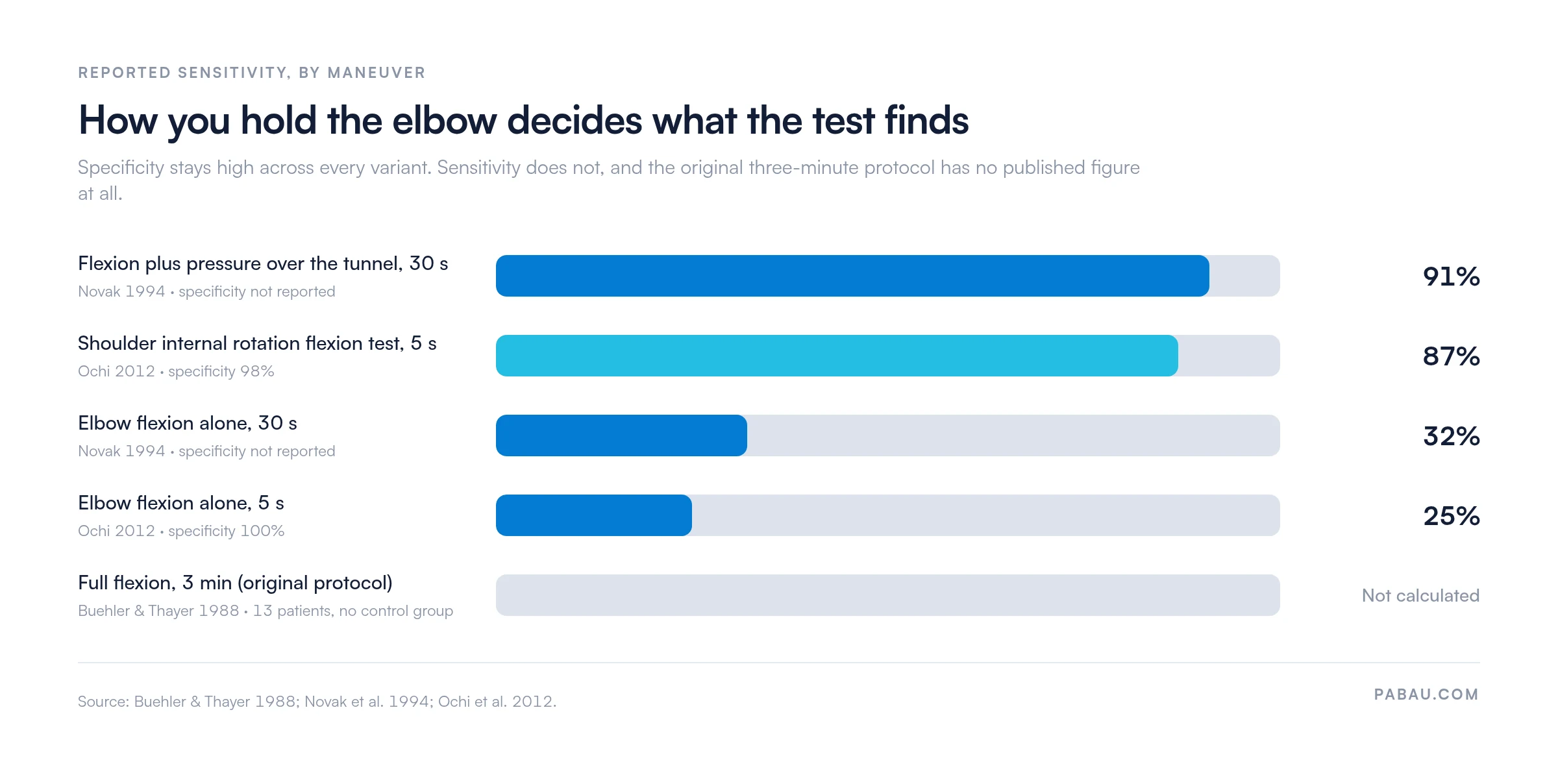
The shoulder internal rotation variant is the practical takeaway from Ochi’s data. Adding shoulder internal rotation to elbow flexion raised sensitivity from 25% to 87% while specificity stayed at 98%. If a busy schedule pushes you toward a short hold, add the shoulder position rather than shortening the test further.
The elbow flexion test is one of several provocative maneuvers used in the cubital tunnel syndrome examination. A comprehensive physical assessment typically includes multiple tests to increase diagnostic confidence. The wider set of hand nerve tests covers the median and radial territories as well.
The pressure provocation test, also called the direct compression test, applies sustained pressure over the cubital tunnel for 30 seconds. The elbow flexion test relies on postural stress and nerve elongation. The pressure test instead relies on mechanical compression of an already narrowed tunnel.
Some clinicians prefer it for patients with limited range of motion or arthritis. Novak’s 1994 data support pairing the two. Sensitivity rose from 0.32 for flexion alone to 0.91 when pressure was added.
The elbow flexion test sits inside a wider screen for upper extremity nerve entrapment. Run it alongside the upper limb tension tests to separate cubital tunnel syndrome from cervical radiculopathy and carpal tunnel syndrome.
Document every provocative test you perform, positive and negative. Sports medicine software keeps those results in one record, so the next clinician sees the whole screen rather than the positive findings alone.
A structured form keeps testing consistent across visits and across clinicians. It improves handover, reduces missing documentation, and gives you something defensible when a payer or an auditor asks.
This form serves physical therapists, athletic trainers, occupational therapists, chiropractors, orthopedic nurses, and sports medicine clinicians. Any practitioner screening for cubital tunnel syndrome benefits from standardized documentation.
The form earns its keep in multi-provider practices. Consistency in testing procedure and result interpretation prevents misdiagnosis and supports continuity of care across providers.
Structured assessment forms reduce documentation errors, save time, and create an audit trail. Clinicians can focus on the patient’s presentation instead of remembering what to document.
The form captures every key finding, from procedure details to positive or negative status and differential diagnoses. Follow-up clinicians and reviewers then have the full context, which matters for medicolegal protection and audit readiness.
Digital assessment forms also let you share results with the patient through the portal and drop them straight into the EMR. That cuts paper, removes handwriting problems, and speeds up clinical decisions.

Accurate coding is essential for billing and for the electronic health record. In ICD-10-CM, cubital tunnel syndrome sits in the G56.2- family, Lesion of ulnar nerve, which carries cubital tunnel syndrome as an applicable synonym.
The category needs a fifth character for laterality before it can be billed. G56.2 on its own is not a valid claim code.
Watch out for G54.2. That code is Cervical root disorders, not elsewhere classified, and it describes cervical radiculopathy. It is a common miscode for cubital tunnel syndrome, and it points a payer at the neck rather than the elbow.
Documentation tip: Coding guidelines update annually, so check the current code set against your payer requirements each year. Record the side, the onset, and the electrodiagnostic result in the same note, because the laterality digit has to come from the chart. Keeping the note in one medical records management system means the coder reads exactly what the clinician wrote.
Provocative test findings usually get typed into the note as free text. The hold time lands in one clinician’s note, the finger distribution in another’s, and the code somewhere else. On the follow-up visit nobody can tell whether the test was repeated the same way.
Practice management software like Pabau replaces that with a structured form. You build the elbow flexion test as a reusable template. Give it fields for hold time, onset in seconds, affected digits, and the paired tests you ran.
The form saves into the patient record, so the next clinician opens the same fields and compares like with like. The same record carries the laterality you need for G56.21 or G56.22, so the coder is not guessing from a narrative note. Every subscription includes the form builder and the records module, so you do not pay extra to switch it on.

Pabau’s customizable digital forms and clinical templates help you document provocative tests accurately, keep the record consistent across your team, and stay ready for audit.

The elbow flexion test is a fast, reproducible screen for cubital tunnel syndrome and a sensible first step in the workup. No single provocative test is diagnostic. Combined with patient history, Tinel’s sign, pressure provocation, and electrodiagnostic studies, it gives you a defensible level of diagnostic confidence.
Standardized documentation is what holds that chain together, from the hold time you used to the laterality digit on the claim. See how Pabau handles it by booking a demo.

Screening the outside of the elbow instead? Cozens test covers the resisted wrist extension maneuver for lateral epicondylitis, with its own assessment form.
Ruling out carpal tunnel at the same visit? Phalen’s test walks through the wrist flexion maneuver and how to read a positive result.
Suspect the symptoms start above the elbow? Adson’s test screens for thoracic outlet syndrome, a common differential for ulnar nerve symptoms.
Managing stiffness once the diagnosis is made? Elbow stiffness exercises handout gives patients a printable home program you can attach to the visit note.
Building the paperwork around the assessment? Physical therapy intake form captures history, baseline pain scores, and consent before the examination starts.
A positive test is reproduction of tingling, numbness, or paresthesias in the ring and little fingers while the elbow is held in full flexion. The standard hold is three minutes. Symptoms should settle shortly after the elbow is released.
Accuracy depends on how the test is performed. Ochi et al. (2012) reported 25% sensitivity and 100% specificity for a five-second hold. The shoulder internal rotation variant in the same study reached 87% sensitivity and 98% specificity. Novak et al. (1994) reported 32% sensitivity at 30 seconds, rising to 91% when direct pressure was added. Use the test as a screen, then confirm with nerve conduction studies and EMG.
You can perform the elbow flexion test at home to check for symptoms. A clinical diagnosis still requires a full physical examination, imaging, and nerve conduction studies performed by a qualified healthcare provider. Self-testing does not replace professional evaluation.
The Wadsworth elbow flexion test is a named variation of the standard test, after T.G. Wadsworth, who published on ulnar nerve compression at the elbow. The core procedure does not change. The patient holds full elbow flexion for three minutes while you watch for ulnar nerve symptoms. The Wadsworth description adds full wrist extension.
Mild cubital tunnel syndrome may resolve with conservative management, such as activity modification, anti-inflammatory medication, and rest. Symptoms often persist without treatment, and severe or progressive cases typically require surgical decompression. Early diagnosis and intervention improve outcomes.