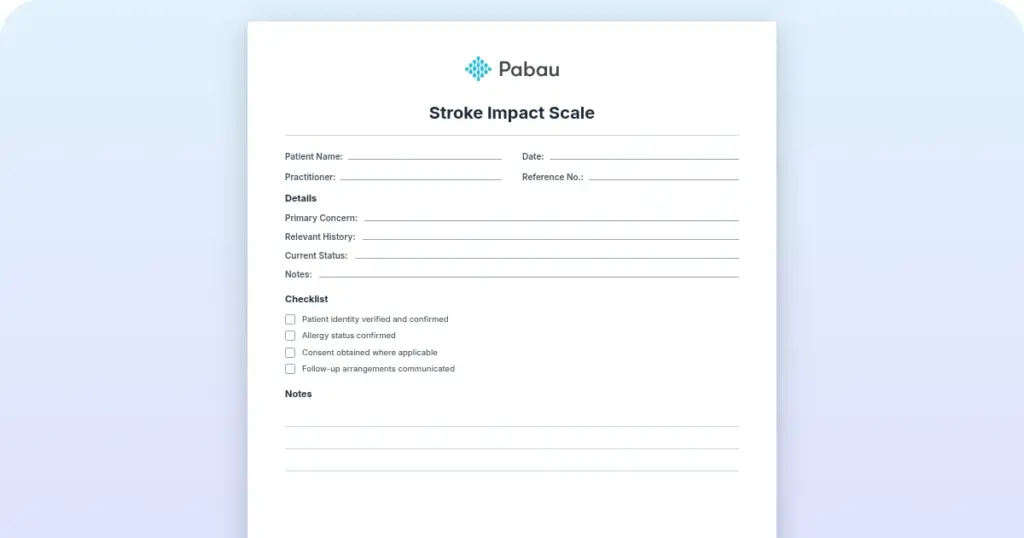
Stroke impact scale: Free PDF, scoring and MCID by domain
The stroke impact scale (SIS) is a 59-item questionnaire in which stroke survivo...

2
Last Updated: Oct 13, 2026

An elbow stiffness exercises handout walks patients through range-of-motion, stretching, and strengthening moves in order, with the holds, reps, and progression rules a physiotherapist would set.
Non-operative treatment works best when it starts within 6 months of stiffness onset, so early, structured exercise matters most in the first few months of recovery.
Pairing active range-of-motion work, passive stretches, and forearm rotation trains flexion, extension, pronation, and supination together, rather than one movement at a time.
With practice management software like Pabau, you can send the handout through the patient portal, see who’s completing their exercises, and adjust the plan inside the patient record.
A patient-ready guide with step-by-step elbow rehabilitation exercises, covering range of motion, stretching, and strengthening for recovery after injury or surgery.
Download templateElbow stiffness is one of the most common problems after a fracture, surgery, or a long spell in a cast or sling. When the joint won’t fully bend or straighten, everyday tasks like eating, dressing, and reaching all get harder. Loss of range of motion (ROM) is what turns a healed injury into a lasting limitation.
This elbow stiffness exercises handout gives patients the exact moves to work through at home, with the holds, reps, and progression rules a physiotherapist would set in the clinic. Below you’ll find the full exercise set, guidance on when to progress or stop, and how to hand the plan to patients and track that they’re doing it.
These are the core moves in the handout, grouped by the movement they target. Work through them slowly, and stop short of sharp pain. Early on, patients should check with their clinician before starting, especially after surgery or a fracture that needed fixation.
Flexion (bending) and extension (straightening) are the two movements most often lost after immobilization. Start here.
Rotating the forearm palm-up (supination) and palm-down (pronation) restores the movement patients need for turning a key, carrying a plate, or using a phone.
Passive stretches suit the early stage, when pain limits how far a patient can move the joint on their own. Something other than the affected muscles does the work.
Add strengthening only once range of motion is improving and pain has settled. These moves rebuild the control patients need for daily tasks.
Push too hard and you risk re-injury and a return of stiffness. Progress too slowly and you waste the window where recovery comes fastest. Three signals show it’s safe to move on to harder work:
The shift from passive to active movement follows the same logic. Early on, passive stretches suit a painful joint because someone or something else moves it. As pain settles, usually around 2 to 3 weeks depending on the injury, patients move to active exercises they control themselves, which recruit the stabilizing muscles and speed up functional recovery. As a rough guide, once flexion reaches about 110 degrees comfortably, it’s reasonable to add resisted forearm rotation. An EMR built for physical therapy keeps exercise prescriptions and outcome measures in the same record.
Some signs mean stop and get the patient reviewed rather than pushing through:
Stalled progress needs its own review point, set in advance rather than decided on the day. The lateral scapular slide test puts that point at six weeks, sending shoulder asymmetry that has not improved on to imaging.
Timing matters at the whole-recovery level too. A literature review on managing the stiff elbow found that non-operative treatment works best when it starts within 6 months of stiffness onset, which is why getting a structured handout into the patient’s hands early is worth the effort.
The handout does more when it sits inside a clear clinical routine. These five steps keep progression safe and give you something measurable to review at each visit.
The handout itself should specify hold times, repetition ranges, frequency per day, and progression criteria, so patients are never guessing what “doing it right” looks like.
Chiropractors often manage rehab plans like this within chiropractic software, alongside SOAP notes and scheduling.
A handout earns its place across several clinical settings. Physiotherapists managing post-fracture or post-surgical patients get a reusable, evidence-based education tool. Occupational therapists use it to speed up return-to-work outcomes.
Patients recovering from common injuries benefit most. That includes distal humerus, olecranon, and radial head fractures, and post-surgical cases such as elbow arthroscopy or ligament repair. Elbow exercises after a fracture are often where stiffness first sets in, so early, structured guidance matters. Patients with lateral epicondylitis (tennis elbow).
For practices focused on patient compliance and engagement, a handout turns passive recipients into active participants. Clear instructions, achievable steps, and measurable milestones are what keep patients doing the work, which is the difference between stiffness that resolves and stiffness that comes back.
Track progress with a simple ROM sheet. Record flexion and extension angles each week using a goniometer or a smartphone app. Seeing the numbers move keeps patients motivated, and it flags the cases that need a clinician to step in, especially when ROM stalls or slips backward.
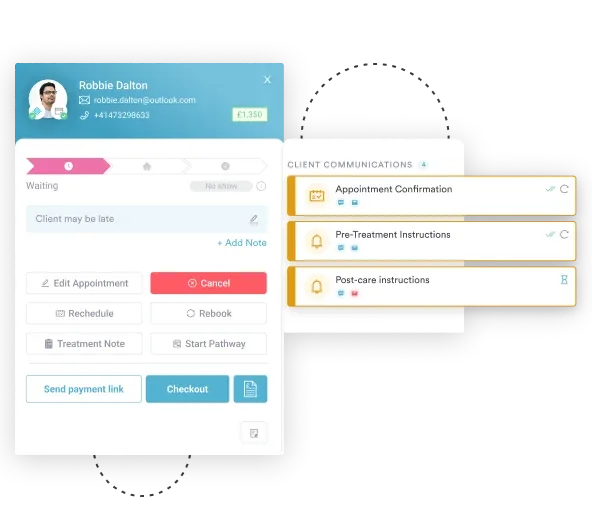
A PDF only helps if patients actually receive it, keep it, and follow it. That’s where a connected system does the heavy lifting. With Pabau.
Ahead of a visit, the care pathway in Pabau GO, our iOS app for practitioners, guides patients to complete their intake forms, sign consent, and add before-photos. Everything they fill in flows into their record automatically, so you start the appointment with the full picture instead of chasing paperwork.
Because delivery and completion are logged, you also keep a clear record of what each patient was given and when, so you can spend the visit reviewing progress rather than reconstructing it.
Want to see how handout delivery, tracking, and follow-up work in one place? Book a demo and we’ll walk through it with your rehab workflow in mind.

Wondering which physical therapy specialty fits your practice? This physical therapy specialties guide breaks down the different paths, from post-surgical care to pediatric development.
Working up lateral hip pain? The resisted external derotation test helps confirm whether the gluteal tendons are the likely pain source.
Need seated exercises for limited-mobility patients? This seated exercises guide offers upper body, core, leg, and back-pain routines to share with patients.
Immobilization triggers inflammation, scar tissue, and less lubricating fluid inside the joint. Moving the elbow early, within days of the injury when it’s safe to do so, keeps those changes in check and protects range of motion. The longer movement is delayed, the higher the stiffness risk.
It depends on the injury and how consistently the patient does their exercises. Most people see measurable range-of-motion gains within 4 to 8 weeks of progressive exercise, and full functional recovery can take 3 to 6 months. Outcomes are best when treatment starts within 6 months of the stiffness starting.
Mild discomfort during a gentle stretch is normal. Sharp pain, sudden swelling, or pain that lingers for hours afterward is not, and it signals you’ve pushed too far. Ease off the intensity and check with your physiotherapist before resuming. Pain should ease session to session, not build.
In most cases, yes. Structured exercise started early prevents lasting stiffness and loss of function. The evidence shows that passive or active movement begun within 6 months of onset gives significantly better long-term range of motion than delayed treatment or none at all.
Passive extension works well. Lie on your back, support the upper arm, and let the forearm lower toward straight, using the other hand for light pressure. Hold for 15 to 30 seconds and repeat 3 times per session. Pair it with wrist and hand movement to keep swelling down while you work on the range.