CRM for chiropractors: how to manage patients, bookings and marketing
A CRM for chiropractors is a patient relationship management system built around...

Last Updated: Oct 13, 2026

Phalen’s test, also called Phalen’s sign or the Phalen maneuver, is a provocative physical exam used to screen for carpal tunnel syndrome by reproducing median nerve compression symptoms.
A positive result (numbness or tingling in the thumb, index, middle, and radial half of the ring finger within 60 seconds) suggests carpal tunnel syndrome but does NOT confirm it.
Sensitivity and specificity vary widely across studies (pooled estimates around 57% and 67%), making confirmatory nerve conduction studies essential after a positive screen.
Pabau’s digital intake forms and clinical records help musculoskeletal and physical therapy practices document exam findings and track patient progress efficiently.
Carpal tunnel syndrome affects roughly 3-6% of the general adult population, according to the American Academy of Family Physicians. As a result, it’s the most prevalent peripheral nerve entrapment disorder managed in primary care, orthopedics, and physical therapy practice management. Phalen’s test is one of the quickest bedside screens for it.
Yet despite its frequency, diagnosis begins with a simple, no-equipment bedside test. Phalen’s test is that starting point. Specifically, this guide covers how to perform Phalen’s test correctly and how to interpret results. It also explains what the diagnostic accuracy data actually means and how the test fits into a complete carpal tunnel examination.
Phalen’s test, also known as Phalen’s sign or the Phalen maneuver, is a clinical provocative test. Specifically, it’s used to screen for carpal tunnel syndrome (CTS). It works by reproducing symptoms of median nerve compression through sustained wrist flexion. Because sustained flexion narrows the carpal tunnel, pressure on the median nerve increases.
However, a positive result does not confirm a diagnosis. It is a screening tool that guides the next stage of investigation.
The test was described by orthopedic surgeon George Phalen in the 1950s. It has remained a cornerstone of the carpal tunnel physical examination ever since. In practice, it’s appropriate for use by physicians, physical therapists, occupational therapists, orthopedic specialists, and hand surgeons in any outpatient or clinic setting.
The median nerve runs through the carpal tunnel, a narrow fibro-osseous channel at the base of the wrist. This channel is bounded by the carpal bones and the transverse carpal ligament. As a result, sustained wrist flexion reduces tunnel volume and compresses the median nerve. This provokes the characteristic paresthesia in its sensory distribution.
No special equipment is required. The test can be administered during a standard outpatient consultation. In addition, it doubles as a quick median nerve damage test at the bedside. Patient positioning and examiner technique are the critical variables.
The test requires no special instruments, no contrast media, and no patient preparation beyond verbal instruction. As a result, this simplicity makes it practical for routine initial screening in any setting.
Interpretation depends on both the presence of symptoms and their anatomical location. The median nerve supplies sensation to a specific territory. Specifically, this includes the thumb, index finger, middle finger, and the radial half of the ring finger. Symptoms outside this distribution point to a different etiology.
Earlier symptom onset, before 30 seconds, may correlate with more severe median nerve compression. However, clinicians should interpret this alongside clinical findings and electrodiagnostic data rather than use it in isolation.
The wide reported accuracy range for Phalen’s test reflects genuine study heterogeneity. This heterogeneity includes variation in reference standards, patient populations, and how studies defined a “positive” result. Therefore, clinicians should understand the range rather than cite a single figure.
These ranges come from a 2023 systematic review and meta-analysis of provocative maneuvers for carpal tunnel syndrome. Specifically, it pooled data from more than 600 patients across seven studies.
Because of the wide specificity range, clinicians should never use a positive Phalen’s test as standalone confirmation. Diagnosing carpal tunnel syndrome still requires confirmatory testing. The American Association of Neurological Surgeons recommends nerve conduction studies as the definitive confirmatory test.
Some studies express Phalen’s accuracy as likelihood ratios rather than raw sensitivity and specificity. The American Academy of Family Physicians reports a positive likelihood ratio of 1.3. By contrast, Physiotutors cites a higher estimate of 2.68. Negative likelihood ratios across sources cluster between 0.5 and 0.7.
In practice, this means a single positive or negative Phalen’s result shifts the probability of carpal tunnel syndrome only modestly. That’s why the test earns its place inside a wider examination rather than as a solo decider.
No single provocative test is sufficient on its own. Clinicians managing CTS typically use a battery of tests, often searched for by their individual carpal tunnel test names. Each test probes the same underlying pathology via a different mechanism. Durkan’s test, for example, is also known as the carpal compression test. Nerve provocation batteries work the same way elsewhere: Bragard’s test refines a positive straight-leg raise in sciatica assessment. The same single-mechanism logic applies to the knee, where the reverse Lachman test grades posterior cruciate ligament laxity. It applies to the Achilles tendon too, where the Royal London Hospital test screens for tendinopathy.
Understanding how the tests differ helps you select the right combination and interpret discordant results. For context on how such orthopedic clinical decision rules function across musculoskeletal conditions, the same principle applies here. Comparable decision rules exist for lumbar instability, assessed with the prone instability test. The same applies to sacroiliac joint pain, screened with the sacral thrust test.
Accuracy ranges for Tinel’s sign and Durkan’s test come from the same 2023 systematic review and meta-analysis cited above. In addition, clinicians should not use any single test in this table to definitively confirm or exclude CTS.
The reverse Phalen’s test (also called the prayer sign test) uses wrist extension rather than flexion. The patient places the palms flat together in a prayer position, with wrists extended. The patient holds this position for up to 60 seconds. As a result, pressure increases on the dorsal structures of the carpal tunnel via a different mechanism than the standard Phalen’s maneuver.
Clinically, it is most useful when Phalen’s test is equivocal but clinical suspicion for CTS remains high. In addition, it adds a second provocation approach without requiring equipment.
The evidence base for the reverse Phalen’s test is thinner than for the standard test. So, clinicians best use it as an adjunct rather than a primary screen in sports medicine practice software-supported musculoskeletal practices.
Document the exact number of seconds before symptom onset during Phalen’s test, not just a binary positive/negative result. Earlier onset (under 30 seconds) may indicate more severe compression, and tracking this over time gives clinicians objective data to assess progression or treatment response.
The wide sensitivity and specificity ranges tell a practical story. Specifically, Phalen’s test produces both false positives and false negatives in meaningful proportions. Knowing when to trust the result and when to remain skeptical is central to responsible use.
Thoracic outlet syndrome needs its own provocation battery when hand numbness persists. The costoclavicular test braces the shoulders back and down to narrow the rib-clavicle interval, while the Wright test loads the subcoracoid space. Running both covers two of the three outlet compression sites.
Ulnar-sided wrist pain points away from the median nerve altogether. Screen for distal radioulnar joint instability when pain and forearm rotation deficits sit over the ulnar head.
Phalen’s test fits best as a first-line screen when a patient presents with hand or wrist symptoms suggestive of CTS. These symptoms specifically include nocturnal hand pain and waking to shake the hand, known as the flick sign. In addition, patients often report numbness or tingling in the radial three and a half fingers. The test is low-risk and requires no referral or equipment. Clinicians can perform it in any outpatient or clinic setting, much like the drop arm test for suspected rotator cuff tears.
Phalen’s test is one component of a structured examination. If you are working out how to check for carpal tunnel during a physical exam, the test slots into a repeatable sequence. Instead, it doesn’t stand alone. A complete physical exam for carpal tunnel looks like this:
The sensory step can go deeper than a detection threshold. Two-point discrimination records what registers in the median nerve territory. Tactile gnosis testing times whether the patient can still identify and handle small objects by touch alone. In a carpal tunnel workup it gives a preoperative baseline and a post-decompression outcome measure.
Structured documentation of each step supports safer, auditable clinical decision-making. For example, digital intake forms allow clinics to capture symptom onset, duration, flick sign, and occupational exposure. Clinics gather this information before the patient even enters the consultation room.
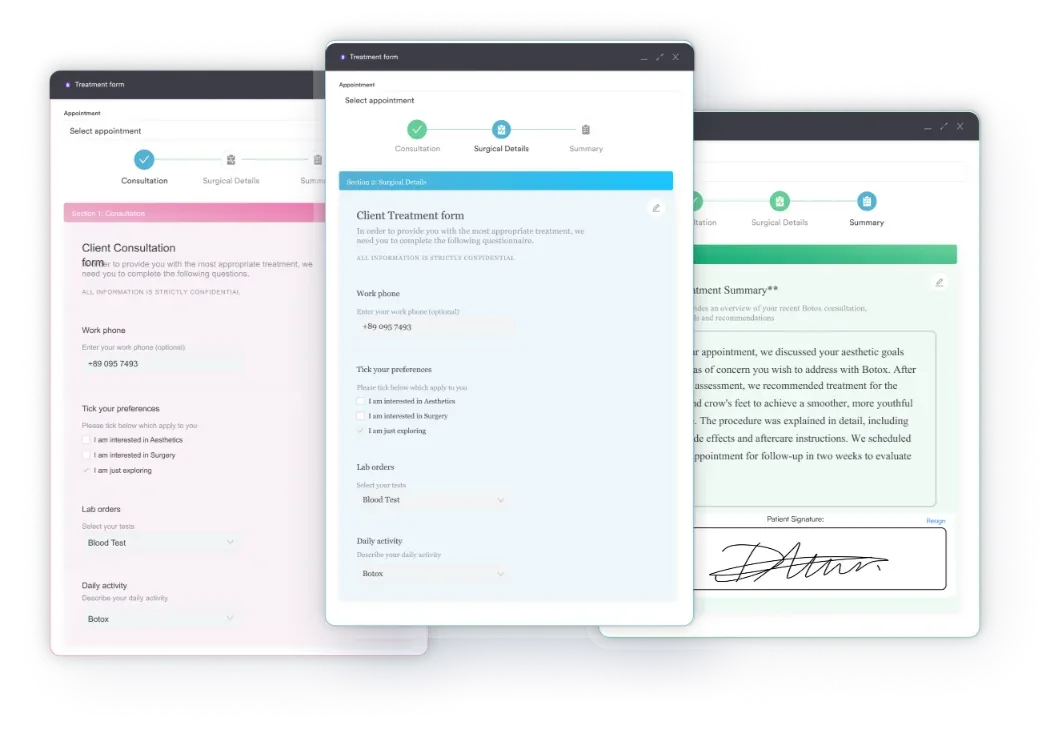
Capturing symptom onset time, hand dominance, and any prior wrist injury on the intake form gives the clinician useful context. This is available before the clinician even performs the Phalen’s test. In addition, consistent fields make it easier to compare provocative test findings across follow-up visits.

Pabau helps physiotherapy and musculoskeletal clinics capture structured clinical exam findings, automate consent and intake workflows, and keep auditable patient records from first screen to discharge.

A positive Phalen’s test is a prompt to investigate further, not a diagnosis. The clinical pathway after a positive screen follows a clear logic. First, corroborate with history. Next, confirm with electrodiagnostics. Finally, decide on management.
Effective patient care management workflows make this pathway smoother. Structured templates ensure no finding is missed. In addition, automated reminders prompt follow-up, and timestamped records provide the audit trail that clinical governance frameworks require. Practices looking at features that save time often find that standardized exam documentation is among the highest-impact changes.
Phalen’s test remains one of the most practical bedside screens in musculoskeletal medicine. It requires no equipment, takes under two minutes, and directly provokes the mechanism underlying carpal tunnel syndrome. Instead, its value lies in appropriate use as a screening step, not a standalone diagnosis.
For clinics managing CTS workloads, structured documentation of test findings, symptom timelines, and referral decisions is where process quality shows. Pabau’s digital intake forms and structured clinical records support exactly this workflow. As a result, practitioners can move from a positive screen to a clear, documented management plan. Book a demo to see how Pabau supports musculoskeletal and physical therapy practices.

Checking for a missed posterolateral corner injury? Reverse pivot shift test covers the technique and accuracy for catching posterolateral corner injuries early.
Need a home program patients can do seated? Seated exercises guide gives upper body, core, and back-pain routines plus a printable 10-minute plan.
Prescribing strength work for older patients? Resistance training for seniors explains how muscle loss accelerates after 60 and how resistance training addresses it.
Phalen’s test is a clinical provocative test used to screen for carpal tunnel syndrome by placing both wrists in sustained full flexion for up to 60 seconds to reproduce median nerve compression symptoms. A positive result does not confirm diagnosis and requires follow-up with nerve conduction studies.
A positive Phalen’s test indicates likely median nerve compression consistent with carpal tunnel syndrome: numbness or tingling reproduced within 60 seconds in the thumb, index finger, middle finger, or radial half of the ring finger. It is a screening finding, not a confirmed diagnosis.
Phalen’s test reproduces symptoms through sustained wrist flexion, which increases carpal tunnel pressure over time. Tinel’s sign reproduces symptoms through percussion directly over the carpal tunnel at the wrist. Both test the same nerve but via different provocation mechanisms, and they are typically used together to improve diagnostic accuracy.
Nerve conduction studies (NCS) are the gold standard for confirming CTS after a positive Phalen’s test. Electromyography (EMG) may also be used to assess motor involvement. These electrodiagnostic studies measure median nerve conduction velocity across the carpal tunnel directly and are required before surgical intervention decisions.
Phalen’s test sensitivity ranges from roughly 12% to 92% (pooled estimate 57%) and specificity from 30% to 95% (pooled estimate 67%) across published studies, according to a 2023 systematic review and meta-analysis. This wide range reflects differences in patient populations, reference standards, and how positive results were defined. Because specificity varies so widely, the test should never be used as a standalone diagnostic tool.
The reverse Phalen’s test places the wrists in extension (prayer position) rather than flexion for up to 60 seconds. It increases dorsal carpal tunnel pressure through a different mechanism and is used as an adjunct when standard Phalen’s test results are equivocal but clinical suspicion for CTS remains high.
You hold the wrist flexion position for up to 60 seconds during a standard Phalen’s maneuver. Record the exact number of seconds before symptoms appear, because onset before 30 seconds can point to more severe median nerve compression.
A modified Phalen’s test combines the standard sustained wrist flexion with an added element, such as direct pressure over the carpal tunnel, to provoke median nerve symptoms when the standard screen is equivocal. It is used as an adjunct, not a replacement for nerve conduction studies.