Intake note template
An intake note is the clinical record a therapist or counselor writes at the sta...

2
Last Updated: Oct 22, 2026
The Edmonton Symptom Assessment Scale (ESAS) is a patient-reported form that rates nine common symptoms in palliative and oncology care on a 0–10 scale.
Patients score pain, fatigue, nausea, shortness of breath, appetite loss, drowsiness, anxiety, depression and overall wellbeing. A score of 0 means the symptom is absent, and any item at 5 or higher signals distress worth acting on.
Eduardo Bruera and colleagues introduced the original ESAS in Edmonton, Canada, in 1991. It rated eight symptoms on a 100 mm visual analog scale. Shortness of breath, the optional 10th line and the 0–10 numerical scale came with later revisions, formalized in the 2011 ESAS-r. This guide covers how to score the form, read the results and keep scores in your clinical records.
A printable ESAS form with a 0–10 rating line for each of the nine symptoms and a spare line for one patient-specific symptom. It also leaves space for clinician notes and treatment changes.
Download template
The Edmonton Symptom Assessment Scale (ESAS) is a patient-reported form that rates nine palliative and oncology symptoms from 0 to 10.
Any single item scored 5 or higher signals clinically significant distress that needs intervention or close monitoring.
The 2011 ESAS-r is the current version, with refined wording and anchors compared with the eight-symptom 1991 original.
Adding the nine items gives a 0–90 total that tracks overall symptom burden and treatment response over time.
Pabau, the practice management platform we build, lets you capture the ESAS as a digital form that saves to the patient record.
The ESAS is a short symptom screen that patients with serious illness complete themselves, usually in two to three minutes. Eduardo Bruera and colleagues at the University of Alberta Department of Oncology introduced it in 1991 for patients with advanced cancer.
The original version rated eight symptoms on a 100 mm visual analog scale. Those were pain, activity, nausea, depression, anxiety, drowsiness, appetite and wellbeing. Shortness of breath, a 10th patient-specific line and the 0–10 numerical rating scale arrived in later revisions. The 2011 ESAS-r formalized them, and it’s the recommended version for new programs.
Patients complete the form during an outpatient visit or hospital stay, and a clinician helps anyone who can’t self-complete it. The scores give the whole care team comparable data for symptom management decisions and for judging whether a treatment is working.
The ESAS rests on a simple idea. Advanced illness brings several symptoms at once, and the patient’s own rating should guide treatment. That patient-centered approach has made it a standard tool in palliative medicine and oncology, and a growing one in primary care.
Each symptom is scored on its own 0–10 line, anchored at 0 (not present) and 10 (worst possible). The table shows each anchor pair and what clinicians usually explore when a score comes back high.
A 10th line lets the clinician add one patient-specific symptom, such as constipation, wound pain or sexual dysfunction, rated on the same 0–10 scale. It captures what matters most to that patient without breaking the standard scoring.
Watanabe and colleagues published the ESAS-r (revised) in 2011, about 20 years after the original. It refined the anchor descriptors and the wording of several items, and kept the nine-symptom structure and 0–10 scoring. The changes targeted ambiguous items and unclear anchor points. Alberta Health Services publishes the full ESAS-r administration manual with item definitions and completion guidance.
Use the ESAS-r for any new program. The original ESAS is still valid and widely cited, so programs with years of ESAS data often keep it for consistent long-term tracking.
Scoring takes a few minutes, but the numbers only help if the patient understood the anchors. Work through these six steps each time.
The flow below shows how one completed form turns into the numbers a clinician acts on.
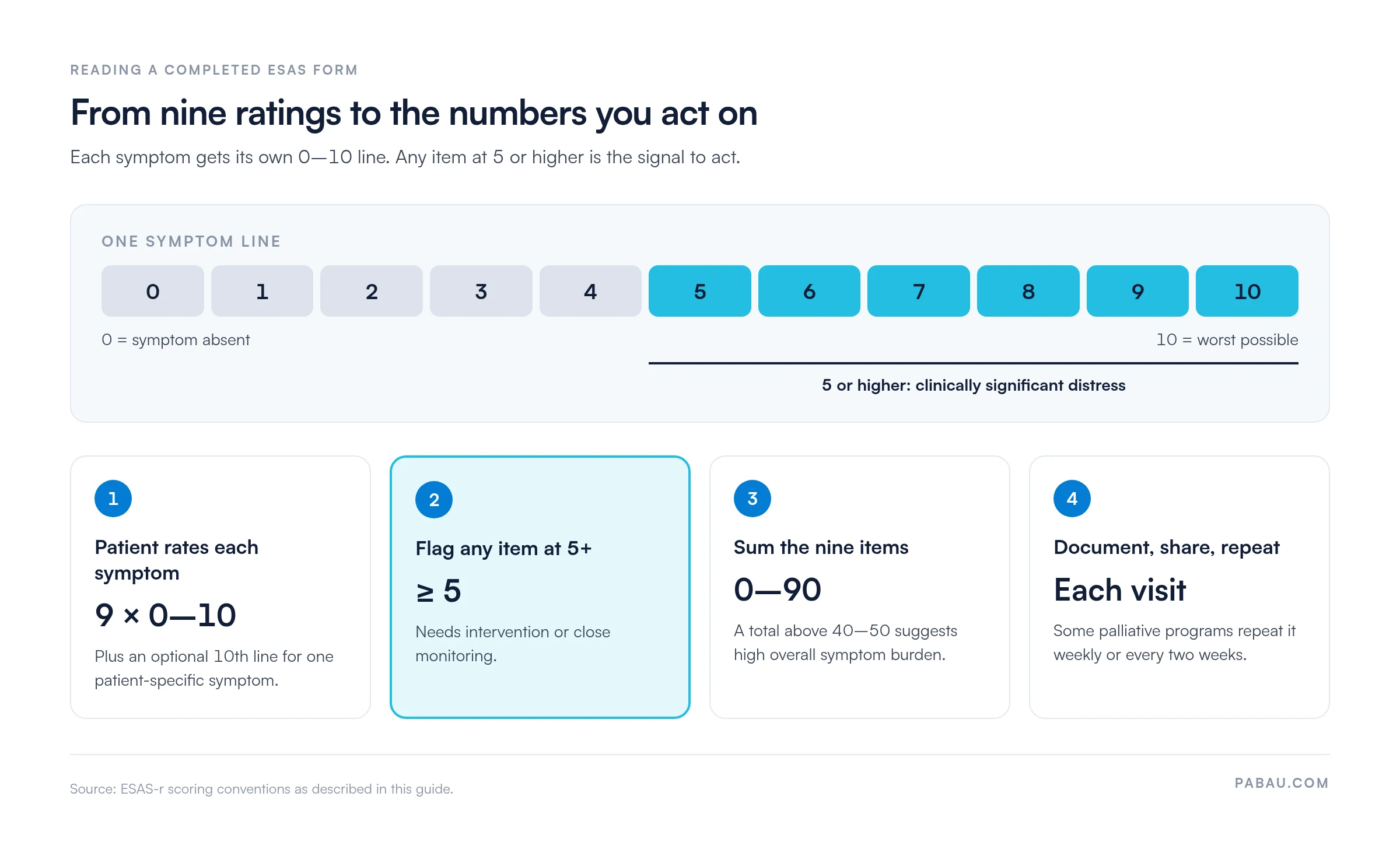
File each completed score set in the patient’s clinical progress notes with the date and time. The next assessment then has a baseline to compare against.
The ESAS is standard across palliative and oncology care, and it’s spreading into other services that manage serious illness.
In oncology nursing, a high item score can feed straight into the patient’s cancer nursing care plan. A repeat ESAS then shows whether the intervention helped.
The ESAS is one of several assessment instruments, and each suits a different clinical question. The table compares it with three tools you’re likely to meet alongside it.
Pick the ESAS when a palliative team needs a quick, validated snapshot of several symptoms at once. It’s short enough to repeat at every visit in a busy service.
It doesn’t measure function, though. For performance status, pair it with the Karnofsky Performance Status Scale, which rates how well a patient manages daily activities and self-care.
Paper ESAS forms work, but they tend to end up as scanned PDFs in a folder. Comparing this week’s scores with last month’s then means digging out old sheets.
Pabau, the practice management platform we build, turns the ESAS into a digital form within its patient intake software. Patients complete it before or during the visit, and the scores save straight to their patient record.
From there, Pabau Scribe, our AI scribe, turns the consultation that follows into a structured clinical note. You spend less time typing and more time with the patient.
Because every ESAS lives in the same integrated patient records, you can review earlier assessments in one place. That makes it easy to see how each symptom responded to a treatment change.
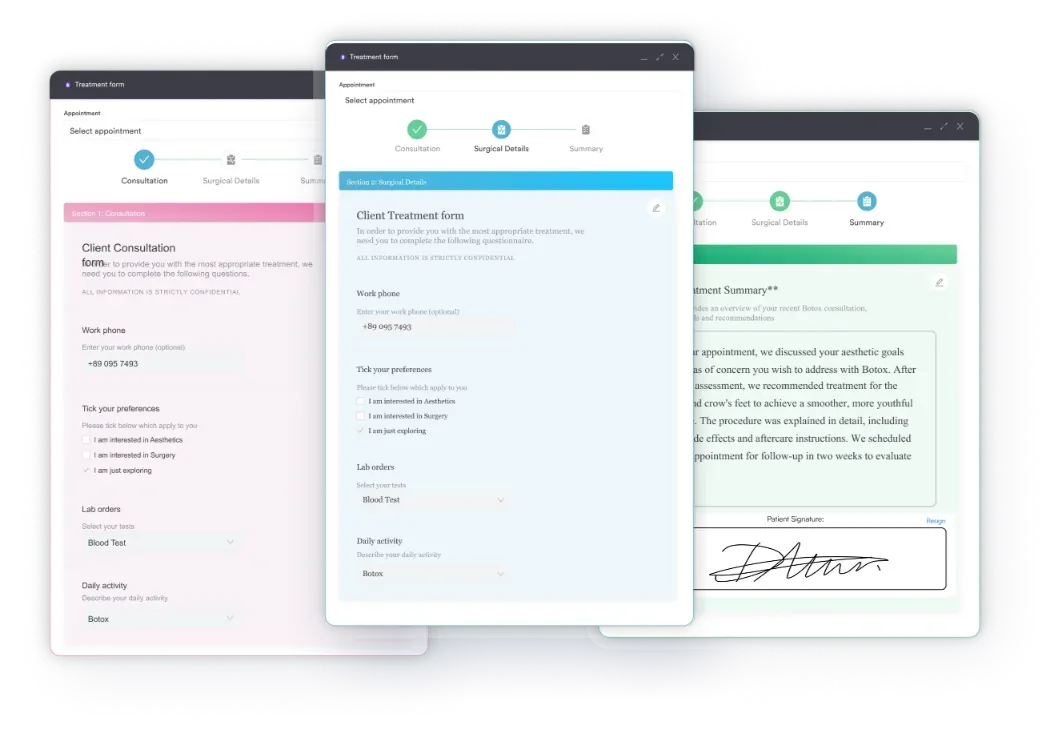

Integrate ESAS and other symptom assessments directly into your clinical workflows with Pabau’s digital forms and patient record features.

If your team already runs the ESAS, scoring is rarely where it goes wrong. Consistency matters more. Use one version, explain the anchors the same way every time and schedule the repeat assessment before the patient leaves.
Start new programs on the ESAS-r, and treat any item at 5 or higher as a prompt to act rather than a number to file. Programs with years of original ESAS data should weigh continuity before switching, since mixing versions muddies long-term trends.
Digital capture makes those repeat assessments far easier to keep up. Book a demo to see how Pabau keeps every ESAS score on the patient record, ready for the next review.

Need a functional score to pair with symptom ratings? Karnofsky Performance Status Scale rates how well a patient manages daily activities and self-care, from 0 to 100.
Using the 10th line for constipation? Constipation nursing care plan turns a high custom-line score into goals, interventions and a review date.
Supporting family members through palliative care? Caregiver care plan sets out who does what at home when symptoms change between visits.
Planning ahead with a seriously ill patient? Health care proxy form records who makes medical decisions if the patient no longer can.
Building a fuller assessment routine? Nursing assessments collects the head-to-toe checks that sit alongside a symptom screen.
The ESAS is a validated patient-reported form that rates nine symptoms on a 0–10 scale in palliative and oncology care. It covers pain, fatigue, nausea, shortness of breath, appetite loss, drowsiness, anxiety, depression and overall wellbeing. Eduardo Bruera and colleagues introduced the original, eight-symptom version in 1991.
The ESAS measures nine symptoms: pain, fatigue, nausea, shortness of breath (dyspnea), appetite loss, drowsiness, anxiety, depression and overall wellbeing. A 10th line lets clinicians add one patient-specific symptom.
Patients score each of the nine items from 0 (absent) to 10 (worst possible). Any item at 5 or higher indicates clinically significant distress. Adding all nine gives a total from 0 to 90. A total above 40–50 suggests high overall distress that needs urgent symptom management review.
The ESAS-r (Revised, published 2011) refined the anchor descriptors and item wording based on roughly 20 years of clinical feedback. That made scoring clearer and more consistent than the original 1991 version. Both are valid. The ESAS-r is recommended for new programs, while established programs often keep the original for long-term data continuity.
It depends on the setting. Oncology practices typically give it at every visit, often monthly to quarterly. Acute palliative care often repeats it weekly or every two weeks. Hospices with fast-changing symptoms may use it several times a week. Repeat it whenever symptoms change significantly or after a new treatment.
Yes. The ESAS is freely available from PubMed Central and Alberta Health Services, and you can download our printable form above. Many electronic health record (EHR) and practice management systems also let you build the ESAS as a digital form. That way, there’s no separate paper copy to file.