Despina Petrushevska
Ethical consent form: free template and what to add
An ethical consent form is a written record that a patient or participant agreed...

2
Last Updated: Oct 26, 2026
Free PDF 1 page, print-ready Clinician-reviewed
A health care proxy form names one person to make your medical decisions if you lose the capacity to make them yourself. That person is called your health care agent. The form only takes effect once your attending physician documents that you can no longer decide.
The free template below is a single page. It gives you an address box, a free-text section for designating your agent, and a guidance section for your preferences. A signature line and one witness block close the page. The file has no fillable fields, so print it and complete it by hand.
Witnessing rules come from your state, not from the template, so check what your state requires before you sign. This guide covers who can serve as your agent, how state forms differ, how to revoke a proxy, and how practices file them.
A one-page health care proxy template with an address box, a free-text agent designation section, and a guidance section for your preferences. It closes with a signature line, a date field, and one witness block. The file has no fillable fields, so print it and complete it by hand.
Start from scratch, or upload this PDF or any form you already use, and Pabau's AI Form rebuilds it with tick boxes, text fields and a signature. Attach it to the treatment once, and every patient gets it on time.
AI Form rebuilds the consent, history and aftercare forms you already use. You review each one, then publish.
Patients complete forms on their phone before they arrive, so the front desk stops retyping paper.
Every signed form is versioned and attached to the treatment record, ready when you need it.
Set how long a consent stays valid. Returning patients skip forms they have already signed.
Supports HIPAA and GDPR compliance AES-256 encryption 4.8 on G2 4.7 on Capterra Trusted by 4,000+ practices worldwide

A health care proxy form names an agent to make your medical decisions once a physician documents that you lack capacity.
This template is one page and holds an address box, an agent designation section, a guidance section, and a signature with one witness block.
The form has no fields for your name or date of birth, and no structured fields for your agent’s address or phone number.
Many states require two adult witnesses or notarization, so check your state’s rules and add what the template leaves out.
Practice management software like Pabau stores signed proxy forms in the patient record, so your care team can find them in an emergency.
A health care proxy form is the legal document that gives your chosen agent standing to speak for you with your care team. Without one, that authority falls to a surrogate chosen by state law, or to a court-appointed guardian. The document keeps your medical wishes on record and takes the weight of the decision off your family.
A living will specifies which treatments you want or do not want. A health care proxy instead names a person who can adapt decisions to circumstances nobody foresaw. The agent exercises judgment within the powers you grant and the preferences you wrote down.

The Patient Self-Determination Act requires Medicare-participating providers to tell patients about their right to make an advance directive. Hospitals must ask on admission whether you already have one, and record the answer in your chart. Many states fold proxy forms into a broader advance care planning framework.
The template is a single A4 page in four parts, and it is designed to be printed rather than typed into. Here is what each part asks for.
Read the authority wording under the designation box before you sign. It lets your agent consent to, refuse, or withdraw consent to treatment. It also reaches organ donation, autopsy, and the disposition of your remains, which is broader than some state forms.
The date field is printed in day/month/year order. Write the month as a word, such as September 14, 2026, so the date cannot be misread years later.
This is a general template, not a state statutory form. Several states publish their own proxy document and expect you to use it. The panel below lines up what the page carries against what your state may still ask you to add.
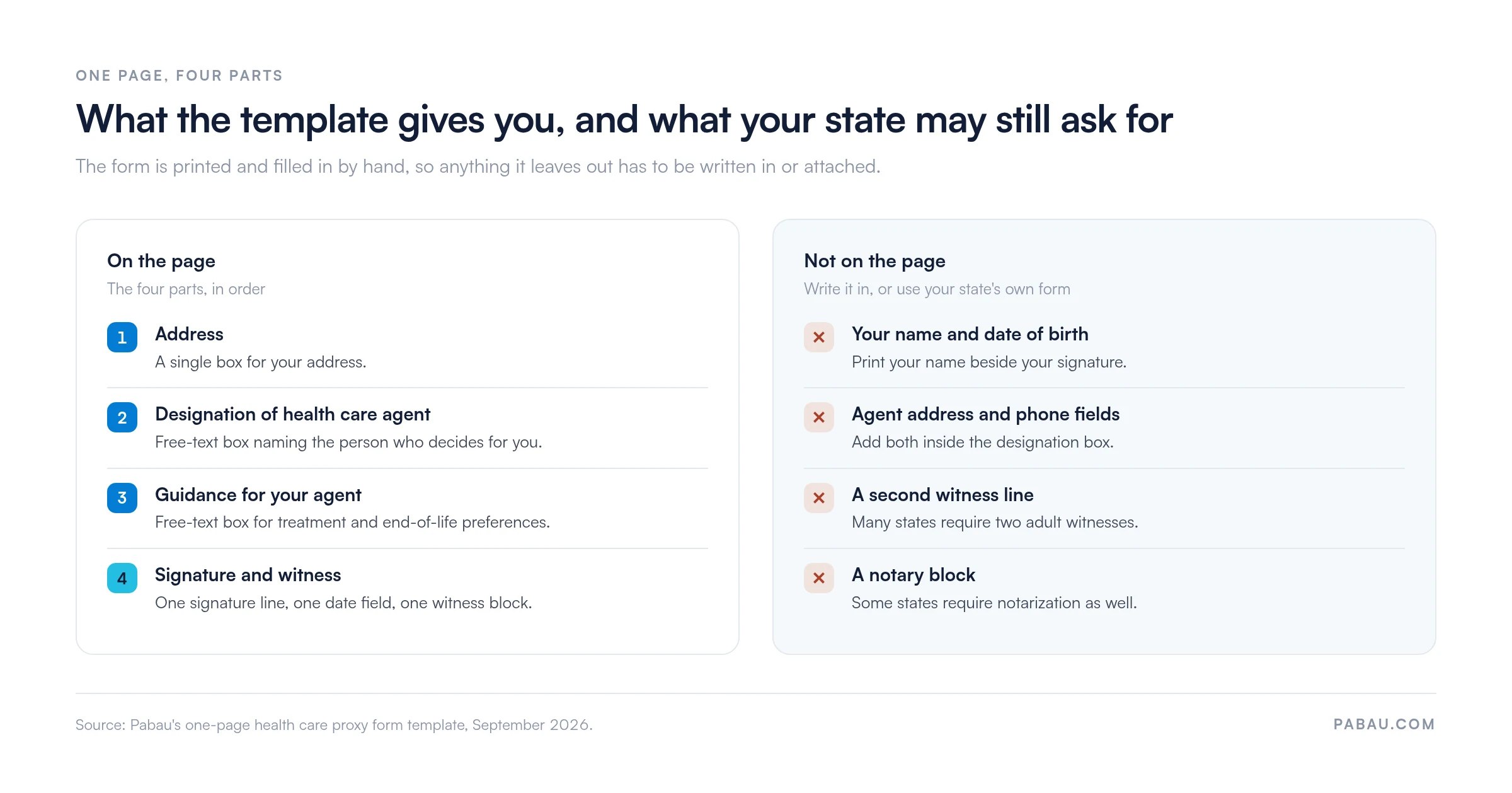
Proxy forms vary significantly by state. Some states call it a “health care proxy,” while others use “Proxy Directive,” “Medical Power of Attorney,” or “Health Care Agent Designation.” Witness requirements, notarization, and agent eligibility also differ.
New York publishes its own two-page form through the New York State Department of Health. Two adults must witness your signature, and neither may be the agent or the alternate agent you named. New York sets no other restriction on who can witness, and no notarization is required.
Massachusetts uses a similar two-witness structure. You sign in front of both witnesses, and neither witness may be the agent or the alternate. Some providers ask for notarization as extra verification, though Massachusetts law does not require it.
New Jersey calls its document a “Proxy Directive” or an “Instruction Directive.” Florida does not use the word proxy for a document you sign. Under Florida Statutes chapter 765, the document you complete is a health care surrogate designation. A Florida “proxy” is the decision-maker the statute picks from a priority list when nobody named a surrogate. Both states set their own witness rules, so work from the statutory form for your jurisdiction.
Not everyone can legally serve as your health care agent. Most states prohibit:
Your agent should be someone you trust completely, who knows your values and wishes, and who can advocate firmly on your behalf. Many people choose a family member or close friend. Some states allow you to name a successor agent in case your first choice is unavailable.
The template is printed and filled in by hand, so work through it in order. An incomplete or incorrectly witnessed form may not be accepted by a hospital.
1. Fill in the address box. The only identifying field on the form is your address, so use the address your medical records carry. Print your name beside your signature too, since the form has no name field.
2. Name your agent in the designation box. Write your agent’s full legal name in the free-text box. Add their address and phone number in the same box, because the form has no structured fields for them. Name a successor agent there as well if you want one.
3. Write your guidance (optional). Use the guidance box for wishes about life-sustaining treatment, organ donation, or religious observance. You may leave it blank, though that leaves your agent to judge without your instructions.
4. Sign, date, and have your witness sign. Sign the signature line and complete the date field. The template carries one witness block, so one adult witness signs it. Your agent should not be that witness.
5. Add whatever your state requires. Many states ask for two witnesses, and some ask for notarization. If yours does, attach a second witness line and a notary block, or complete your state’s own form instead.
Your health care proxy form does not take effect when you sign it. Lawyers call it a springing document. It activates only when a physician determines you lack the mental capacity to decide. That determination goes into your medical record, and your agent and care team are told.
Until incapacity is formally assessed, you retain full decision-making authority. Your agent has no legal standing to override your choices while you still have it.
These three advance care documents serve different purposes and often work together:
Many people complete both a proxy and a living will to cover multiple scenarios. A proxy provides flexibility (your agent adapts to circumstances), while a living will documents specific wishes.
You can revoke your health care proxy form at any time while you have capacity. Methods include:
The template’s own wording is narrower than some state laws. It says you revoke the proxy by notifying your agent or your attending physician in writing. Put any revocation in writing, even where your state also accepts a spoken one.
Notify your agent and your providers promptly so nobody acts on the old document. A practice that keeps a secure patient portal can file the revocation where the care team will see it.
A signed proxy is useless if it cannot be found during an emergency. Best practices for distribution:
On the practice side, the copy has to land somewhere a clinician will look. Medical records management keeps the scanned proxy attached to the patient’s chart rather than in a shared drive.
HIPAA privacy rules govern who may see a patient’s records. Once an agent is designated, they have the right to receive the health information needed to decide. Practices must record the agent’s identity and authority in the chart, then update access permissions in the EHR. Patient intake software is where most of that detail gets captured, at the point the patient first hands over the form.
The Uniform Health-Care Decisions Act (UHCDA) gives many states a shared framework for proxy law, though each one keeps its own variations. Psychiatric practices lean on proxy documentation more than most. Conditions that bring periods of impaired capacity make the named agent the person a clinician has to reach.
Advance care planning is a core practice responsibility. Practice management software like Pabau can carry that work in the chart rather than in a side list. Compliance management software records a proxy status on every patient file, marked completed, declined, or pending.
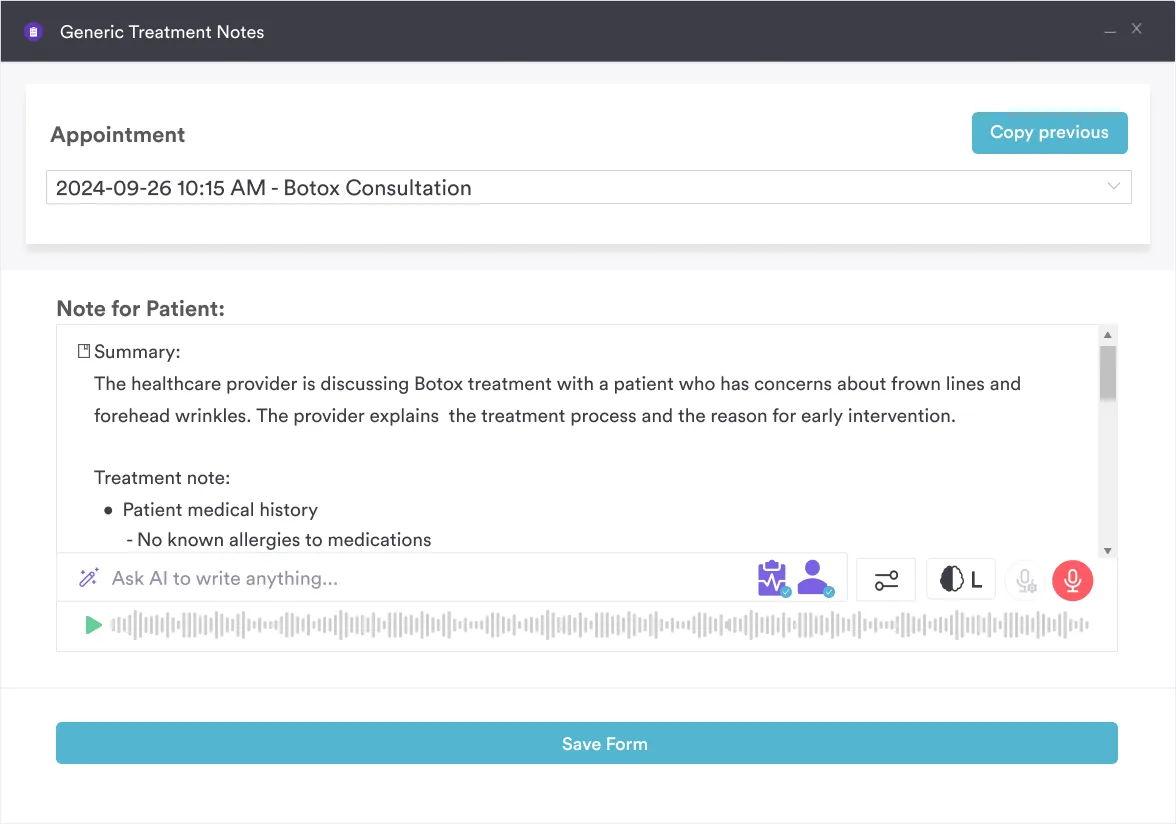
Pabau Scribe, our AI scribe, writes the advance care planning conversation into the visit note while it happens. Digital intake forms let a patient upload a signed proxy through the portal before they arrive. The document files itself against the chart, so nobody has to scan it later.
CMS reimburses advance care planning conversations. Codes 99497 and 99498 cover a facilitated discussion, the first for 30 minutes and the second for each additional 30. The conversation is billable work, not unpaid time. Secure messaging then lets the team chase the patients who have not returned a signed form.

Pabau’s digital forms and secure portal make it easy to collect, store, and reference patient advance directives-so when decisions matter most, your team has answers.

The hard part of a health care proxy form is not the signing. It is making sure the right people can find the signed page on the worst day of your life. Sign it, witness it to your state’s rule, and hand out copies the same week.
A form nobody can produce in an emergency leaves your family arguing in a corridor while a clinician waits. Filing it in the patient record closes that off. Book a demo to see how practice software can make advance care planning routine in every patient record.

Need the general consent form that sits alongside it? Medical consent form for adults covers routine treatment authorization for a patient who still has capacity.
Want the form that releases records to the agent? HIPAA authorization form is what a practice needs on file before it shares a chart with a third party.
Sharing records with another provider? Authorization for release of confidential information sets out who may receive which parts of a patient record.
Planning care for someone who cannot manage alone? Caregiver care plan maps out daily support, medications, and the escalation steps a caregiver follows.
Need a general records release? Medical release form gives a patient one page to authorize the transfer of their medical records.
A health care proxy names a person (agent) to make medical decisions for you; a living will documents your specific treatment preferences (resuscitation, life support). Both are advance directives and often used together.
Notarization requirements vary by state. New York does not require notarization for health care proxies, but some states do. Check your state’s Department of Health website for the specific requirement.
Most states allow you to name one primary agent and one or more successor agents (who step in if the primary agent is unavailable). Naming co-agents (two agents making decisions together) is discouraged and not recognized in many states.
A health care proxy takes effect only when a physician determines you lack the mental capacity to make medical decisions. It does not activate automatically upon signing.
No. Most state forms are simple and do not require legal review. However, if your situation is complex (multiple properties, business interests, or family disputes), consulting an attorney is advisable.
Your proxy automatically transfers authority to the successor agent you named (if applicable). If no successor is listed, your proxy becomes void and your family or healthcare providers must seek court-appointed surrogate decision-makers.