Intake note template
An intake note is the clinical record a therapist or counselor writes at the sta...

2
Last Updated: Oct 22, 2026
How does dental plaque form? It starts within minutes of brushing, when salivary proteins coat clean enamel in a thin film called the pellicle.
Pioneer bacteria attach to that film within hours, and by 24 to 72 hours they’ve built a mature, acid-producing biofilm. Plaque left in place that long can harden into tartar, which only a dentist or hygienist can remove.
This guide walks through each stage, how to spot plaque, how it differs from tartar, and how patients can keep it under control. Dental practices can hand the free checklist below to patients after every cleaning.
A patient handout that explains the three stages of plaque formation and how to spot plaque and tartar tooth by tooth. It ends with a daily prevention checklist to print or email after a cleaning.
Download template
Dental plaque is a sticky bacterial biofilm that starts forming within minutes of cleaning and can harden into tartar within 24 to 72 hours.
Plaque forms in three stages: pellicle deposition (minutes), early bacterial adhesion (hours), and biofilm maturation with acid production (days).
Tartar (calculus) is hardened plaque that cannot be removed at home, so only professional dental scaling can clear it.
Daily brushing, flossing, and antimicrobial rinses disrupt plaque formation and prevent progression to gum disease and tooth decay.
Dental plaque is a colorless or pale yellow sticky film of bacteria, saliva, and food particles that clings to tooth surfaces and the gumline. Also called dental biofilm, it’s a living, organized community of microorganisms embedded in a matrix of polysaccharides and proteins. The first colonizers are Streptococcus sanguinis and other pioneer (Mitis-group) streptococci. Early plaque is invisible to the naked eye, so patients can’t see it without a disclosing tablet or a dental exam.
Plaque also differs from food debris. Food particles rinse away, but plaque bacteria are firmly attached and won’t come loose with water or gentle brushing alone. Plaque is the primary cause of tooth decay (caries) and gum disease (gingivitis and periodontitis), which makes daily removal the foundation of oral health.
Plaque formation follows a predictable biological sequence. Within minutes of a thorough cleaning, the mouth starts rebuilding the biofilm through three overlapping stages.
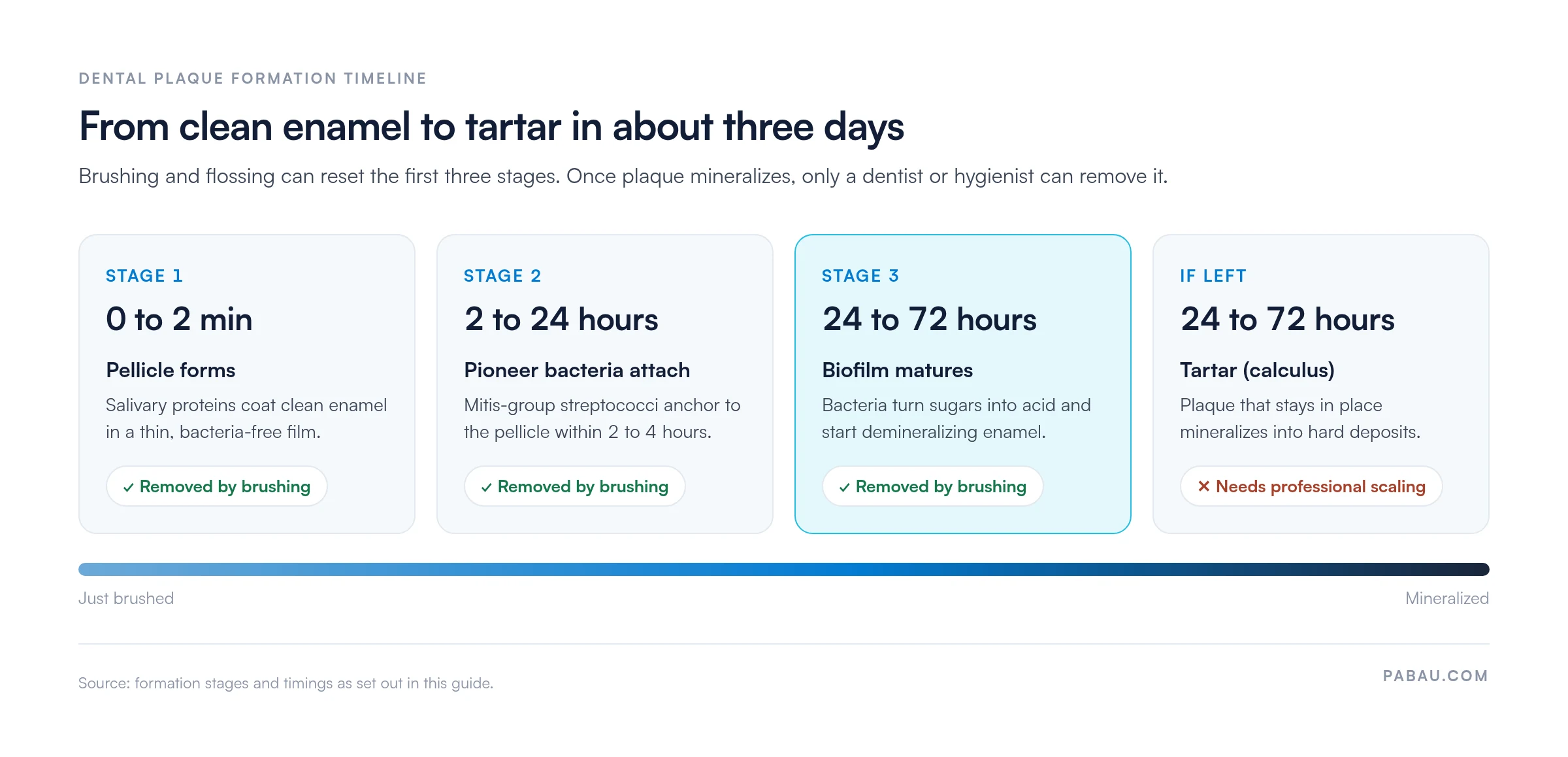
Immediately after brushing, salivary proteins settle on the clean enamel surface. They form a thin, invisible layer called the acquired pellicle. The pellicle contains no bacteria. It’s a protein-rich film from saliva that acts as a biological “glue.” It forms within seconds to minutes and is a normal, protective function of saliva.
Once the pellicle is established, pioneer bacteria (chiefly Streptococcus sanguinis and other Mitis-group streptococci) adhere to it. These bacteria recognize specific receptor proteins in the pellicle and anchor themselves firmly to the tooth surface. Within 2–4 hours, the first bacterial cells are in place. Within 24 hours, multiple species have colonized the pellicle, and the early biofilm begins to mature.
As the biofilm matures, bacteria communicate through chemical signals (quorum sensing). They also secrete extracellular polysaccharides (EPS), sticky molecules that bind the community together and protect it from antibiotics and antimicrobial agents.
When patients eat fermentable carbohydrates (sugars and refined starches), the bacteria metabolize them into lactic acid and other organic acids. These acids lower the pH in and around the biofilm and start enamel demineralization, the first step toward cavities. By 48–72 hours, the biofilm is a mature, organized structure with distinct zones and a division of labor among species.
The timeline below shows how quickly the stages stack up, and the point where brushing is no longer enough.
In the first 24 hours, plaque is invisible without a disclosing agent. As it matures, it becomes visible as a whitish or pale yellow sticky film. It collects along the gumline, between teeth where a toothbrush can’t reach well, and on the chewing surfaces of back molars.
Patients who skip oral hygiene for two to three days can see mature plaque in a mirror as a fuzzy, sticky coating. Disclosing tablets, which hygienists use during cleanings, stain plaque red or purple to show exactly where bacteria have settled.
Patients often confuse plaque and tartar, but they differ in composition, removal method, and clinical significance.
Critical patient safety message: Tartar cannot be safely removed at home. Scraping it with picks or sharp instruments risks damaging enamel, injuring gums, and introducing infection. Only a dentist or hygienist using ultrasonic or hand-scaling instruments should remove tartar.
Untreated plaque sets off a chain of oral and systemic health problems. Within days of maturing, plaque bacteria and their acids irritate the gum margin and trigger inflammation and bleeding. These are the early signs of gingivitis. If plaque and tartar persist, the inflammation deepens and destroys the periodontal ligament and alveolar bone. That is periodontitis, and it can end in tooth loss.
Plaque acid also demineralizes enamel and starts cavities (carious lesions). The longer plaque stays in place, the deeper and wider the decay spreads. Beyond the mouth, periodontal bacteria and their endotoxins can enter the bloodstream. CDC oral health research and the clinical literature link this to cardiovascular disease, diabetes complications, respiratory infections, and adverse pregnancy outcomes.
Common plaque-related consequences:
Daily mechanical removal does most of the work. Brushing and flossing disrupt plaque more effectively than antimicrobial rinses alone, though combining them gives the best results.
Brushing technique: Brush for at least two minutes, twice a day, with fluoride toothpaste and a soft-bristled brush. Angle the brush at 45 degrees to the gumline and use gentle circular or vibrating motions to disrupt plaque without damaging soft tissue. Pay extra attention to the gumline and the areas between teeth, where plaque builds up most.
Flossing: Floss at least once a day, using an up-and-down motion between teeth and curving the floss into a C-shape around each tooth. Water flossers are an alternative for patients with limited dexterity or periodontal disease. Flossing reaches the plaque between teeth that a toothbrush misses.
Antimicrobial rinses: Chlorhexidine 0.12% or essential-oil rinses (like Listerine) add plaque-disrupting action when used as directed. That’s typically 30 seconds, twice a day, after brushing and flossing. They help most for patients with active gingivitis or recent periodontal surgery, but they don’t replace mechanical removal.
Dietary changes: Eating fermentable carbohydrates less often, especially between meals and before bed, starves plaque bacteria of the sugar they turn into acid. Patients who have sugary snacks or drinks several times a day keep their mouths acidic, which speeds up demineralization. Encourage water as the main drink and keep snacks to mealtimes.
Professional plaque removal is needed once tartar forms, or when home care can’t control gum inflammation.
Recommended recall intervals:
Red flag symptoms that need prompt attention: Bleeding or swollen gums that don’t settle within a week of better home care need a professional exam. So do persistent bad breath, loose teeth, pain on chewing, or visible calculus deposits. That visit covers tartar removal and a periodontal assessment. Practices can record the findings on a perio chart form as a baseline for the next recall.
Patient education is one of the highest-value interventions in preventive dentistry. A clear, visual explanation of how plaque forms eases patient anxiety and shows why tartar can’t be removed at home. It also gives patients a reason to stick with daily hygiene and their recall schedule.
The checklist gives patients a daily routine they can start the same day. It includes sections for logging brushing and flossing, tracking high-sugar snacks, and visual guides for spotting plaque and tartar on their own teeth.
Hand it out at the first consultation, after a professional cleaning, or whenever you recommend better home care. Note the patient’s starting habits in your dental note template so the hygienist can see what changed at the next visit.
Distribution strategies:
Most practices hand out hygiene advice at the chair and hope it sticks. By the next recall, the leaflet is lost and the patient is back with months of calculus.
Pabau, the practice management platform we build, sends this checklist by email after every scaling appointment. Its digital forms for dentists capture each patient’s brushing and flossing habits, so the hygienist can compare them at the next visit.

Recall visits are where plaque control is won or lost. Automated SMS reminders prompt patients to book their next cleaning at the interval the dentist set. The patient portal lets them rebook without calling the front desk.

The outcome is patients who arrive with less buildup, and hygiene appointments that go on prevention instead of heavy scaling.

Pabau sends your prevention checklist after every visit, captures hygiene habits on digital forms, and reminds patients when their next cleaning is due.

Plaque rebuilds every day, so the practices that control it best make daily removal easy to follow. The stages give patients a clock to beat. Tartar can start forming within 24 to 72 hours, and after that only scaling helps.
Hand the checklist over when patients are most motivated, right after a cleaning, and pair it with a recall interval set by their gum health. A few minutes of chairside explanation now saves longer scaling appointments later. Book a demo to see how Pabau sends education resources and recall reminders to your dental patients automatically.

Need a structured record of each checkup? Dental examination form template covers the clinical findings to capture at every exam.
Tracking gum health between recalls? Perio chart form template helps you record periodontal findings over time.
Screening new patients for risk factors? Dental medical history forms template collects the health history that shapes a hygiene plan.
Planning scaling or other treatment? Dental treatment consent form sets out what to cover before a procedure goes ahead.
Educating parents as well? Baby teeth eruption chart shows the ages and order in which children’s teeth come in.
Plaque begins forming within 2-4 minutes of cleaning as salivary proteins deposit on enamel. Within 24-48 hours, it becomes visible as a sticky film. Mature plaque capable of producing acid forms within 24-72 hours if not disrupted by brushing or flossing.
No. Tartar (calculus) is hardened and cannot be removed at home with brushing, flossing, or over-the-counter tools. Attempting to scrape tartar damages tooth enamel and risks gum injury. Only professional dental scaling removes tartar safely.
Early plaque is invisible without a disclosing tablet. Mature plaque (48+ hours) appears as a whitish or pale yellow sticky film along the gumline and between teeth. Disclosing tablets (used by hygienists) stain plaque red or purple, making it visible.
Gum bleeding is a sign of inflammation caused by plaque accumulation at the gumline. Plaque bacteria and their byproducts irritate gum tissue, triggering swelling and bleeding. Consistent daily removal of plaque typically resolves bleeding within 1-2 weeks.
Healthy patients benefit from professional cleaning every 6-12 months. Patients with gingivitis or early periodontitis should attend every 3-4 months; those with severe periodontal disease may require 2-3 month intervals. Your dentist will recommend a schedule based on your plaque and tartar accumulation rate.