HIPAA compliant texting: What you can send patients & how to communicate securely
HIPAA compliant texting is possible when a text holds no protected health inform...

Last Updated: Oct 16, 2026

A doctor’s note for work is an official medical document signed by a licensed healthcare provider certifying a patient’s medical status and work fitness.
Required elements include patient name, date of visit, diagnosis summary, work restrictions or limitations, estimated return date, and provider signature.
Three main types exist: absence notes (sick leave), return-to-work clearance notes, and work restrictions letters for ongoing accommodations.
Employers can legally request a doctor’s note under FMLA, but HIPAA protects patient privacy — employers cannot demand the full diagnosis, only fitness for duty.
A ready-to-use template for healthcare providers to document patient fitness for work, including diagnosis summary, work restrictions, return-to-work date, and signature block. Download and customize for your practice.
Download templateA doctor’s note for work is one of the most frequently requested medical documents in clinical practice. Whether your patient needs to justify an absence, return after recovery, or disclose temporary work restrictions, a well-structured note protects both the patient’s privacy and your practice’s documentation standards.
This guide walks you through what a doctor’s note is, why it matters legally, the types you’ll encounter, and how to complete one that’s clinically sound and employer-acceptable.
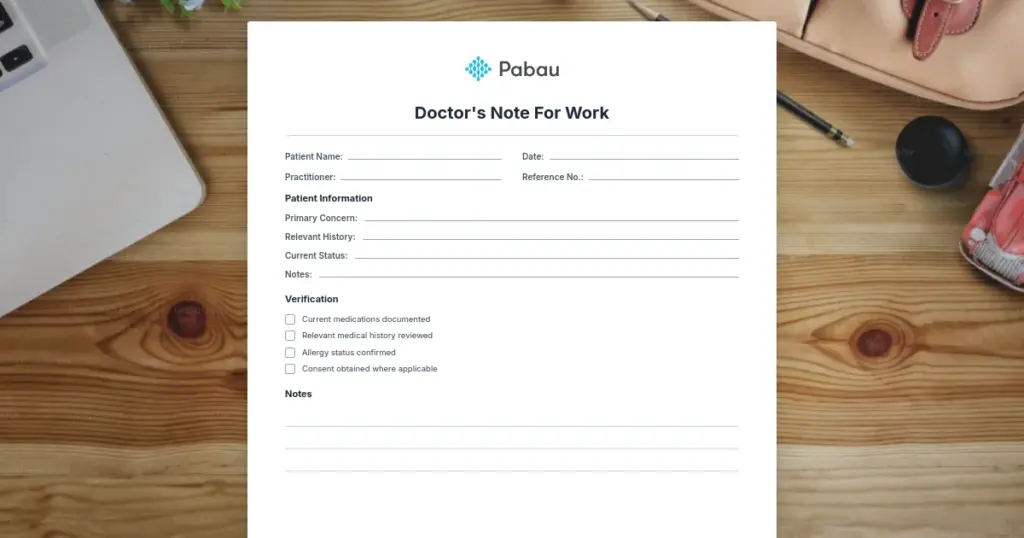
A doctor’s note for work is an official written statement from a licensed healthcare provider confirming that a patient was seen for a medical reason and documenting their fitness for work duties.
Unlike a casual message, a formal doctor’s note carries legal weight — employers use it to verify absences, adjust work schedules, and comply with regulations like the Family and Medical Leave Act (FMLA).
The note serves three stakeholders: the patient (proof of medical visit), the employer (verification of medical absence or restrictions), and your practice (documentation of care and communication). Under HIPAA rules, the patient controls what diagnosis details are shared with their employer — you document the medical facts, and the patient decides disclosure.
A complete doctor’s note for work contains seven mandatory elements. Missing any of these can render the note incomplete or unacceptable to employers.
A well-organized note paired with structured intake documentation. Complete each field legibly and without ambiguity.
Three distinct types of doctor’s notes address different workplace scenarios. Knowing which to use prevents confusion and ensures you document appropriately.
An absence note confirms the patient was medically unable to work for a specific period. Example: “Patient was seen on January 15 for acute flu-like illness with fever. Unable to work January 15-17. Estimated return to work January 18.” This is the most common type, and it should be submitted promptly upon return, per the employer’s attendance policy.
A return-to-work note certifies the patient is medically fit to resume duties after an illness or injury. Example: “Patient has recovered from acute illness and is cleared to return to regular work duties effective January 18.” This is essential after extended absences or physical therapy return-to-work documentation for musculoskeletal recovery.
For patients returning after a hospital stay.
A restrictions letter specifies ongoing work limitations for patients who need to return but with conditions. Example: “Patient is cleared to work but requires the following accommodations: no heavy lifting, seated work only, breaks every two hours.” This document often supports ADA accommodations and requires careful wording to avoid inadvertently violating disability protections.
Restrictions letters frequently follow a functional capacity evaluation from occupational therapy providers, who assess exactly what a patient can safely do before you finalize the wording.
If the restrictions turn long-term and the patient applies for disability benefits, a printable disability form asks you to document the same limits.
Patients often ask where to obtain a doctor’s note. As a provider, you control this process and can streamline it using digital systems.
The gold standard: the patient visits your practice, you assess them, and you issue the note immediately. This ensures the note reflects a real clinical encounter and is difficult for employers to dispute.
If a patient cannot reach their primary provider, urgent care clinics can issue a doctor’s note for work. The note is valid as long as it’s signed by a licensed provider at that facility. Many urgent care visits are specifically for obtaining a note for work-related absences.
A telemedicine visit followed by a digital note is increasingly acceptable, particularly for minor illnesses. The provider must be licensed in the patient’s state and document the visit properly. Sharing the note through a patient portal keeps delivery secure and gives you a timestamped record of when the patient received it.
As a healthcare provider, you are responsible for completing the note accurately and in a way that protects your patient while meeting employer standards. Follow these five steps to ensure a clinically sound, legally defensible note.
A common pitfall: over-documenting. Avoid listing every test, medication, or personal detail. The employer’s question is simple: “Can this person work?” Your note should answer that clearly in one page or less.
Both employers and healthcare providers operate within strict legal boundaries. Understanding these protections prevents unintentional violations and protects your practice.
Under the Family and Medical Leave Act (FMLA), employers with 50+ employees can require employees to submit a completed WH-380-E form (Employee Certification of Health Care Provider) for FMLA-covered absences.
This form asks you to certify the employee’s incapacity for work and, optionally, the medical condition category, not the diagnosis name. Providing false certification carries legal consequences, so complete this form only based on your clinical assessment.
You can provide a doctor’s note confirming the visit and work status, but you are not required to disclose the diagnosis to the employer.
You may want to encourage patients to redact diagnosis details before submitting to their employer, or provide two versions: one for the employer with minimal detail, and one for their records with full detail.
If a patient has a disability (physical or mental health condition), their work restrictions letter may trigger ADA accommodation requirements. You are not responsible for deciding accommodations, but your note documenting the patient’s functional limitations can inform the employer’s obligations. Use neutral, factual language: “unable to lift more than 10 pounds” rather than “disabled” or “unfit.”
The same wording carries over if those limitations become permanent. When the patient files an SSA disability claim, a medical source statement form records them in the numeric detail examiners can apply.
A clear, accurate doctor’s note for work protects your patient’s employment, ensures compliance with FMLA and HIPAA, and documents your clinical assessment for the record. Using a structured template and organizing your notes digitally streamlines this routine task and reduces errors. Download the template above and customize it to your practice’s needs.

Need a note for a phased return after time off? Return-to-work doctor’s note template covers clearance dates and any work restrictions the employer needs.
Looking for a shorter fitness-for-work document? Medical certificate template gives patients a concise, employer-ready alternative to a full note.
Completing a do-not-resuscitate order? DNR form template It offers a free template covering physician details, duration, proxy details, and witness signatures.
Want a broader consent form for confidential information? Authorization for release of confidential information covers requests beyond standard PHI disclosures.
Standardizing your patient intake process? Health worksheet template It offers a free assessment form capturing health history, wellness status, and baseline data at intake.
Yes, under FMLA and most employment laws, employers can generally require a doctor’s note to support an absence. The main exception involves paid sick leave: under California’s Healthy Workplaces, Healthy Families Act, employers cannot require a doctor’s note as a condition of using accrued paid sick leave, particularly for the first 40 hours or five days of protected leave each year. Outside of paid sick leave, employers can still request documentation for other absences.
No. HIPAA protects your diagnosis privacy. Your employer can ask for a doctor’s note confirming you were medically unable to work, but you or your provider can omit the specific diagnosis and provide only the work status and restrictions.
Yes, if issued by a licensed provider in your state following a real telemedicine visit. The note must include the provider’s name, license number, and signature (digital signature is acceptable). Some employers may be skeptical of telehealth notes; advise patients to confirm their employer’s policy first.
There is no standard expiration. A note covering January 15-17 is valid for that absence. For ongoing restrictions, provide a dated note specifying the restriction period. Employers may ask for updated notes if the restriction extends beyond the stated return date.
Only if you conduct a proper telehealth visit and document it in the patient’s chart. Issuing a note without a recent clinical assessment is unethical and exposes you to liability. Always examine or assess the patient first.
Do not do this. Backdating a note you did not write on the stated date constitutes fraud. Document the note with today’s date and note the date you actually saw the patient.