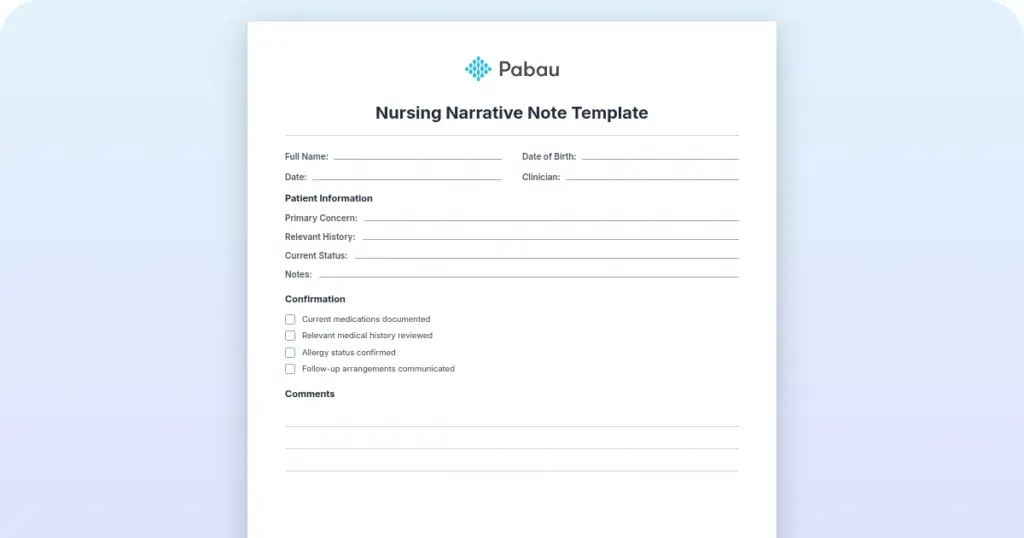
Nursing narrative note template
A nursing narrative note template is a structured PDF that guides you through re...

3
Last Updated: Oct 21, 2026

A health worksheet is a structured assessment form that captures patient medical history, current health status, and wellness goals in one document.
Health worksheets streamline patient intake, reduce missing clinical information, and create a consistent baseline for treatment planning across all patients.
HIPAA compliance and secure storage are critical when worksheets contain identifiable patient data – encryption and access controls are non-negotiable.
Pabau’s digital forms feature allows practices to deploy health worksheets electronically, auto-populate client records, and eliminate paper storage entirely.
A ready-to-use assessment form capturing patient health history, medical background, current wellness status, and baseline health data. Use this health worksheet to standardize your intake process and ensure no critical health information is missed during initial consultations.
Download templateA health worksheet is far more than a generic form. It is the clinical foundation of patient care.
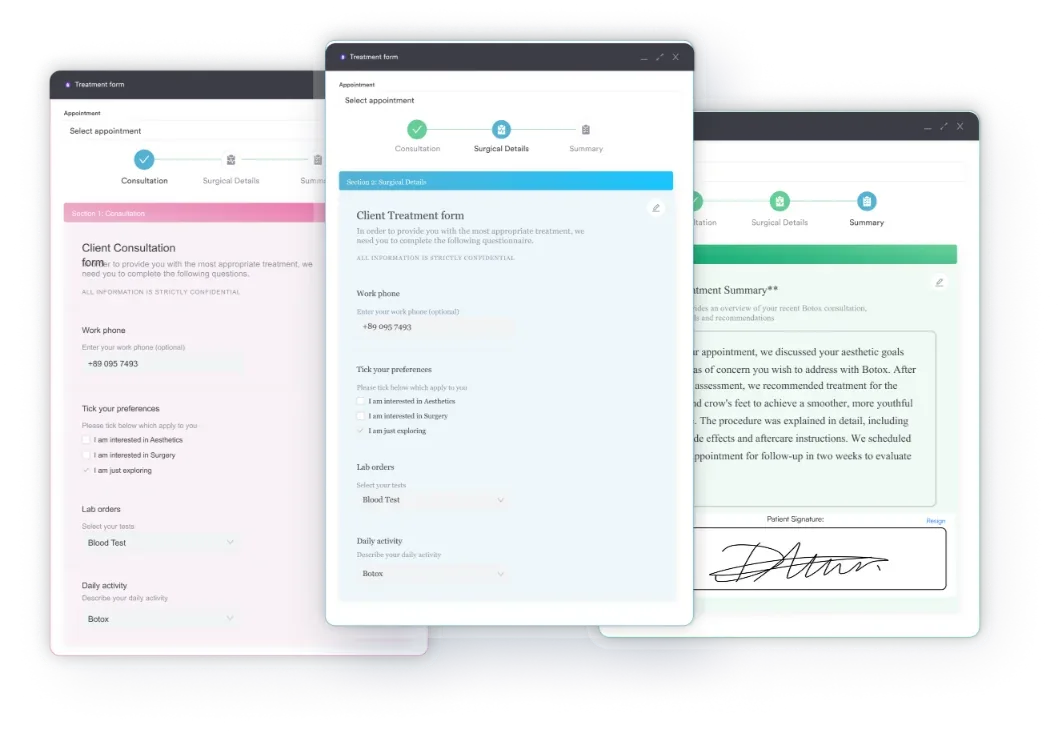
When a patient arrives for their first appointment, the questions you ask set the tone for everything that follows. A comprehensive health worksheet captures medical history, current symptoms, lifestyle factors, and treatment goals in one structured document. This baseline data informs your diagnosis, shapes your treatment plan, and protects you legally by documenting informed consent and risk awareness.
Yet most practices still use outdated paper intake forms or disconnected questionnaires that scatter information across multiple documents. Critical details get missed. Data entry becomes manual work. Patient records remain incomplete.
This guide walks you through the purpose of a health worksheet, how to use one effectively in your clinic, and how to integrate it into your practice management workflow so patient health data flows seamlessly from intake to clinical record to ongoing care.
A health worksheet is a structured clinical assessment document that systematically collects patient health information at the point of care.
Unlike generic intake forms, a health worksheet serves a specific clinical function: it captures the baseline data needed to assess patient health status, identify risk factors, inform treatment decisions, and establish a complete medical record. A typical health worksheet covers constitutional history (age, medical diagnoses, medications, surgeries), system-by-system review (cardiovascular, respiratory, gastrointestinal, neurological, mental health), lifestyle factors (sleep, nutrition, stress, exercise), and current chief complaints.
In regulated healthcare settings, a health worksheet also documents patient awareness of risks, contraindications, and treatment expectations – serving as both a clinical tool and a consent record. The NHS, CQC-regulated clinics in England, and HIPAA-covered practices in the US all recognize health worksheets as essential clinical documentation.
The difference between a health worksheet and a basic questionnaire is specificity. A health worksheet for mental health clinicians will include detailed psychiatric history, medication responses, and trauma screening. A health worksheet for aesthetic practitioners will ask about allergies, prior cosmetic procedures, and injection sites. A health worksheet for physical therapy will map pain location, movement limitations, and injury history. Each variant is built for the clinical decisions that specific practice type needs to make.
Using a health worksheet effectively means integrating it into your workflow so patient data flows seamlessly from intake to diagnosis to treatment planning.
The goal is not checkbox compliance – it is building a complete clinical picture so every decision you make is informed by the patient’s full health context.
A health worksheet is essential for any healthcare practice where your clinical decisions depend on understanding patient health status.
Mental health clinicians – therapists, counsellors, psychiatrists, psychiatric nurses – rely on health worksheets to screen for mental health history, medication use, trauma, and risk factors that shape treatment planning and determine safety protocols.
Physical and occupational therapists use health worksheets to assess pain, movement limitation, injury history, and functional goals so rehabilitation protocols target the right structures and progress safely.
Aesthetic and medical spa practitioners use health worksheets to capture allergy history, prior procedures, skin sensitivity, medication use, and pregnancy/breastfeeding status – all contraindications for cosmetic procedures. A single missed allergy or prior adverse reaction can lead to patient harm or liability.
Primary care and wellness clinicians – GPs, nurse practitioners, functional medicine doctors, integrative health providers – use health worksheets as the foundation of preventive care assessments and lifestyle modification planning.
IV therapy, weight loss, fertility, and longevity clinics use health worksheets to establish baseline metabolic status, screen for contraindications, and track metrics over time as patients progress through treatment.
Filing completed forms in patient management software keeps documentation consistent across your whole team.
Standardises patient intake. Every patient completes the same comprehensive assessment. No critical health questions are skipped because a clinician was rushed or working from memory. Consistency improves quality and protects you if a missed detail later becomes clinically relevant.
Reduces clinical risk. A complete health history surfaces contraindications before treatment begins. You catch medication interactions, allergy patterns, prior adverse reactions, and complex comorbidities that might otherwise go unrecognized and lead to patient harm or malpractice claims.
Improves treatment outcomes. When you understand a patient’s full health context – previous treatments, what has worked, what hasn’t, lifestyle constraints, mental health status – your clinical decisions become more precise and your treatment plans more likely to succeed.
Saves clinician time. Pre-completed worksheets arrive before the patient walks in. You spend less time gathering basic history and more time on clinical assessment, treatment, and patient education.
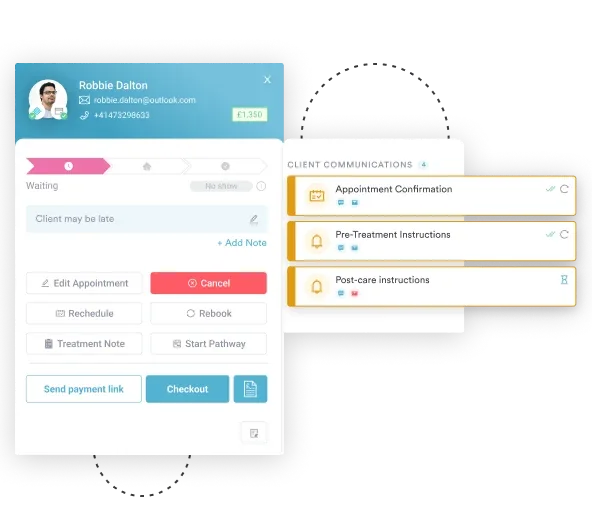
Supports regulatory compliance. Health worksheets create an audit trail. They document informed consent, show that you screened for contraindications, and prove you based your clinical decisions on complete information. CQC inspectors, HIPAA audits, and malpractice defence all rely on complete clinical documentation – a health worksheet is that foundation.
Builds patient trust. When a patient sees a comprehensive health worksheet, they know you are thorough and take their wellbeing seriously. This transparency builds confidence in your clinical expertise and increases likelihood they will disclose sensitive information candidly.
Collect health worksheets before the first visit, not during the consultation. Digital health worksheets sent via email or patient portal arrive pre-completed, saving 15-20 minutes per appointment and allowing you to review health history and flag contraindications before the patient arrives.
A health worksheet contains identifiable patient health information, which means it triggers compliance obligations in any regulated jurisdiction.
In the US, HIPAA requires that any physical or electronic health worksheet containing patient name, contact details, medical record number, or health data is treated as a protected health record (PHR). This means you must encrypt the document in transit and at rest, limit access to authorized staff only, audit who accesses the data, and maintain secure disposal procedures for paper copies.
In the UK, GDPR and NHS standards apply. Patient health worksheets must be stored securely (encrypted if digital, locked storage if paper), and patients have a right to access their own health worksheet and request corrections. The Information Commissioner’s Office (ICO) enforces these obligations, and breaches can result in fines up to 4% of annual turnover.
Best practice: use digital health worksheets in a HIPAA-compliant or GDPR-aligned practice management system rather than paper forms or email. Digital systems encrypt data automatically, control who can view worksheets, and create audit logs that prove compliance.
The power of a health worksheet is not the document itself – it is how you integrate it into your clinical workflow.
Practices using client portals can deploy health worksheets digitally the moment a new patient books. The patient completes the worksheet online, data auto-populates into the client record, and clinicians access the completed form instantly. No scanning. No manual entry. No lost documents.
This saves clinician time while ensuring nothing gets missed.
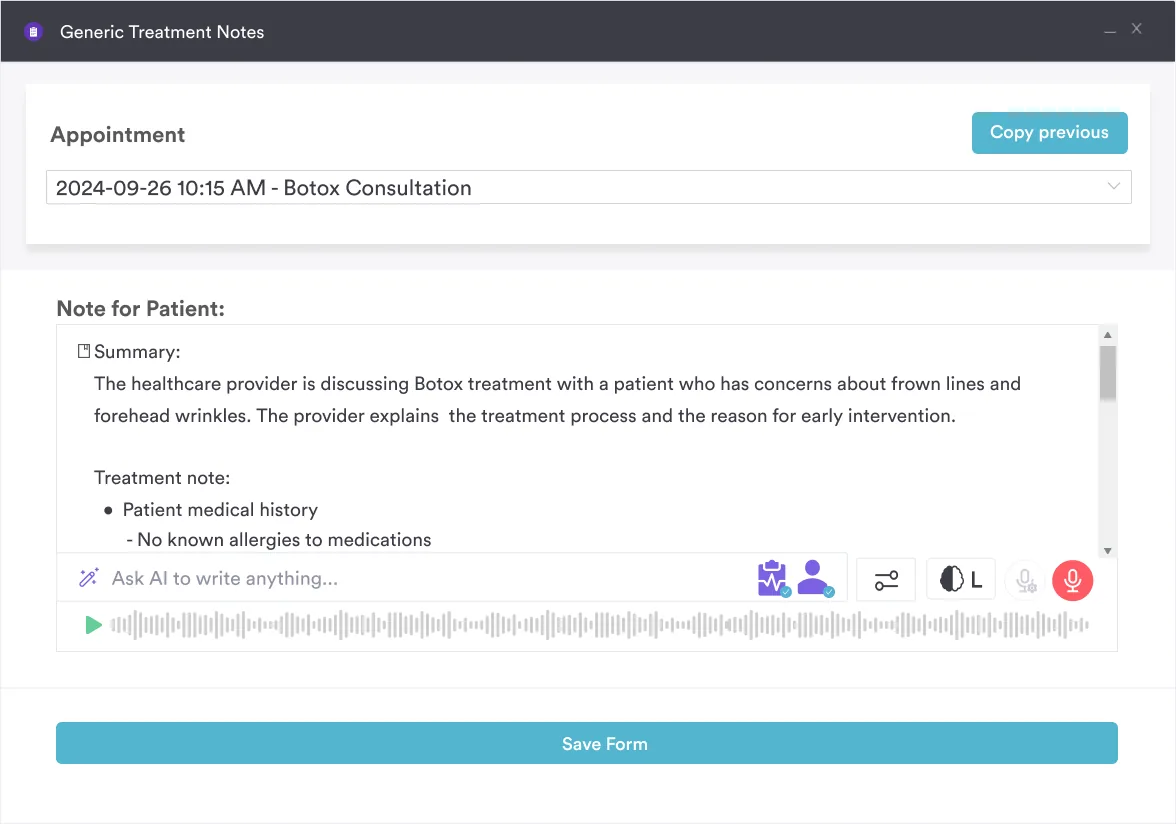
If the patient reports new allergies, alert the prescribing clinician. Smart workflows turn health worksheets from static documents into active safety tools.
The key shift is from paper-based, siloed intake to integrated, digital health assessment – where the health worksheet feeds directly into your clinical decisions, treatment planning, and ongoing care.

Deploy health worksheets digitally, auto-populate client records, and integrate patient health data into every clinical decision – without paper forms or manual entry.

A health worksheet is the clinical foundation of every patient relationship. It captures the baseline data you need to make informed decisions, reduces clinical risk, and protects you legally by documenting assessment and consent.
Yet paper worksheets and email questionnaires waste time and fragment your records. If your practice is still managing health worksheets manually, the time to modernize is now.

Onboarding a new patient instead? new client intake form template captures demographics, medical history, medications, allergies, and consent at the first appointment.
Need a quick stroke assessment tool? NIHSS score sheet scores 11 fields from consciousness to language on a quick-capture sheet for acute stroke.
Need a shift report for nursing? nurse brain sheet adapts across Med/Surg, ICU, ER, and labor and delivery in a free 12-page printable PDF.
A health worksheet is a structured clinical assessment form that captures patient medical history, current health status, medications, allergies, lifestyle factors, and chief complaints. It serves as the baseline for treatment planning and informed consent documentation.
Patients should complete the health worksheet before their first appointment – ideally 24-48 hours in advance. This allows you to review their health history before the consultation and identify contraindications or risk factors that may affect your assessment.
A health worksheet becomes a protected health record when it contains identifiable patient information. HIPAA requires encryption in transit and at rest, restricted access, and secure disposal. Using a HIPAA-compliant practice management system ensures your health worksheets meet legal requirements automatically.
Yes, digital health worksheets are preferred. They auto-populate client records, eliminate scanning and manual entry, encrypt data automatically, and create audit logs for compliance. Digital forms delivered via email or patient portal also increase completion rates compared to paper forms.
Patients should review and update their health worksheet at least annually, or whenever they experience a significant health change – new medications, surgeries, diagnoses, or lifestyle shifts. Some practices ask patients to update at every visit to keep records current.