Prediabetes diet food list: Foods to eat, avoid and print
A prediabetes diet food list is a practical set of foods that helps people with ...

1
Last Updated: Oct 22, 2026
A denture consent form is the written record that a patient understands a denture fitting, its risks and its alternatives before treatment starts. Dental practices use it to document informed consent for removable prosthetics, including partial, complete and immediate dentures. Having one on file protects the patient and the practice when expectations and outcomes do not line up.
Below, you’ll find what the form should cover, how the wording changes by denture type, and when to revisit consent after the first signature. Download the free template and adapt it to your practice.
A two-page form covering the treatment description, risks and complications, benefits, alternatives including no treatment, and a cost acknowledgment. It closes with a patient acknowledgment and a dentist declaration, each with signature and date fields.
Download template
Partial, complete and immediate dentures carry different risks, so the wording should differ by type.
Include a no-guarantee statement, since denture fit and comfort vary between patients.
Reconfirm consent at the delivery appointment, and take fresh consent when a reline or replacement changes the treatment.
HIPAA privacy notices are a separate document, but the consent form should reference them.
Pabau, the practice management platform we build, sends denture consent forms digitally and stores signed copies against the patient record.
A denture consent form is a signed document that records a patient’s informed agreement to denture treatment. It sets out what the procedure involves, the risks, the alternatives and the patient’s responsibilities during adjustment. It is narrower than a general dental treatment consent form, because it deals only with removable prosthetics.
The form rests on the principle of informed consent. In the United States, the American Dental Association (ADA) publishes guidance on informed consent for dental procedures, including prosthodontic care. State dental boards may set their own requirements. Confirm the rules that apply in your state before you finalize any template.
A signed form dates the risk discussion to before treatment, well ahead of any complaint. It also gives the team a clear record to refer back to if the patient later questions the result.
Most denture consent forms share a core set of clauses. Work through this list when you adapt the template.
The free template covers the description, risks, benefits, alternatives, costs and both signatures. Add your own no-guarantee clause and a line pointing to your privacy notice before you use it.
Patients need to hear about the common adjustment issues before they sit in the chair. Set out these points in plain language.
Immediate dentures carry extra risks because they are fitted on the same day as extraction. Tissue and bone change quickly after the teeth come out, so an immediate denture usually needs relining or replacement soon after.
The right disclosures depend on what you know about the patient. Review their dental medical history form before the consent conversation, so conditions that affect healing are on the table.
Each denture type needs its own emphasis. The table below shows where the wording should differ.
Partial denture consent should explain that clasps rest on neighboring teeth. Patients need to know that clasp pressure can affect those teeth over time.
A complete denture form should name bone resorption as a long-term change. It should also say that the fit can change and that periodic relining may be needed.
An immediate denture consent form should state that the denture is placed on the day of extraction and is temporary by design. It should explain that a reline or replacement will follow once healing is complete.
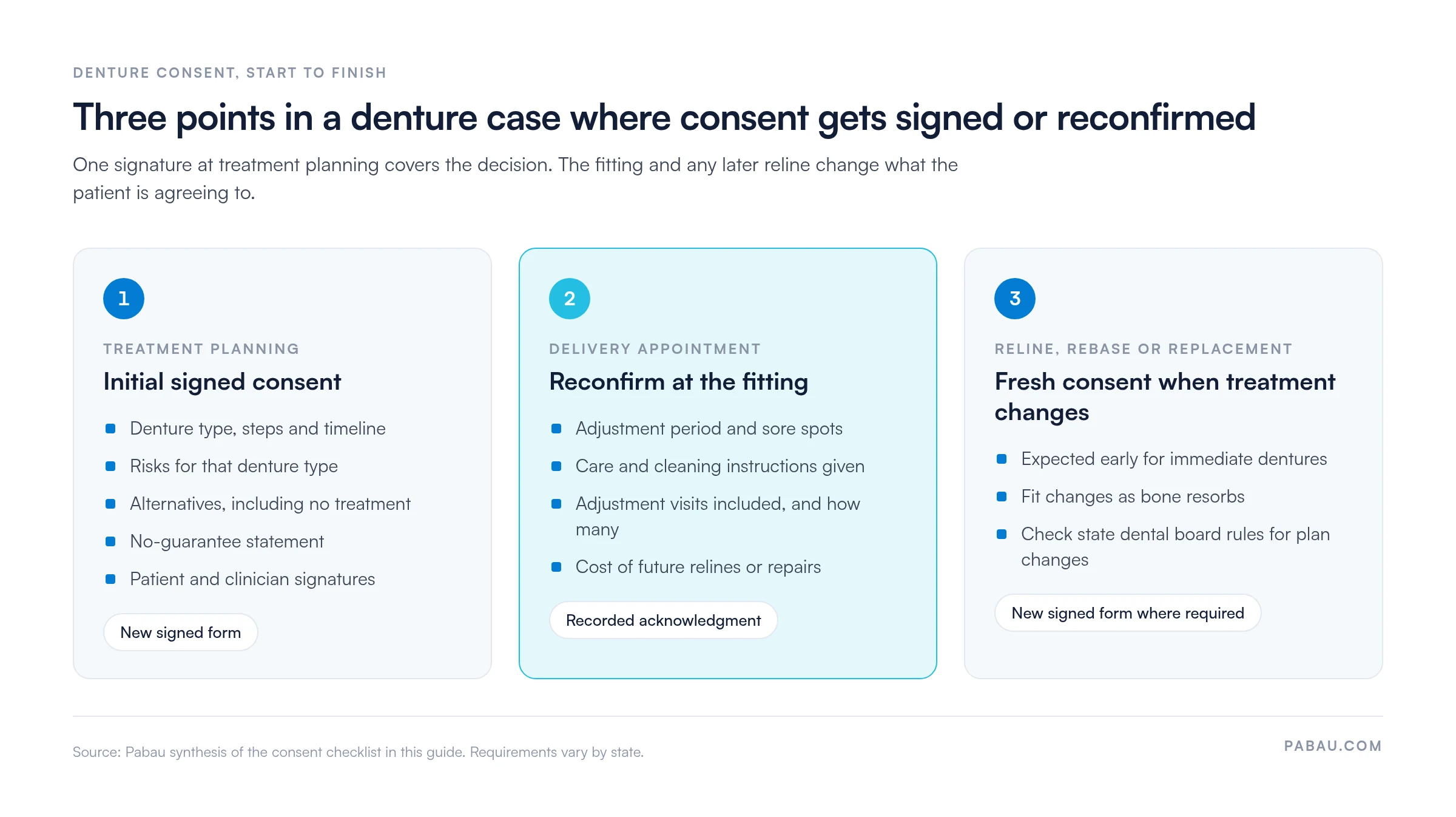
Consent is usually signed once, at treatment planning. Reconfirm the key points when the denture is fitted, because that is when the patient first feels the fit and starts adjusting.
The fitting is the second of three points in a denture case where consent comes up, as the flow below shows.
Log the delivery conversation in the clinical note for that appointment. A dental note template keeps the entry consistent from one clinician to the next.
Under the Health Insurance Portability and Accountability Act (HIPAA), covered entities such as dental practices must provide a Notice of Privacy Practices (NPP).
The HHS guidance on HIPAA for professionals explains the requirement. The NPP is a separate document from treatment consent, but the consent form can point to it so patients know where to find it.
Keep the privacy notice and the treatment consent as separate signed items, and store both against the patient record.
Paper forms create filing and retrieval problems, and a printed signature is hard to match to the right appointment. Pabau’s digital forms let patients complete and sign consent before they arrive.
You can keep a separate consent template for each denture type, so a partial denture patient never signs immediate-denture wording. With Care Pathways, the matching form goes out ahead of the visit, and an unsigned consent shows up on the practitioner’s pre-appointment checklist.
Signed forms are stored against the patient record and linked to the relevant appointment. Your team can find the consent for any denture case in a few clicks, which simplifies audits and responses to complaints.

Pabau’s digital forms send the right denture consent before each visit and store every signed copy against the patient record. Your team can pull up the consent for any case in seconds.

A denture consent form protects the practice only when it matches the denture you are fitting. Adapt the template to each type, add a no-guarantee clause, and point patients to your privacy notice.
The bigger change is revisiting consent after the first signature. Reconfirm it at the fitting, and take it again when a reline or replacement changes the plan. Those records carry the most weight if a patient later disputes the fit.
Book a demo to see how Pabau sends the right denture consent before each visit and files every signed copy against the patient record.

Sending consent online? E-consent form: what to include covers the fields an electronic consent needs and how to send it to patients.
Charting the arch before a fitting? Dental chart symbols explains the notation your team reads on the patient’s dental chart.
Treating gum disease before dentures? Perio chart dental codes walks through D0180, D4910 and a free periodontal charting template.
Need sign-off from the patient’s physician? Dental clearance form gives you a template for medical clearance before treatment starts.
Referring a complex case to a specialist? Dental referral form sets out what to include so the receiving dentist has the full history.
A denture consent form is a signed record that a patient understands the denture procedure, its risks, its alternatives and the adjustment period. It documents informed consent before treatment starts.
Include a procedure description, the risks for the denture type and the alternatives. Add a no-guarantee statement, a patient acknowledgment, a HIPAA reference for US practices, and signature and date fields.
Not always, but a new consent is sensible when a reline, rebase or replacement changes the treatment. Check your state dental board’s requirements for changes to an approved plan.
Yes, a denture consent form can be completed and signed digitally, provided the system captures a valid signature and stores the record securely. Confirm that your platform meets your local privacy requirements.