Despina Petrushevska

HIPAA compliant texting: What you can send patients & how to communicate securely
HIPAA compliant texting is possible when a text holds no protected health inform...

Last Updated: Oct 16, 2026
Free PDF 2 pages, print-ready Clinician-reviewed
An ethical consent form is a written record that a patient or participant agreed, freely and with full information, to a treatment, service or study. Before signing, the person learns in plain language what it involves, the risks and benefits, and the rights they keep.
In fact, it’s one of the first documents a regulator, ethics committee or auditor asks to see. The free template below is a clinical treatment consent form, so for therapy or research, add a confidentiality section and a voluntary participation statement before you use it.
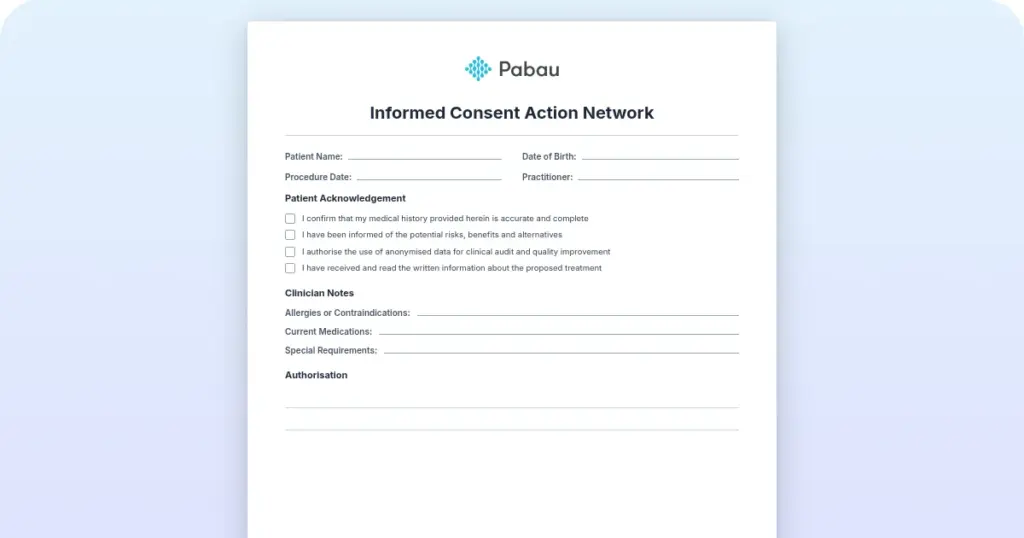
A single-procedure clinical consent form covering the procedure description, benefits, risks and side effects, and alternatives. It adds photography consent, medical history, a withdrawal statement, and patient, clinician and guardian signature lines.
Upload this PDF, or any form you already use, and Pabau's AI Form rebuilds it with tick boxes, text fields and a signature. Attach it to the treatment once, and every patient gets it on time.
AI Form rebuilds the consent, history and aftercare forms you already use. You review each one, then publish.
Patients complete forms on their phone before they arrive, so the front desk stops retyping paper.
Every signed form is versioned and attached to the treatment record, ready when you need it.
Set how long a consent stays valid. Returning patients skip forms they have already signed.
Supports HIPAA and GDPR compliance AES-256 encryption 4.8 on G2 4.7 on Capterra Trusted by 4,000+ practices worldwide

An ethical consent form records voluntary, informed agreement, not just a signature.
A complete form needs purpose, risks and benefits, confidentiality, withdrawal rights and contact details.
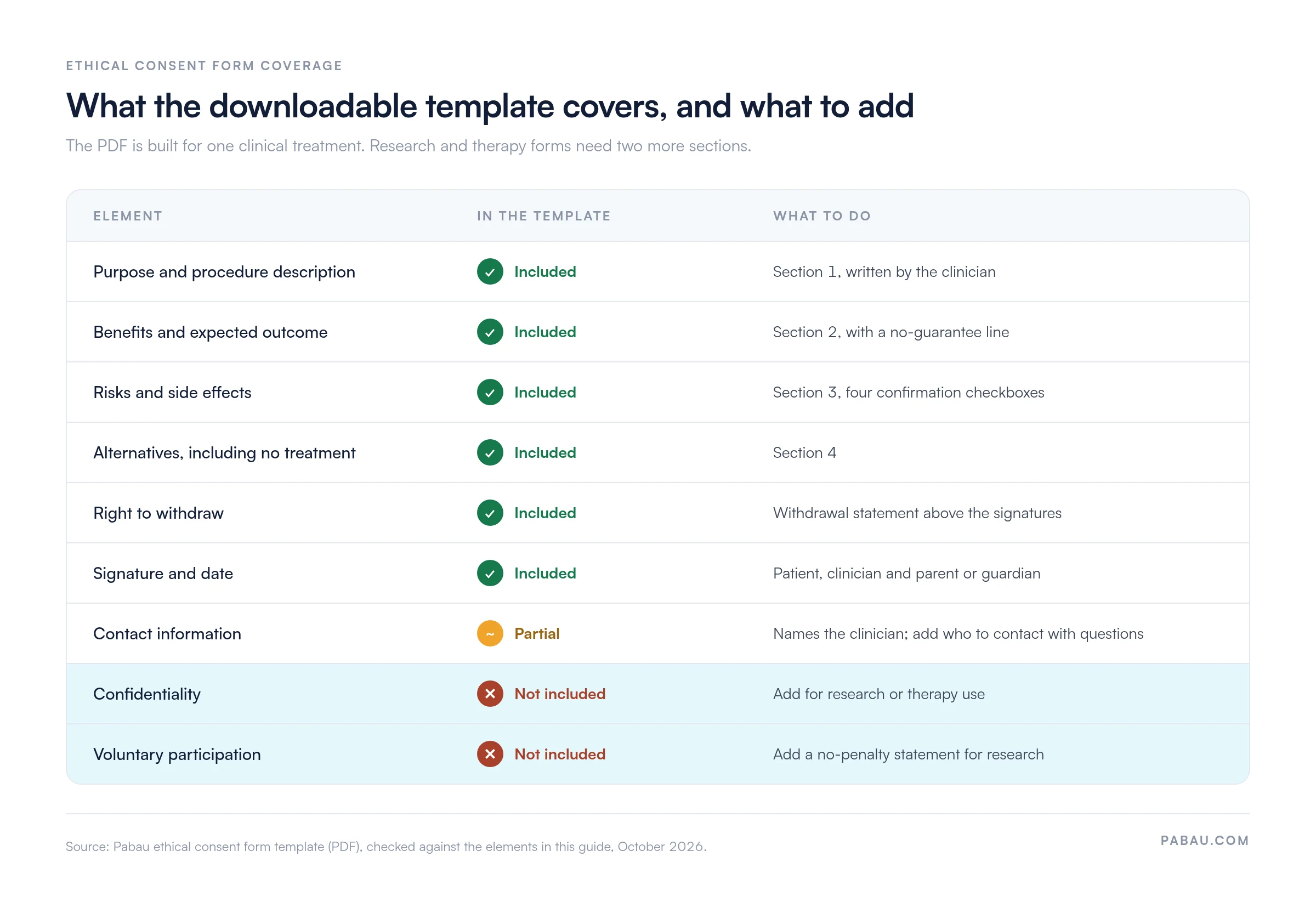
The template covers the clinical-treatment elements, so add confidentiality and contact sections for research or therapy use.
Regulators and ethics committees expect the form in plain language the participant can understand.
Digital forms in Pabau, the practice management platform we build, file each signed consent in the patient record.
An ethical consent form is the document that shows informed, voluntary agreement to join a study, accept a treatment, or receive a clinical service. The word “ethical” matters here. The form exists to protect the person being asked to agree, not only the practice or research team collecting the signature.
A basic consent form lists what the person is signing. An ethical one also explains why the activity is happening, what could go wrong, and how the person can stop at any point without penalty. For that reason, ethics committees and clinical governance teams check that difference first.
Most ethics boards and regulators look for the same core components. Therefore, a complete form needs every element below. The downloadable template covers the clinical-treatment elements, so add confidentiality and contact sections for research or therapy use.
So, against that list, the template suits a single clinical treatment and needs two additions for any other use.
Write each section in plain language. Readability guidance from research ethics bodies commonly points to roughly an eighth-grade reading level, so a participant can understand the form without a glossary.
Drafting is easier when you work through the form in order. Start with the purpose and finish with signatures, so each section builds on the last.
In a practice, the consent form usually covers a specific treatment rather than a study. Therefore, treatment consent should describe the procedure, the expected outcome, the common side effects, and the alternatives the patient could choose instead. Our adult medical consent form shows the same structure for general treatment.
In addition, confidentiality deserves its own clear section. In the United States, HIPAA sets rules on how health information is used and disclosed, and HHS.gov is the authoritative reference. Where you plan to share records with a third party, pair the consent with an authorization to release information. Check the form against current guidance, and take legal advice where your situation is unusual.
Therapy consent carries a specific duty to explain the limits of confidentiality. In particular, patients need to know in advance when a practitioner must break confidence. Typical triggers are a risk of harm to self or others, or a safeguarding concern.
Also, include the practitioner’s professional registration and how the practice records or shares sessions. Remote sessions often need their own telehealth consent form. For minors, state who can consent and how you take the young person’s views into account, since the legal age of consent varies by jurisdiction. A separate consent to treat minor form covers the parent’s side.
An Institutional Review Board (IRB) or research ethics committee usually reviews research consent before participants see it. The form should reflect the approved protocol, and any change to the study typically requires a revised form and fresh approval.
The World Health Organization publishes consent guidance and templates for research. In the US, the Common Rule (45 CFR 46) sets the required elements for federally funded studies. Use the WHO’s informed consent templates and HHS’s Common Rule page to check your wording against the current standard.
Paper forms are hard to search, easy to lose, and slow to audit. Many practices now collect consent through a secure digital form that the patient completes before the appointment. As a result, the signed copy goes straight into the record. Digital intake forms make that the default rather than a manual upload.
US law generally recognizes electronic signatures under the ESIGN Act and UETA. Validity depends on how the signature is captured and verified, so confirm the approach with your compliance lead. Our e-consent form guide covers what an electronic version needs.
Most practices still print a PDF consent form, have the patient sign it at the front desk, then scan it into a patient file. That leaves room for unsigned forms, lost pages and old versions that nobody retired.
Pabau’s digital forms send the consent form before the visit and capture the patient’s signature. Pabau files the signed copy against their record. Consent sits alongside treatment notes and appointments rather than in a separate filing system.
When a form changes, you update the template once and every new patient gets the current version. As a result, at audit time, the signed consent for each treatment is one search away.

Pabau sends consent forms before the appointment, captures the signature, and files the signed copy in the patient record. Your team stops chasing paper, and every treatment has its consent on file.

Start from the template if your form covers one clinical treatment, and fill in the procedure field before anyone signs it. If you run research or therapy, add confidentiality, voluntary participation and a named contact first. After all, those sections are what an ethics committee checks.
However, the harder part is keeping one current version in use and every signed copy findable. Book a demo to see how Pabau sends, signs and files consent forms so each treatment has its consent on record.

Need consent for surgery? Free operation consent form covers the extra detail an operative procedure needs.
Running a vaccination service? Consent form for vaccination gives you a ready form for immunization visits.
Treating children? Consent form template for parents sets out what a parent signs on a child’s behalf.
Sharing health information? HIPAA authorization form explains the authorization a disclosure needs.
Consenting dental patients? Dental treatment consent form adapts the same elements for dental procedures.
An ethical consent form is a document that records a person’s informed, voluntary agreement to a study, treatment or service. It explains the purpose, risks, benefits, confidentiality and the right to withdraw.
Research studies usually need approval from an IRB or research ethics committee before the form is used. Routine clinical treatment consent generally does not, but your regulator or professional body may set its own requirements.
Yes, electronic consent is widely used, provided the signature is captured reliably and the record is stored securely. Confirm the approach against the data protection rules that apply to your practice.