Kate Tarrant

Average cost of Botox per state, from 562 practices’ price lists
The average cost of Botox per state runs from $12 to $15 a unit, and the nationa...

Last Updated: Nov 5, 2026
Free PDF 7 pages, print-ready Clinician-reviewed
A dental medical history form template is a standardised patient intake document that collects essential health information before dental treatment begins. The dental medical history form template gathers details about medications, allergies, medical conditions, surgical history, and family health background. This structured approach ensures clinicians understand each patient’s health status before proceeding with any procedure. By using a dental medical history form template, dental practices maintain consistent documentation standards across all new patient encounters.
Medical history collection is not optional. Undiagnosed conditions, medication interactions, or allergies can influence treatment planning and patient safety. A comprehensive dental medical history form template serves as the foundation for informed consent, risk assessment, and clinical decision-making. This document becomes part of the permanent patient record and supports both clinical and compliance objectives within a dental practice.
A ready-to-use medical history form covering patient details, medical background, medication lists, allergy documentation, contraindication screening, and signature blocks for informed consent.
Start from scratch, or upload this PDF or any form you already use, and Pabau's AI Form rebuilds it with tick boxes, text fields and a signature. Attach it to the treatment once, and every patient gets it on time.
AI Form rebuilds the consent, history and aftercare forms you already use. You review each one, then publish.
Patients complete forms on their phone before they arrive, so the front desk stops retyping paper.
Every signed form is versioned and attached to the treatment record, ready when you need it.
Set how long a consent stays valid. Returning patients skip forms they have already signed.
Supports HIPAA and GDPR compliance AES-256 encryption 4.8 on G2 4.7 on Capterra Trusted by 4,000+ practices worldwide

A dental medical history form template captures medications, allergies, and medical conditions before treatment
Structured medical history reduces clinical risk and supports informed consent documentation
HIPAA-compliant forms protect patient privacy whilst ensuring regulatory compliance
Digital forms in practice management software automate distribution and data capture
A dental medical history form is a clinical document designed to capture a patient’s past and present health status. It documents systemic diseases, medications, allergies, and relevant surgical or traumatic history. Dentists require this information because medications and medical conditions directly affect treatment planning. For example, anticoagulation therapy alters bleeding risk during extraction. Uncontrolled diabetes impacts healing capacity. Bisphosphonate therapy increases osteonecrosis risk with oral surgery. Without accurate medical history data, clinicians cannot properly assess procedural risk or select appropriate treatment alternatives.
From a regulatory perspective, documented medical history serves critical functions. The American Dental Association (ADA) guidelines establish that obtaining a medical history is a standard of care requirement. HIPAA regulations require that patient health information be collected, stored, and maintained with appropriate safeguards. Documentation of informed consent depends on evidence that clinicians disclosed relevant risks and alternatives to patients with full knowledge of their medical status. A complete dental medical history form template becomes the evidentiary foundation for risk management and regulatory compliance within a dental practice.
Some practices call it a dental health history form, and others call it a dental medical history form. Both names describe the same document, which groups its questions into eight core sections. These are patient details, medical history, medications, allergies, dental history, lifestyle, pregnancy status, and a signed accuracy declaration.
The medication and allergy sections carry the most clinical weight. Ask for the full name and dose of each drug, not just its category, since that detail decides whether a dentist adjusts treatment.
Our free PDF covers six of those sections in depth across seven pages. Its medical history checklist lists more than 40 conditions, and it asks about bone loss drugs, past diet pills, and premedication advice.
Two sections need more before you print it. Patient details stop at name and patient ID, with no date of birth, phone number, or emergency contact. The lifestyle questions cover tobacco but not alcohol, so add an alcohol question if your practice asks one.
Adult forms focus on chronic conditions and lifestyle factors that change over time. Ask about cardiovascular disease, diabetes, and current medications at every review, not only at the first visit.
Include pregnancy and nursing status for patients of childbearing age, since it informs X-ray use and medication choices. Word tobacco and alcohol questions without judgment, so patients answer them honestly.
On a child’s form, a parent or guardian gives the answers. That makes the guardian’s name, their relationship to the child, and a consent signature essential fields. Our PDF has a parent or guardian signature line but no field for the guardian’s name or relationship, so add one.
Add questions on birth history, growth and development, vaccination status, and fluoride sources such as supplements or drinking water. Medication and allergy questions still apply to children, and an emergency contact matters even more than on an adult form.
The American Dental Association sells its own health history forms, with separate versions for adults and children. Both come as printed pads or downloadable PDFs, and many practices use them as a reference structure.
Our template is not the ADA form. It covers the same core areas of dental history, medical history, medications, and allergies, so you can check it against the ADA version. If you need to confirm what your records must contain, check your state dental board’s record-keeping rules.
Using a dental medical history form template effectively requires a structured workflow that captures all essential information whilst respecting patient time and clinic efficiency. Follow these operational steps to integrate the template into your practice:
Practice management software like Pabau turns this PDF into a fillable digital form. Patients complete it online before their appointment, and their answers save straight to the patient record.
Staff update the form once, and the change reaches every new patient who books. A new alcohol or emergency contact question goes live the same day, with no stack of outdated PDFs left at reception.
Dental practices across all specialties and practice sizes benefit from a structured medical history template. General dentistry practices see all patient types and require a flexible template that captures baseline health information for diverse procedures. Oral surgery clinics need deeper detail on bleeding history, anticoagulation use, and surgical contraindications. Cosmetic dentistry practices benefit from medical screening that documents informed consent for elective treatments. Paediatric dentistry practices use simplified versions of the dental medical history form template, often with parent or guardian completion. Pediatric practices should pair this template with a medical release form for minors when a parent cannot be present.
Multi-location dental practices and dental support organisations (DSOs) gain consistency benefits from a standardised dental medical history form template. Using a template across all locations ensures uniform information capture, reduces compliance risk, and supports data integration across the organisation. Private practices leverage templates to establish professional standards and automate intake processes. Community health centres and dental schools use medical history templates to train clinicians on systematic patient assessment.
A patient management platform stores every completed form against the right patient record automatically.
A structured template delivers measurable operational and clinical benefits. Standardised forms reduce staff training time because team members follow a consistent format. Patients spend less time writing and more time discussing clinical concerns with clinicians. Digital templates eliminate illegible handwriting and missing fields. Practices reduce callback cycles where staff contact patients weeks later seeking missing medication information. When dental medical history form templates are integrated with practice management software, data automatically populates patient records, eliminating manual data entry and transcription errors.
Clinical safety improves when medical histories are comprehensive and reviewed systematically. Dentists identify contraindications before treatment planning begins, avoiding procedural complications. Documentation of informed consent becomes defensible when records show that clinicians had full knowledge of patient risk factors. Regulatory audits and compliance reviews progress faster when records are complete and consistently formatted. Risk management teams use comprehensive dental medical history form templates to reduce liability exposure and support quality improvement initiatives.
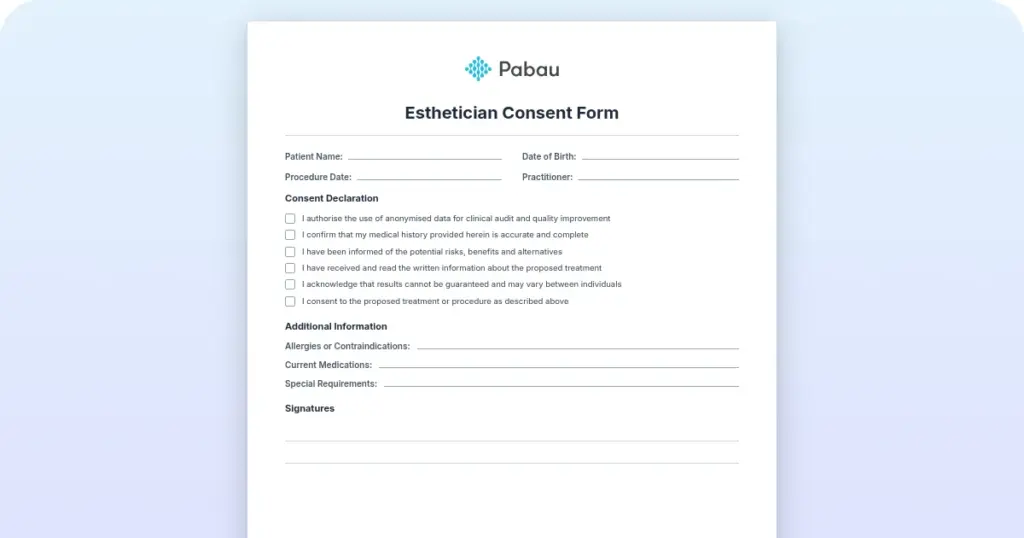
Procedure-specific consent forms sit on top of that history. A practice fitting removable prosthetics adds a denture consent form once the medical history is complete.

Pabau’s digital forms system lets you send templates before appointments, collect responses via secure patient portal, and automatically populate patient records. Reduce manual work and improve data accuracy.

Accurate medical history documentation is a cornerstone of patient safety in dental practice. Medications affect treatment planning in ways many practitioners encounter regularly. Anticoagulants like warfarin or novel oral anticoagulants (NOACs) increase bleeding risk during extractions and implant placement. The CDC emphasises that comprehensive medical information prevents adverse events in healthcare settings. Bisphosphonates used for osteoporosis increase osteonecrosis risk with alveolar bone exposure. Corticosteroids used for immune conditions impair wound healing. A complete dental medical history form template ensures clinicians know which medications their patients take and can adjust treatment protocols accordingly.
Allergy documentation within a dental medical history form template prevents medication errors and anaphylaxis risk. Documenting penicillin and cephalosporin cross-reactivity affects antibiotic selection for endodontic treatment. Latex allergy affects glove selection and barrier protocols during procedures. Iodine allergy influences local anesthetic selection. These details seem minor in isolation but cumulate into significant patient safety impacts across a practice cohort. A dental medical history form template that systematically captures allergy history prevents medication-related harm and supports clinical decision-making that respects patient safety constraints.
Privacy and security requirements apply to all dental patient health information, regardless of how it is collected. The Health Insurance Portability and Accountability Act (HIPAA) requires that Protected Health Information (PHI) be stored securely and accessed only by authorized personnel. PHI must also be transmitted using encryption. A dental medical history form template becomes a compliance document once it contains patient information. Paper forms must be stored in locked cabinets with restricted access. Digital forms must use encrypted transmission, password-protected systems, and access logs. Disposal of completed paper forms requires shredding or secure destruction to prevent inadvertent disclosure.
Most dental practices are covered entities under HIPAA, so the form should tell patients how their information is used. Add a privacy notice and a signature line where the patient acknowledges receiving it. A notice of privacy practices template gives you wording to adapt.
Our PDF already promises confidentiality and asks permission to request records from other providers. It has no privacy notice acknowledgement yet, so add that line beside the patient signature.
For practices operating internationally, additional data protection laws apply. UK practices must comply with UK General Data Protection Regulation (UK GDPR) principles when collecting and storing patient medical information. EU practices follow GDPR with similar consent, security, and data subject rights requirements. Australia implements Privacy Act protections. Canada enforces PIPEDA requirements. A dental medical history form template used across multiple jurisdictions must incorporate safeguards that meet the strictest applicable standard. Digital solutions that manage forms through encrypted platforms with automated access controls reduce compliance risk compared to paper-based workflows.

Need to streamline patient data collection? HIPAA authorization form lets your practice disclose protected health information beyond routine treatment and operations.
Looking to standardize shift handoffs? I-PASS handoff template gives your team a proven framework for reducing communication errors during handoffs.
Looking to unify patient records across locations? Medical information form covers a four-page health screening questionnaire for new patients.
A dental medical history form template is a fundamental document within modern dental practice. It captures essential health information that informs clinical decision-making, enables informed consent, and supports regulatory compliance. Whether paper-based or digital, a structured template ensures systematic information gathering across all patient encounters. Dental practices that implement standardised medical history templates experience improved data consistency, reduced compliance risk, and enhanced patient safety outcomes.
Using a well-designed template is only part of the solution. Digital practice management platforms that integrate medical history forms with patient records, clinical workflows, and compliance tracking amplify these benefits further. Practices that move from paper-based to digital medical history capture reduce manual work, improve data accuracy, and create audit trails that support regulatory reviews. The investment in a structured approach to medical history collection returns value through safer clinical care, fewer administrative errors, and stronger regulatory defensibility.
A comprehensive dental medical history form template should capture patient demographics, medical conditions, medications, allergies, surgical history, family health background, substance use, and dental history. It should include screening questions about bleeding disorders, heart disease, diabetes, and other conditions affecting dental treatment. Many templates also include informed consent language specific to planned procedures.
Patients should update their medical history at least annually or whenever significant health changes occur. Many practices request updates at recare appointments or annually before routine exams. Digital systems can send automated reminders for patients to review and confirm their information is current, reducing staff workload and improving data accuracy.
Digital templates offer significant advantages over paper forms. Digital forms reduce illegible handwriting, eliminate missed fields through validation, allow secure transmission via patient portals, and automatically populate patient records. They also create audit trails for compliance and reduce storage space requirements. Paper forms remain acceptable but require manual data entry and physical storage security measures.
HIPAA compliance requires that patient health information be encrypted during transmission, stored in access-restricted systems, and handled only by authorised staff. Use digital forms transmitted over secure connections rather than email or unencrypted platforms. Maintain locked storage for paper forms. Establish staff access policies limiting who can view completed templates. Dispose of paper forms securely through shredding rather than standard waste disposal.
Yes, templates are designed to be customisable. You can modify sections to emphasise conditions relevant to your patient population or specialty focus. General practices may include additional preventive screening questions. Oral surgery practices may add detailed bleeding history and anticoagulation questions. Many practice management systems allow template customisation whilst maintaining compliance safeguards and data structure standards.