Sulcus Test: Shoulder Instability Assessment
The sulcus test is an orthopedic special test that checks for inferior glenohume...

2
Last Updated: Oct 22, 2026
The perio chart dental code for a full periodontal exam is D0180, the CDT (Current Dental Terminology) code for a comprehensive periodontal evaluation. Charting has no billable code of its own. Instead, the probing depths, bleeding points, recession and furcation grades on the chart justify D0180, and later D4910 (periodontal maintenance) at recall visits.
Hygienists and billing staff tend to stumble on three calls: D0150 or D0180, periodontal maintenance or prophylaxis (D1110), and which findings back each code. This guide works through each one, with a free chart template you can print or fill in digitally.
It also covers how digital clinical records keep the completed chart attached to the claim, ready for an insurance audit.
A one-page periodontal charting form with a six-point probing grid, BOP and recession columns, and furcation fields. It closes with a CDT code reference for D0180, D0150, D4910, D4341 and D1110.
Download template
D0180 is the code for full-mouth six-point probing and charting, while D0150 covers a general exam without a periodontal focus.
Probing depths, bleeding on probing and recession on the chart decide whether a recall visit is billed as D4910 or routine prophylaxis (D1110).
D4341 (scaling and root planing) treats active disease first, and D4910 follows only once that prior active therapy is on record.
Practice management software like Pabau captures each required data point at the chair through digital forms, so claims don’t wait on missing notes.
Periodontal charting is a clinical exam in which a hygienist or dentist probes six sites per tooth and records the findings. The sites are mesiobuccal, midbuccal, distobuccal, mesiolingual, midlingual and distolingual. Each chart records:
The threshold values on the chart justify the CDT code you select. Those values are pockets of 4mm or more, the BOP percentage, recession measurements and furcation grade. A chart showing pockets of 4mm or more with BOP supports a periodontitis diagnosis, and moves later recall visits to D4910.
Without those findings, the visit may need to be billed as D1110 instead, at a 30-50% lower reimbursement. Under HIPAA, the chart is protected health information and has to be stored securely. Digital records also log the exam date, clinician and findings alongside the submitted code.
A perio chart template is a structured form that lays out six-point probing, BOP, recession and furcation fields. That layout matches the ADA’s definition of a comprehensive periodontal evaluation (D0180). With every field in a fixed place:
Payers audit dental claims by checking the charting against the billed code. A D0180 claim without documented six-point probing will be denied. So will a D4910 claim without evidence of prior active periodontal therapy. A template confirms the exam is complete before the patient leaves, rather than months later when the denial arrives.
The template is a one-page PDF that works alongside your intake forms or as a standalone sheet during the hygiene appointment. Six steps take you from probing to a billable code:
A CDT code reference at the bottom of the template lists when to use D0180, D0150, D4910, D4341 and D1110. Check your code choice against it before the claim goes out. On paper claims, the ADA dental claim form is where that code travels to the payer, with the chart attached.
Several CDT codes can follow a completed perio chart, depending on the patient’s history and current findings. Knowing the sequencing and bundling rules keeps claims from being denied or downcoded:
Key billing rule: D1110 (prophylaxis) and D4910 (periodontal maintenance) can’t be billed on the same date. If the chart shows periodontitis, only D4910 is billable. If it shows healthy status, only D1110 applies. Mixing the two up is one of the most common causes of dental claim denials.
The map below turns those rules into two questions, one for evaluation visits and one for cleaning visits.
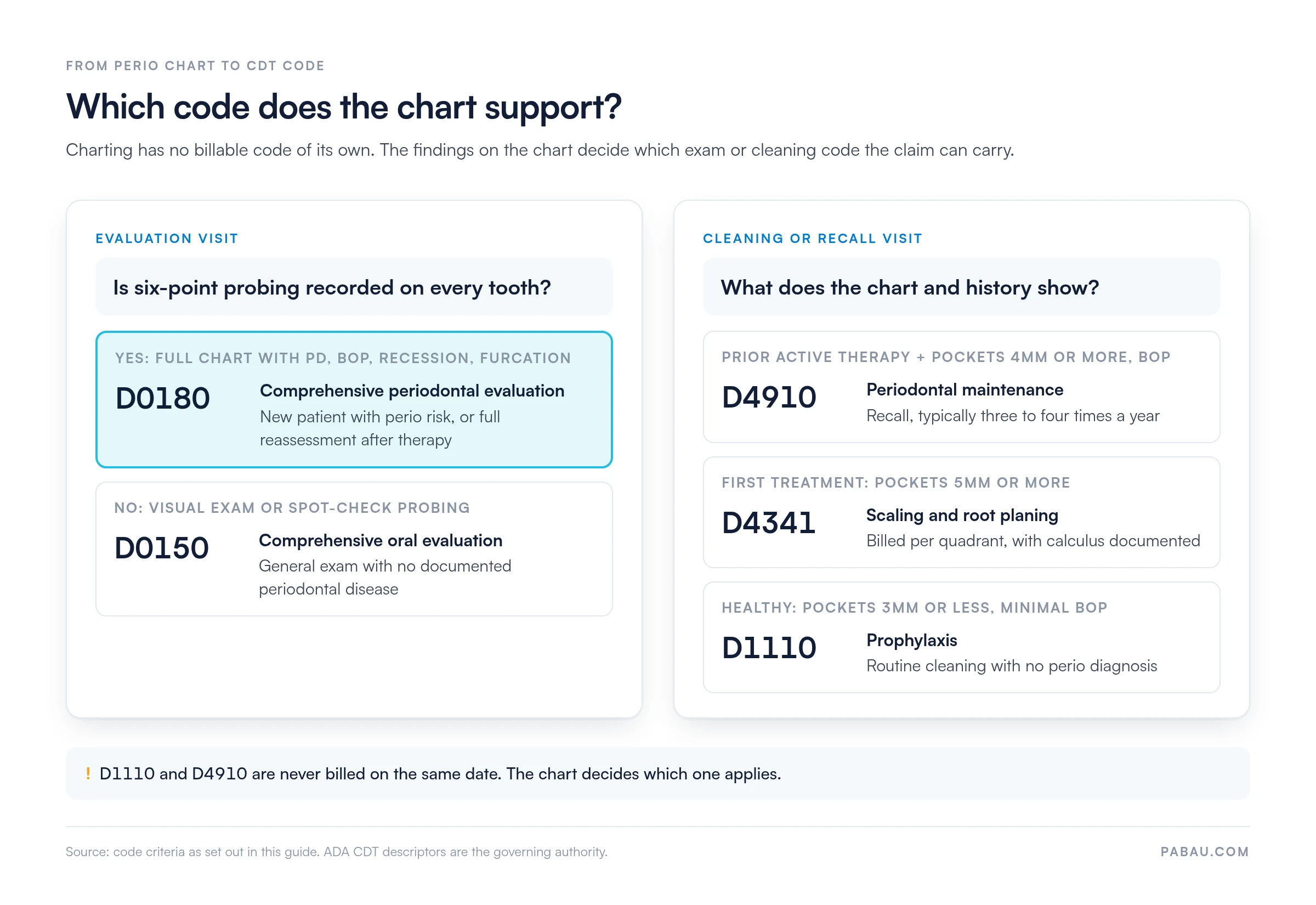
Mixing up D0150 (comprehensive oral evaluation) and D0180 (comprehensive periodontal evaluation) leads to denied and downcoded claims. The deciding factors are the scope of the exam and what the chart documents:
If the chart contains six-point probing measurements, bill D0180. If only a visual screening or spot-check probing was done, use D0150. Payers compare the claim code against the chart, so the documentation decides. The ADA’s CDT code descriptors are the authoritative source for this distinction.
The perio chart covers the gums only. Pair it with a dental examination form for the rest of the oral evaluation.
Once a D0180 exam confirms periodontitis, recall visits shift from D1110 to D4910. The diagnosis rests on pockets of 4mm or more, BOP and/or clinical attachment loss. At each recall, the chart has to keep justifying D4910:
When payers audit D4910 claims, they ask for the supporting perio chart, the prior D4341 billing history and proof the patient meets the periodontitis criteria. A complete chart has that evidence ready, which protects the practice from overpayment recovery demands.
The template suits dental teams across several practice types:
Any practice billing for periodontal services benefits from a structured perio chart. If your team relies on free-text notes, switching to the template gives every claim the same complete evidence.
Record BOP as a percentage at the end of every exam, because payers want quantified inflammation data. A BOP above 10%, alongside pockets of 4mm or more, supports a periodontitis diagnosis. A BOP below 5% may support moving a patient from D4910 back to D1110.
Build the chart into the clinical and billing steps your team already follows:
Many dental practices still chart on paper, scan the sheet and attach it to the claim by hand. Each handoff is a chance for a skipped site or a lost page, and the denial only shows up weeks later.
With Pabau, the perio chart is a digital form attached to the hygiene appointment. The hygienist fills it in at the chair, and it saves straight to the patient’s Client records file with the date and clinician.
Your billing team then works from the same record when they choose the CDT code and submit the claim. When a payer asks for documentation, the chart is already filed against the visit.

Pabau’s digital forms capture the full perio chart at the chair and file it against the patient record. Your billing team codes and submits from the same file.

The CDT code on a perio claim is only as defensible as the chart behind it. If your team changes one habit after reading this, make it recording BOP as a percentage at every exam. That single figure settles most D4910 versus D1110 questions before they reach a payer.
The trade-off is a few extra minutes per hygiene visit. That’s far less time than reworking a denied D0180 claim or answering an overpayment audit months later.
Book a demo to see how Pabau files each perio chart against the visit, so your team codes periodontal claims from complete evidence.

Writing up the hygiene visit itself? Our dental note template shows what to include so the clinical note backs up the codes on the claim.
Setting recall intervals for perio patients? The dental cleaning schedule template sets recall intervals by risk level, which lines up with D4910 maintenance timing.
Need the full picture at a new-patient visit? A dental medical history form captures the risk factors that often justify a D0180 exam.
CDT code D0180 is the comprehensive periodontal evaluation code. It applies when every tooth gets six-point probing and charting. That covers probing depths, bleeding on probing, gingival recession, furcation involvement and clinical attachment level. Use D0180 on initial perio exams, at the start of periodontal treatment, or when a full reassessment is indicated. Routine recall visits after diagnosis use D4910 instead.
D0150 is a general comprehensive oral evaluation with no periodontal focus, so six-point probing isn’t required. D0180 is a comprehensive periodontal evaluation with full-mouth probing and charting. If the exam includes six-point probing, bill D0180. If only a visual screening or spot-check probing was done, use D0150. The patient’s chart decides which code applies.
D4910 is the periodontal maintenance code for recall visits after a periodontitis diagnosis and active periodontal therapy, such as D4341 scaling and root planing. It includes scaling and root planing as needed. It’s typically billed three to four times a year for perio patients. It can’t be billed without documented active perio disease and treatment history.
It depends on your state, because scope of practice for independent billing varies. Most states require a dentist to diagnose periodontal disease from the hygienist’s charting before D0180, D4341 or D4910 goes to insurance. Check your state’s dental practice act and your dental board’s regulations. Documented dentist review of the perio diagnosis also makes the claim easier to defend.
Usually, yes, but coverage for D0180 varies by payer and plan. Most major dental plans, including Delta Dental, Aetna, Cigna and United Healthcare, cover comprehensive periodontal evaluations under routine preventive or diagnostic benefits. Frequency limits often apply, such as once a year or once every three years. Verify coverage before the appointment so patients know their out-of-pocket cost.
Patients on D4910 maintenance need a new perio chart at least once a year. For patients with stable, healthy status, charting every two to three years may be enough. New patients should always get a full D0180 perio chart at their first appointment. Payers may request the most recent chart during an audit, so keep charts current.