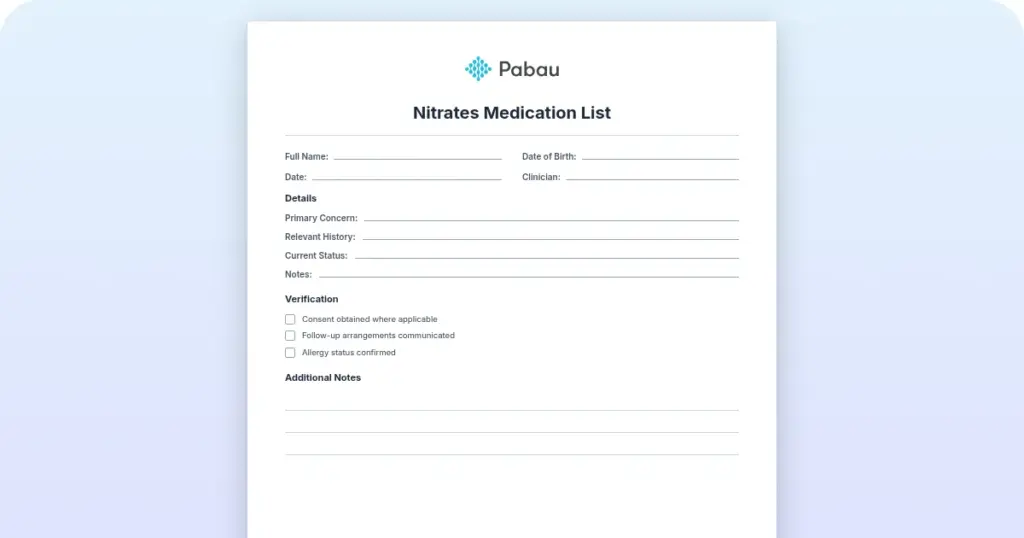
Nitrates medication list
A nitrates medication list is a point-of-care reference that sets out the main c...

Last Updated: Oct 6, 2026
A dental note template is a pre-structured form for recording a visit, covering the chief complaint, tooth-by-tooth charting, diagnosis, treatment rendered, and recall. Use one and every clinician records the same fields, in the same order, every time. That consistency is what carries a note through an insurance review or a board complaint years later.
Free-text notes rarely manage it. The template is below, free to download. After that, we get into what belongs in each field and how SOAP works in a dental chart. We also cover the details that come back to bite practices at audit.
A ready-to-use form covering patient details, medical history, tooth-by-tooth charting, periodontal findings, treatment rendered, and recall intervals. Print it as it is, or adapt the fields to match how your practice charts.
Download template
A dental note template standardizes the chief complaint, charting, diagnosis, treatment, and recall so every clinician records the same fields in the same order.
SOAP is the structure most dental schools teach, and it maps cleanly onto a dental chart from complaint through to recall.
Each procedure adds its own fields, so an extraction note and a recall note should never look alike.
Write the note the same day, use measurements instead of adjectives, and record the reasoning behind the treatment you chose.
Practice management software like Pabau keeps the template inside the patient record, so notes stay searchable and audit-ready.
A shared format does three jobs at once. It holds up in a dispute, it supports the claim, and it lets the next clinician pick up the case cold.
Without one, each dentist and hygienist writes in their own shorthand. Terminology drifts, fields get skipped, and nobody spots it until a payer asks for the chart.
A malpractice claim is argued on the record. A thin note leaves the practice defending a memory instead of a document, which is a much harder position.
Billing rewards the same discipline. Capture the diagnosis, the surface, and the materials while the patient is still in the chair, and the claim goes out complete. Reconstructing that detail a week later is how denials start.
Eight fields carry a dental note. Miss one and the record stops short exactly where someone will look hardest.
Dental schools, state boards, and insurance payers all treat these eight as the minimum. The tooth-by-tooth row is the one practices most often shortcut. If you chart by hand, a printed tooth chart template keeps the notation identical between clinicians, which matters more than the symbols you pick.
SOAP splits the note into four parts, moving from what the patient tells you to what you plan to do about it. The order mirrors how you already think through a case. You listen, you look, you decide, you act.
Here is a single visit, written the way it would sit in the chart.
Notice how little of that is prose. Measurements, tooth numbers, and the patient’s own words do the work. A note written this way takes less time than a paragraph and says considerably more. If the format is new to your team, our guide to SOAP notes works through the same four sections in other specialties.
The SOAP spine stays the same at every appointment. What changes is the detail each procedure has to prove, and that is where thin templates fail. The chart below shows what each of the five common note types adds on top of that core.
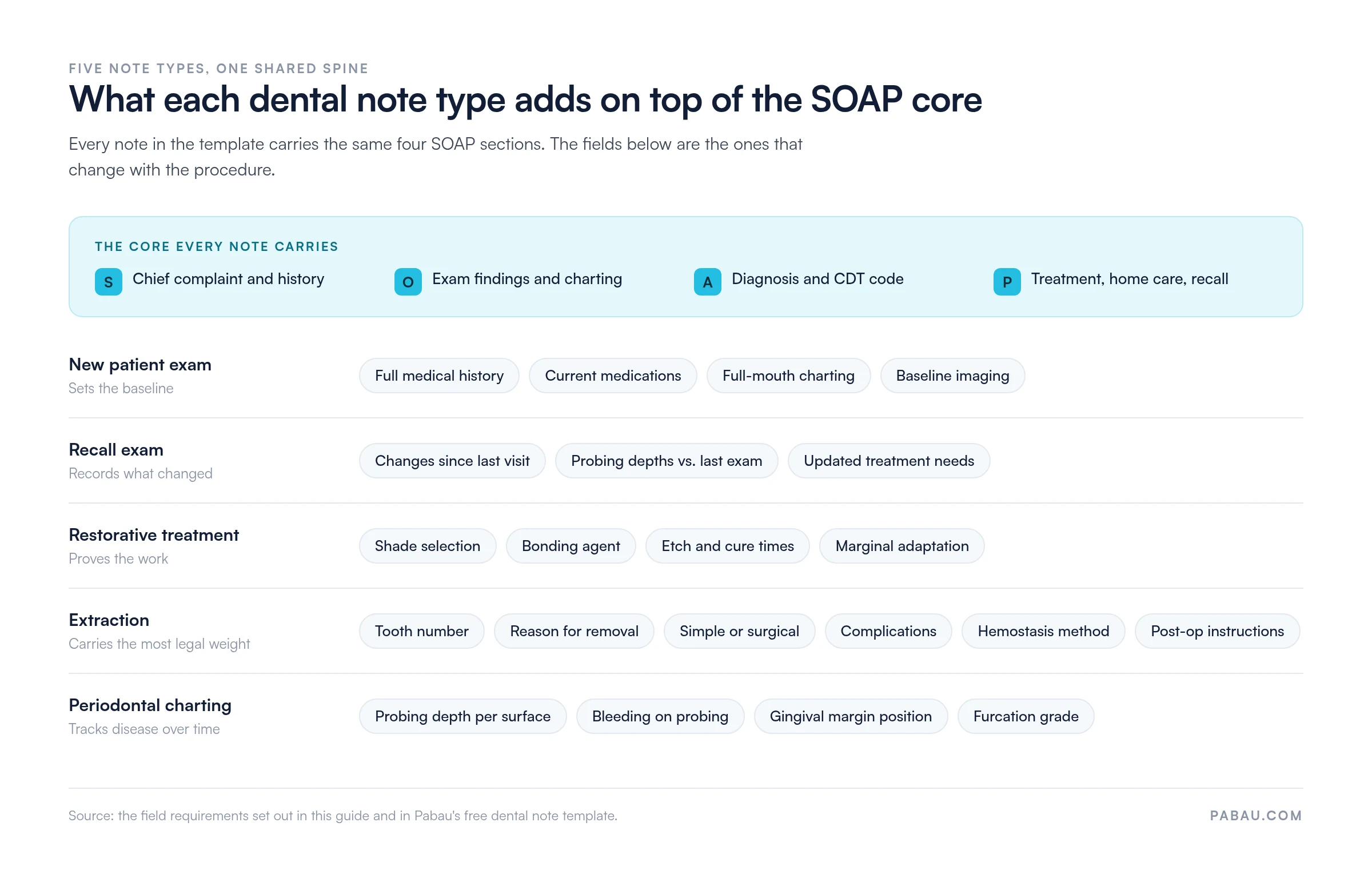
A first visit is your only chance to record a clean starting point. Capture full medical and dental history, current medications, allergies, a full-mouth assessment, and any imaging taken.
Much of that history can be collected before the patient arrives. Practices that send forms ahead through patient intake software start the exam with the history already in the chart.
A recall note is a comparison, not a repeat. Say what moved since the last visit. New or worsening caries, periodontal trend, and any change to the treatment plan all belong in it. Set the next interval from the patient’s risk profile. Dental cleaning intervals sit at six months for low-risk prophylaxis and three to four for periodontal maintenance.
Comparison fields help here, such as a line reading “probing depths stable versus last exam”. A recall note identical to the previous one gives a reviewer no evidence of what you checked, and payers do check.
Fillings, crowns, and build-ups get judged later on what you used. Record the shade, the bonding agent, etch and cure times, the cement, and how the margin adapted.
If the restoration fails in two years, this is the record that shows whether the technique was sound. Standard materials can be pre-filled, so the clinician only changes what differs from the usual protocol.
Record the tooth number, the reason for removal, and whether the extraction was simple or surgical. Then add complications, how hemostasis was achieved, and the post-operative instructions the patient was given.
Note who received those instructions, and how. If a dry socket turns into a complaint, this is the paragraph that answers it.
Probing depths mean little unless they are recorded the same way each visit. Log depth per surface, bleeding on probing, gingival margin position, and furcation grade where it applies.
Consistent notation is what turns six numbers into a trend line. Change the shorthand halfway through a course of treatment and you lose the comparison.
Write the note before the patient leaves the building. That one habit fixes most of what goes wrong with dental records, because detail fades fast and reconstructed notes read like reconstructed notes.
Run this check at the end of the appointment. It takes about fifteen seconds once it becomes a habit.
Two sets of rules apply to a dental record. Your state board decides how long you keep it, and HIPAA decides how you protect it.
Retention minimums vary by state. Adult records are typically held for seven to ten years after the last treatment. Records for minors run longer, often until the patient turns 21 or later. Check your own board before you set a destruction schedule.
Every note needs the patient’s name, the date of service, and the treating clinician. Corrections are made by addendum, dated and signed. Never use white-out, and never delete an entry outright.
HIPAA covers the rest, including who can open a chart, how it is stored, and what the access log shows. The US Department of Health and Human Services publishes the current guidance for covered entities.
A medical records management system handles the storage, the logs, and the retention clock without anyone tracking it by hand.
A downloaded form gives you a consistent structure. It still has to be printed, filled in, scanned, and filed against the right patient. That is four chances for a note to land somewhere nobody thinks to look.
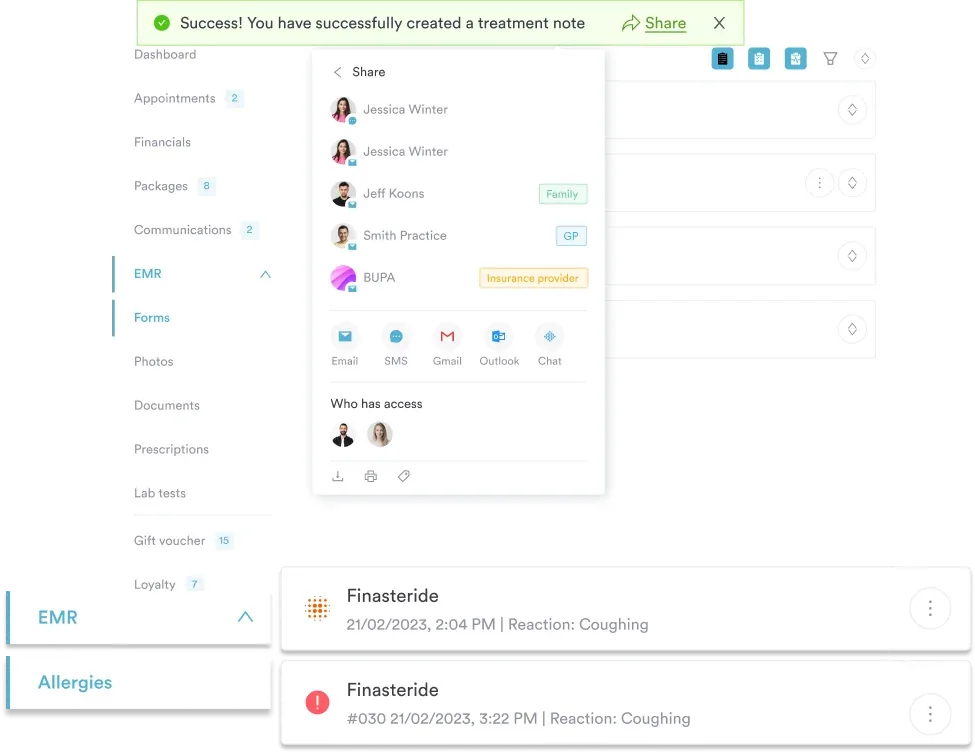
Practice management software like Pabau closes that loop by holding the note template inside the chart. You pick the appointment type, the matching note opens with its fields ready, and the finished note saves straight to the patient record. Required fields cannot be skipped, so incomplete notes stop leaving the operatory.
Because the note lives with the rest of the record, you can search it. Pull every patient with a probing depth over 5mm, or every extraction from last quarter, without opening a paper chart. Recalls run off the same data, so patients due an exam surface on their own.
Consistency across a team is the other half of the job. Team management software sets who documents what, and shows which notes are still unsigned at the end of the day. That stops a draft note sitting unnoticed for a week.

Pabau builds your dental note templates into the appointment itself, so notes are complete before the patient leaves and searchable the moment they are signed.

Pick one structure and hold the practice to it. Which template you choose matters less than the whole team using the same one. Do that for a year and the chart reads as a single record rather than five people’s habits.
The trade-off is easy to accept once you have seen it play out. A fuller note costs a few seconds at the chair and saves hours at audit. Practices chased for records are rarely the ones writing too much.
Start with the free template above and adapt the fields to how you already work. Would you rather the structure lived inside the patient record than in a PDF? Book a demo and see how Pabau handles dental charting from intake to recall.

Need the exam form that feeds the note? Dental examination form template covers history, clinical findings, charting and dentist certification in one document.
Still recording probing depths on paper? Perio chart form template gives you a printable grid for depths, recession and bleeding points.
Need consent documented before you treat? Dental treatment consent form sets out risks, alternatives and the patient’s signature line.
Sending patients home after an extraction? Wisdom teeth removal aftercare gives you the post-operative instructions to hand over and record.
Comparing systems to chart in? Clinical documentation software walks through what to look for before you switch.
Yes, for the care they provide. Hygienists document their own periodontal charting, prophylaxis and home care instructions, then sign that entry. The dentist signs the exam, the diagnosis and the treatment plan. Delegation rules differ, so check your state board.
DAP folds the subjective and objective findings into one data section, so it has three parts instead of four. SOAP keeps the patient’s own account separate, which helps when symptoms and findings disagree. Busy hygiene departments often prefer DAP for speed.
In most states, yes, provided they are legible, dated and signed. The practical problem is retrieval. A paper chart cannot be searched, backed up, or produced quickly when a payer requests records for review.
Yes. Under HIPAA, patients have a right to a copy of their record, usually within 30 days of a written request. Write every note assuming the patient will read it, and keep opinions about the patient out of the chart.
Record the code for each procedure you complete, alongside the diagnosis it supports. A periodic oral evaluation is D0120, and a one-surface posterior composite is D2391. The ADA republishes the CDT set every year, so check the current descriptors before you bill.