Intake note template
An intake note is the clinical record a therapist or counselor writes at the sta...

1
Last Updated: Oct 22, 2026
Dental chart symbols are the standard marks, letters and colors dentists use to record each tooth’s condition and treatment on a patient’s chart. On most charts, red marks a problem or planned work and blue marks completed work. An X flags a tooth that’s missing or due for extraction.
Each symbol sits on a numbered tooth. The numbering follows one of three systems: Universal in the US, FDI internationally, or Palmer in some UK and orthodontic settings.
This guide covers the symbol legend, all three notation systems, periodontal marks, common abbreviations, and how to read a completed chart step by step. It also shows how to translate a tooth number when a chart arrives from a practice that uses a different system.
A printable sheet for logging findings by tooth or quadrant, with columns for notes, source and approval. A dated recording section tracks who charted each finding and when.
Download template
Dental chart symbols are standardized marks used to record oral findings, treatment history and clinical status on a patient’s chart.
Three notation systems number the teeth: Universal (1-32, the US standard), FDI (two digits, international) and Palmer (a quadrant grid used in some UK practices).
Red usually marks existing conditions or planned treatment and blue marks completed treatment, though color conventions vary between practices and software.
Practice management software like Pabau stores charts, forms and notes in the patient record, so a patient’s charting history stays in one place.
Dental chart symbols are a visual shorthand for clinical findings. Rather than writing out that a molar has a two-surface filling, a clinician draws the mark on a tooth chart and moves on. The result is compact enough to scan in seconds.
The same marks support treatment planning, team handoffs and referrals. They also form the legal record of what was found and done, and they let you track changes in a patient’s oral health across visits.
Three notation systems define how dentists refer to and chart individual teeth. The one you use depends on geography, specialty and practice preference.
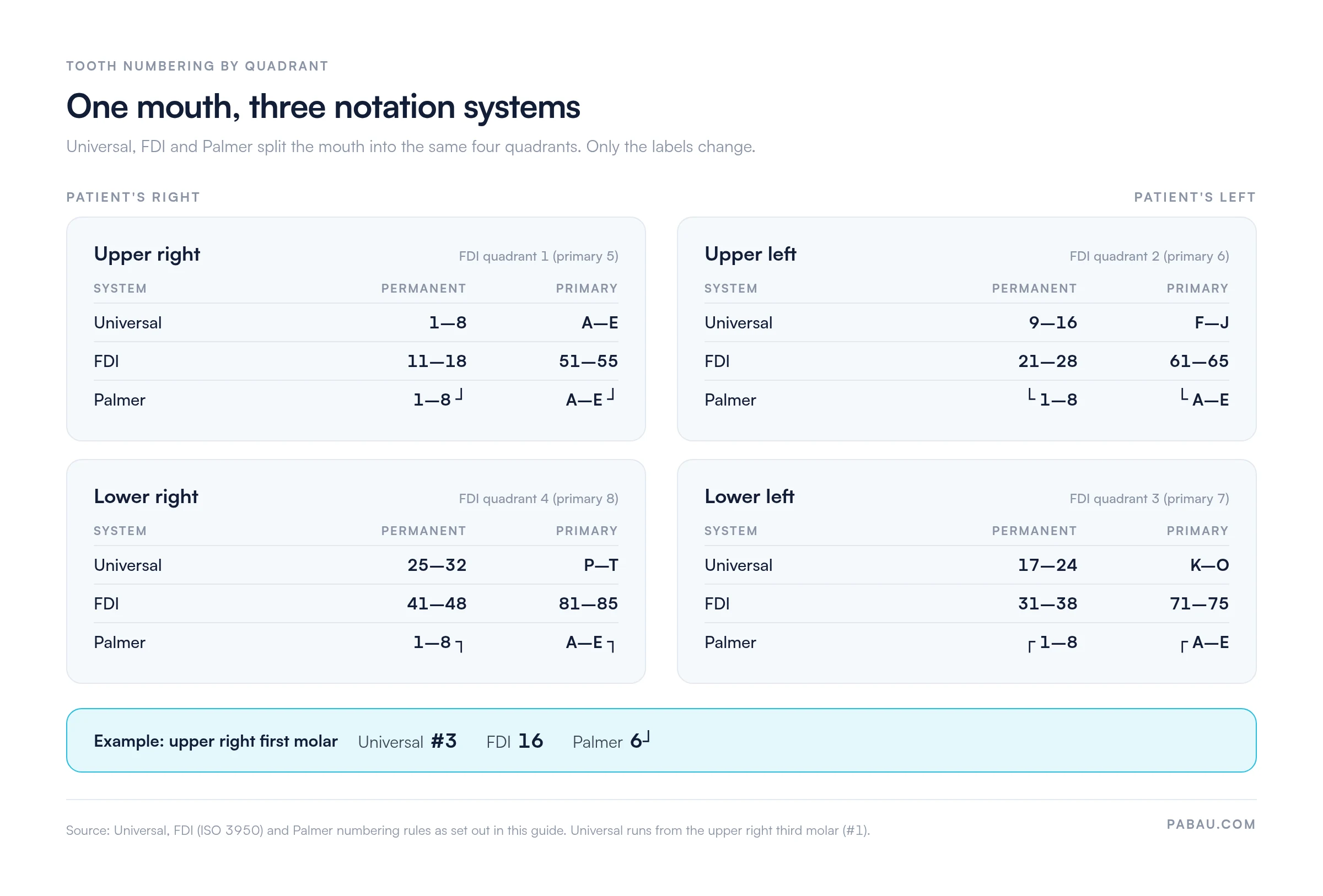
The Universal system numbers permanent teeth 1-32, starting with the upper right third molar as tooth #1. Numbering runs across the upper arch to #16, the upper left third molar. It then drops to #17 (lower left third molar) and ends at #32 (lower right third molar). Primary teeth use letters A-T in the same order.
Our baby teeth eruption chart shows when each of those 20 primary teeth typically appears.
The FDI system uses two digits. The first identifies the quadrant: 1-4 for permanent teeth and 5-8 for primary teeth. The second gives the tooth’s position from the midline, from 1 (central incisor) to 8. Tooth 16 is the upper right first molar in the permanent dentition. FDI is the international standard (ISO 3950) and is widely used outside the United States.
Palmer notation pairs a grid symbol (┘└┐┌) showing the quadrant with the tooth’s position from the midline. Permanent teeth are numbered 1-8, and primary teeth use the letters A-E instead. Palmer is less common in digital charting. It’s still taught in some dental schools and used in some UK practices and orthodontic settings.
All three systems split the mouth into the same four quadrants and differ only in their labels. The map below shows each quadrant in all three, using the upper right first molar as a worked example.
The core symbols represent clinical conditions and treatments. Each has its own graphical form, and most follow the red (existing or planned) and blue (completed) color convention.
Bridges and implants have no single standard letter. Any abbreviation for them is practice-specific, so check your practice’s legend or software key before relying on one.
The red and blue convention is widespread but not universally standardized. Red usually indicates existing conditions, such as decay, or planned treatment, such as a restoration still to be placed. Blue denotes completed treatment or existing restorations. Some practices use other color schemes or none at all, so confirm your practice’s convention during onboarding.
Periodontal charting adds its own marks for gum health, pocket depths and furcation involvement. They sit alongside the standard tooth chart, and a perio chart form keeps them on one page.
Abbreviations complement symbols with quick shorthand for surfaces, materials and treatments. The surface letters are M (mesial), O (occlusal), D (distal), B (buccal), L (lingual) and I (incisal). Combined, they describe multi-surface restorations. Common examples:
Reading a dental chart takes three things: The notation system in use, the symbol set, and the color convention. Follow these steps:
Referrals between US and international practices are where tooth numbers get misread. An FDI chart that marks tooth 36 for extraction means the lower left first molar, which is #19 on a Universal chart. Convert the number before you read the symbol, and never assume a two-digit number is FDI.
Name the system in your own records too. A line at the top of every dental note template you use spares the next clinician the same guesswork.
Digital dental charting replaces paper charts with an electronic record, which cuts transcription errors and keeps each chart legible for the whole team. Most dental charting software lets you pick a symbol from a menu and places it on the tooth for you. The exact look of each mark varies by platform.
Saved charts also make comparison over time easier, because each visit’s findings stay on file rather than being drawn over. That history matters most when several clinicians treat the same patient.
Dental students should start with the Universal system, the standard in US schools, and the core symbols: Decay, restoration, extraction, crown and root canal. Learn all three notation systems, but prioritize whichever your curriculum emphasizes. Reading completed charts during clinic placements makes the symbols familiar quickly.
Study tip: Make your own reference cards with symbol drawings, and quiz yourself weekly on tooth numbers and meanings. If your school provides a symbol legend, keep a copy with you during patient exams.
Plenty of practices still chart on paper, scan the page, and file consent forms and notes somewhere else. Finding a patient’s last chart then means checking two or three places.
Pabau, the practice management platform we build, stores charts, forms and notes in the patient record. Pabau’s digital forms collect intake and consent before the visit, and the patient record keeps them next to the chart.
Pabau Scribe, our AI scribe, drafts the clinical note from the consultation. Less of each visit gets typed up after hours, and the record is complete when the next clinician opens it.


Pabau stores dental charts, intake forms and clinical notes in the patient record, so your team finds a patient’s history in one place. Pabau Scribe drafts the clinical note from the consultation.

Learn the notation system your patients’ charts arrive in first, then drill the core symbols until you can read a chart without a key. In the US that means Universal, and almost everywhere else it means FDI.
The color convention is the part to double-check, because practices don’t all apply it the same way. Confirm your practice’s legend on day one, and name the notation system on any chart you send out.
Book a demo to see how Pabau keeps charts, forms and notes in the patient record for your dental team.

Charting a new patient? Dental new patient form captures registration, medical history and dental concerns before the first exam.
Following up an implant? Implant follow-up SOAP note structures the review visit from history through to plan.
Filing a dental claim? ADA claim form guide covers the patient details every dental claim depends on.
Decay (cavity) is the most frequently charted symbol in general practice, followed by restorations (fillings). In periodontal practice, pocket depth numbers and bleeding on probing marks appear on every chart.
No. Red (existing or planned) and blue (completed) are common, but some practices use different schemes or no color coding at all. Confirm your practice’s convention during onboarding.
Yes. The symbol meanings are the same, though most digital systems let you pick a symbol from a menu. The visual appearance and color can vary slightly between software platforms.
If you practice in the US, start with the Universal system (1-32). If you work internationally or plan to, learn the FDI two-digit system. Palmer notation matters less unless you specialize in orthodontics or work in UK practices.
It varies by state, commonly 5-10 years for adult records and longer for minors. Check your state dental board’s rules and your malpractice insurer’s requirements.