GLP-1 diet plan
A GLP-1 diet plan is a structured eating framework for patients taking semagluti...

2
Last Updated: Oct 13, 2026

A medical practice business plan is a detailed roadmap for your practice’s mission, financial goals, and operational strategy. It matters whether you’re launching a new practice or expanding an established one.
Healthcare business plans must address regulatory compliance (HIPAA, state licensing, and data-privacy laws), staffing structure, revenue models, and patient acquisition tailored to your specialty.
Financial projections should include startup costs, monthly operating expenses, break-even timelines, and conservative revenue forecasts based on your target market and pricing.
Practice management software like Pabau brings scheduling, patient records, and financial tracking into one system, so you can execute the operational strategy your plan sets out.
A structured business plan template covering executive summary, market analysis, financial projections, operational strategy, and healthcare compliance requirements.
Download templateA medical practice business plan turns a clinical vision into a fundable, workable operation. It maps how you’ll acquire patients, staff the practice, manage cash flow, and stay compliant before you sign a lease or draw down a loan. This free template covers every section a healthcare practice needs.
The sections below walk through each part of the template and show how the requirements shift by specialty, so a med spa business plan, a physical therapy business plan, and a mental health private practice business plan each end up with numbers that hold up.
A medical practice business plan is a written document that details your practice’s vision, operational strategy, financial projections, and growth objectives. It serves three functions:
For healthcare practices, a business plan is non-negotiable. It connects clinical vision to operational reality. It documents how you’ll acquire patients, manage cash flow, comply with regulations, and retain clinical staff.
The template is organized into five core sections. Complete each in order, because later sections reference earlier ones (e.g., your financial projections depend on your market analysis and staffing plan).
Spend 4–6 weeks on your business plan. Rush it, and you’ll overlook critical cash flow problems or market assumptions.
Why this matters: Clinicians often prioritize clinical setup (staffing, equipment, credentials) and underestimate administrative lead time (legal structure, bank account setup, compliance registration). A written business plan surfaces these dependencies months earlier.
Practice management software like Pabau helps here too.
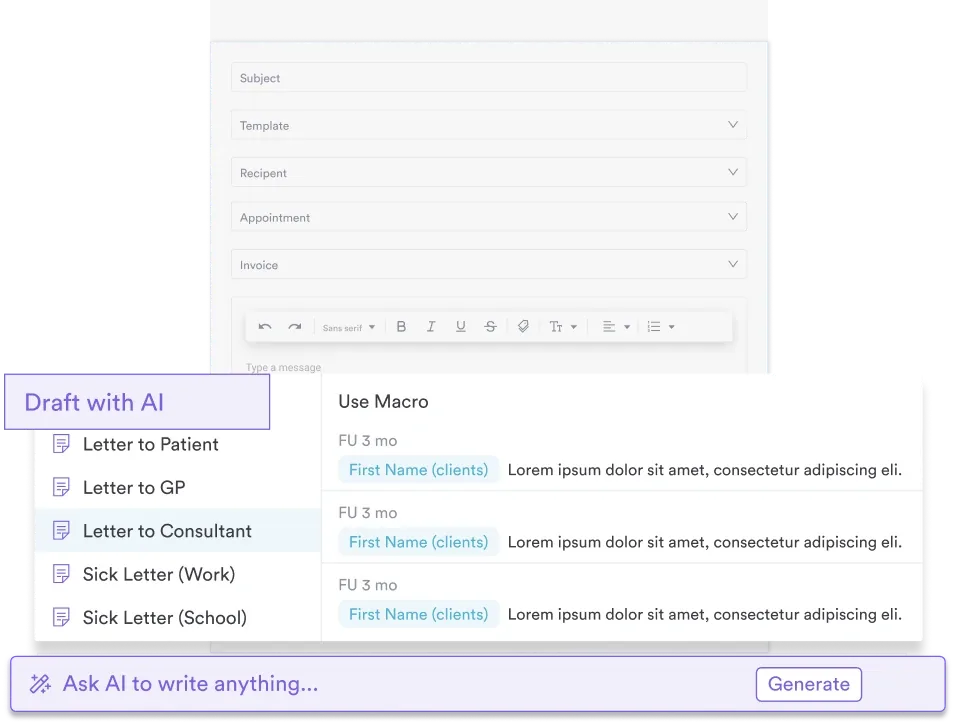
Book a demo with Pabau to see how it helps practices track patient acquisition cost, revenue per appointment, and staffing efficiency, the KPIs your business plan predicts.
Keeping paperwork like this under control is a core part of private practice management.

Pabau’s practice management software helps practices automate scheduling, patient records, and financial tracking, turning your business plan projections into operational reality.

A business plan is essential for anyone launching or significantly expanding a healthcare practice.
Clarity: Writing forces you to answer hard questions before you spend money. “How many new patients per month do I need to break even?” becomes a number you can defend, not a hopeful guess.
Funding readiness: Banks and SBA lenders will not consider a loan application without a business plan. A structured, realistic plan increases your approval odds and may improve your interest rate.
Regulatory alignment: The template includes sections for compliance requirements (HIPAA, state licensing, data-privacy compliance, and malpractice insurance). Addressing these upfront prevents costly mid-year surprises.
Team alignment: Sharing your written plan with co-founders, investors, and future staff ensures everyone understands the practice’s financial model and growth targets. Misaligned expectations are a leading cause of practice partnership breakdown.
Decision support: When you face a critical decision (“Should I hire a second practitioner now or wait until Year 2?”), your plan provides the data. You already modeled both scenarios and know the cash flow impact.
Run three financial scenarios in your business plan: a conservative case (50% of projected patient volume), a realistic case (your best estimate), and an optimistic case (25% above estimate). This protects you from overconfidence and forces you to define what patient volume assumptions would trigger a course correction.
Healthcare business plans differ from generic startup plans because they must address compliance from day one. Your template should document:
Pro tip: Contact your state licensing board 6–12 months before your planned opening and ask for a pre-application consultation. Many provide guidance on documentation and staffing requirements that directly inform your business plan’s feasibility.
The template provides structure; you provide the numbers. Here’s how to build realistic financial projections:
Your business plan must define staffing roles from day one. For aesthetic practices, this includes clinical staff (nurses, estheticians, technicians) and support roles (schedulers, intake coordinators, billing staff).
For service-based practices (therapy, coaching, physical therapy), this ratio may be 20–30% if you’re operating solo.
Your template should include an organizational chart for Year 1 and Years 2-3 (as you scale). This clarifies reporting structures and identifies where bottlenecks emerge. Many solo practitioners wait too long to hire a scheduler or administrator, burning out by month 12.
Your business plan must answer: “How will patients find me?” Allocate 5–10% of revenue to marketing and patient acquisition. For new practices, this is often higher upfront (10–15% in Year 1) because you’re building awareness from zero.
Document your channels: online booking integration (crucial for med spas and wellness practices), Google Business profile optimization, social media strategy (Instagram/TikTok for aesthetics, LinkedIn for B2B coaching), and referral programs. Patient acquisition cost (CAC) and lifetime value (LTV) projections directly inform whether your pricing strategy is sustainable.
If your 3-year vision includes opening a second location, your business plan should model it separately. Opening a second practice is operationally different from running one. You’ll need management systems, consistency protocols, and centralized billing and staffing oversight.
A paper-based single practice might just about cope. A two-location practice cannot. Include software costs in your multi-location expansion projections.
Write a separate business plan addendum for each new location. Each location’s demographics, rent, and staffing may differ significantly, requiring distinct financial models.
A business plan is not a static document. Review it monthly during Year 1 against actual results. Track:
Use integrated billing and reporting tools to pull your numbers monthly. Spreadsheets are error-prone. Practice management software automates this tracking and flags variance early.
A written business plan is your practice’s blueprint. It forces you to test assumptions, allocate resources realistically, and prepare for regulatory compliance before you open your doors. Download the template, work through it section by section, and update it quarterly as your practice grows. Your future self and your lender will both thank you.
Once your business plan is written, executing it requires operational systems. Book a demo with Pabau to see how practice management software brings your plan to life, automating scheduling, patient communication, and financial reporting so you can focus on clinical delivery.
A medical practice business plan is a written document that outlines your practice’s vision, operational strategy, financial projections, and growth objectives. It guides internal decision-making and communicates your practice direction to lenders, investors, and staff.
Typically 15-30 pages, depending on complexity. Solo practitioners need a simpler plan than multi-location operators. The template provides structure; you fill in the specifics relevant to your practice model and specialty.
Yes. Banks and SBA lenders require a written business plan before considering a loan application. It demonstrates you’ve thought through your financial model and can service the debt.
Overestimating early patient volume. Many clinicians assume a full schedule from day one, then ramp far more slowly in practice. Build conservative projections and adjust upward once you have your own booking data.
Yes. Review it quarterly in Year 1, then annually thereafter. Compare actual results to projections, update financial forecasts, and adjust your strategic priorities based on what you’ve learned operationally.
4-6 weeks working part-time, or 2-3 weeks full-time. Don’t rush. Time spent now prevents costly operational missteps later.
The core sections are an executive summary, company description and legal structure, market analysis, services and pricing, and financial projections. Healthcare plans add compliance (HIPAA, state and facility licensing), a staffing model, and a patient acquisition strategy.
A healthcare business plan has to account for regulation from day one: HIPAA-compliant systems, state and facility licensing timelines, malpractice cover, and data-privacy rules. It also models clinical staffing ratios and patient volume rather than generic sales targets.