Tanja Lepcheska

Self-love meditation script: Free PDF and 5-minute version
A self-love meditation script is a ready-to-read guide that takes a listener thr...

1
Last Updated: Nov 9, 2026
Free PDF 2 pages, print-ready Clinician-reviewed
An assertive communication worksheet is a structured therapy resource that helps patients state their needs, opinions and boundaries clearly while respecting other people.
Therapists use it to contrast passive, aggressive and assertive communication, then practice the skills in controlled exercises. Assertiveness is a common goal in therapy for anxiety, low self-esteem and relationship difficulty, so a repeatable worksheet gives sessions a clear structure.
This guide covers what the worksheet includes, how to run it with adults, teens and couples, and how to send it to patients digitally.
A printable worksheet with space for each stage, a passive, aggressive and assertive comparison grid, and a boundary-setting section. Use it in session or send it home as homework.
Start from scratch, or upload this PDF or any form you already use, and Pabau's AI Form rebuilds it with tick boxes, text fields and a signature. Attach it to the treatment once, and every patient gets it on time.
AI Form rebuilds the consent, history and aftercare forms you already use. You review each one, then publish.
Patients complete forms on their phone before they arrive, so the front desk stops retyping paper.
Every signed form is versioned and attached to the treatment record, ready when you need it.
Set how long a consent stays valid. Returning patients skip forms they have already signed.
Supports HIPAA and GDPR compliance AES-256 encryption 4.8 on G2 4.7 on Capterra Trusted by 4,000+ practices worldwide

The worksheet teaches the difference between passive, aggressive and assertive communication.
I-statements give patients a structure for owning feelings without blaming others.
Boundary-setting exercises let patients rehearse saying no in low-stakes settings.
DESC and DEAR MAN suit patients who need a script, while broken record and fogging help under pressure.
Pabau can send the worksheet as a digital form, so each response lands in the patient record.
An assertive communication worksheet guides a patient through the main communication styles and helps them practice direct, respectful ways of expressing needs. It’s used between sessions as homework or completed in session as a guided exercise.
Clinicians use it with patients who avoid conflict, struggle to say no, or consistently put others first. The worksheet gives therapist and patient a shared vocabulary, plus a record of progress across sessions. Patients who cannot yet name a need can work through strengths and rights on a self-advocacy worksheet before drafting an I-statement.
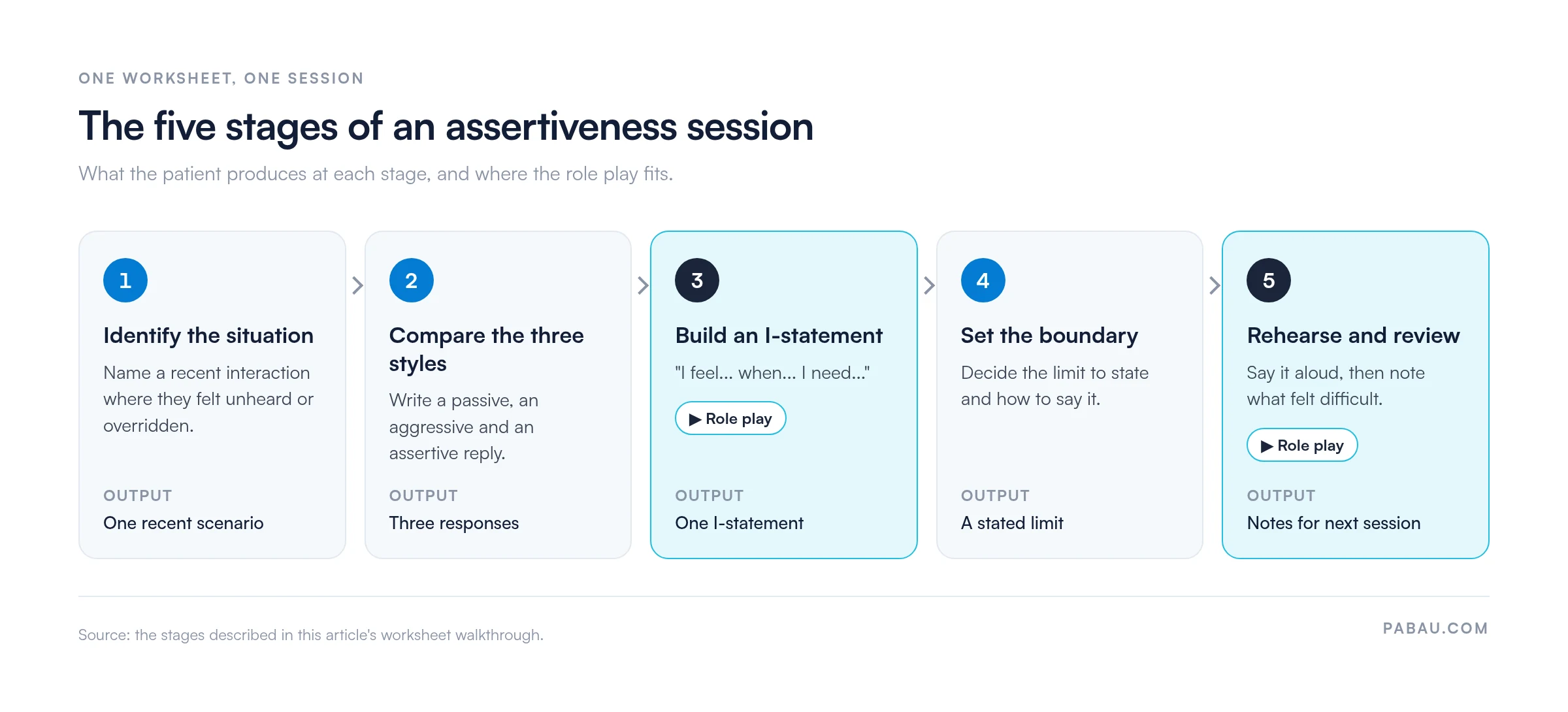
The worksheet works best when the clinician walks through it in five stages, pausing for the patient to reflect at each one.
Clinicians often run stages three and five as a role play, swapping roles so the patient hears the phrasing from the other side. The flow below shows what the patient walks away with at each stage.
Passive communication avoids conflict by giving up one’s own needs. Aggressive communication pushes needs forward at the expense of others. Assertive communication states needs directly and leaves room for the other person’s view. Patients who find that view hard to picture can practice it first on a worksheet for perspective taking.
Passive-aggressive communication, where hostility is expressed indirectly, is often added as a fourth style. Patients frequently recognize it in themselves once the other three are named. If a patient needs more time on the styles themselves, a communication styles worksheet makes a good first step.
Most assertiveness worksheets focus on four components, and each one can be practiced separately before combining them.
Ask the patient to rate each component from one to five before the session ends. Scores that rise across three or four weeks show progress more clearly than a general sense of confidence.
The worksheet introduces several named techniques. Clinicians can choose the ones that match the patient’s presenting problem.
DESC and DEAR MAN suit patients who need a fixed script. Broken record and fogging suit patients who are pressured into agreeing on the spot. Patients already in dialectical behavior therapy can pair DEAR MAN with a DBT therapy worksheet.
The examples section converts everyday statements into assertive versions. Patients compare the original line with the rewrite and say which one they could use at work.
Role-play prompts can use these same situations. The clinician plays the other person, pushes back once, and the patient holds the assertive line.
The worksheet suits a range of patients and settings. Clinicians adapt the language and examples to fit each group.
Teenagers who struggle to say no to friends may get more from a peer pressure worksheet first. For couples, a couple communication worksheet gives both partners the same exercises to work through.
The PDF is a printable version of the worksheet, ready to use in a session or to send home as homework. It includes space for each stage, a style comparison grid and a boundary-setting section.
Clinicians can adapt the examples to suit their patient group. Keep the completed copy in the patient file once the session notes are done.
Many therapists still hand out a printed worksheet at the end of a session and hope it comes back. Completed pages then sit in a paper folder or a scanned PDF, away from the session notes.
Pabau, the platform we build for therapy practice management, lets you send the worksheet as one of your digital forms before a session. The patient completes it at home, and the response lands in their patient record.
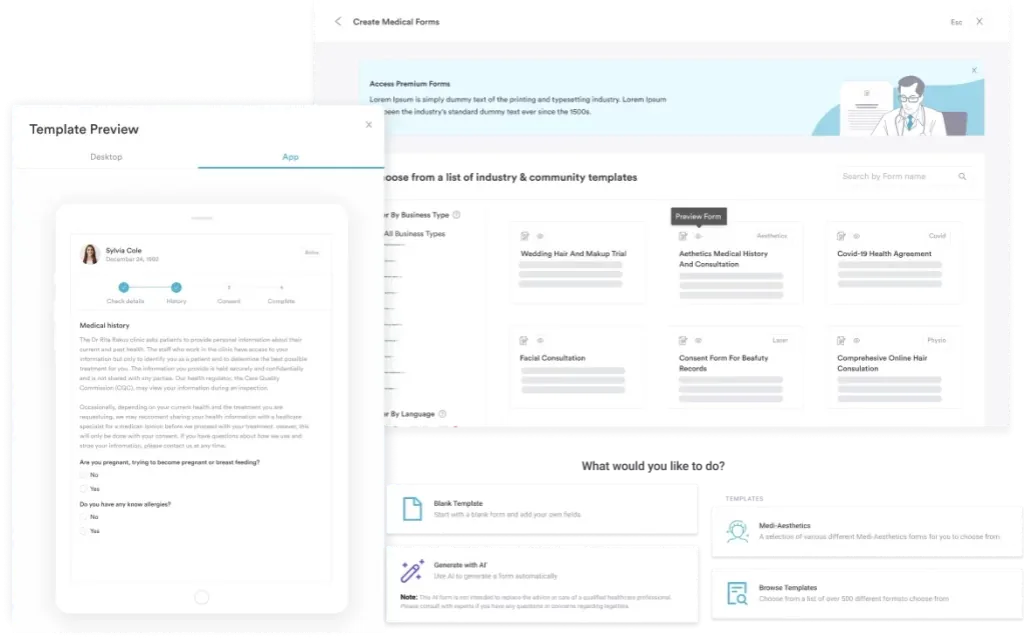
Because completed worksheets sit with the patient file rather than in a downloads folder, progress is easier to review across sessions. Client records keep that history in one place for the whole team.
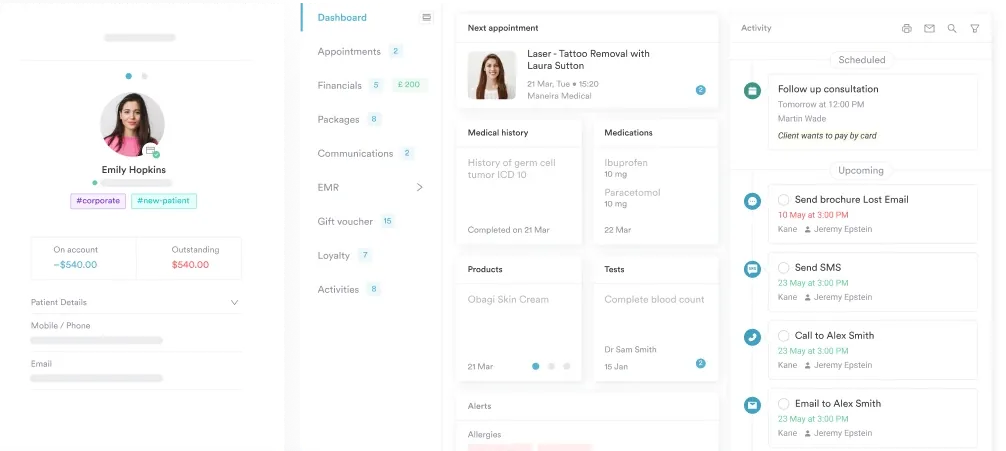
The result is fewer lost worksheets and a clearer view of how each patient’s assertiveness is changing from week to week.

Pabau’s digital forms send the worksheet to patients before their appointment. Completed responses land in the patient record, ready to review in session.

Assertiveness is built through repetition, so the worksheet earns its value over several sessions rather than one. Start with a single recent situation the patient brings in, and rehearse it until the I-statement comes out unprompted.
Track the component ratings week to week. When scores stall, switch technique rather than repeating the same script. A patient who keeps getting talked out of a position may do better with broken record than with DESC.
Book a demo to see how Pabau sends therapy worksheets as digital forms and keeps every response in the patient record.

Want a gentler framework for needs and feelings? Non-violent communication worksheet walks patients through observations, feelings, needs and requests.
Is conflict the main trigger? Conflict resolution worksheet gives patients a structure for working through disagreements.
Does your patient always say yes? People-pleasing worksheet helps patients spot the habit before practicing assertive replies.
Struggling to ask for support? Asking for help worksheet breaks down how to make a clear, direct request.
Working on limits as well as words? Emotional boundaries worksheet helps patients name the limits they want to state.
Assertive communication is a direct, respectful way of stating your needs, opinions and boundaries while considering the other person’s view. It sits between passive and aggressive styles.
Yes. The worksheet on this page is available as a free PDF download for clinicians and practice teams.
DESC scripting and I-statements suit most adults, while broken record suits patients who are pressured to agree. Choose based on the presenting problem.
Assertive communication focuses on stating your own needs clearly. Nonviolent communication, developed by Marshall Rosenberg, focuses on expressing needs and feelings while staying connected to empathy for others.