Despina Petrushevska

Support system worksheet: Free PDF and session guide
Download your free support system worksheet A ready-to-use assessment form for m...

1
Last Updated: Nov 9, 2026
Free PDF 1 page, print-ready Clinician-reviewed
A perspective taking worksheet is a session form that helps children, adolescents and adults practice seeing a situation from another person's point of view. Perspective taking is the cognitive side of empathy, the skill of working out what someone else thinks, feels or knows. This one-page clinical form gives therapists, school counselors and other clinicians headed space for the session objective, an empathy exercise, communication strategies and reflective analysis. It can be printed or completed digitally. This guide covers what each section is for, how to run a session with it, and scenarios to work through.
A one-page clinical form with headed sections for the session objective, patient profile, identifying concerns, an empathy exercise and communication strategies. It closes with space for collaborative care, reflective analysis, customization and notes.
Start from scratch, or upload this PDF or any form you already use, and Pabau's AI Form rebuilds it with tick boxes, text fields and a signature. Attach it to the treatment once, and every patient gets it on time.
AI Form rebuilds the consent, history and aftercare forms you already use. You review each one, then publish.
Patients complete forms on their phone before they arrive, so the front desk stops retyping paper.
Every signed form is versioned and attached to the treatment record, ready when you need it.
Set how long a consent stays valid. Returning patients skip forms they have already signed.
Supports HIPAA and GDPR compliance AES-256 encryption 4.8 on G2 4.7 on Capterra Trusted by 4,000+ practices worldwide

A perspective taking worksheet gives a session a written record of the patient’s work on seeing a situation from another person’s viewpoint.
Perspective taking is the cognitive side of empathy, separate from the emotional response to another person’s experience.
This free form has nine headed sections, from the session objective to reflective analysis, with blank space under each one.
Run the perspective work in the Empathy exercise section, using one concrete scenario at a time.
Practice software such as Pabau can send the worksheet before a session and file completed answers on the patient record.
A perspective taking worksheet is a session form for practicing one social skill: working out what another person thinks, feels or knows. This version is a one-page clinical form. It gives the clinician headed space to set a goal, record the perspective work, and review it afterward.
Perspective taking is a component of theory of mind, the broader ability to attribute mental states to others. It is the cognitive side of empathy, separate from the emotional response to another person’s experience. The worksheet targets that cognitive step first, because a patient who can’t yet describe another viewpoint is unlikely to respond to it with understanding.
To gauge a patient’s starting point before you begin, pair the form with an empathy test. Clinicians use the format within cognitive behavioral therapy (CBT) and social-emotional learning (SEL), where structured reflection is a standard way to build social skills.
The PDF is a single page with nine headed sections and blank space under each one. It doesn’t prescribe a script, so you decide what goes in each section. Here are the headings, with a practical use for each.
The form gives you the headings, not the steps. The approach below is one way to run a session, built around the Empathy exercise and Reflective analysis sections. The nine sections fall into three stages: setup before the session, perspective work during it, and review afterward.
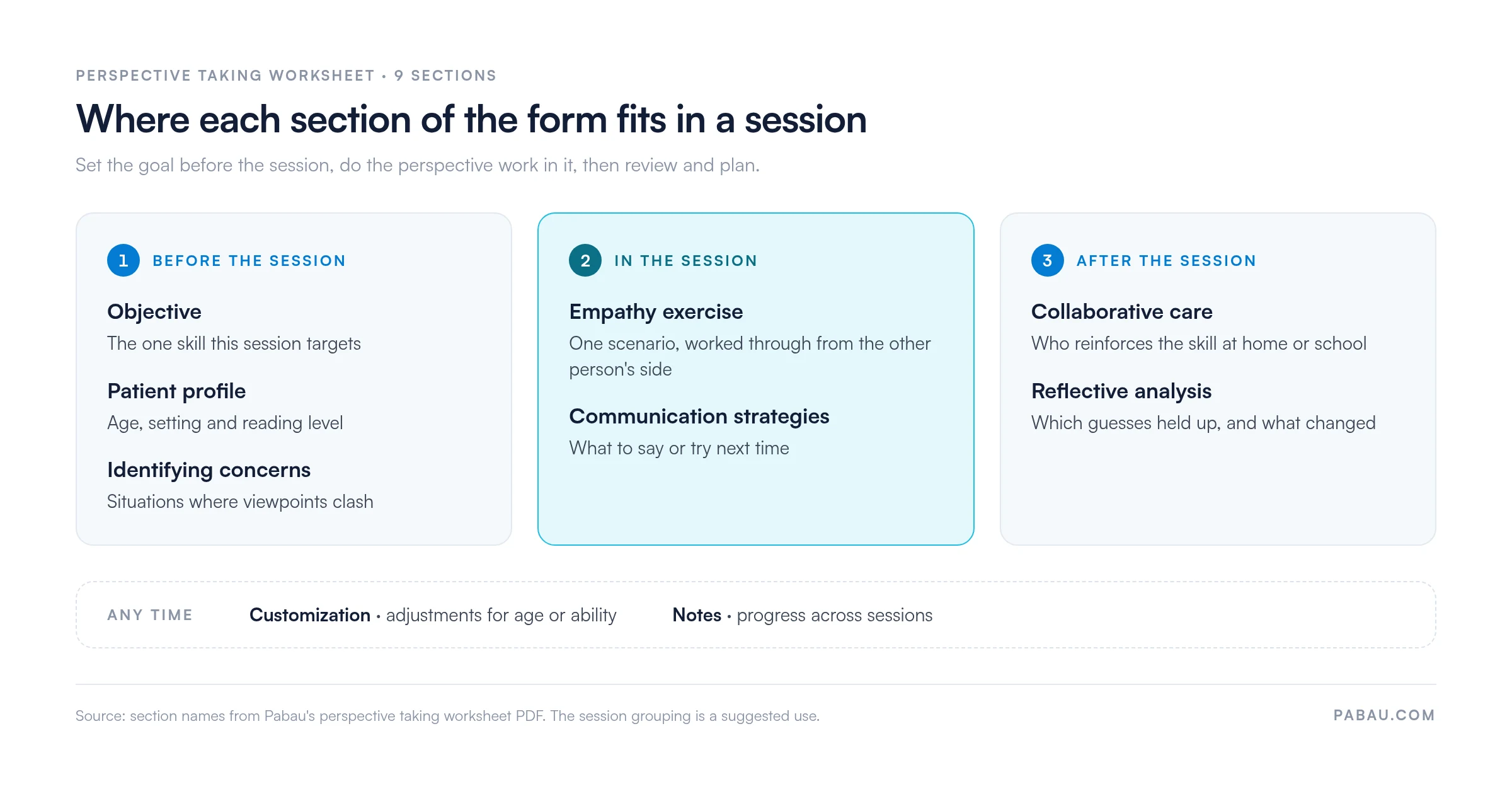
Keep completed forms in the patient’s file, so you can compare progress across sessions.
Scenarios give the Empathy exercise something concrete to work on. They work best when they are close to the patient’s own experience. Avoid one so charged that the session turns into a debrief of a live conflict. When the scenario is an ongoing dispute rather than a single moment, a conflict resolution worksheet may suit the session better.
The worksheet suits any practice that works on social cognition. Its open sections adapt to the age and ability of the person completing it.
Clinicians working with autistic patients often adapt the scenarios and cut down the open-ended questions. Adults use the format in therapy too, with the wording matched to their reading level and goals. Schools can run it alongside other social emotional learning activities in small groups.
A worksheet is one tool among several. Pairing it with short activities helps patients rehearse the skill away from the form.
Listening is the other half of the skill. A reflective listening worksheet trains patients to check what the other person meant before they respond.
Practitioners who run group work should cover group therapy informed consent first, so participants understand how recorded reflections are used.
Paper worksheets tend to end up in a folder, away from the session notes they belong to. That makes it hard to set one session’s reflective analysis beside the next.
Pabau, the therapy practice management software we build, turns a form like this into a digital one. Its digital forms send the worksheet before a session and keep the completed answers on the patient record.
Patients fill it in on their own device, and you review it alongside your notes. Over several sessions, the record shows whether the patient’s guesses about other people are getting more accurate.
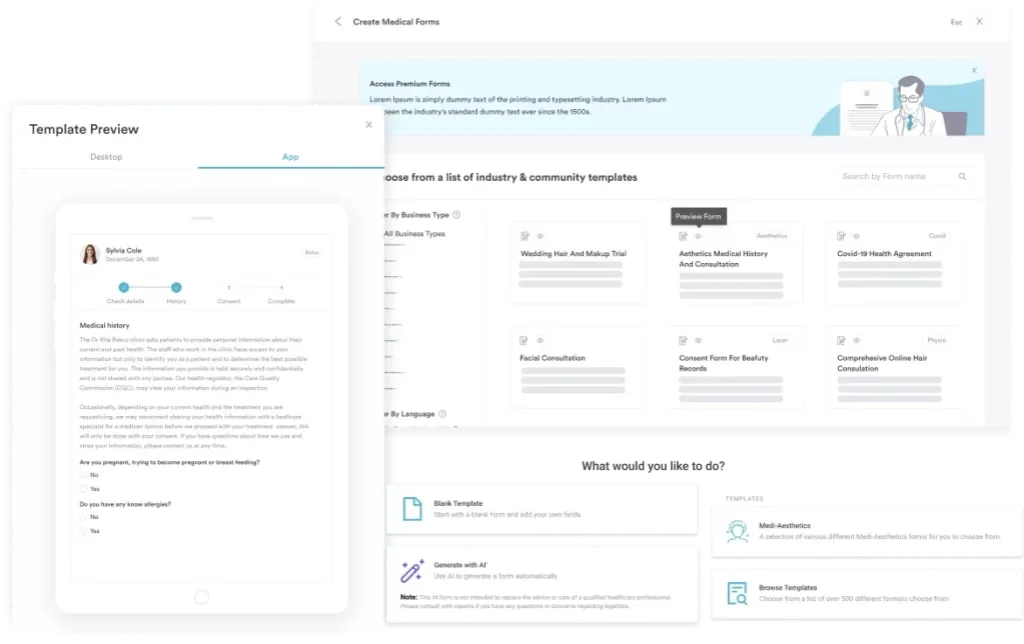

Pabau’s digital forms send perspective taking worksheets before a session and store completed answers on the patient record. You can compare reflective analysis across sessions without a paper folder.

The form is deliberately open, so the session’s value depends on the scenario you choose. Start with one specific, low-stakes interaction, and keep the patient’s guesses about the other person apart from what they know.
Then review those guesses in Reflective analysis at the next session. That review is where the skill builds, because the patient sees which assumptions held up and which didn’t.
Book a demo to see how Pabau sends worksheets before a session and keeps each answer on the patient record.

Working on wider social skills? Interpersonal effectiveness skills worksheet helps patients ask for what they need while keeping the relationship intact.
Want a scored measure of empathy? Toronto Empathy Questionnaire explains the scoring and gives you a free template to use at intake.
Practicing back-and-forth talk? Conversation skills worksheet breaks a conversation into turns patients can rehearse in session.
Need a listening drill to pair with this form? Active listening skills worksheet gives patients prompts for showing they heard the other person.
Running a group or classroom session? Empathy bingo turns perspective prompts into a game for children and teens.
A perspective taking worksheet is a session form for practicing how to see a situation from another person’s viewpoint. This version is a one-page clinical form with nine sections, including an empathy exercise and reflective analysis. It is used in therapy and SEL settings.
The download is a one-page PDF form rather than a set of scenarios. The scenarios in this guide can be written into its Empathy exercise section, one per session.
Yes, adults use the format in therapy and coaching. Adjust the wording and scenario complexity to match the patient’s goals and reading level.
No, the worksheet supports clinical work but does not replace assessment or formal therapy. It is a session tool used within a broader treatment plan.