Mental health self-care checklist
A mental health self-care checklist is a structured daily tool for tracking the ...

6
Last Updated: Oct 20, 2026
A peer pressure worksheet is a structured tool that helps a counselor, therapist, or teacher show a young person how friends shape their choices. This free PDF covers influence types, six practice scenarios, and six refusal techniques the student rehearses out loud.
Susceptibility to peer influence follows a curve across the teenage years. It climbs through early adolescence and peaks around age 14. From there the ability to resist rises steadily through age 18. That curve is why the worksheet lands hardest with middle schoolers and younger high schoolers.
The worksheet works in a school counseling office, a therapy room, or a classroom. It gives you a frame for the topic that avoids moralizing, and it treats the social stakes a teenager faces as genuine.
Download it below at no cost. The PDF prints for a class, saves to a client record, or goes home with a parent. There is no registration and no subscription.

A peer pressure worksheet walks a young person through identifying peer influence and rehearsing refusal skills.
Susceptibility to peer influence peaks around age 14, then declines as the ability to resist grows through age 18.
The worksheet separates positive influence from negative influence, then drills six refusal techniques against six everyday scenarios.
A 45-minute session plan splits the worksheet into six timed stages, with scenario practice taking the largest slice.
Pabau’s digital forms and client records let therapists track peer pressure themes across sessions and set follow-up reminders.
A ready-to-use form covering influence identification, positive versus negative pressure, six practice scenarios, and refusal skills training. It includes reflection prompts and a clinician notes section for responses and risk factors.
Download templateNot all peer influence is harmful. One of the worksheet’s first jobs is helping a young person tell encouragement apart from coercion. Positive pressure pushes toward sports, study, or standing up for someone. Negative pressure pushes toward substance use, risky sexual behavior, or freezing another student out.
Students often read a refusal as a threat to the friendship. Naming it as boundary-setting instead gives them permission to say no and stay in the group. The worksheet uses that framing to build age-appropriate assertiveness.
The worksheet contains several sections, and you can spread them over one session or two:
The worksheet stays short on purpose, so a 45-minute session still leaves room for discussion. Teachers can run it as a class activity, and counselors can use it one-to-one or in a small group. Therapists tracking peer pressure themes across appointments can attach it as one of their digital intake forms.
The worksheet leans on scenarios because a teenager will argue with an abstract rule and recognize a specific Friday night. Six situations are covered:
Students work through each one with you. They name the tactic, name what they felt, then say the refusal out loud. Rehearsing the words in a calm room makes them easier to reach for in a loud one.
The six techniques below come from refusal skills training that the CDC and the National Institute on Drug Abuse both back. Each one gives the student a specific line to use, not a slogan:
The worksheet pairs each technique with the scenarios above, so the student practices in a low-stakes room. If a student needs more work on the wording, our handout on assertive communication techniques breaks down tone, posture, and phrasing.
The plan below fits a standard 45-minute period. Adjust the timings for a shorter class or a longer therapy hour.
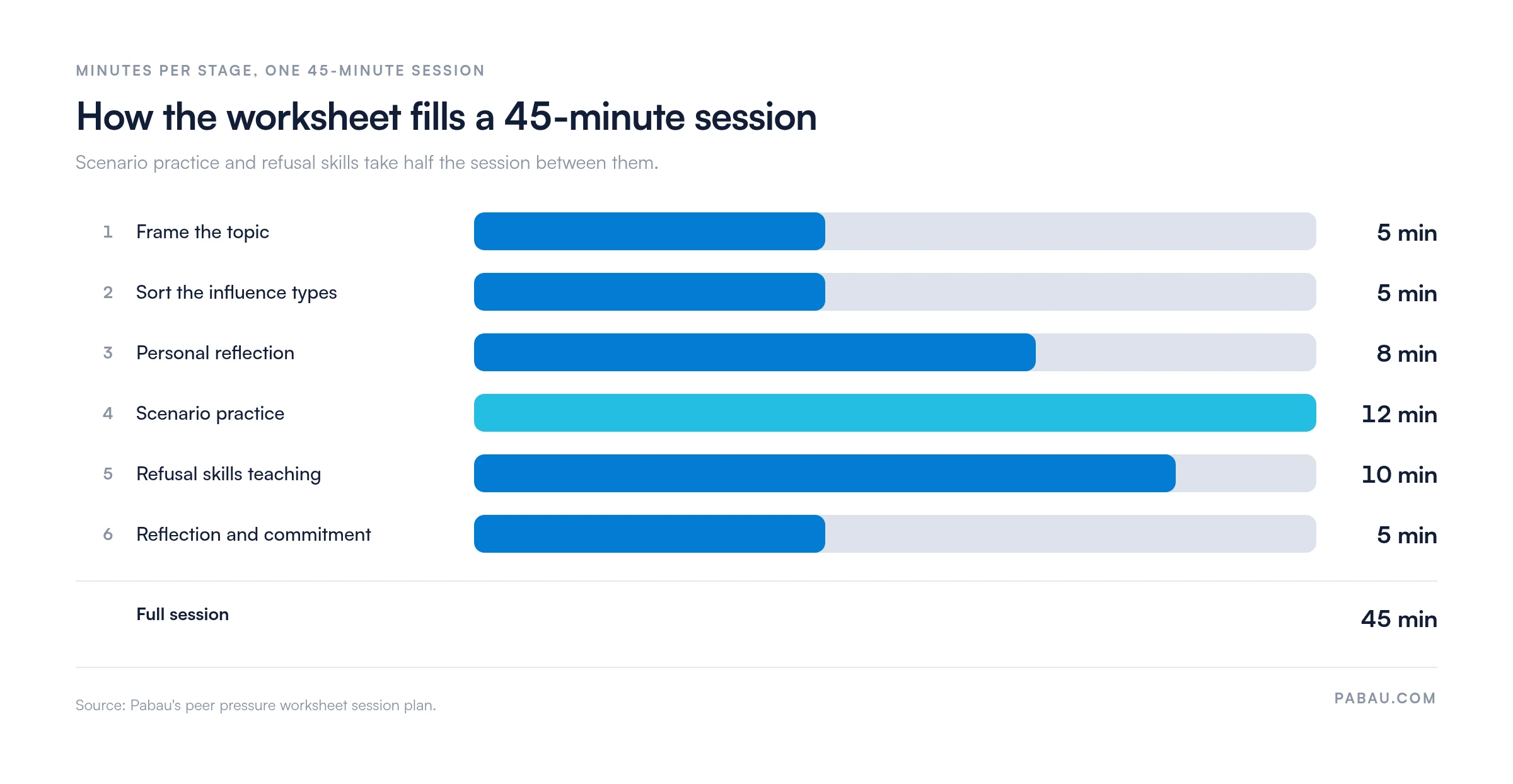
Students open up more when the worksheet feels like a conversation. Treat the timings as a guide and stretch whichever stage the student needs. A student who wants to talk through one scenario for 20 minutes is doing the work.
These prompts deepen the learning once the worksheet is done. Discuss them aloud, journal them, or send them home as homework.
The answers do double duty. They help the student carry the worksheet into next week, and they tell you where the support has to go next. Watch for thin social support, high anxiety about peer conflict, or risky behavior that has already started.
Practitioners who use therapeutic worksheets like this one run into the same logistical problems. Responses end up in a paper folder, client data sits in two places, and follow-up depends on somebody remembering. Practice management software like Pabau closes all three.
Pabau attaches the peer pressure worksheet to a client’s appointment or clinical note as a digital form. The client completes it online beforehand, or on a tablet in your office. Their answers drop straight into the client records, ready to quote in your session notes.
Pabau’s automated workflows can also schedule the follow-up you meant to send. A message a week later asking how the refusal conversation went keeps the toolkit in the client’s head between appointments.
A school counselor or therapist carrying a full caseload feels this most. Practice management for therapists means fewer spreadsheets and more time with the student in front of you.

Pabau’s digital forms and client records keep every peer pressure worksheet with the client it belongs to. Automated follow-ups then chase the next conversation for you.

Peer pressure is developmentally normal. A teenager will meet it whether or not anyone prepared them, so the useful work is rehearsal, done before the moment arrives.
That is the trade-off worth remembering. A single 45-minute session will not change behavior on its own. What changes behavior is the student having said the words out loud once already, with an adult who took the pressure seriously.
Print the worksheet, run it once this month, and note in the client record which technique the student picked. If you want those notes and the follow-up handled in one place, book a demo to see how Pabau supports work with adolescents.

Taking on a new teenage client? Adolescent intake questionnaire gathers the developmental and social history that gives the peer pressure work context.
Is low self-worth driving the pressure? Self-esteem worksheet for teens measures where a student’s confidence sits before you work on refusal.
Need to teach boundaries more broadly? Healthy boundaries worksheet covers the same skill across family, friendships, and online life.
Worried about immediate risk? Safety plan for teenagers template gives you a structured plan to complete with a student who is not safe.
Looking for what comes after refusal skills? Coping skills worksheet builds the wider toolkit a student uses when the pressure has already landed.
It fits adolescents ages 11 to 18, or grades 6 through 12. The strongest fit is ages 13 to 16, when susceptibility to peer influence is at its highest. Children aged 8 to 10 need a simplified version focused on friendship and a basic no. Older teens may need scenarios set in college, work, or a romantic relationship.
It works in both. Teachers can run it inside a health class or a social-emotional learning unit. School counselors use it in small groups or one-to-one. Therapists fold it into individual sessions when peer issues come up. The wording and the scenarios adapt to any of those rooms.
Yes. The Collaborative for Academic, Social, and Emotional Learning has compiled evidence that social-emotional learning programs reduce risky behavior and improve social competence. The CDC and the National Institute on Drug Abuse both treat structured refusal skills training as an evidence-based prevention strategy. A worksheet on its own does not change behavior, though. Guided practice inside a trusting relationship is what does the work.
Once a year as a baseline is common. Move to every six months if peer pressure is an active clinical concern. In a classroom or camp setting, once or twice a year is standard. Some therapists keep it on hand and reach for it whenever peer issues surface in conversation.
It is free to download from Pabau. Print as many copies as your classroom, practice, or caseload needs. There is no subscription and no licensing fee.