Mental health self-care checklist
A mental health self-care checklist is a structured daily tool for tracking the ...

5
Last Updated: Oct 20, 2026

The Altman Self-Rating Mania Scale (ASRM) is a validated 5-item screening tool for assessing manic and hypomanic symptoms in bipolar disorder.
A score of 6 or higher indicates probable mania; the scale is designated as the DSM-5 Level 2 Mania measure for adults.
The ASRM takes 2-3 minutes to complete and covers mood, confidence, sleep, speech, and activity level over one week.
Pabau’s digital forms and mental health practice management software enable clinicians to administer and track ASRM scores within secure clinical records.
Get the printable PDF of the validated 5-item ASRM. It scores mood, self-confidence, sleep, talkativeness, and activity over the past week to screen for and monitor mania and hypomania.
Download PDFThe Altman Self-Rating Mania Scale (ASRM) is one of the fastest ways to screen for manic and hypomanic symptoms in routine practice. This guide reproduces the full five-item scale, explains how the 0–20 score is interpreted, reviews the evidence behind it, and shows how to fold it into psychiatric assessment workflows. You can download a ready-to-use copy above.
The Altman Self-Rating Mania Scale (ASRM) is a 5-item self-administered questionnaire designed to assess the presence and severity of manic and hypomanic symptoms. Developed in 1997 by Dr. Edward Altman and colleagues, the ASRM provides clinicians and researchers with a quick, validated screening tool for detecting mood elevation in patients with bipolar disorder, schizoaffective disorder, and other conditions characterized by manic episodes.
The scale asks patients to rate five dimensions of mania — elevated mood, increased self-confidence, reduced need for sleep, increased talkativeness, and increased activity level — over a one-week period. Each item is scored 0-4, for a total possible score of 20. The ASRM is now officially designated as the DSM-5 Level 2 Cross-Cutting Measure for Mania in Adults by the American Psychiatric Association, which supports its use in standardized clinical assessment.
Unlike the clinician-administered Young Mania Rating Scale (YMRS), the ASRM is self-rated, making it ideal for routine screening, repeated symptom monitoring.
The ASRM is in the public domain as part of the American Psychiatric Association’s DSM-5 cross-cutting measures, so you can reproduce and use it freely. Patients read each group of statements and choose the one that best describes how they have felt over the past week. Score each item from 0 to 4, then add the five items for a total of 0–20.
A note on wording: “occasionally” means once or twice, “often” means several times or more, and “frequently” means most of the time.
Add the five item scores for a total of 0–20. A total of 6 or higher indicates a high probability of a manic or hypomanic condition and warrants further clinical assessment. Permission for use granted by E.G. Altman, MD.
Administering the ASRM takes five steps that fit into routine practice workflows:
Integration into secure clinical records allows clinicians to track ASRM trends over months and years, supporting long-term bipolar disorder management.
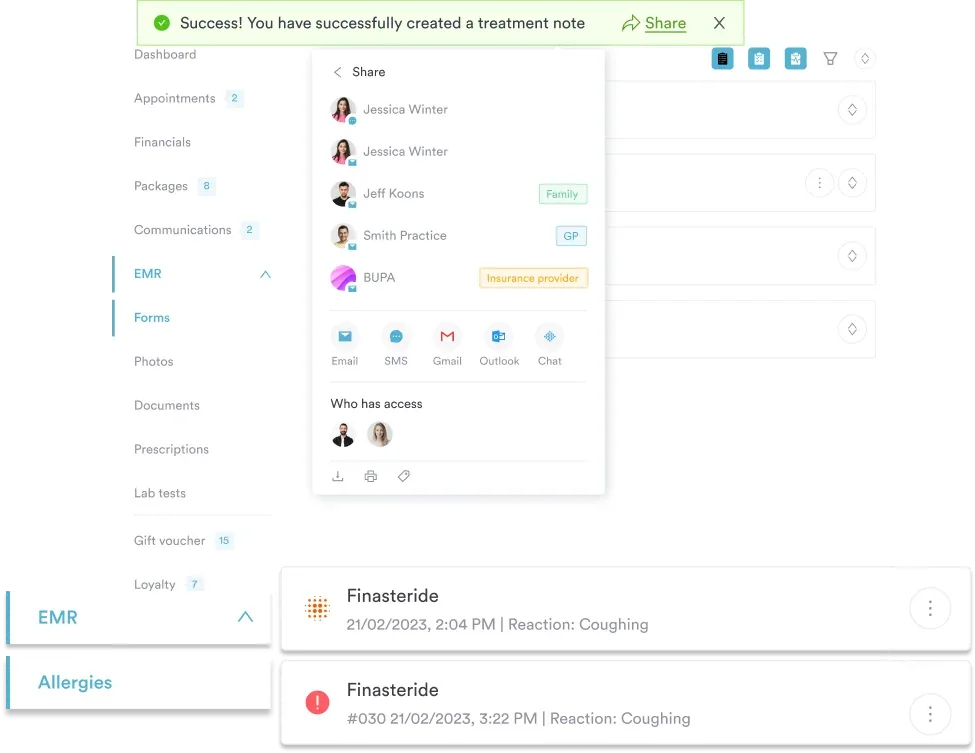
With a tool that tracks clinical measurements, baseline and follow-up scores sit side by side in the patient record.
Each of the five items is rated on a 0-4 scale, for a total score between 0 and 20. The table below shows how to read each score band and what to do next.
| ASRM score range | Clinical interpretation | Recommended action |
|---|---|---|
| 0-5 | Euthymic or non-manic state. No significant manic symptoms detected. | Continue current treatment. Routine follow-up as scheduled. |
| 6-9 | Probable manic or hypomanic symptoms. Mild to moderate mood elevation present. | Clinical interview to assess full manic syndrome. Consider medication adjustment or increased monitoring. |
| 10-15 | Moderate to significant manic symptoms. Marked mood elevation, reduced sleep, increased goal-directed activity. | Urgent clinical evaluation. Psychiatric medication review recommended. Consider inpatient assessment if safety is a concern. |
| 16-20 | Severe manic symptoms. Likely acute manic episode with marked impairment. | Immediate psychiatric evaluation and safety assessment. Medication escalation or inpatient treatment may be necessary. |
The threshold of 6 or higher has demonstrated good sensitivity and specificity for detecting probable mania in research and clinical populations. However, the ASRM is a screening tool, not a diagnostic instrument — a high score requires clinical confirmation through structured diagnostic interviews and assessment of functional impairment.
The Altman Self-Rating Mania Scale is applicable across multiple clinical settings and patient populations:
An adapted version for adolescents (ages 11-17) is also available via the APA DSM-5 portal.
Integrating the ASRM into routine psychiatric and psychological care delivers multiple clinical and operational benefits:
The Altman Self-Rating Mania Scale has been rigorously tested in peer-reviewed research. The original validation study (Altman et al., 1997) evaluated the ASRM in a sample of 105 patients (22 schizophrenic, 13 schizoaffective, 36 depressed, and 34 manic). The scale demonstrated strong internal consistency (Cronbach’s alpha 0.79) and excellent concurrent validity against the Clinician-Administered Rating Scale for Mania (CARS-M, r = 0.77) and the Mania Rating Scale (MRS, r = 0.72).
Subsequent international studies, including Greek (2021) and Persian (2025) validations, have confirmed the ASRM’s reliability and applicability across diverse populations and healthcare systems. In the original validation, a cutoff score of 6 or higher produced a sensitivity of 85.5% and a specificity of 87.3% for detecting manic or hypomanic episodes.
A 14-item extended version (ASRM-14) has also been developed for research contexts requiring more detailed symptom assessment, though the 5-item version remains the standard for routine clinical use.
While the ASRM is a valuable screening tool, clinicians should understand its constraints:
Best practice integrates the ASRM with clinical documentation best practices, including structured diagnostic interviews and contextual clinical notes supporting interpretation.
Consider a typical outpatient psychiatry scenario: A 34-year-old patient with bipolar II disorder presents for monthly medication monitoring. At check-in, the front desk staff provide a digital ASRM questionnaire via the practice’s secure patient portal. The patient completes it in the waiting room (2 minutes). The score (7) appears in the clinician’s notes before the appointment, prompting a focused assessment of recent mood fluctuations.
The clinician reviews the score during the visit, asks targeted follow-up questions about sleep and goal-directed activity, and adjusts lamotrigine dosing based on the combination of ASRM score, clinical interview, and patient-reported functional status. The result is documented in the clinical record, creating a longitudinal dashboard that tracks mood stability over 12 months of treatment.
This workflow runs smoothly when mental health teams use patient care management systems that support standardized assessment.
Several clinician- and self-rated mania scales exist. The ASRM differs from alternatives in important ways:
| Scale | Type | Items | Administration time | Best use |
|---|---|---|---|---|
| Altman Self-Rating Mania Scale (ASRM) | Self-rated | 5 | 2-3 minutes | Routine screening and monitoring in outpatient settings; DSM-5 standard measure. |
| Young Mania Rating Scale (YMRS) | Clinician-rated | 11 | 15-20 minutes | Detailed mania severity assessment; gold standard for research and acute inpatient evaluation. |
| Clinician-Administered Rating Scale for Mania (CARS-M) | Clinician-rated | 15 | 20-30 minutes | Comprehensive assessment of manic symptoms with behavioral observation; used in specialized research. |
| Mania Rating Scale (MRS) | Clinician-rated | 8 | 10-15 minutes | Brief clinician assessment; research and acute psychiatric settings. |
The ASRM’s brevity and self-administration make it ideal for repeated screening in busy outpatient practices. The YMRS, by contrast, requires trained clinician administration but provides more granular behavioral detail useful in inpatient or research settings. For comprehensive mental health assessment, many clinicians use both: the ASRM for rapid tracking and the YMRS when acute mania requires detailed evaluation.
The Altman Self-Rating Mania Scale sits within several regulatory frameworks important for clinical use:
The Altman Self-Rating Mania Scale gives you a fast, validated way to screen and monitor manic symptoms in bipolar disorder and related conditions. It fits into routine assessment whether you run a small mental health practice, a larger psychiatry group, or an integrated primary care setting.
Administering it digitally and tracking scores over time cuts the admin burden and keeps your data consistent. Your patients get objective measurement at every visit, and your team gets faster, error-free data capture. For clinician wellbeing alongside patient care.
To see how Pabau lets you send the ASRM digitally, score it automatically, and track results in the patient record, book a demo with our team.
A score of 6 or higher indicates probable manic or hypomanic symptoms warranting clinical assessment. However, the ASRM is a screening tool, not diagnostic. A clinician must conduct a full psychiatric interview, assess symptom duration (≥7 days for mania), and confirm functional impairment before diagnosing a manic episode.
The standard adult ASRM is used with patients aged 18 and older. The American Psychiatric Association also publishes an adapted DSM-5 version for children and adolescents aged 11 to 17, completed by the young person before the visit. Use the version that matches the patient’s age, and refer to the age-appropriate scoring guidance when interpreting results.
Frequency depends on clinical context. For acute mood monitoring, weekly or biweekly administration is typical. For stable outpatients, monthly or quarterly screening may be sufficient. Clinicians should tailor frequency based on symptom stability and treatment changes.
The term ‘self-rating’ refers to the fact that the patient rates their own symptoms, not that clinicians cannot administer it. Clinicians can present the ASRM during appointments, answer clarification questions, and review results with the patient — the key is that symptom severity is reported by the patient themselves, not observed by a clinician.
The ASRM is in the public domain via the American Psychiatric Association’s DSM-5 cross-cutting measures. Clinicians may print, digitize, and use it in practice without licensing fees. However, researchers using the scale in publications should cite the original Altman et al. (1997) paper.
In severe manic episodes, patients often lack insight (anosognosia), potentially underreporting symptoms on the ASRM. Clinician observation, collateral history from family members, and behavioral assessment become crucial during acute presentations. The ASRM works best in euthymic or mild-to-moderate mood states.