Despina Petrushevska
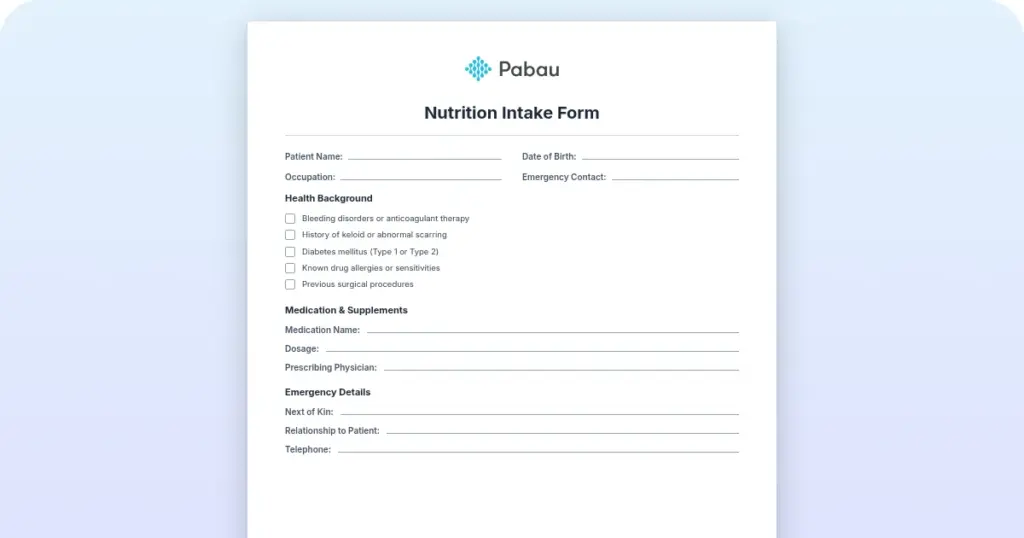
Nutrition intake form
A nutrition intake form is a structured questionnaire that records a patientR...

4
Last Updated: Oct 22, 2026
Free PDF 5 pages, print-ready Clinician-reviewed
Download your free allergy and immunology consultation notes template Allergy & Immunology Consultation Notes A ready-to-use consultation template covering patient history, allergy testing results, physical examination findings, diagnostic impressions, and detailed treatment and follow-up plans for allergic and immunological conditions. Download template An allergy and immunology consultation captures more moving parts than a standard visit: […]
A ready-to-use consultation template covering patient history, allergy testing results, physical examination findings, diagnostic impressions, and detailed treatment and follow-up plans for allergic and immunological conditions.
Upload this PDF, or any form you already use, and Pabau's AI Form rebuilds it with tick boxes, text fields and a signature. Attach it to the treatment once, and every patient gets it on time.
AI Form rebuilds the consent, history and aftercare forms you already use. You review each one, then publish.
Patients complete forms on their phone before they arrive, so the front desk stops retyping paper.
Every signed form is versioned and attached to the treatment record, ready when you need it.
Set how long a consent stays valid. Returning patients skip forms they have already signed.
Supports HIPAA and GDPR compliance AES-256 encryption 4.8 on G2 4.7 on Capterra Trusted by 4,000+ practices worldwide

Structured documentation captures allergy history, testing, diagnosis, and treatment plans in a standardized format that improves clinical clarity.
HIPAA-compliant templates protect patient data while ensuring every consultation meets regulatory documentation standards.
Digital forms reduce administrative burden and enable allergists to focus on patient care instead of manual note entry.
Pabau’s digital forms feature streamlines allergy consultation documentation while maintaining clinical accuracy and compliance.
An allergy and immunology consultation captures more moving parts than a standard visit: each allergen tested, the exact skin-test reaction, immunotherapy dosing, and anaphylaxis risk all have to be recorded in one place. An allergy and immunology consultation notes template gives you a fixed structure for all of it, so nothing is left out between the appointment and the claim.
This guide walks through how to use the template step by step, what to document that a general medicine note leaves out, and how the coding lines up (including the consultation-code rule that trips up allergy billing with Medicare). A template built into practice management software like Pabau keeps every consultation consistent and audit-ready, whether one allergist or a whole team is charting.
An allergy and immunology consultation notes template provides healthcare professionals with a structured framework for documenting patient assessments during allergy and immunology consultations. It ensures thorough recording of patient history, symptoms, examination findings, diagnostic test results, and treatment plans for allergic and immunological conditions.
The template works as both a HIPAA-compliant documentation system and a clinical communication tool. It standardizes how allergists capture the chief complaint, relevant medical history, and findings from allergy testing (skin prick, intradermal, serum-specific IgE). It also records physical examination results, diagnostic impressions, and the treatment plan, whether that is immunotherapy, medication management, or environmental modification.
For busy allergy practices, a well-designed template reduces missed documentation and improves continuity of care when patients see multiple providers. It also supports billing and coding accuracy for specialist consultations. The American Academy of Allergy, Asthma & Immunology (AAAAI) notes that comprehensive consultation documentation is essential for proper patient management and referral clarity.
Using the template follows a clinical workflow that mirrors the standard evaluation process:
The general examination in step three follows a head-to-toe sequence, the same organ-system order used in a routine physical exam. Allergy-specific findings are recorded on top of that baseline.
Following this structure means nothing critical goes undocumented.
A structured consultation template is useful across several practitioner groups:
Standardizing allergy and immunology consultations delivers several operational and clinical benefits:
Compliance and regulatory safety: A structured template reduces the risk of findings during clinical audits. It supports HIPAA-compliant data protection, proper documentation of testing procedures, informed consent for immunotherapy, and accuracy in billing code assignment.
Workflow efficiency: The template prompts clinicians to complete each section in turn. That cuts incomplete notes and the time spent chasing missing information during billing or referral follow-up. Teams can pair it with a HIPAA compliance checklist to keep documentation standards consistent.
Clinical clarity and continuity: When a patient returns for follow-up or sees a different allergist at a multi-location practice, the standardized format makes it immediately clear what testing was done, what results came back, and what treatment was recommended. This reduces duplicate testing and improves continuity of care.
Billing and coding accuracy: A consultation note that documents history, examination, medical decision-making, and testing results supports proper assignment of evaluation and management (E/M) codes and specialty consultation codes. Better documentation often leads to improved claim approval rates and fewer denials.
Knowing why patients are referred to allergy specialists helps frame the note’s clinical scope. A tertiary-care study of inpatient allergy and immunology consultations, published in Annals of Allergy, Asthma & Immunology, found the following breakdown of referral reasons:
Take a patient with a suspected penicillin allergy. The note needs the original reaction documented in detail, including rash, anaphylaxis, and timing relative to drug exposure. This matters because penicillin allergy delabeling is increasingly common, and the record has to hold enough detail to support either confirming or removing the allergy label.
A patient referred for recurrent anaphylaxis or food allergies needs clear documentation of trigger identification, testing results, and instructions on epinephrine auto-injector use and environmental avoidance.
Suspected immunodeficiency accounts for 13% of those referrals, and the workup can extend to genetic testing. Record which panel was ordered and what it was looking for, so the next clinician knows what is already underway.
Most modern EHR and practice management platforms support customizable note templates. To put your consultation template to work:
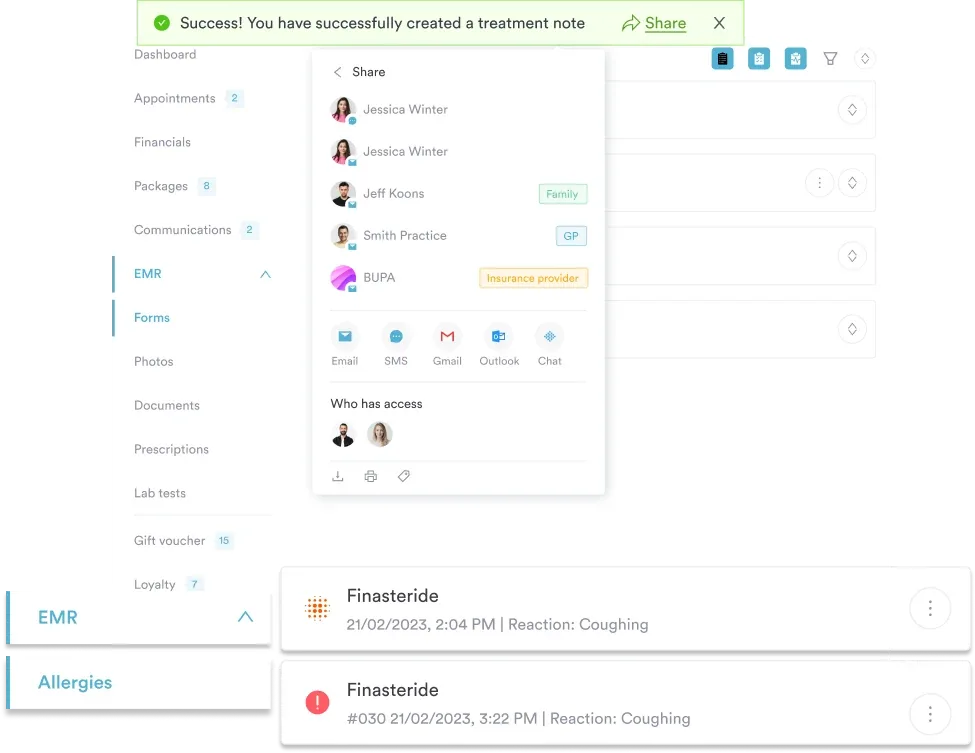
For practices using detailed clinical record management, customizable consultation templates are a core feature that improves both clinical quality and day-to-day efficiency.
Allergy and immunology consultation notes have to meet several regulatory and professional standards. A good template supports each one:
Patient safety and informed consent: The note must confirm that the patient understands their diagnosis, testing procedures, and treatment options, especially when you recommend immunotherapy (subcutaneous or sublingual) or prescribe medications that carry allergy-related risks.
Billing and coding requirements: CMS and private payers require specialist consultations to demonstrate medical complexity, detailed assessment, and clinical decision-making. A note that documents history, examination findings, testing interpretation, and a detailed plan supports appropriate billing and reduces denial risk.
One billing detail catches out allergy practices: Medicare stopped recognizing the office consultation codes (99242–99245) in 2010 and will not reimburse them. For Medicare patients you bill standard evaluation and management codes instead, 99202–99205 for new patients or 99211–99215 for established ones, chosen by medical decision-making or time. Some commercial payers still accept the consultation codes, so confirm each payer’s policy and make sure the note documents the complexity that supports the level you bill.
Continuity and care coordination: When a patient needs follow-up or a second opinion, the original note has to be clear enough for another clinician to understand the initial assessment and plan. This matters most for referrals between primary care and specialty allergy services.
The AAAAI and the American College of Allergy, Asthma & Immunology (ACAAI) publish consultation and referral guidelines that outline the scope of specialist assessment and what should be documented. For practices running multiple practitioners and locations.
Allergy and immunology consultations call for documentation elements you rarely see in a general medicine note. Three stand out:
Allergen-specific testing detail: Rather than a single laboratory panel result, allergy notes document each allergen tested, the test modality (skin prick, intradermal, or serum), the measured reaction (wheal size for skin tests, IU/mL for serum-specific IgE), and the clinical correlation. That level of detail is what confirms diagnoses and tracks sensitization trends over time.
Immunotherapy planning: Consultations that lead to allergen immunotherapy (SCIT, SLIT, or venom immunotherapy) need documented informed-consent discussions and baseline allergen panel results. The plan itself must include initial dosing, build-up schedules, and maintenance protocols, which is essential for safe administration and billing.
Risk stratification for anaphylaxis: Patients with food allergies, drug allergies, or a history of anaphylaxis need specific documentation of reaction severity, triggers, emergency prescriptions (epinephrine auto-injectors), and patient education. This goes well beyond a standard visit note and is central to patient safety.
Allergy and immunology consultation notes are the foundation of safe, efficient specialist care. A well-designed template standardizes documentation, reduces missed information, supports regulatory compliance, and improves continuity across providers. For allergists and immunologists, that means higher-quality care with less administrative load.
Ready to tighten your practice’s allergy consultation workflow? Book a demo to see how Pabau’s customizable consultation templates and digital forms fit into your existing clinical workflow and improve both outcomes and team efficiency.
A structured documentation framework that guides allergists in recording patient history, allergy testing results, physical examination findings, diagnosis, and treatment plans in a standardized format.
Include the chief complaint, history of present illness, relevant past medical and allergy history, family history, allergy testing performed (type, allergens, results), physical examination findings, assessment with diagnoses, and a detailed treatment and follow-up plan.
For skin testing, document the allergen name, wheal and flare measurements, and reaction grade. For serum-specific IgE tests, document the allergen name and IU/mL values. Always include clinical correlation, noting which test results match the patient’s reported symptoms and which do not.
The SOAP format (Subjective, Objective, Assessment, Plan) is widely used. Subjective covers the patient’s complaint and history, objective includes examination and testing findings, assessment documents diagnoses, and plan outlines treatment and follow-up. Templates often add allergy-specific sections for testing detail and immunotherapy planning.
Refer patients when first-line treatment fails to control allergic conditions such as allergic rhinitis or asthma, when food or drug allergies need specialist evaluation, or when immunotherapy is being considered. Recurrent anaphylaxis, suspected immunodeficiency, and complex reactions also warrant referral.
A template is a tool; how your team uses it determines compliance. Make sure the EHR storing the notes applies proper encryption, access controls, audit logging, and data retention policies. Pabau’s digital forms and clinical documentation tools support HIPAA-compliant workflows.