Piercing consent form
A piercing consent form is a signed record that a client understood a piercing&#...

4
Last Updated: Oct 2, 2026

An ADHD planner is a structured daily and weekly organizational tool designed to support executive function deficits common in ADHD, including time blindness, task initiation difficulty, and working memory overload.
ADHD planners with minimal visual clutter, clear priority frameworks, and built-in medication tracking help patients reduce cognitive load and improve consistency in managing treatment goals.
Time-blocking and ‘brain dump’ sections allow patients to externalize thoughts, manage transitions, and break large tasks into achievable steps, all core strategies recommended in ADHD clinical practice.
Pabau’s digital forms feature lets clinicians deliver ADHD planners directly within the patient portal, track completion, and integrate planner data into clinical notes for coordinated care.
A comprehensive daily and weekly planning tool with task initiation prompts, medication tracking, priority matrices, energy-level monitoring, and brain dump sections to help your patients manage ADHD symptoms and stay organized.
Download templateAn ADHD planner template is a structured daily and weekly organizer built around the executive function challenges that define attention deficit hyperactivity disorder (ADHD). The free template above gives clinicians a psychoeducation and self-management resource to share with patients. It externalizes the planning, prioritizing, and time-tracking that a patient’s working memory struggles to hold on its own.
An ADHD planner template is a purposefully designed organizational document that scaffolds the planning and task-management process for individuals with ADHD. Unlike generic planners, an ADHD planner is built around evidence-based design principles:
ADHD affects around 2.5% of adults worldwide. It is characterized by persistent difficulties with executive function, the cognitive processes that govern planning, working memory, impulse control, and time perception.
Individuals with ADHD often experience time blindness (difficulty perceiving how time passes), working memory deficits, and task initiation paralysis. A structured planner offsets these difficulties by providing external structure, so patients rely less on internal cognitive resources.
For healthcare clinicians, sharing an ADHD planner template with patients serves several purposes:
According to the CDC, structured routines and visual planning tools support better functional outcomes in ADHD management.
Delivering an ADHD planner effectively requires integrating it into your clinical workflow and helping patients understand its purpose. Follow these five steps to introduce and support adoption:
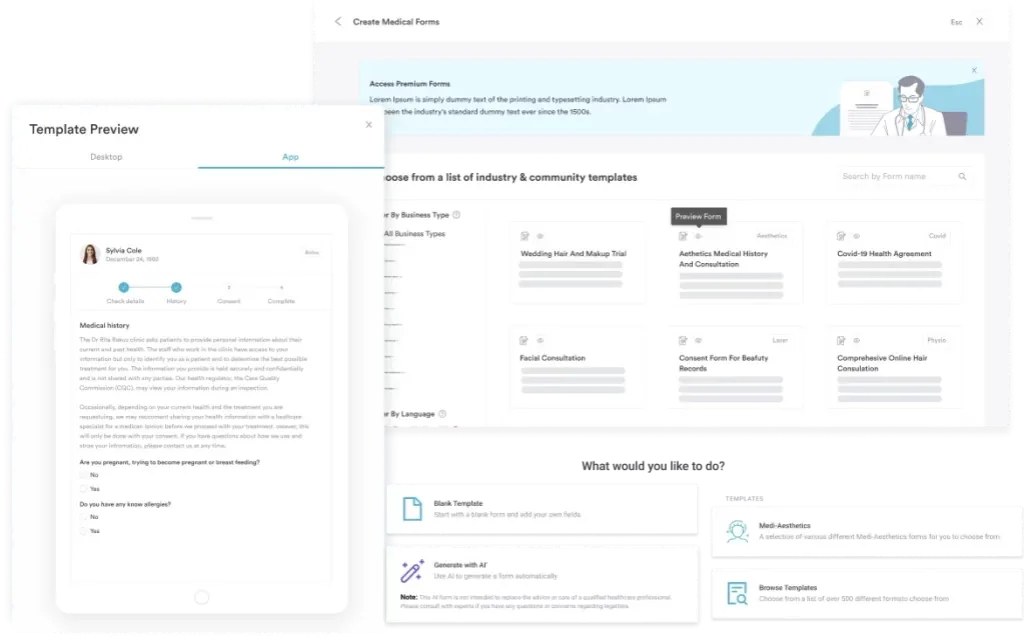
Practice management software like Pabau lets you deliver the planner as a digital form, track who has completed it, and pull the entries into the patient’s clinical record for coordinated follow-up care.
Telehealth tools make it easy to review this resource with clients face to face online.

Digital forms, patient portals, and automated reminders help clinicians deliver evidence-based ADHD management tools and track patient engagement in one integrated system.

The ADHD planner template supports a range of practitioner settings and patient populations:
Most requests are for an ADHD planner for adults, though the template adapts to teens in the same way.
The template works best for adolescents and adults with ADHD who are seeking structured support, while children need developmentally adapted versions. It suits patients who are newly diagnosed as well as those going through treatment adjustment or a period of functional decline.
Customize the planner template to match your patient population. If most patients are working professionals, add a ‘weekly review’ section for goal reflection. If managing crisis moments is a priority, include an ’emergency coping strategies’ reference card at the top of the daily page.
Effective ADHD planners share common design and content features. Visual simplicity is paramount. Busy, multicolored pages with overlapping sections overwhelm rather than support ADHD brains, while clean typography, ample white space, and a consistent heading hierarchy reduce cognitive friction.
Beyond a clean layout, a few features do the heavy lifting:
A brain-dump section gives patients unstructured space to capture every thought before filtering, which addresses the ADHD tendency to feel flooded by intrusive thoughts. Once those thoughts are captured externally, the mind can relax and focus on organized prioritization.
Most planners in this space are either paper products or standalone apps, so patients weigh the same trade-off the ADHD community debates constantly: a printable ADHD planner they can write on by hand, or a digital ADHD planner that lives on a phone or laptop. For self-directed patients, a printable PDF is often enough. They pin the daily page somewhere visible and fill it in without another app to open.
The clinical picture looks different. When you hand a patient a printable planner, its use vanishes between appointments, and you only learn whether they stuck with it by asking. A digital ADHD planner delivered through your practice changes that. Completion is visible, entries sync to the patient record, and the daily and weekly pages become data you can review before the next session instead of a self-report you take on trust.
This is where an ADHD daily planner or weekly planner earns its place in the treatment plan rather than the stationery drawer. Deliver the template as a digital form and you can see which patients completed their brain dump, whether medication reminders were ticked, and where consistency slipped, so you can adjust the plan at the next visit.
Executive function is the cognitive system that governs planning, working memory, impulse inhibition, and task flexibility, and it is substantially impaired in ADHD. A structured planner acts as external scaffolding for it, taking over several roles a patient’s brain struggles with.
The planner captures what needs doing (working memory support), shows when it is due (time management), flags priority (decision-making support), and prompts action (task initiation). With repeated use, these scaffolds can strengthen internal planning capacity, though most patients keep the planner in place.
Clinical guidance points toward multimodal treatment: medication combined with behavioral and organizational strategies rather than medication on its own. A planner sits on the behavioral side of that plan, working alongside therapy and coaching rather than replacing them. Pairing it with a structured measure like the Vanderbilt ADHD Rating Scale gives you a consistent way to track whether function is improving over time.
An ADHD planner is a practical, evidence-informed tool for supporting executive function, reducing overwhelm, and helping patients achieve consistency in self-management. By sharing this template with your patients, you normalize the use of external structures as a treatment strategy and provide immediate, practical support for the planning and time-management deficits that define ADHD.
The template works best when integrated into your clinical workflow: presented as part of psychoeducation, reviewed regularly in sessions. Book a demo to see how Pabau’s digital forms and patient portal can deliver and track ADHD planners within your practice’s workflow.

Want to assess ADHD severity systematically? How to score the Vanderbilt ADHD Rating Scale provides step-by-step scoring and interpretation for one of the most widely used ADHD assessment tools.
Need concrete ADHD intervention strategies for sessions? ADHD therapy activities to enhance focus and control pairs planning tools with in-session exercises that build executive function skills.
Need help reading nonverbal patient cues? facial expression chart helps practitioners document facial expressions, emotion patterns, and behavioral cues as sessions unfold.
An ADHD planner is a structured organizational tool designed to support executive function deficits by externalizing tasks, priorities, and time awareness. It combines task capture (“brain dump”), priority ranking, time-blocking, and medication tracking into one simple system.
Present it as external memory support, not as evidence of failure. Walk through the brain-dump section first, then demonstrate priority ranking using one or two real examples from the patient’s life. Review planner use at follow-up visits and adjust design as needed.
Yes. The planner includes a medication-reminder section that creates a behavior cue and documents adherence. Using the planner alongside medication is standard practice and improves outcomes when compared to medication alone.
The template works best for adolescents and adults with ADHD. Children require developmentally adapted versions with simpler language, larger spaces, and more visual supports.
Daily updates are ideal; weekly reviews at minimum. Consistency strengthens executive function capacity over time. Start with whatever frequency feels sustainable and increase gradually.
An effective option for grown-ups pairs a brain-dump space, priority ranking, and time blocks with a medication-tracking row and an energy or focus check-in. Adults juggling work and home also benefit from a weekly review prompt to reset priorities.
You can download the PDF at the top of this page at no cost. It is print-ready for patients who prefer paper, and clinicians can also deliver it digitally through a patient portal to track completion.