An ADHD visual test is a standardized screening tool measuring visual attention and processing speed that may indicate ADHD symptoms.
Continuous Performance Tests (CPT) like T.O.V.A. and Conners CPT are equally sensitive (85%) at demonstrating attention dysfunction in diagnosed children.
A standard eye chart test (Snellen) does not detect visual processing problems like convergence insufficiency that can mimic ADHD.
Pabau’s digital forms and automated documentation streamline ADHD assessment workflows and secure patient evaluation data.
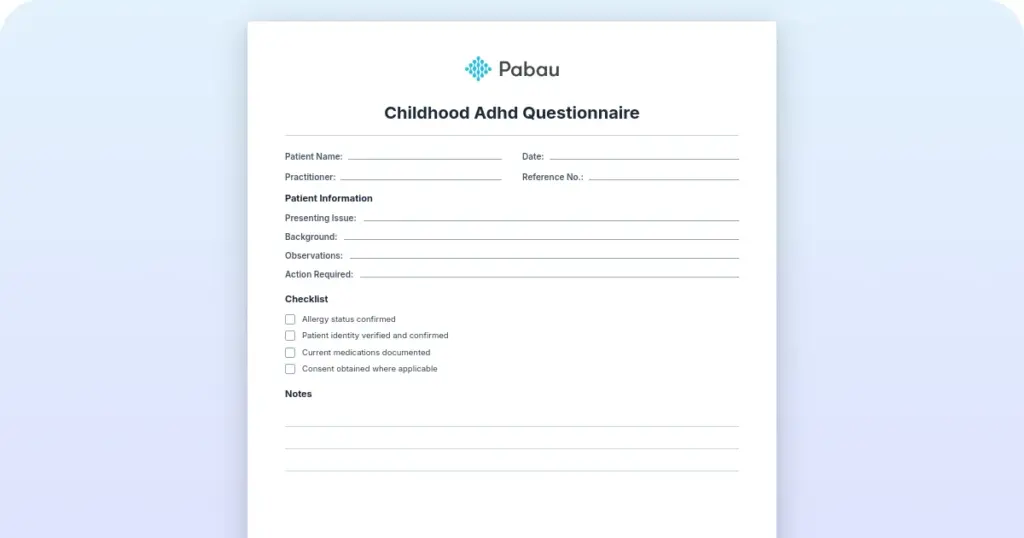
Download your free ADHD visual test template
A ready-to-use assessment tool covering visual attention screening, processing speed evaluation, sustained focus tasks, and clinical observation checklists for ADHD diagnosis support.
An ADHD visual test is a structured clinical assessment that evaluates visual attention, processing speed, and sustained focus—core cognitive functions often impaired in patients with Attention Deficit Hyperactivity Disorder. Unlike a standard eye chart test, an ADHD visual test measures your ability to maintain attention during repetitive tasks, respond to specific stimuli, and filter distractions. This guide covers how clinicians use visual screening tools to support ADHD diagnosis and when to refer patients for comprehensive neuropsychological evaluation.
Found our content helpful?
What is an ADHD visual test?
An ADHD visual test is a standardized assessment designed to measure attention and impulse control through structured visual exercises. The test presents stimuli on a screen and records your response time, accuracy, and consistency—indicators of sustained attention and executive function.
Unlike a typical vision or eye exam (Snellen chart), an ADHD visual test does not measure clarity or color perception. Instead, it evaluates the neural systems governing focus, attention switching, and impulse inhibition.
Measures sustained attention: Ability to maintain focus over extended periods
Evaluates response inhibition: Capacity to resist impulses and follow instructions
Assesses processing speed: How quickly you respond to visual cues
Detects variability: Consistency of responses, which correlates with ADHD severity
Important: an ADHD visual test alone cannot diagnose ADHD. According to the CDC, diagnosis requires a physical exam (including vision and hearing tests to rule out other conditions), clinical interview, and rating scales completed by multiple observers (teachers, parents, or family members).
How to use an ADHD visual test
Administering an ADHD visual test in a clinical setting follows a structured protocol. Here are five key steps clinicians follow when delivering this assessment:
Pre-test screening: Confirm the patient has corrected vision (20/20 if needed) and adequate hearing. Rule out vision problems, hearing loss, or neurological conditions unrelated to ADHD that could affect performance. Use your digital forms to collect pre-screening health history and medication use.
Explain the task: Describe that the patient will see visual stimuli (shapes, letters, or colors) appear on a screen. Instruct them to respond by clicking, pressing a button, or tapping when they see a target stimulus. Emphasize speed and accuracy equally.
Administer the test: Run the assessment using validated software like T.O.V.A., Conners CPT, or QbTest. The test typically lasts 15-20 minutes. Record response times, errors, and omissions automatically captured by the platform.
Observe behavior: Note signs of distraction, fidgeting, restlessness, or impulsive responses. Document whether the patient struggled to maintain attention or showed inconsistent performance across the test phases (usually an easier first half, harder second half).
Document findings:Mental health EMR systems allow you to store assessment results, scores, and clinical observations securely in the patient record. Link findings to the clinical interview notes and rating scales to form a complete diagnostic picture.
Test scores provide objective data: sensitivity and specificity for T.O.V.A. and Conners CPT are equally strong (85% sensitive) at demonstrating attention dysfunction in children diagnosed with ADHD. However, correlation between test scores and real-world symptoms is moderate at best. Always integrate test findings with parent/teacher feedback, medical history, and clinical observation.
Who is an ADHD visual test helpful for?
An ADHD visual test is most helpful for specific clinical populations and diagnostic scenarios.
Pediatric patients: Children aged 6-17 with suspected inattention or hyperactivity, especially those struggling in school or showing inconsistent task completion.
Adult diagnostic workup: Adults presenting with focus difficulties, time management challenges, or family history of ADHD. The Adult ADHD Self-Report Scale (ASRS-v1.1) is the most widely validated adult screening tool, often paired with continuous performance testing.
Differential diagnosis: Patients where vision problems, learning disabilities, anxiety, or sleep disorders might mimic ADHD symptoms. Visual testing helps rule out attention deficits as the primary cause.
Treatment monitoring: Clinicians can readminister visual tests to track whether medication or behavioral interventions improve sustained attention and impulse control over time.
Academic or occupational evaluation: Schools and employers sometimes request objective ADHD assessment data to support accommodation requests or treatment planning.
Therapists, psychologists, and medical doctors (MDs, NPs, PAs with appropriate credentials) can administer and interpret these tools depending on their state’s scope of practice and training.
Benefits of using an ADHD visual test
An ADHD visual test provides several clinical and operational advantages when integrated into your assessment protocol.
Objective measurement: Removes subjective bias from attention evaluation. Quantified data strengthens diagnostic confidence and supports treatment decisions.
Early identification: Detects attention deficits before they cascade into academic failure, social withdrawal, or untreated comorbid anxiety or depression.
Treatment planning: Baseline scores establish a benchmark for monitoring medication efficacy or behavior modification outcomes.
Insurance and legal documentation: Standardized test scores and clinical reports satisfy insurance requirements and support accommodation requests in schools or workplaces.
Reduced misdiagnosis: Visual testing combined with patient care documentation helps distinguish ADHD from other conditions (anxiety, depression, learning disorders, vision or hearing loss) that present similarly.
Many clinicians pair continuous performance testing with computerized ADHD questionnaires (like the Conners Rating Scale or Vanderbilt ADHD Diagnostic Rating Scale) to create a multi-modal diagnostic profile.
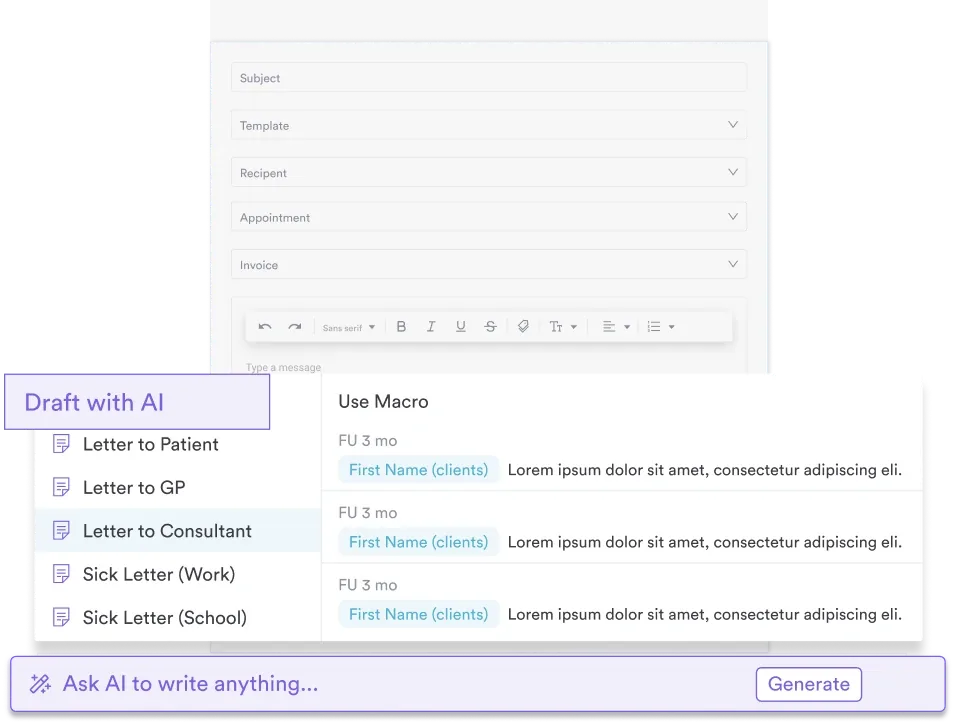
AI powered patient letters
Visual processing problems vs. ADHD: key differences
A critical clinical distinction: problems with visual processing (convergence insufficiency, eye tracking dysfunction, visual field defects) can mimic ADHD symptoms but require completely different treatment approaches.
Convergence insufficiency: The eyes struggle to focus together at near distances. This causes difficulties with reading, sustained close-up work, and eye fatigue—often misattributed to “not focusing” or “not trying hard enough.” People with ADHD are 3-5 times more likely to have convergence insufficiency concurrently. A standard 20/20 Snellen eye chart test will NOT detect this problem; specialised vision assessments by an optometrist or developmental optometrist are required.
Eye tracking dysfunction: Difficulty following moving targets smoothly. Results in skipping words while reading, losing place, or appearing distracted. Optometric vision therapy can treat this; ADHD medication alone will not.
Visual field defects: Loss of peripheral vision or blind spots. Causes safety issues and difficulty attending to surrounding activity. Requires referral to neuro-ophthalmology or optometry.
Always include a vision screening (and optometric evaluation if indicated) in your ADHD diagnostic workup. Vision development professionals can assess whether visual dysfunction is present alongside or instead of ADHD.
ADHD visual screening tools and checklists
Several validated instruments guide ADHD visual assessment in clinical practice.
Continuous Performance Tests (CPT):T.O.V.A. and Conners CPT are the most widely used computerized tests. Both measure reaction time, accuracy, and impulse control. T.O.V.A. is referenced in over 300 peer-reviewed papers; Conners CPT is equally sensitive (85%) in demonstrating attention dysfunction in ADHD-diagnosed children.
QbTest: A newer objective ADHD assessment combining continuous performance testing with eye tracking and motion analysis. Provides quantified data on inattention, hyperactivity, and impulsivity in a single session.
Adult ADHD Self-Report Scale (ASRS-v1.1): A screening questionnaire for adults, not a visual test, but often paired with continuous performance testing for comprehensive diagnostic workup. Asks 18 questions about inattention, hyperactivity, and impulsivity.
Conners Rating Scale: Teacher and parent rating forms that quantify ADHD behaviors across settings. Integrates observer input with objective test data.
The National Institute of Mental Health (NIMH) recommends a multi-method approach: clinical interviews, behavior rating scales from multiple observers, and objective cognitive testing (like a continuous performance test). No single test diagnoses ADHD; rather, converging evidence from multiple sources informs a confident diagnosis.
Documenting ADHD visual test findings in your patient record
Secure, organized documentation of ADHD assessment findings is essential for continuity of care, insurance submissions, and legal protection.
Record test name and date: Name the specific test administered (e.g. “T.O.V.A. administered 2026-06-15”), software version if applicable, and test duration.
Document raw scores: Include reaction time (milliseconds), accuracy percentage, omission errors, commission errors, and standard scores relative to age-matched norms.
Note clinical observations: Describe patient behavior during testing: level of engagement, signs of distraction, fidgeting, impulsivity, or fatigue. Did they appear motivated? Did they ask for clarification?
Interpret findings: Explain what the scores mean for this patient’s attention and impulse control. Are findings consistent with suspected ADHD? Are there other explanations (fatigue, anxiety, medication effects)?
Link to other data: Cross-reference rating scales (ASRS, Conners), teacher/parent feedback, and clinical interview observations. Explain how the visual test findings integrate with the broader diagnostic picture.
Many clinicians use patient engagement strategies (like sharing results summaries with patients and families) to promote understanding and treatment compliance after testing.
When to refer for neuropsychological or specialist evaluation
Visual testing provides screening data, but some cases require deeper specialist assessment.
Inconclusive results: If visual test scores fall in the borderline range or conflict with clinical observation, refer to a neuropsychologist for comprehensive cognitive testing (including IQ, working memory, processing speed, and executive function domains).
Complex comorbidity: If the patient has concurrent learning disorders, autism spectrum disorder, anxiety, mood disorders, or substance use history, a psychologist or neuropsychologist can disentangle which symptoms stem from which condition.
Treatment resistance: If ADHD-targeted interventions (stimulant or non-stimulant medication, behavior therapy) are not producing expected improvements, specialist evaluation may reveal alternative or additional diagnoses.
Vision concerns: If you suspect convergence insufficiency, eye tracking problems, or other optometric issues, refer to a developmental optometrist or neuro-optometrist for visual function assessment and vision therapy recommendations.
Neuropsychologists and ADHD specialists hold advanced credentials (PhD or PsyD in clinical psychology, board certification by ABCN or similar) and administer comprehensive test batteries lasting 4-8 hours. Their reports carry legal and clinical weight in educational and occupational accommodation settings.
Before the referral goes out, record the history, mental status findings, and risk screening in a structured diagnostic assessment. That record gives the specialist the clinical picture behind your referral.
Pabau’s digital forms and secure client records help you document visual test findings, track treatment progress, and manage multi-setting evaluations efficiently.
While useful, visual tests have real constraints clinicians must acknowledge to patients and families.
Not diagnostic alone: A positive visual test does not diagnose ADHD; it only provides objective data suggesting attention difficulties. Diagnosis requires convergence of multiple sources: clinical interview, behavior rating scales, medical workup, and observation.
Moderate predictive validity: Correlation between continuous performance test scores and real-world ADHD symptoms or teacher/parent ratings is modest at best. Some people score poorly on the test but show minimal symptoms in everyday life, and vice versa.
Practice effects: Repeated testing can lead to improved scores due to familiarity with the task, not true improvement in attention. Avoid retesting more frequently than clinically necessary.
Situational variation: A person’s test performance depends on medication status, sleep quality, anxiety level, motivation, and test-day stressors. Results reflect that moment in time, not stable trait attention.
Age limitations: Most validated visual tests are designed for children aged 6+ or adults 18+. Preschoolers and very young children require different assessment approaches.
The American Psychological Association emphasizes that ADHD diagnosis is a clinical judgment integrating test data with multi-source evidence, never a diagnosis by test score alone.
Next steps after ADHD visual testing
Once you have visual test results, the next steps depend on findings and clinical context.
Results consistent with ADHD: If visual test scores are abnormal and corroborate clinical suspicion, move toward diagnosis confirmation and treatment planning. Discuss medication options (stimulant or non-stimulant) and behavior therapy (school or workplace accommodations, time management coaching).
Results inconclusive or atypical: Refer for specialist evaluation (neuropsychologist, developmental pediatrician, psychiatrist) to rule out alternative diagnoses or identify comorbid conditions.
Vision concerns noted: Refer to an optometrist or developmental optometrist for visual function assessment. Vision therapy may resolve symptoms previously attributed to ADHD.
Positive test, no clinical symptoms: Avoid over-pathologizing. Some people show reduced sustained attention on a test but function well in real life. Discuss whether treatment is warranted or monitoring is sufficient.
Share results with the patient and relevant stakeholders (parents, teachers, employer) in plain language. Explain what the test measures, what the scores mean, and what comes next. Use a client record system to track follow-up appointments, treatment initiation, and outcome monitoring across months or years.
Conclusion
An ADHD visual test is a valuable screening tool in a comprehensive diagnostic evaluation. Continuous performance tests (T.O.V.A., Conners CPT, QbTest) provide objective, quantified data on sustained attention, impulse control, and processing speed—core cognitive functions impaired in ADHD. However, visual tests alone do not diagnose ADHD; they inform clinical judgment when combined with interviews, rating scales, medical workup, and multi-observer feedback.
Remember to screen for visual processing problems (convergence insufficiency, eye tracking dysfunction) that can mimic ADHD. Always document test results, clinical observations, and next steps securely in a patient record. When you need to refer for specialist assessment or track treatment progress over time, integrated clinical record systems keep diagnostic findings, test scores, and treatment plans organized and accessible to your entire care team. Book a demo to see how Pabau streamlines ADHD assessment workflows.
Continue your research
Need to document the full clinical picture?Psychiatric evaluation template gives psychiatrists and therapists a structured framework for conducting full mental health assessments.
Also using parent and teacher rating forms?Vanderbilt ADHD scoring guide walks through scoring, subscale interpretation, and symptom and impairment thresholds for parent and teacher forms.
Working with clients on substance use too?Harm reduction worksheets offer structured tools to assess risk, identify triggers, and support clients without an abstinence-only approach.
Frequently Asked Questions
What is a visual test for ADHD?
An ADHD visual test is a computerized assessment measuring attention, impulse control, and processing speed through structured visual tasks. Unlike an eye chart test, it evaluates the brain’s ability to sustain focus, resist distractions, and respond accurately—core deficits in ADHD.
Can an eye exam detect ADHD?
A standard eye exam (Snellen chart) checks vision clarity and does not detect ADHD. However, an eye exam may reveal vision problems (like convergence insufficiency or eye tracking dysfunction) that mimic ADHD symptoms. A specialist eye exam by a developmental optometrist can identify these visual disorders.
What tests are used to diagnose ADHD?
ADHD diagnosis uses multiple tools: clinical interviews, behavior rating scales (ASRS-v1.1, Conners Rating Scale), continuous performance tests (T.O.V.A., QbTest), medical exam, and observations from multiple settings (home, school, work). No single test diagnoses ADHD; diagnosis integrates all sources.
Is there an objective test for ADHD?
Continuous performance tests (CPTs) like T.O.V.A. and Conners CPT provide objective, quantified data on attention and impulse control. However, these tests are screening tools, not diagnostic tests. They support-but do not replace-clinical diagnosis combining interviews, rating scales, medical workup, and multi-observer feedback.
How long does an ADHD visual test take?
Most continuous performance tests (T.O.V.A., Conners CPT) take 15-20 minutes to administer. However, a complete ADHD diagnostic evaluation (including interview, rating scales, observation, and medical workup) typically spans 2-4 hours across one or multiple appointments.
Who administers ADHD visual tests?
Psychologists, neuropsychologists, pediatricians, psychiatrists, and nurse practitioners with ADHD training can administer and interpret visual tests, depending on their licensure and scope of practice. Specific state regulations vary; check your jurisdiction’s requirements.