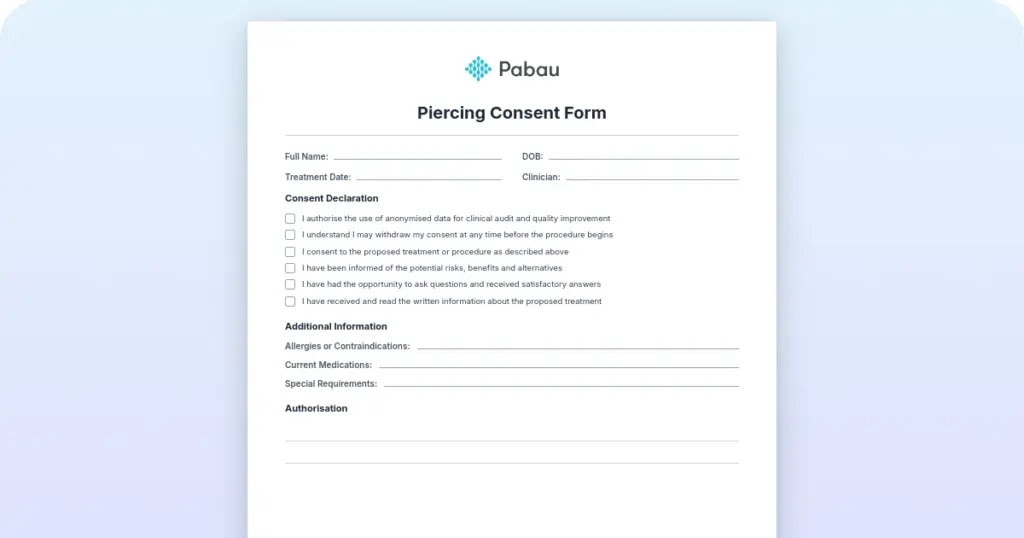
Piercing consent form
A piercing consent form is a signed record that a client understood a piercing&#...

4
Last Updated: Oct 2, 2026
ADHD therapy activities work best as short, structured exercises that train one skill at a time, matched to the patient’s age. In practice, that means CBT routines, breathing resets, attention and impulse-control games, sensory work and movement breaks, each run for about 5 to 15 minutes.
These activities support evidence-based treatment, such as parent training, behavior therapy and medication where prescribed. They don’t replace it. For school-age children, the CDC recommends medication and behavior therapy together, in line with American Academy of Pediatrics (AAP) guidance. Adult guidelines, such as NICE’s, offer medication first and add psychological support where it’s needed.
Getting the match right matters, because the wrong activity burns session time and sends families home without a useful practice task. The Activity Matrix below sorts 20 activities by age band, target skill, minutes, materials and setting.
After that, the Pick, Practice, Track loop turns one activity into a six-week plan, with a home tracker that shows whether it’s working. A short video from an ADHD therapist follows the takeaways.

The best ADHD therapy activities pair one short, structured task with the specific skill it trains, such as attention, impulse control or emotional regulation.
Keep blocks to roughly 5 to 15 minutes and repeat them often. Short, frequent practice is easier to sustain with ADHD than one long session.
Kids respond to movement games with a clear stop signal and teens need a say in their goals. Adults benefit from planning tools like the 1-3-5 rule.
The Pick, Practice, Track loop links each in-session activity to one home assignment and a 0 to 10 rating you review at the next session.
The CDC recommends parent training in behavior management as the first treatment for children under 6, so bring caregivers in early.
Filter by target skill first, then check the age band and setting. The matrix holds 20 core activities, and the sections below add a few variations, such as bubble breathing and mindful coloring. The minutes are starting lengths from practice, not research-set doses, so adjust them to each patient.
Therapy activities turn vague goals like “focus better” into small, repeatable actions a patient can practice, measure and carry home.
ADHD affects executive functions, the self-management skills behind starting, planning, pausing and handling strong feelings. Talking about those skills is a start. Patients build them through practice, feedback and repetition. That’s why therapy activities for ADHD usually target one of five domains:
Measure before you start. An ADHD self-rating scale at intake gives you a baseline. A DSM-5-aligned ADHD symptom tracker then shows whether symptoms shift between sessions.

CBT-based activities for ADHD teach patients to notice an unhelpful thought, pause, and swap it for a practical next step they can act on.
Cognitive behavioral therapy (CBT) is a structured talk therapy that links thoughts, feelings and behavior. NICE’s ADHD guideline suggests a course of CBT for young people whose symptoms still cause problems on medication. For adults, it lists CBT as one option within structured psychological support.
For ADHD, the useful part is behavior, turning insight into a routine the patient repeats. These ADHD therapy exercises work for children and adults, with simpler language for younger patients.
Trains: impulse control. Time: about 5 minutes. Ages: 5 and up.
Practice it on low-stakes choices first, like which game to play, before using it in a heated moment. A picture cue card helps younger children remember the three steps.
Trains: emotional regulation. Time: about 10 minutes. Ages: 8 and up.
Write a common thought on one side of an index card, such as “I’ll never finish this.” Ask what evidence supports it. On the back, write a balanced version the patient believes, like “I can finish one page before my break.” Patients keep the cards in a pocket or their phone notes.
Trains: task initiation. Time: 5 minutes. Ages: 10 and up.
The patient commits to five minutes on a task they’re avoiding, then sets a timer. When it rings, they can stop or keep going. Starting is often the hardest step with ADHD, and a fixed, short commitment lowers that barrier.
Trains: planning and follow-through. Time: 10 to 15 minutes. Ages: 10 and up.
Pick one goal, split it into three to five steps, and give each step a time estimate. The session ends with the first step scheduled for today. For a child, use pictures and a parent as coach. Adult CBT exercises for ADHD usually center on work tasks, procrastination and self-criticism.

Calming activities for ADHD settle the body first, using slow breathing, grounding and muscle work, so the patient is ready to focus or talk.
Use one at the start of a session, then teach it as a reset for home. Each takes under 10 minutes:
Pair each reset with a cue word the family also uses at home, such as “balloon time.” The shared word helps the skill carry over between settings. Once the body is calm, attention work has a much better chance of sticking.
Good attention-building activities for ADHD begin with a task the patient can already finish, then add a little length or difficulty each week.
Adults with ADHD can apply the same rule to focus exercises and start shorter than feels necessary. Try a 10-minute time box on one inbox task, then add 5 minutes once that goes well.
ADHD therapy games for impulse control all train one move: waiting for a signal before acting, then stopping on cue.
Debrief after each game with one question: what helped you wait? That question links the game to the classroom, the dinner table or the office.
Social skills practice gives patients with ADHD a safe place to rehearse turn-taking, listening and handling frustration before trying them with peers.
Peer difficulties are common in ADHD, as research on social functioning has documented. Group or one-to-one sessions can target the specific moments that go wrong:
ADHD occupational therapy activities use movement, touch and hand-strength tasks that may help the body settle before cognitive work.
An occupational therapist may build a sensory diet, which is a planned set of sensory activities spread through the day. Common elements include:
Evidence for sensory-based approaches in ADHD is limited, so use them as one part of a wider plan, not a standalone treatment. Where sensory needs look significant, refer to an occupational therapist rather than improvising a program.
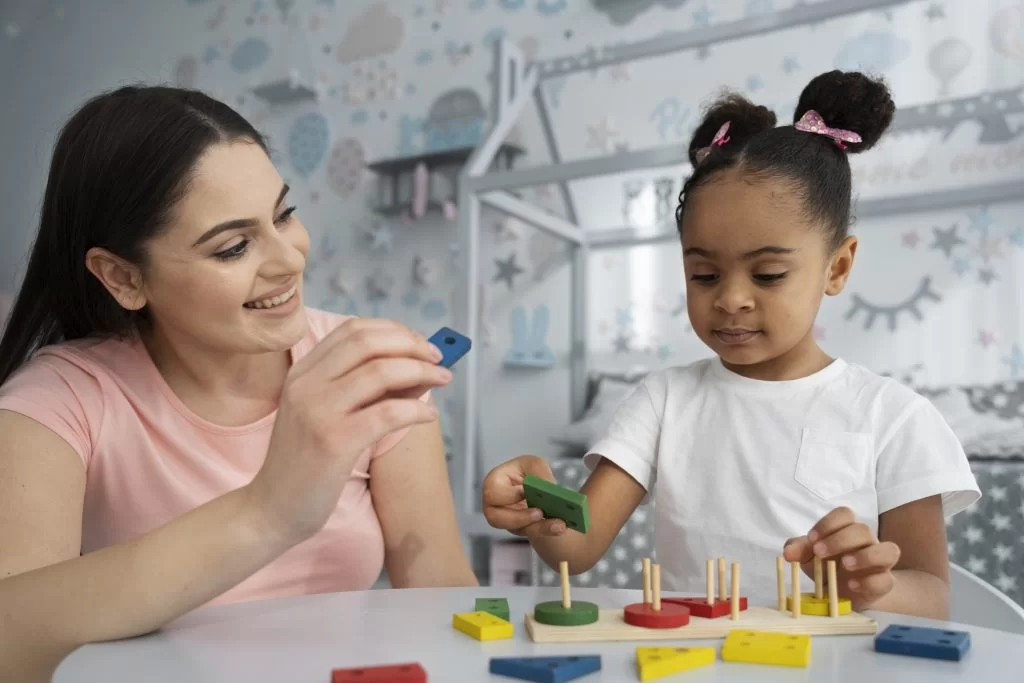
Short bouts of physical activity can modestly improve attention and executive function in some patients with ADHD, though effects vary. That’s the pattern in a 2015 meta-analysis of exercise trials in children with ADHD. Build short movement breaks into sessions and rate how focus changes afterward.
Time outdoors can work as an attention reset, and one small study found children with ADHD concentrated better after a 20-minute walk in a park.
In that 2009 study by Faber Taylor and Kuo, 17 children aged 7 to 12 each took three guided walks. They concentrated better after the park walk than after walks downtown or in a residential neighborhood. The sample was small, so treat it as a promising sign rather than proof. To give a walk structure, add small tasks:
The best ADHD therapy activities for kids are short, movement-rich games with a clear stop signal, run in blocks of about 3 to 10 minutes.
For children under 6, the CDC’s treatment guidance recommends parent training in behavior management before medication is tried. So the best activities for preschoolers with ADHD are ones a parent can run at home. Five reliable therapy activities for kids with ADHD:
When you plan therapy activities for a hyperactive child, put movement early in the session. In our experience, a heavy work break or obstacle course before a seated task goes better than movement saved as a reward.
Stimulation activities such as swinging, jumping or squeezing putty can give a child who seeks extra movement a planned outlet. Not every child with ADHD seeks sensory input, so watch how each one responds. ADHD play therapy uses structured play, like board games and role-play, to practice turn-taking with a therapist.
Send families home with an ADHD handout for parents so the cue words and routines match what you practiced in session.
ADHD therapy activities for teens work best when the teen chooses the goal and the tools, and the skills tie to school or friendships.
Teens tend to disengage from games that feel childish. Swap Simon Says for timed challenges or a debate, and let them track their own ratings.
ADHD therapy activities for adults focus on planning, starting and finishing tasks, using tools like the 1-3-5 rule, body doubling and time-boxing.
These ADHD activities for adults double as practical hacks between sessions. An ADHD planner template gives patients one place for the daily 1-3-5 list.
For adults who drift when a task gets boring, stimulating activities such as walking meetings, background music or a standing desk can help. Test one change at a time and rate it, so you know which one helps.
Pick one activity per goal, practice it in short blocks in session and at home, then track a simple rating between sessions.
Keep blocks short and frequent. In our experience, about 5 to 15 minutes several times a week is easier to sustain than one long weekly practice. Homework with a set place to log it is also easier to review.
The loop below shows how one activity moves from the therapy room to home and back.
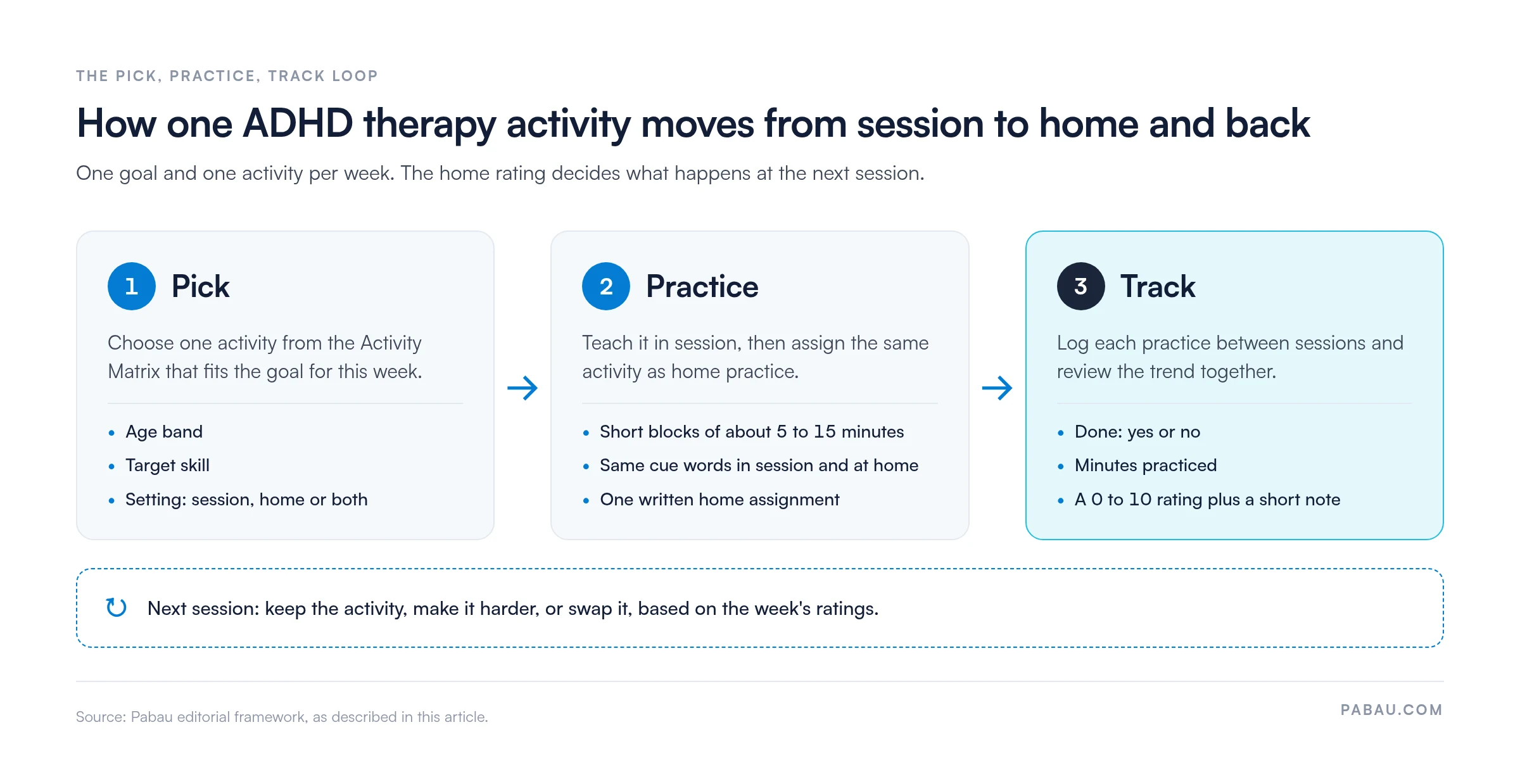
Here’s one way to sequence the loop for a school-age child. Swap in activities from the matrix to fit an adult or teen.
Give the patient or parent one row per day with five columns. Keep it simple enough to fill in under a minute.
Most home practice stalls on logistics rather than motivation. Run through this list before the patient leaves the room:
Three mistakes come up again and again. Changing two activities in the same week hides which one helped. Offering the activity as a reward turns practice into a bargaining chip. And assigning three tasks at once usually means none of them happen.
Activities support treatment, but they don’t replace an assessment or a treatment plan. Refer or review treatment if symptoms disrupt school, work or relationships, or if ratings stay flat for several weeks.
Mood changes, signs of anxiety or any safety concern also need a licensed clinician. Parents and adults working alone should speak to a professional before relying on activities by themselves.
The Track step breaks down when ratings live in notebooks, texts and emails. Pabau, the therapy practice management software we build, keeps the plan, the homework and the scores in the patient record.
With Pabau’s measurements tracking, you set up the weekly tracker as a scored questionnaire. Pabau sends it to the patient or parent on a schedule, calculates the score on submission and plots it across visits.
Your session notes sit beside that chart, so the keep, harder or swap decision is ready at the next appointment. Automated reminders also prompt families before each follow-up.
For ADHD-focused practices, Pabau’s ADHD clinic software also sends intake forms and rating scales automatically when patients book.


Pabau sends scored weekly check-ins, charts the ratings across visits and keeps them beside your session notes, so each session starts from the data.

Start smaller than feels useful. One goal, one activity and one rating per week will tell you more than a folder of 20 activities used once each.
The loop around an activity matters more than the activity itself. A simple game that gets practiced, rated and adjusted each week usually does more than a clever one that never leaves the therapy room.
The trade-off is admin, since tracking takes a few minutes per family each week. Hand the collecting and charting to a system, and the loop costs very little to run.
Book a demo to see how Pabau collects and charts ADHD home-practice ratings between sessions.

Building a full care plan? ADHD treatment plan sets out goals, interventions and review dates in one clinical template.
Need printable exercises? ADHD worksheet gives therapists ready-made worksheets to use in and between sessions.
Working with adult patients? ADHD strategies for adults collects practical coping strategies to share after a session.
Want a structured thought record? ABCDE CBT worksheet walks patients through challenging an unhelpful belief step by step.
Choosing the right approach? Therapeutic interventions compares the main types of intervention and the evidence behind each.
The 30% rule is a rule of thumb drawn from ADHD researcher Russell Barkley’s work. It suggests executive functioning and self-regulation may develop roughly 30% more slowly on average. That figure is Barkley’s estimate, and it varies by person and skill. So a 10-year-old may self-regulate more like a 7-year-old. It shapes expectations and is not a diagnostic measure.
They help some patients focus and distract others, and research on them is limited. A quiet fidget, like putty or a stress ball, suits listening tasks better than a spinner. Trial one for a week and compare the ratings.
They can support emotional regulation and self-expression, especially for patients who struggle to put feelings into words. The evidence is thinner than for behavioral approaches. Use them alongside skill-based activities, not instead of them.
Many do. Breathing resets, thought reframing cards, goal breakdowns and body doubling all run well on video. Movement and impulse-control games with young children need a parent in the room to set up and run them.
We don’t offer a single printable download of this list. You can copy the Activity Matrix and the weekly home-practice tracker into your own handout. Or send the tracker digitally so ratings come back to you.