Kate Tarrant
Bear hug test: Procedure, interpretation and free template
The bear hug test is a quick shoulder special test that screens for subscapulari...

4
Last Updated: Oct 23, 2026
Free PDF 1 page, print-ready Clinician-reviewed
Clinicians assessing hamstring flexibility need a standardized, reliable tool that captures consistent measurements across visits and enables meaningful comparison between limbs. The 90-90 hamstring test meets that need with a simple, evidence-based assessment that takes under 5 minutes yet provides actionable data for treatment planning and progress tracking.
This guide walks you through the test procedure, normal values, clinical interpretation, and how to integrate the assessment into your practice workflow.
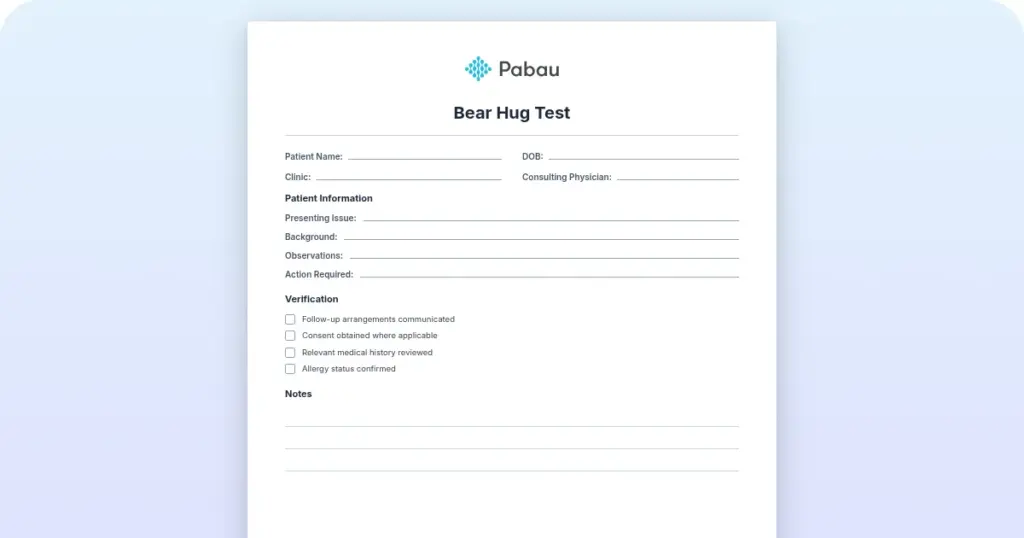
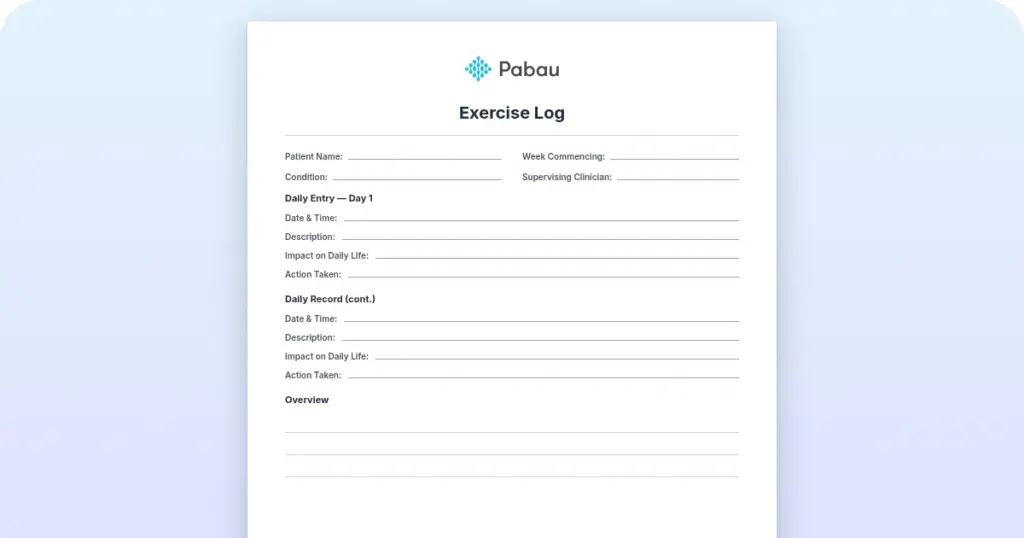
A ready-to-use assessment template covering patient details, an equipment checklist, single-leg test instructions, a findings section, and a binary positive/negative outcome for standardized hamstring flexibility evaluation in your practice.
Upload this PDF, or any form you already use, and Pabau's AI Form rebuilds it with tick boxes, text fields and a signature. Attach it to the treatment once, and every patient gets it on time.
AI Form rebuilds the consent, history and aftercare forms you already use. You review each one, then publish.
Patients complete forms on their phone before they arrive, so the front desk stops retyping paper.
Every signed form is versioned and attached to the treatment record, ready when you need it.
Set how long a consent stays valid. Returning patients skip forms they have already signed.
Supports HIPAA and GDPR compliance AES-256 encryption 4.8 on G2 4.7 on Capterra Trusted by 4,000+ practices worldwide

The 90-90 hamstring test measures hamstring muscle length and flexibility by positioning the hip and knee at 90 degrees and recording the popliteal angle or knee extension deficit.
Normal hamstring length is typically less than 20 degrees of knee extension deficit in adults; deficits over 30 degrees indicate significant tightness requiring intervention.
Measurement requires a goniometer or inclinometer placed at the knee joint, with standardized patient positioning (supine, hip at 90°) to ensure reliable bilateral comparison.
Practice management software like Pabau lets you document 90-90 results directly in the patient record, track trends across your patient population, and flag results for follow-up without manual file management.
The 90-90 hamstring test is a clinical assessment that measures hamstring muscle length and flexibility by quantifying the range available when the hip and knee are positioned at 90-degree angles. The clinician passively or actively extends the patient’s knee and records the popliteal angle — the remaining angle at the knee joint — or calculates the knee extension deficit.
Higher deficits, or larger angles, indicate tighter hamstrings. Lower deficits suggest better flexibility.
Why this matters: hamstring tightness contributes to lower back pain, limits performance in running and jumping sports, and restricts hip mobility during functional activities like bending or sitting.
This test has demonstrated good reliability across repeated measurements, making it a trusted baseline for monitoring progress.
The 90-90 hamstring test goes by several names in clinical literature, which can cause confusion when reviewing research or consulting practice guidelines.
Understanding these aliases helps you search the literature, communicate with referring physicians, and locate the assessment in electronic health records (EHR) systems where terminology varies. When documenting in Pabau’s digital assessment forms, standardized naming ensures your data is searchable and comparable across time and team members.

Pro tip: goniometry accuracy depends on correct anatomical landmark identification and joint alignment. Mark the lateral epicondyle of the femur, fibular head, and lateral malleolus lightly with a pen or palpate clearly before each measurement to ensure consistency.
In software built for occupational therapy practices, scores from scales like this feed straight into progress notes.
Standardized positioning is essential for reproducible results. Here’s the protocol:
The popliteal angle — the angle formed behind the knee when the hamstring is stretched — is the key measurement. Goniometry is the gold standard but requires proper technique.
Reference norms vary slightly by age, activity level, and population. The table below provides widely accepted benchmarks for adult populations based on clinical literature.
Important caveat: These norms are population-specific. Athletes may show naturally lower deficits (tighter hamstrings are normal); patients with spinal cord injury or stroke may have values outside this range due to spasticity. Always interpret results in clinical context, not in isolation.
A “positive” result (high knee extension deficit or popliteal angle >25-30°) signals hamstring tightness or contracture. Clinically, this tells you:
The 90-90 hamstring test supports clinical decision-making — it is one assessment among many and does not diagnose a condition on its own. Combine results with clinical history, other mobility assessments, strength testing, and imaging (if indicated) before making treatment recommendations.

Integrate the 90-90 hamstring test into your patient records with Pabau’s customizable assessment templates. Document results, track trends, and flag follow-ups in one system.

The 90-90 hamstring test is used across physical therapy and sports medicine settings to assess, track, and guide treatment:
Clinical adoption of the 90-90 hamstring test is supported by research on its measurement properties. Multiple studies published in peer-reviewed journals including the Journal of Orthopaedic & Sports Physical Therapy and on PubMed Central demonstrate good intra-rater and inter-rater reliability when standardized procedures are followed.
Key findings: Intraclass correlation coefficients (ICC) for the 90-90 test typically range from 0.80 to 0.95, indicating excellent reliability. Passive testing (clinician-applied overpressure) shows slightly higher reliability than active testing (patient self-correcting).
Goniometry is the gold-standard measurement tool; inclinometry and tape-measure methods are valid alternatives when goniometers are unavailable but show slightly lower ICC values. The test correlates well with other hamstring flexibility measures, such as straight-leg raise and sit-and-reach, and demonstrates sensitivity to changes in hamstring length over a 4-week stretching program.
An important variation practices should know about: the 90-90 position can also be used for isometric strength testing, distinct from the flexibility assessment described above. Here the patient performs a maximal isometric contraction (pushing against clinician resistance) rather than passively stretching.
When to use the isometric variant: Post-rehabilitation clearance for athletes, return-to-sport protocols, and strength imbalance detection (comparing limb symmetry index via dynamometry). This requires a handheld dynamometer and is more time-intensive than the flexibility version but provides quantified strength data alongside flexibility baseline.
The downloadable template above is structured to capture all essential data points from your 90-90 assessment in a standardized format. Here’s how to integrate it into your practice workflow:
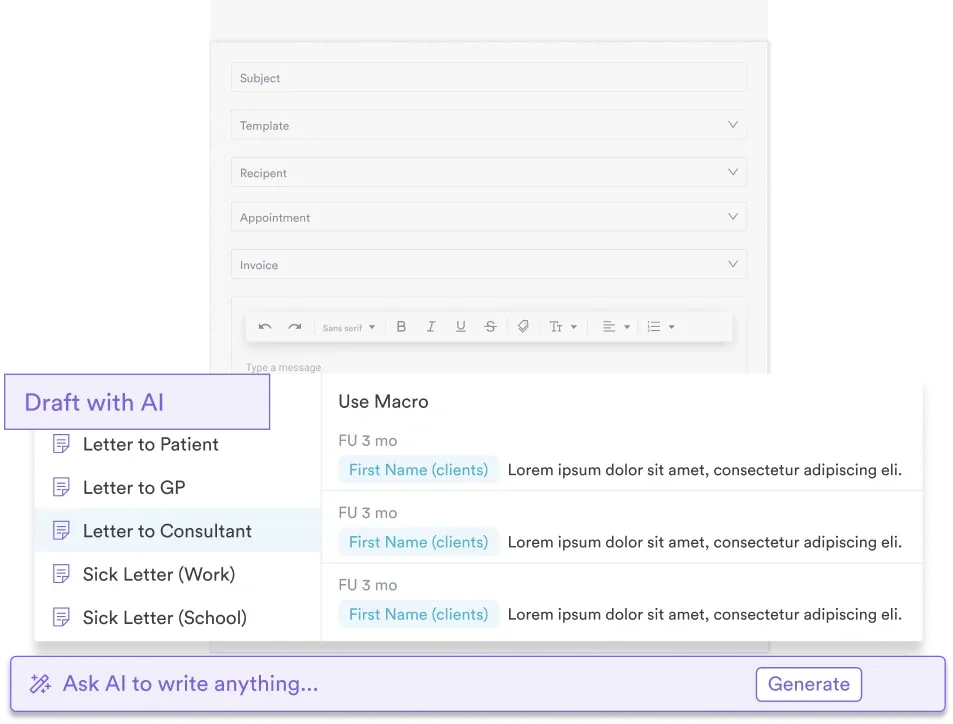
When using Pabau’s AI-assisted clinical documentation, you can dictate your findings and the system auto-populates this template, saving transcription time. Many practices bill the standalone assessment under 97799 when no more specific evaluation code applies. Results are stored in the patient’s permanent record alongside prior assessments, allowing you to track hamstring flexibility trends over months and years. That’s a powerful tool for longitudinal outcome tracking and demonstrating progress to patients.
The 90-90 hamstring test is a quick, reliable, and evidence-supported assessment that belongs in every physical therapist’s and sports medicine clinician’s toolkit. Standardized measurement of hamstring flexibility guides stretching interventions, supports return-to-sport clearance, and helps prevent lower back pain and injury recurrence.
Use the template above to ensure a consistent, repeatable assessment. Store results in your electronic health record system, like Pabau’s integrated clinical records, so you can monitor outcomes and build a population-level picture of your patient cohort’s musculoskeletal health. See how Pabau integrates flexible, customizable assessment templates into your practice’s workflow without adding paperwork.

Looking for other musculoskeletal assessment templates? Ankle injury assessment templates follow the same standardized approach to capture fracture-risk data in sports medicine.
Assessing other joint complaints? The AC resisted extension test uses a similarly quick, single-movement protocol to isolate acromioclavicular joint pain.
Need a template for a hip complaint? hip examination guide helps identify whether hip pain is intra-articular, periarticular, or referred from the spine.
The 90-90 hamstring test measures hamstring muscle length and flexibility by quantifying the popliteal angle or knee extension deficit when the hip and knee are positioned at 90 degrees. Clinicians use it for baseline flexibility assessment, progress tracking during rehabilitation, return-to-sport clearance, and injury prevention screening in athletic and occupational health settings.
Normal knee extension deficit in adults is typically 0-20 degrees. Deficits of 20-30 degrees indicate mild to moderate tightness; above 30 degrees suggests significant hamstring contracture. Values vary by age, activity level, and population, so always interpret results in clinical context alongside other findings.
Position the patient supine with buttocks near the table edge and the non-tested leg’s knee at 90 degrees. Flex the tested hip to 90 degrees (thigh vertical), then passively or actively extend the knee as far as comfortable. Measure the popliteal angle at the knee with a goniometer or inclinometer, record to the nearest degree, and repeat on the opposite leg.
A positive result (knee extension deficit greater than 20-30 degrees) indicates hamstring tightness or contracture. This can contribute to lower back pain, limit athletic performance, increase re-injury risk, and drive postural compensation patterns. Combine the finding with clinical history and other assessments before making treatment decisions.
Active testing (patient straightens the knee themselves) is less reliable but useful for home exercise instruction. Passive testing (clinician applies gentle overpressure) is the clinical standard — it has higher inter-rater reliability, controls for muscular effort, and is better for tracking serial change during treatment.
Place a goniometer’s center point at the lateral knee joint with the knee at end-range extension. Align one arm along the lateral femur (toward the hip) and the other along the fibula (toward the ankle). Read the angle formed — this is the popliteal angle. Alternatively, use a digital inclinometer placed on the anterior shin for faster measurement with acceptable accuracy.