Journal prompts for mental health
Journal prompts for mental health are guided questions that help people process ...

2
Last Updated: Oct 13, 2026

A 5-minute meditation script is a structured guide that helps practitioners lead clients through brief mindfulness practices in clinical settings.
Research shows short-form mindfulness reduces acute stress and anxiety; body scan and breathing techniques are the most clinically grounded approaches.
This page includes the full word-for-word script to read aloud, breathing, grounding, and body scan variations, and a free PDF, so delivery stays consistent across sessions and clinicians.
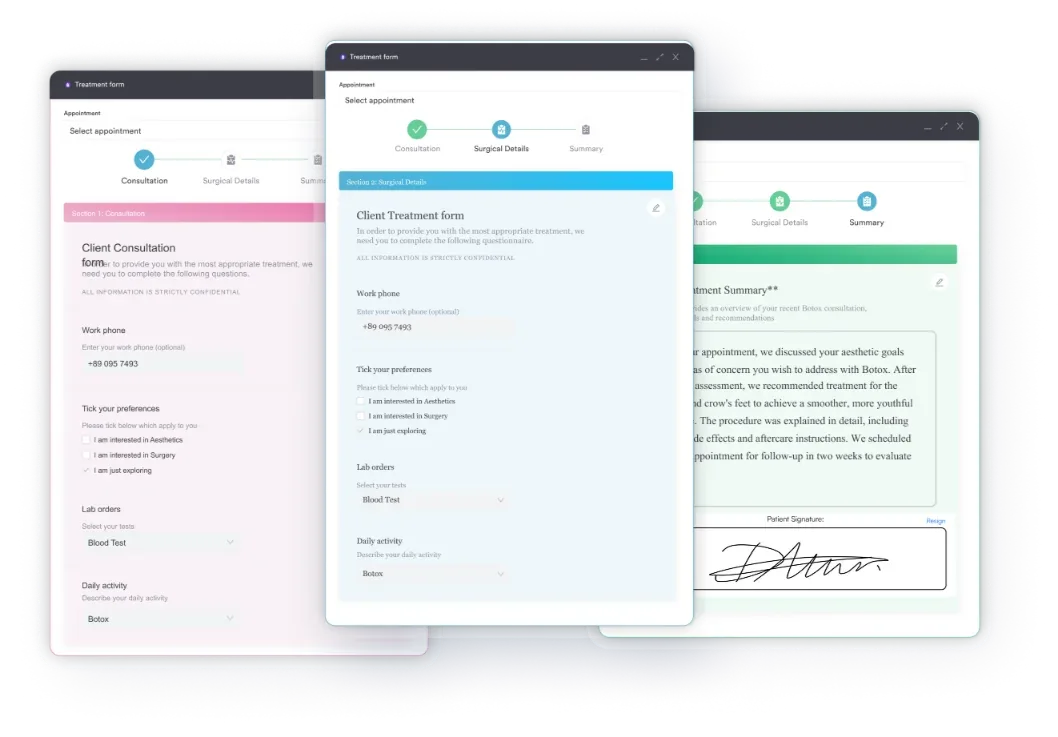
Pabau’s digital forms and clinical notes features help document patient responses and integrate meditation practices into treatment workflows.
A structured meditation script template for healthcare practitioners to guide patients through a 5-minute mindfulness practice, including breathing techniques, body scan, and present-moment awareness exercises with facilitator pacing notes.
Download templateA 5-minute meditation script gives therapists, counselors, and wellness practitioners a ready-to-use framework to bring mindfulness into a session without improvising. This is a short guided meditation script you can read aloud word for word, with facilitator pacing notes built in, plus a free guided meditation script PDF you can download and keep. Whether you’re easing anxiety, resetting after a difficult moment, or closing a session, it drops straight into your clinical workflow.
Here is the full word-for-word script. Read it aloud slowly in a calm, even voice, and pause for three to five seconds wherever you see an ellipsis so the client has time to follow. The five segments below run roughly one minute each.
Facilitator note: the pauses do the work, so resist the urge to fill the silence. A full 30 seconds of quiet before you invite the client to open their eyes gives the practice time to land.
A meditation script is a word-for-word guide that practitioners read aloud to lead clients through a structured mindfulness practice. A 5-minute meditation script condenses the full arc of a meditation — an opening grounding, a body or breath focus, and a closing return — into a brief timeframe suitable for clinical sessions, group classes, or brief wellness interventions.
Unlike recordings, a live-read script allows you to adjust pacing, pause length, and tone to match your client’s needs. The template format includes facilitator notes that signal where to pause (typically 3-5 seconds) and how to cue breathing or body awareness. This structure ensures consistency, reduces preparation burden, and keeps the practice grounded in clinical evidence rather than free-form guidance.
Meditation scripts for clinical use are distinct from general wellness content. Group therapy consent frameworks outline how practitioners should introduce any guided practice to ensure informed participation. The script itself serves as part of the treatment or wellness protocol, documented in digital intake forms so you can track which clients received the practice and their responses over time.
Follow these five operational steps to deliver the script effectively in a clinical session.
Practices using software for managing patients retrieve past forms in seconds during consultations.
This template is designed for any licensed healthcare practitioner or wellness provider who works with clients in structured sessions. It doubles as one of the mindfulness scripts for therapists who want a repeatable, evidence-aligned practice rather than free-form guidance. Key audiences include:
The script’s brevity makes it ideal for busy clinics where full-length meditations (15-30 minutes) are impractical, yet a moment of intentional calm improves patient outcomes and session focus.
Track which clients use the meditation script by documenting it in their session notes. Over time, you’ll identify which clients respond best to meditation, when in their treatment it’s most effective, and whether certain script variants (breathing, body scan, gratitude) outperform others for your population.
Most effective 5-minute scripts combine one or two primary techniques for clarity and depth. Understanding these core elements helps you choose the right script variant for each client’s needs.
The core script above works for most sessions. These three variations swap the central focus to match a specific presentation, keeping the same open-and-close structure so you can switch between them without relearning the format.
Use this breathing meditation script when a client is anxious or activated and needs a fast way to settle the nervous system. After the opening, guide a simple count: “Breathe in for four… hold for four… and out for six… let the out-breath be longer than the in-breath.” Repeat for eight to ten rounds, then close. The extended exhale is what signals safety to the body.
Reach for this grounding meditation script during acute anxiety, dissociation, or panic, when closing the eyes may feel unsafe. Keep the client’s eyes open and move through the five senses: “Name five things you can see… four you can hear… three you can feel… two you can smell… and one you can taste.” Naming the room anchors attention in the present without demanding stillness.
Choose this body scan meditation script for clients who hold stress physically or struggle to focus on the breath. Move attention slowly from the feet upward: “Notice your feet against the floor… now your legs… your back against the seat… your shoulders… your jaw,” inviting each area to soften. Longer pauses between regions deepen the relaxation response.
Integration with your clinical system ensures meditation becomes a repeatable, trackable intervention rather than an ad hoc addition.
Many practitioners find that running a brief meditation weekly with the same script builds client trust and deepens the practice effect over time. A script that becomes routine is more likely to be used consistently.

Pabau’s digital forms, clinical notes, and client portal make it easy to deliver, document, and track guided practices like meditation scripts across your entire practice. See how clinics use Pabau to improve patient wellness outcomes.

Different client populations and presenting concerns benefit from script variants tailored to their needs. While the free template provided covers the foundational 5-minute format, practitioners often develop modified versions for specific scenarios:
Psychiatric assessment tools often complement meditation scripts by establishing baseline anxiety or mood before the practice and tracking changes post-intervention, supporting data-driven refinement of your protocols.
A ready-made 5-minute meditation script is one of the highest-leverage tools a practitioner can use: it takes 60 seconds to deploy, costs nothing, and produces measurable calm and focus in client sessions. Unlike most free guided meditation scripts online, this one carries facilitator pacing notes written for clinical use. Whether you’re managing anxiety, supporting group wellness, or integrating mindfulness into treatment protocols, this template removes the barrier of content creation and lets you focus on delivery and client observation.
Download the free PDF, practice reading it aloud once or twice, and begin incorporating it into your standard session flow. Over weeks and months, you’ll refine the pacing to match your client population and discover which variants work best for your practice. Book a demo to see how Pabau helps document and track meditation practices as part of integrated patient care.

Running a guided meditation with a group? Group therapy informed consent outlines what to include, from confidentiality limits to session rules and boundaries.
Need a fuller mental health assessment tool? Psychiatric evaluation template gives psychiatrists and therapists a structured framework for conducting full mental health assessments.
Also run coaching sessions in your practice? Coaching management software guide compares platforms for running a coaching practice in the UK using consistent evaluation criteria.
A simple breathing or body scan script works best for beginners. Start with the breath (in for 4 counts, out for 6), then progress to body awareness once the client feels settled. Avoid complex imagery or demanding physical practices; simplicity builds confidence.
Yes. For stress, lead with the breathing variation and lengthen the exhale (in for four, out for six), which activates the relaxation response and lowers heart rate within a minute or two. If the client is highly activated, switch to the grounding version with eyes open so they stay anchored in the room.
Use a script with clear transition markers and longer pauses (5-7 seconds) to account for varied pacing. Speak slightly slower than normal conversation, maintain calm tone, and position yourself where you can observe the group. End with a full 30 seconds of silence before inviting eyes to open.
Yes. Peer-reviewed research on mindfulness-based stress reduction (MBSR), including a 2014 JAMA Internal Medicine meta-analysis, confirms that even brief meditation (5-10 minutes) reduces acute stress, lowers heart rate, and improves focus. Effects compound with regular practice over weeks.
A clinical-grade script includes: (1) opening grounding, (2) breath or body focus with pacing notes (3-5 second pauses marked), (3) sensory or emotional cue, (4) gentle return to room awareness, (5) closing invitation to open eyes. Optional: facilitator notes on modifications for accessibility.
Yes, with modifications. Frame the practice as optional (“You may notice thoughts or sensations; if anything feels uncomfortable, simply return your attention to your breath”). Avoid surprise physical touch or commands. A trauma-informed assessment beforehand is important to establish safety and consent.