Pabau Engage inbox

Pabau Engage is here: every patient conversation in one inbox.

Learn more
HCPCS Code

HCPCS code V5100 – Bilateral body-worn hearing aid


Code Definition

HCPCS code V5100 is the Level II code for a bilateral, body-worn hearing aid, the pocket-style unit corded to ear molds in both ears. It bills the device only, so the fitting goes on a separate claim line.

Most V5100 billing errors come from mixing it up with V5110 (the bilateral dispensing fee) or misreading Medicare's statutory hearing aid exclusion. Traditional Medicare never pays for hearing aids, so payment depends on choosing a payer that covers them and meeting its paperwork rules. The sections below follow the claim from benefit check to remittance, including the mistakes that stall it.

Level
Level II
Category
V — Vision and hearing services
Code range
V5008-V5364 Hearing services
Billable
No
Code also known as
body-worn hearing aid, body aid
Save time. Improve accuracy. Get paid faster.
Automate coding with Pabau

Let Pabau's smart automation suggest the right codes, reduce claim denials, and keep your practice compliant—effortlessly.

  • AI-powered code suggestions
  • Real-time compliance checks
  • Faster claims, fewer denials
Why practices choose Pabau
Save hours every week

Automate repetitive tasks and focus on what matters most—your patients.

Improve accuracy

Reduce coding errors and ensure compliance with the latest regulations.

Get paid faster

Clean claims, fewer denials, and faster reimbursements.

Grow with confidence

Powerful insights and reporting to help your practice thrive.

HIPAA compliant SOC 2 certified GDPR-compliant Trusted by 4,000+ clinics worldwide

Key takeaways

Key takeaways

HCPCS code V5100 bills a bilateral body-worn hearing aid, and V5110 bills the bilateral dispensing fee on its own line.

Traditional Medicare excludes hearing aids under §1862(a)(7), so V5100 is paid by Medicaid, Medicare Advantage, TRICARE, the VA or commercial plans.

Binaural codes V5120 to V5150 pair with the V5160 fee, so never mix the two families on one claim.

Most V5100 purchase claims carry the NU modifier, and a missing modifier gets the claim rejected before review.

Confirm the hearing aid benefit, prior authorization and replacement interval at the order, not after a denial.

HCPCS code V5100 bills the device, not the fitting

HCPCS code V5100 is a Level II code with the official descriptor “Hearing aid, bilateral, body worn.” It sits in the V-code range for vision and hearing items, which CMS maintains in the HCPCS. The code covers the hearing aid itself. The fitting and dispensing service bills separately, as V5110.

Body-worn aids are the pocket-style devices. A case worn on the body holds the amplifier, and a cord runs to ear molds. They are rarer than behind-the-ear styles. Audiologists still fit them for severe-to-profound loss, poor dexterity, or ear conditions that rule out in-canal devices.

FieldDetail
HCPCS codeV5100
Official descriptorHearing aid, bilateral, body worn
Code typeHCPCS Level II, supply/device
Code rangeV5008-V5364 (hearing services)
LateralityBilateral (both ears)
Device styleBody worn (case worn on the body, corded to ear molds)
Paired fee codeV5110 (Dispensing fee, bilateral)
Medicare statusNot covered by statute, §1862(a)(7)
Code status (2026)Active, but verify current-year status on CMS.gov before billing

V5100 covers the aid, while accessories bill under other codes

V5100 covers one bilateral body-worn hearing aid: the case, the amplifier and the cords to both ears. Ear molds have their own code, V5264, although some payer contracts bundle them into the device price. Check the contract before you add a mold line.

On the V5100 line:

  • The bilateral body-worn hearing aid, fitted to both ears
  • Ear molds only when the payer contract bundles them into the device
  • Not the fitting: the dispensing and fitting service bills separately as V5110

Billed with a different code:

  • Monaural body-worn aids: V5030 (air conduction) or V5040 (bone conduction)
  • Behind-the-ear aids: V5060 (monaural) or V5140 (binaural)
  • In-the-canal and completely-in-canal aids: the matching V52xx code, such as V5248 for an analog binaural CIC
  • Implantable hearing devices: a separate code series
  • Batteries, replacement cords and accessories: their own HCPCS supply codes
  • Audiological evaluation: CPT codes in the 92550-92588 audiometry series, such as 92557

V5100 is the aid and V5110 is the fee, so bill both

The word “bilateral” appears in both descriptors, and that is where most coding slips start. V5100 is the device. V5110 is the bilateral dispensing fee, the service of fitting and handing over that device. They are partners on the claim, not alternatives.

CodeDescriptorLateralityStyle
V5100Hearing aid, bilateral, body wornBilateralBody worn
V5110Dispensing fee, bilateralBilateraln/a (fee)
V5120Binaural, bodyBinauralBody worn
V5130Binaural, in the earBinauralIn the ear
V5140Binaural, behind the earBinauralBehind the ear
V5160Dispensing fee, binauralBinauraln/a (fee)
V5030Hearing aid, monaural, body worn, air conductionMonaural (one ear)Body worn

Bill V5100 for the device and V5110 for the fitting, as separate lines. The binaural family works the same way, with V5160 as its fee. A one-ear body aid moves to V5030 instead.

Mixing families is a quiet error. V5100 with V5160, or V5120 with V5110, pairs a device with the wrong fee. Payers also price each line differently. The Louisiana workers’ compensation fee schedule allows $1,061 for V5100 and $287 for V5110, or $1,348 for the pair.
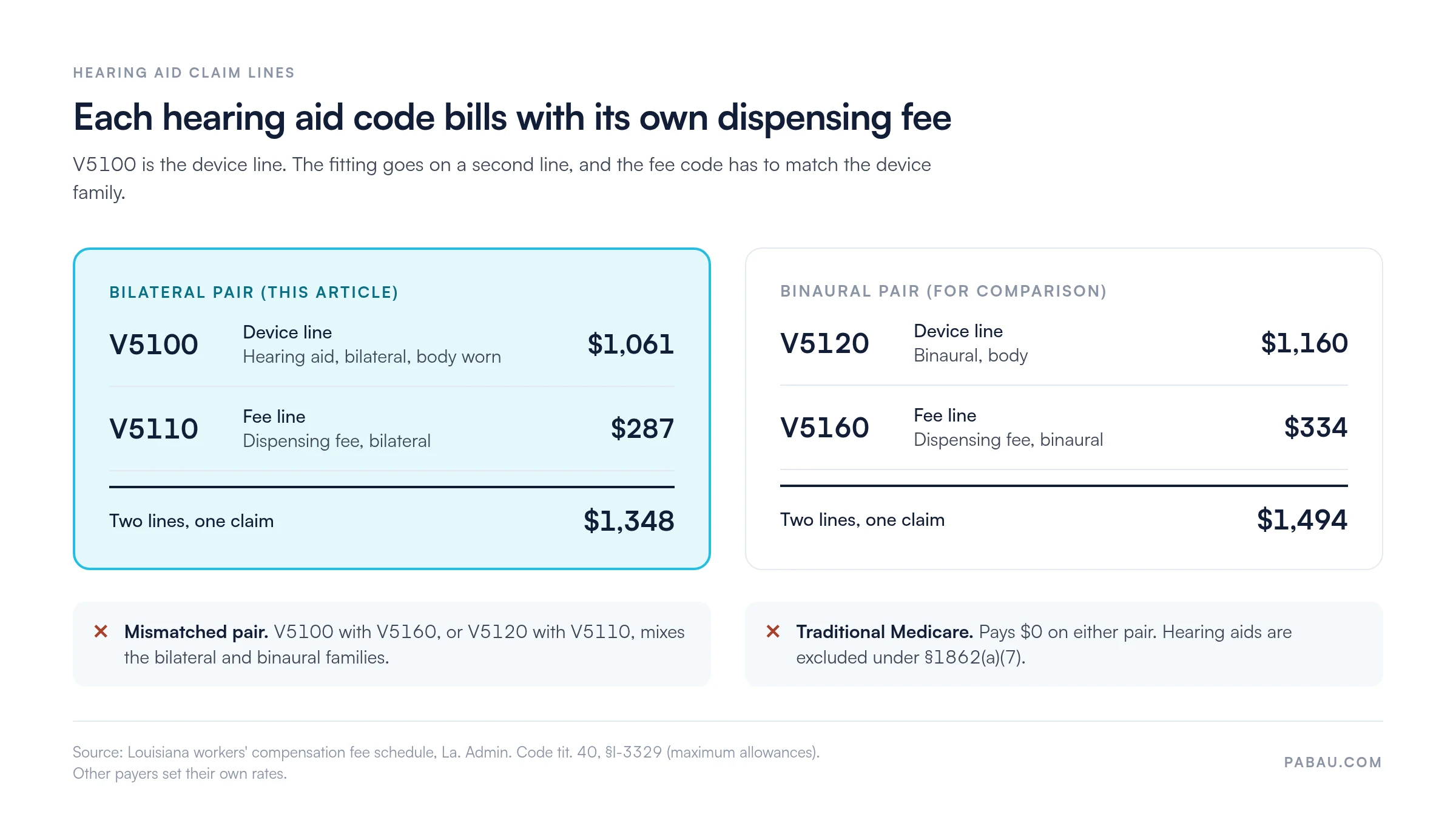
Claim-line pairing for hearing aids
The binaural pair pays $146 more than the bilateral pair in Louisiana, so a family mix-up changes the payment. Figures from the Louisiana workers’ compensation fee schedule.

Traditional Medicare never pays for V5100, so pick the payer first

Section 1862(a)(7) of the Social Security Act excludes hearing aids, and the exams to prescribe or fit them, from Medicare. Severity of loss, a physician order and medical necessity notes make no difference. A V5100 claim sent to Part B comes back denied as non-covered, not as a coding error.

These payer channels can cover V5100:

  • Medicare Advantage (Part C): Plans may add a supplemental hearing benefit under 42 CFR §422.102. Limits, device types and prior authorization vary by plan, so run insurance eligibility verification before dispensing.
  • Medicaid: State programs differ widely. Some cover adults, some cover only children, and some exclude hearing aids. Check the state Medicaid policy or provider bulletin.
  • Department of Veterans Affairs (VA): Eligible veterans get hearing aids through the VA benefit. Claims through VA channels follow VHA policy rather than CMS DMEPOS rules.
  • TRICARE: Covers hearing aids for active-duty family members whose hearing loss meets its thresholds. Prior authorization is typically required.
  • Workers’ compensation: When the hearing loss is work-related, the state’s workers’ compensation fee schedule sets the allowable.
  • Private/commercial payers: Plans with a hearing aid benefit publish medical policies. These set covered styles, one-ear vs two-ear limits and replacement frequency.

Pro Tip

Check the hearing aid benefit at the point of order, not at claim submission. Medicare Advantage hearing benefits are not standardized, and a plan that covered bilateral aids last year may have changed at the January renewal.

How a V5100 claim moves from order to payment

Here is the path a clean V5100 claim takes, in order. Each step catches a different denial before it happens.

  1. Order and benefit check. Confirm the payer covers hearing aids, and note the benefit cap and replacement interval.
  2. Prior authorization. Request it before the fitting appointment if the plan requires it, and record the approval number.
  3. Fitting and delivery. Log both device serial numbers, the fitting date and the patient’s signed proof of delivery.
  4. Build the claim. Put V5100 with NU on line one and V5110 on line two, with a diagnosis that shows loss in both ears.
  5. Submit and track. Send it inside the plan’s filing window, then watch the status until the remittance posts.
  6. Read the remittance. If a line is denied, the adjustment code tells you whether to correct, appeal or write off.

The documentation file that gets a V5100 claim paid

Payers that cover V5100 want proof of three points: medical necessity, the device type, and delivery. Keep these records together before the claim goes out.

Retain them for at least six years under HIPAA documentation rules, and 10 years for Medicare Advantage records (42 CFR 422.504(d)). Some states require longer. Medical billing compliance covers the wider retention rules.

  • Audiological evaluation showing bilateral loss that meets the payer’s threshold, with air and bone conduction results and speech scores
  • Written order naming the diagnosis, the device type and bilateral laterality
  • Fitting and dispensing records: fitting date, ear mold impressions and serial numbers for both units
  • Proof of delivery signed by the patient
  • The prior authorization approval number, where the payer requires one
  • Evidence for the plan’s own medical policy criteria, such as hearing thresholds or trial-period compliance

Medicare doesn’t cover V5100, so no MAC local coverage determination applies to it. The plan’s own medical policy sets the bar instead, and it can add requirements beyond this list.

NU does most of the modifier work on V5100

The modifier tells the payer whether the aid was bought, rented or replaced. A missing or wrong modifier can get the claim rejected at the front-end edit, before anyone reviews it.

ModifierDescriptionWhen to use
NUNew equipment, purchaseThe aid is sold, which covers most V5100 dispensing
RRRentalThe aid is rented rather than bought (rare for hearing aids, so verify payer policy)
RAReplacement of a DME itemReplacing a lost, damaged or worn-out aid within the payer’s replacement frequency
RBReplacement of a part of a DME itemReplacing one component rather than the whole device
KH / KI / KJKH: initial claim (purchase or first rental month). KI: second and third rental months. KJ: months 4-15 (capped rental)DMEPOS rental modifiers; confirm payer use

Hearing aids are almost always sold, so NU fits most V5100 claims. Two slips come up again and again. One is leaving the modifier off. The other is adding NU when a managed care plan treats the aid as a capped rental.

V5100 rates come from the payer, not a Medicare fee schedule

Medicare excludes hearing aids, so CMS publishes no DMEPOS allowable for V5100. The rate comes from the plan contract, the state Medicaid schedule, VA procurement or a commercial agreement.

  • Medicare Advantage: Ask the plan’s provider relations team or check its portal. The CMS Physician Fee Schedule lookup helps with related professional codes, but the device allowable comes from the plan.
  • Medicaid: Each state publishes its own DMEPOS fee schedule on its provider portal.
  • VA: Rates are set through government acquisition contracts and are not in the CMS DMEPOS tables.
  • Private payers: Allowables are contract-specific. The AAPC HCPCS lookup helps confirm the code, but only the payer confirms the rate.

Check code status on CMS.gov before billing. HCPCS Level II has an annual January update plus quarterly updates, and descriptors, status or coverage can change at each quarterly or annual update.

Seven V5100 denials you can stop before they happen

V5100 denials repeat the same few errors, which makes them predictable. Each one below has a prevention step you can build into the workflow.

Denial reasonRoot causePrevention step
Non-covered serviceClaim sent to traditional Medicare Part BConfirm the payer covers hearing aids before submission
Wrong code or wrong pairingV5110 billed as the device, or V5100 paired with V5160Bill V5100 for the device and V5110 for the fitting
Missing prior authorizationApproval not obtained before dispensingCheck the requirement at the benefit check and get approval before the fitting
Incomplete documentationAudiogram, proof of delivery or serial numbers missingRun the pre-submission checklist below
Missing or incorrect modifierNU left off, or RR used on a purchaseConfirm purchase, rental or replacement, then apply the matching modifier
Timely filing limit exceededClaim sent after the payer’s filing windowRecord the plan’s window at the benefit check and submit promptly
Replacement frequency not metAid replaced before the payer’s minimum intervalCheck the last-billed date and document why early replacement is needed

When a V5100 claim comes back denied, look up the denial codes on the remittance advice. The claim adjustment reason code shows which edit fired. That decides whether you resubmit, appeal or write the line off.

Before you submit a V5100 claim, run this checklist

It takes a couple of minutes, and it covers every denial in the table above.

  • The payer covers hearing aids, and it isn’t traditional Medicare
  • Prior authorization is on file, if the plan requires it
  • The audiogram shows bilateral loss
  • The patient signed the proof of delivery
  • Both device serial numbers are recorded
  • V5100 carries NU for a purchase
  • V5110 sits on its own line, and no binaural fee code is on the claim

How Pabau keeps hearing aid claims moving after the fitting

V5100 errors usually come from manual steps that break under volume. A practice dispensing dozens of aids a month can’t rely on memory for every pairing and modifier. Whatever billing system you use, look for these features:

  • Eligibility checks at scheduling: confirm the hearing aid benefit and prior authorization rules before the fitting
  • Prior authorization tracking: flag claims that still need an approval number
  • Denial routing: send denied lines to the right person with the reason code attached
  • Required-field checks: stop a claim that is missing serial numbers or a delivery date

Pabau, the practice management platform we build, handles the submission side. Its claims management software sends claims through Pabau’s clearinghouse integrations, Claim.MD in the US. Your team then tracks each V5100 and V5110 line until the remittance posts.
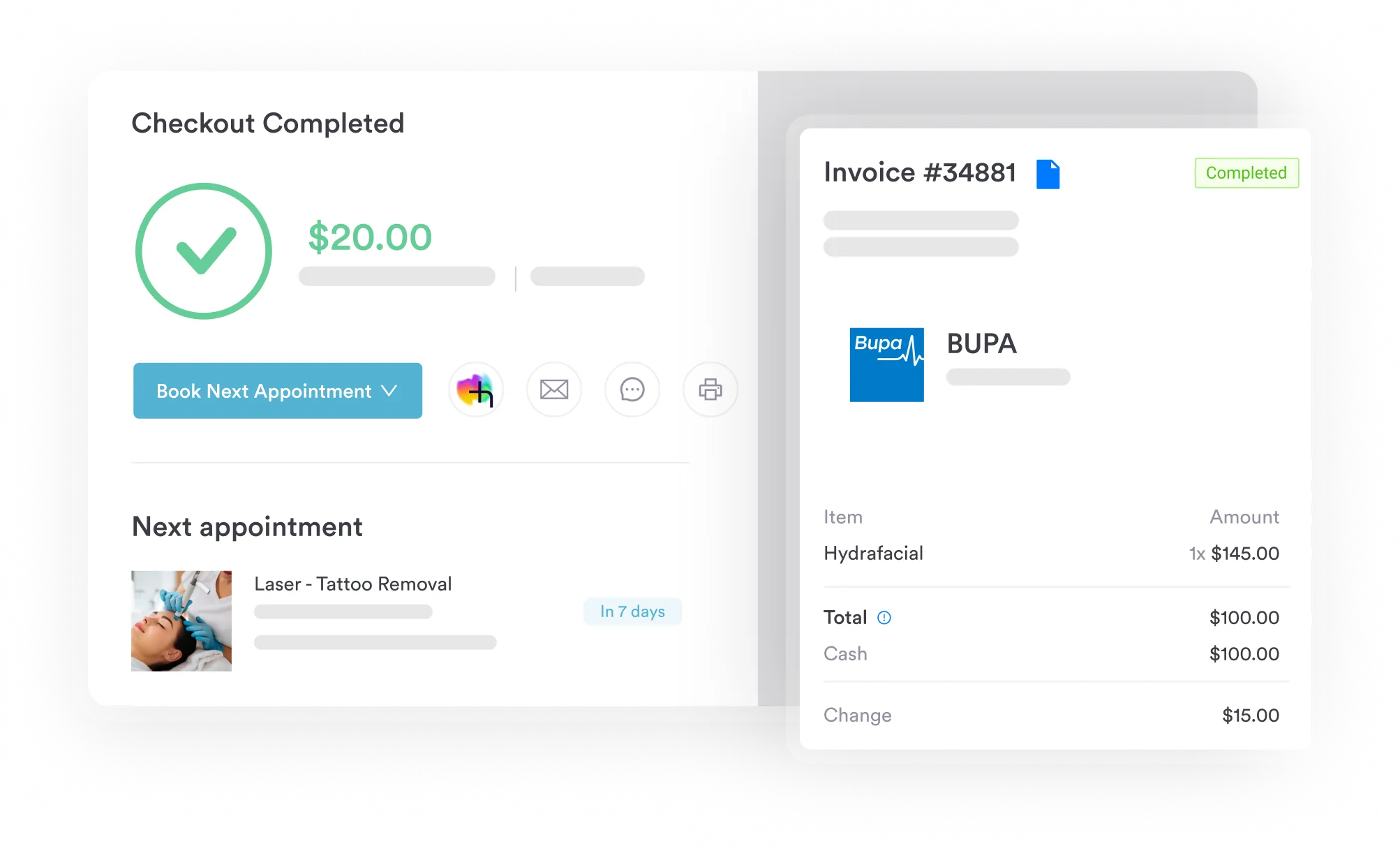
Pabau claims management screen for submitting and tracking claims
Pabau’s claims management tracks each submitted claim, so your team sees which V5100 and V5110 lines are paid, pending or denied.

Get hearing aid claims out the door faster

Pabau’s claims management submits and tracks each claim through its clearinghouse integrations. Your team sees which V5100 lines are paid and which need work.

Pabau claims management for audiology billing

Conclusion

V5100 is a narrow code, but it fails in predictable ways. Treat the payer check as the first coding decision, because no modifier rescues a claim sent to traditional Medicare. Then keep the device and the fee on two lines, in the same family.

Get those two calls right and the rest is paperwork you can check off before submission. If your team still pairs codes from memory, that’s the habit to replace first.

Book a demo to see how Pabau tracks hearing aid claims from submission to payment.

Continue your research

Continue your research

Billing the fitting that goes with V5100? V5110 covers the bilateral dispensing fee and how it sits beside the device line.

Fitting a binaural pair instead? V5160 explains the binaural dispensing fee that pairs with V5120 to V5150.

Need to read a hearing aid remittance? Denial codes in medical billing explains the CARC and RARC codes on remittance advices for HCPCS supply codes.

Confirming hearing aid benefits before dispensing? Insurance eligibility verification walks through the checks to run before the fitting appointment.

Setting up record retention for supply claims? Medical billing compliance covers documentation retention, audit readiness and payer policy alignment.

Frequently asked questions

What ICD-10 codes support a V5100 claim?

Use a diagnosis that shows loss in both ears, matching the bilateral device. Common choices are H90.3 for bilateral sensorineural loss, H90.0 for bilateral conductive loss and H90.6 for bilateral mixed loss. A one-sided diagnosis invites a laterality denial.

Are hearing aid batteries included in V5100?

No. Batteries bill separately with V5266, the code for a battery used in a hearing device. Many plans cap how many batteries they cover each year, so check the benefit before you add the line.

Is V5100 the same as a CROS or BICROS hearing aid?

No. CROS and BICROS aids route sound from a poorer ear to the better one, and they have their own codes. CROS devices sit at V5170 to V5190 with the V5200 fee. BICROS devices sit at V5210 to V5230 with the V5240 fee.

Who can dispense a V5100 hearing aid?

A licensed audiologist or hearing instrument specialist usually fits and dispenses it. State licensing law decides who qualifies, and payers often require the dispenser to be enrolled with the plan before they pay the claim.

Is V5100 still a valid code in 2026?

Yes. V5100 has been in effect since January 1, 1995, and it remains active for 2026. Recheck its status at each quarterly HCPCS update, because descriptors and status can change.
Avatar photo
Monika Lazarevska
Content Writer

Monika Lazarevska writes content for owners and healthcare professionals who want clear, no-fluff content that actually helps them run their practice better. With a background in storytelling and SEO, she knows how to make even the driest topics worth reading. Off the clock, you'll find her in a café somewhere in Europe, probably with a good book and an even better coffee.
×