CCSD code H4430: Examination of rectum under anaesthetic
CCSD code H4430 pays for the examination alone CCSD code H4430 is the UK private...

Last Updated: Oct 20, 2026
V2790 is the HCPCS Level II code for amniotic membrane for surgical reconstruction, per procedure.
Plenty of coding guidance tells practices to add V2790 to the surgical claim so the membrane gets paid for. For CPT 65778 and CPT 65779, that instruction is backwards. Medicare already pays for the membrane inside the allowance for those two codes, so the separate line is the error.
Let Pabau's smart automation suggest the right codes, reduce claim denials, and keep your practice compliant—effortlessly.
Automate repetitive tasks and focus on what matters most—your patients.
Reduce coding errors and ensure compliance with the latest regulations.
Clean claims, fewer denials, and faster reimbursements.
Powerful insights and reporting to help your practice thrive.
HIPAA compliant SOC 2 certified GDPR-compliant Trusted by 4,000+ clinics worldwide

HCPCS Code V2790 describes amniotic membrane for surgical reconstruction, per procedure. It is an HCPCS Level II V-code used mainly in ophthalmology for ocular surface repair.
V2790 is included in the allowance for CPT 65778 and CPT 65779. Billing it separately alongside either code is a billing error, not a missed charge.
V2790 is separately payable to Part B only in an office setting, billed with CPT 65780. A copy of the invoice has to go with the claim.
There is no locality-adjusted fee schedule amount to look up for V2790. Medicare treats it as carrier priced, so payment comes from the invoiced amount.
Article A53441 is a billing and coding article, not a diagnosis list. Its ICD-10 medical necessity sections read N/A, so coverage follows the surgical CPT code and payer policy.
HCPCS Code V2790 is a Healthcare Common Procedure Coding System Level II code. It describes amniotic membrane for surgical reconstruction, reported per procedure. In particular, the code sits in the V-code range, which covers vision services and supplies under Medicare Part B.
In effect, the code names the membrane itself as a supply item. Practices report the operative technique with a CPT code instead. Still, that split does not mean both lines belong on every claim. Whether V2790 is payable at all depends on which CPT code was billed and where the procedure happened.
Amniotic membrane is used in ophthalmology when the ocular surface is damaged and conventional treatment has not healed it. Specifically, the graft brings anti-inflammatory, anti-scarring, and wound-healing properties that support epithelial regeneration.
Accordingly, the indication drives the ICD-10-CM diagnosis code on the claim, and it drives the choice of surgical CPT code. Sutureless placement is CPT 65778. Single-layer sutured placement is CPT 65779. Multi-layer ocular surface reconstruction is CPT 65780. In short, only that third option opens the door to a separate V2790 line.
When the indication is pterygium, the excision and the graft are reported together with 65426. That code is not one of the three membrane placement codes above, so check the MAC’s local coverage article before adding a V2790 line.
V2790 is separately payable to Part B in one situation only. You have to bill it with CPT 65780, in an office place of service, with a copy of the invoice attached to the claim. Every other combination pays for the membrane through another allowance.
CMS Local Coverage Article A53441, issued by Palmetto GBA, states the rule plainly. Indeed, V2790 is included in the allowance for CPT 65778 and CPT 65779. Those two codes already include payment for the membrane, so practices should not bill V2790 separately when either one is on the claim.
Four routes cover every amniotic membrane claim, and only one of them carries a V2790 line.
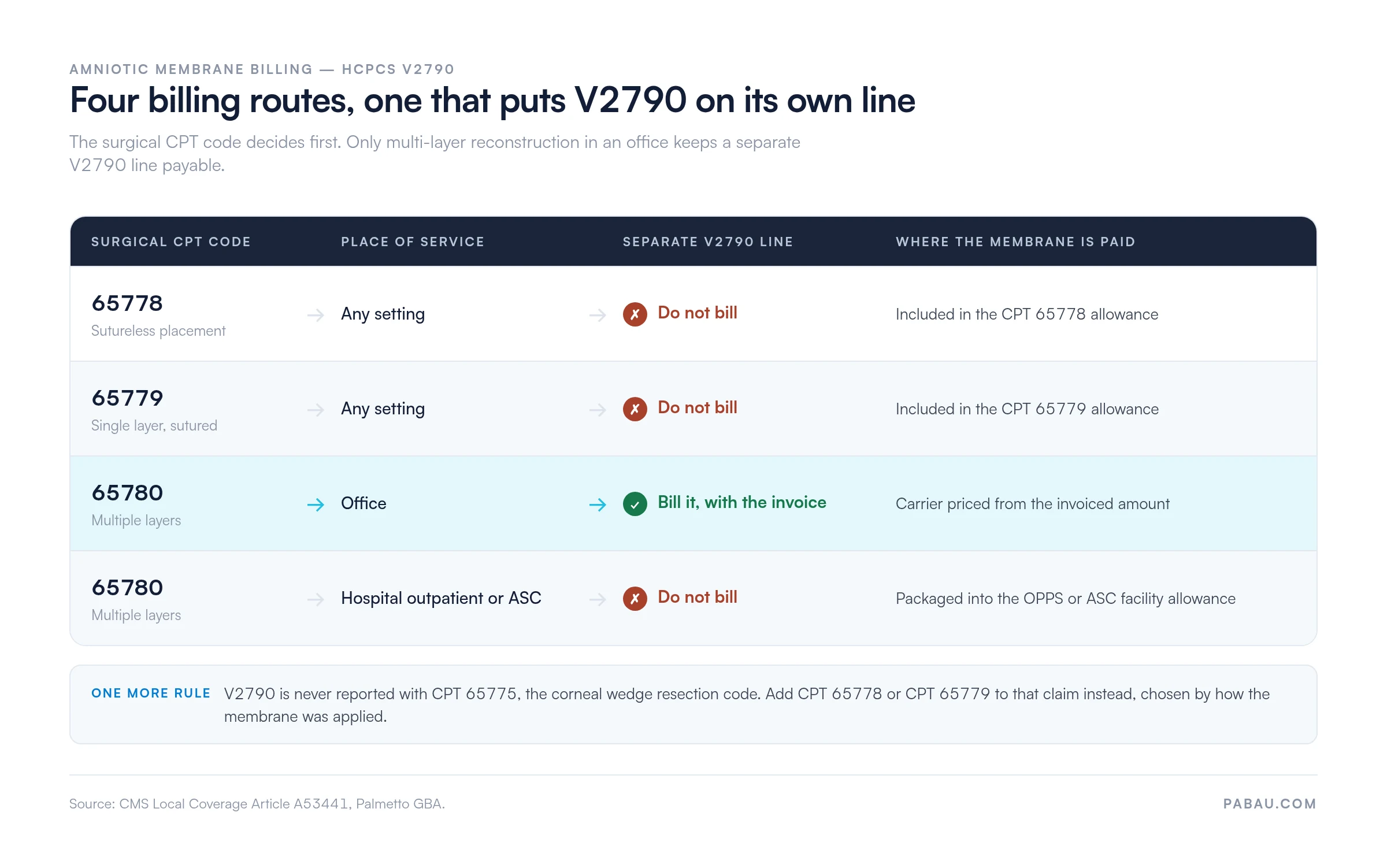
Notably, the corneal wedge resection rule is easy to overlook. A53441 says not to bill V2790 with CPT 65775. If the surgeon applies a membrane during that procedure, report CPT 65778 or CPT 65779 with 65775, chosen by how the membrane was applied. The membrane is then paid inside that code.
Build the bundling rule into your charge capture rather than your denial review. If the surgical code on the encounter is 65778 or 65779, the V2790 line should not exist. If the code is 65780 and the place of service is the office, the claim needs an invoice before it goes out. Two questions at charge entry remove most V2790 rework.
Beyond the bundling question, V2790 follows a short set of rules. Getting them right before submission prevents the common denial patterns.
Reported per procedure: Practices report V2790 once per surgical encounter. Regardless, the unit does not change with the number of membrane sheets used in that session. As a result, reporting multiple units for one operative session invites a medical review flag.
Place of service decides payability: the office place of service is the only one where a separate V2790 line can pay. In a hospital outpatient department the membrane is inside the OPPS allowance. In an ambulatory surgical center it is inside the facility allowance.
The invoice is mandatory, not optional: A53441 requires a copy of the invoice when V2790 and CPT 65780 are billed on the same claim. For electronic claims, fax the invoice. For paper claims, the actual invoice goes with the claim.
Modifiers: A53441 lists no modifier requirements for V2790, so its modifier section reads N/A. Laterality modifiers may still be appropriate on the surgical line. Confirm any other modifier with your own Medicare Administrative Contractor before you rely on it.
Jurisdiction: A53441 applies to Palmetto GBA jurisdictions J-J and J-M, covering Alabama, Georgia, Tennessee, South Carolina, Virginia, West Virginia, and North Carolina. Practices elsewhere should check their own MAC for an equivalent billing and coding article.
There is no fee schedule amount to look up for V2790. In other words, Medicare lists the code as carrier priced, which means CMS publishes no national or locality-adjusted payment amount for it. The CMS Physician Fee Schedule lookup tool will not return a facility or non-facility rate for this code.
In the one scenario where V2790 pays on its own line, the amount comes from the invoice. That is why A53441 requires the invoice with the claim. The contractor prices the line from the acquisition cost you document, so the invoice is the fee schedule for practical purposes.
Two consequences follow for the practice. You cannot build revenue projections from a published rate, so build them from acquisition cost and expected volume instead. Base patient cost estimates for office cases on the same invoice figure rather than a fee schedule guess.
Keep supplier invoices where the billing team can reach them, filed by date of service and patient. A carrier-priced line stalls when the invoice has to be requested from the supplier weeks after surgery. Practices that attach the invoice at the point of charge entry get paid on the first pass far more often.
A53441 is a billing and coding article, not a coverage policy with a diagnosis list. Its ICD-10 sections say so directly. “ICD-10 Codes that Support Medical Necessity”, “ICD-10 Codes that DO NOT Support Medical Necessity”, and “Additional ICD-10 Information” all read N/A.
The only codes the article lists are procedure codes: CPT 65775, CPT 65778, CPT 65779, CPT 65780, and V2790 itself. So there is no Palmetto GBA list of covered diagnoses to check a V2790 claim against. A list presented as one came from another source.
Payers judge medical necessity on the surgery instead. Instead, the documented condition has to justify the ocular surface procedure reported with CPT 65778, CPT 65779, or CPT 65780. Your MAC’s policies on the procedure, plus any applicable national coverage rules, govern coverage for that procedure. Verifying the patient’s benefits before the procedure is still the practical safeguard.
Commercial payers set their own rules and many treat amniotic membrane products differently from Medicare. Notably, some require prior authorization, and some pay the membrane separately in settings where Medicare bundles it. Check the payer’s own policy before you assume the Medicare bundling logic applies.
Where you expect a service to be non-covered, issue an Advance Beneficiary Notice before the procedure. Without one, the practice cannot bill the Medicare patient after a denial. In short, a retroactive notice does not fix this.
Documentation decides whether a V2790 claim pays. For the office and CPT 65780 scenario, the CMS article itself names one document, and the rest is what supports the surgery. Each chart should hold the following before the claim goes out.
The charge slip should link the surgical CPT code, the diagnosis code, and the invoice for any office V2790 line. Consequently, mismatches between those three are the usual trigger for a medical review request. Compliance reviews also look for V2790 lines sitting next to CPT 65778 or 65779, which should not appear together.
V2790 only makes sense next to the surgical codes it pairs with, and next to the V-codes it is confused with. The relationship column decides whether V2790 belongs on the claim, and it is where most published guidance on this code goes wrong. Our CPT codes library covers the surgical side of these pairings in more detail.
The pairing rule is narrower than it looks. Basically, the CPT code reports what the surgeon did in every case. Add V2790 only for the office and CPT 65780 combination, and only with an invoice. In effect, adding it to a 65778 or 65779 claim duplicates a charge Medicare has already paid.
These errors show up repeatedly in V2790 claims and audits. Good denial management in healthcare means catching them at charge entry rather than after the remittance arrives.
Error 1: Billing V2790 alongside CPT 65778 or 65779. Generally, this is the most common one, and it is usually done on purpose by billers who think they are capturing the supply cost. Those two allowances already include the membrane, so the extra line is a duplicate charge. Expect a denial on the V2790 line, and expect a pattern of them to draw attention.
Error 2: Billing V2790 separately in a facility setting. In a hospital outpatient department, OPPS packages the membrane into its payment. In an ambulatory surgical center it is inside the facility allowance. Ultimately, a separate line in either setting will not pay, whichever CPT code is used.
Error 3: Omitting the invoice on an office 65780 claim. Here the V2790 line is correct, but the claim is incomplete without it. A carrier-priced line gives the contractor no figure to price against, so it denies. Fax the invoice for electronic claims and attach it for paper claims.
Error 4: Reporting V2790 multiple times per encounter. Again, the code is per procedure, not per sheet. Several pieces of membrane placed in one session still produce a single unit. Multiple units trigger automated edits.
Error 5: Reporting V2790 with CPT 65775. A53441 rules this out directly. When the surgeon applies a membrane during a corneal wedge resection, add CPT 65778 or CPT 65779 to the 65775 claim. Instead, choose between them by the method of application.
Error 6: Chasing a fee schedule rate that does not exist. Building estimates from a supposed locality rate for V2790 produces figures with no source. Use the invoiced acquisition cost instead, and price patient estimates from the same figure.
In most ophthalmology practices the three things a V2790 claim needs live apart. For instance, the operative note is in the clinical record. Likewise, the place of service is on the schedule. The supplier invoice is in a supply folder or an accounts inbox, and nobody looks for it until the line denies.
Pabau is practice management software that keeps the clinical record and the billing record in one system. Operative notes, the membrane product and lot number, and the place of service sit on the same patient timeline. Its claims management submits from that record, so the invoice travels with the encounter rather than sitting in a supply folder.
Because charge capture happens next to the note, the surgical code is visible when the biller adds the supply line. A biller who sees CPT 65779 on the encounter can leave V2790 off. A biller who sees CPT 65780 in an office slot can check that the invoice is attached.
Overall, the outcome is fewer duplicate supply lines, fewer carrier-priced lines waiting on paperwork, and an audit request that can be answered from one place. As a result, billing staff stop reconstructing claims after the fact.

Pabau keeps operative notes, product records, place of service, and supplier invoices on the same patient timeline. Your billing team can see which lines belong on the claim before it is submitted, instead of finding out from the remittance.

V2790 reads like a supply code you add to every amniotic membrane claim. For CPT 65778 and CPT 65779 the membrane is already inside the allowance. Ultimately, the extra line is itself the mistake, added by practices trying to avoid one.
That leaves one narrow path to a separate payment: CPT 65780, in the office, with the invoice attached. Thus, treat those three conditions as a single check at charge entry. The check takes seconds, and it decides whether the line pays or duplicates a charge.
The wider lesson is to verify a bundling rule at the source rather than inherit it from a coding summary. Pabau keeps the note, the product record, and the invoice on one timeline so those checks happen before submission. To see how it handles amniotic membrane billing end to end, book a demo.

New to the billing side of a supply code? What is medical billing walks a claim from the encounter through to payment.
Need to understand how claims move through the billing cycle? Revenue cycle management fundamentals covers each stage from coding to reimbursement, and where supply codes fit.
Worried about documentation audits? Medical billing compliance outlines what auditors look for in supply code claims and how to keep defensible records.
Want the line to pay on the first submission? What makes a clean claim lists the fields and attachments payers check before they release payment.
Building the charge slip for an office procedure? Superbills explained shows how the CPT code, the diagnosis, and the supply line should line up.
HCPCS Code V2790 is a Level II HCPCS supply code for amniotic membrane provided for surgical reconstruction of the ocular surface, reported once per procedure. It is used mainly in ophthalmology. Typical indications are persistent corneal epithelial defects, bullous keratopathy, ocular Stevens-Johnson syndrome, chemical burns of the eye, and conjunctival reconstruction. Whether it can be billed as a separate line depends on the surgical CPT code and the place of service.
No. CMS Local Coverage Article A53441 states that V2790 is included in the allowance for CPT 65778 and CPT 65779. Both codes already include payment for the membrane itself, so V2790 should not be billed separately when either one is reported. Adding the V2790 line duplicates a charge Medicare has already paid, and the line is expected to deny.
No. V2790 is carrier priced, so CMS publishes no national or locality-adjusted payment amount for it. The Physician Fee Schedule lookup tool will not return a facility or non-facility rate for this code. Where the code is separately payable, the contractor prices the line from the invoice submitted with the claim. Your acquisition cost is the working figure.
No. A53441 states that V2790 should not be billed with CPT 65775, the corneal wedge resection code. If amniotic membrane application is required during that procedure, report CPT 65778 or CPT 65779 with 65775, chosen by the method of application. The membrane is then paid inside that code, so no separate V2790 line is added.