



CCSD code G5100: Bypass of duodenum billing guide
CCSD code G5100 bills a bypass that leaves the duodenum in place CCSD code G5100...

Last Updated: Oct 16, 2026

CPT Code 66982 covers extracapsular cataract removal with IOL insertion when the case needs devices or techniques beyond routine phacoemulsification.
Two independent pathways reach the code: a qualifying complicating condition in an adult, or surgery on a patient in the amblyogenic developmental stage.
Adult qualifiers include small pupil, zonular dialysis or dehiscence, traumatic cataract, and incomplete cataract requiring manual technique.
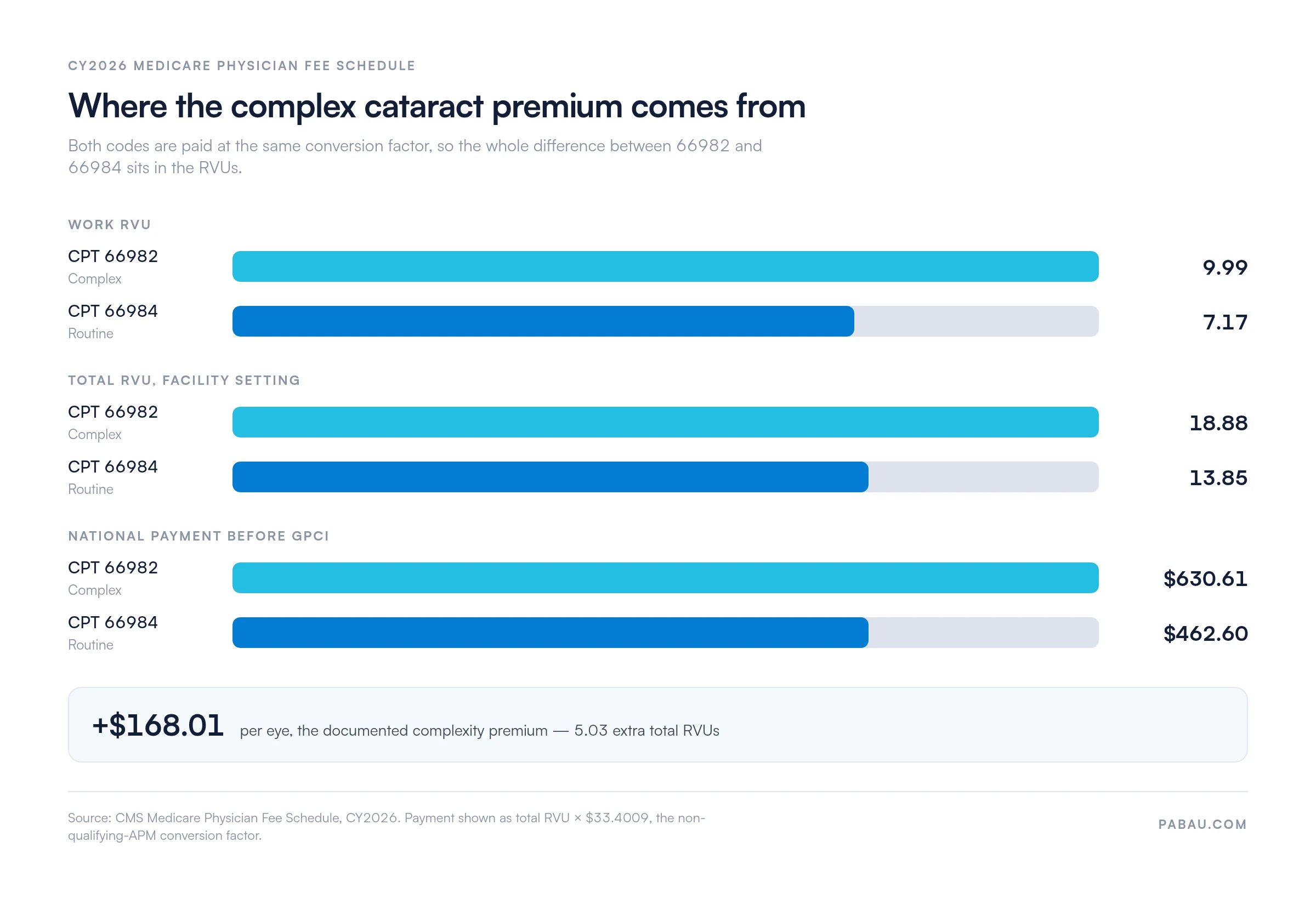
CY2026 assigns 66982 a work RVU of 9.99 and a total facility RVU of 18.88, roughly $631 nationally.
That is about $168 more per eye than CPT 66984, and the operative report has to name the complicating factor to earn it.
CPT Code 66982 is the billable code for complex extracapsular cataract removal with insertion of an intraocular lens prosthesis, performed in one stage. Complex means the surgeon needed a device or technique that a routine cataract case would not call for. Surgery on a patient in the amblyogenic developmental stage also qualifies on its own.
This reference covers the official descriptor, the qualifying complex conditions, and the CY2026 Medicare fee schedule and RVU breakdown. It also covers modifiers, ICD-10 pairings, documentation requirements, and the billing errors that trigger denials.
According to the American Medical Association (AMA), the descriptor names two separate routes into the code. One is a case “requiring devices or techniques not generally used in routine cataract surgery.” The descriptor names iris expansion devices, suture support for the lens, and primary posterior capsulorrhexis as examples. The other is a case “performed on patients in the amblyogenic developmental stage,” which needs no other complicating factor.
The descriptor also closes with “without endoscopic cyclophotocoagulation.” A complex cataract extraction combined with ECP is reported under CPT 66987 instead. The code sits in the ophthalmology subsection of the surgery section, alongside its routine counterpart.
Full official descriptor, CPT 66982
The load-bearing phrase is “requiring devices or techniques not generally used in routine cataract surgery.” Phacoemulsification alone does not qualify a case as complex. The complicating factor has to change the operative approach in a way the surgeon can name and document.
A descriptor also decides how quantity reaches the claim line. The 66982 descriptor covers a whole procedure, while HCPCS code B4100 bills per ounce of product, so a 16-ounce container is 16 units.
CMS Billing and Coding Article A53047 defines the qualifying complicating conditions. Not every difficult surgery meets the threshold. The complicating factor has to require a device or technique that a routine case would not use.
Medical necessity under Article A53047 is not established by diagnosis alone. The operative note has to state which complicating condition was present, which device or technique it prompted, and why that approach was required. A claim without that narrative fails the criteria whatever ICD-10 code is submitted.
The choice between the two codes is the most scrutinized decision in cataract billing. Both describe extracapsular removal with IOL insertion. The difference is whether a complicating condition forced techniques beyond standard phacoemulsification, which is the territory CPT 66984 covers. Each code assumes the eye still holds its natural lens. An IOL exchange after earlier surgery is CPT 66986.
Billing 66982 for a case whose operative report describes only routine phacoemulsification and an uneventful course is upcoding. It is the most common finding in ophthalmology billing reviews. The payment difference exists to cover the added complexity, time, and resources, and a long or frustrating case does not create it on its own.
According to the CMS Physician Fee Schedule, payment for 66982 varies by geographic locality through GPCI adjustments. The figures below are national amounts before that adjustment. Practices should confirm their own rates in the CMS lookup tool, since amounts differ across the Palmetto GBA, Noridian, Novitas, and CGS jurisdictions.
Relative value units set the base of Medicare payment before geographic adjustment. CMS reduced facility practice expense values across surgical codes for CY2026. The figures below are lower than the ones many practices budgeted from prior years.
CY2026 is the first year with two conversion factors. Qualifying APM participants are paid at $33.5675 and everyone else at $33.4009. Multiplying 18.88 by each gives $633.75 and $630.61, which is where the payment row above comes from. The same arithmetic on 66984 lands at $462.60, so the complexity premium is about $168 per eye.
Confirm the exact values against the current CMS MPFS file before using them for revenue projections. RVUs are republished every year, and the facility and non-facility columns do not carry the same practice expense.
Download the CMS Physician Fee Schedule file in November each year to capture finalized rates before January 1. Map your ophthalmology codes against the new file during Q4, so an RVU or conversion factor change never reaches a claim first.
Modifier selection affects both claim processing and audit exposure. Per the AAPC, the modifiers reported most often with this code are the laterality modifiers LT and RT. Modifier 22, for increased procedural services, comes next.
Modifier 22 is the one most often misused here. A difficult case is not enough on its own. The operative report has to quantify the additional work: how much extra time it took, and what was encountered beyond the expected complexity. Send a cover letter with the claim, because many MACs deny the upward adjustment without a narrative and require a separate appeal.
A claim needs an ICD-10-CM diagnosis code that supports medical necessity and matches the complicating condition in the operative report. The H25 series covers age-related cataract and the H26 series covers other cataract, and both are common pairings.
Where a code carries laterality, specify it and match the LT or RT modifier on the surgical claim. Right eye is 1, left eye is 2, and bilateral is 3 where the subcategory offers it. A mismatch between the diagnosis code and the modifier is an automatic edit failure at most clearinghouses.
H26.20 is the exception worth memorizing, since unspecified complicated cataract has no laterality split at all. The diagnosis also has to justify the complex designation. Reporting H25.011 for a standard cortical cataract, with no documented reason the case needed complex techniques, is the disconnect payers flag on review.
Article A53047 sets the documentation standard. A claim that clears the clearinghouse edits can still be denied on post-payment review when the medical record does not support the billed complexity. Treat the operative report as the primary evidence, because on audit it is the only account of what happened.
The OIG Work Plan has named cataract surgery upcoding as a focus area for years. Most 66982 denials trace back to one of the errors below. Read them alongside the common claim denial codes to see which remark code each one produces. Post-payment audits raise the stakes further, since findings can be extrapolated across the full volume of similar claims.
Complex is a defined threshold in other code families too. CPT 95972 hinges on the number of device parameters changed during the session rather than on the clinician’s sense of difficulty.
A clearinghouse workflow that runs pre-submission edits catches laterality mismatches, missing modifiers, and invalid diagnosis pairings before the claim reaches the MAC. After submission, pulling electronic remittance data back into the practice management system lets billing staff see which payers deny 66982 most often.
Audit your 66982-to-66984 ratio by surgeon each quarter. If one provider reports 66982 far more often than peers with similar patients, pull a sample of operative reports. Check that the complicating conditions are documented consistently. Fixing the pattern internally costs far less than answering a MAC post-payment audit.
Most errors on this code are not deliberate upcoding. They happen when the operative note never reaches the coder in usable form. If the note template never prompts for the complicating condition and the technique it required, the coder is working blind. The team then either guesses at the level or drops to 66984 unnecessarily.
Pabau is practice management software for medical and aesthetic practices, and its claims module works as software for ophthalmology billing. Surgeons work from structured operative note templates. Each one asks for the complicating condition, the device used, and the clinical justification before the note can be signed. The coding team then receives the narrative it needs to support 66982. Claims transmit through the Claim.MD integration, which runs its own pre-submission edits before the claim reaches the payer.
For multi-location ophthalmology groups, Pabau’s reporting shows 66982 acceptance rates by surgeon and by location. Billing managers can spot an outlier and arrange documentation coaching before a MAC audit finds the same pattern.

Pabau helps ophthalmology practices enforce operative note checklists, apply modifiers correctly, and submit 66982 claims through the Claim.MD clearinghouse network. See how it works in a live demo.

Treat 66982 as a documentation decision rather than a billing one. The code holds up on review when the operative report names the complicating condition and the device or technique it forced. It also has to say why both were necessary.
Without that narrative, the extra $168 per eye is money the practice will eventually give back with interest. The pediatric pathway is the part worth re-reading. Surgery in the amblyogenic developmental stage qualifies on its own.
Practices that treat it as needing a second complicating factor undercode cases they are entitled to bill. Book a demo to see how Pabau ties the operative note to the claim, so complex cataract cases are coded the way they were performed.

Need to understand clean claim requirements before submitting 66982? Clean claim submission guide walks through what makes a claim pass first-pass adjudication without manual review.
Wondering how electronic remittance works after your 66982 claim adjudicates? Electronic remittance advice explained covers how to read and reconcile ERA files against your fee schedule.
Looking for guidance on insurance credentialing for ophthalmology providers? Getting credentialed with insurance companies covers the enrollment steps MACs and commercial payers require before claims will pay.
CPT Code 66982 covers extracapsular cataract removal with insertion of an intraocular lens prosthesis when the case is complex. Complexity is established two ways. Either a complicating condition required a device or technique beyond routine phacoemulsification. Qualifying conditions include small pupil, zonular dialysis, traumatic cataract, and incomplete cataract needing manual technique. Or the patient was in the amblyogenic developmental stage, which qualifies on its own.
The most common modifiers are LT for the left eye and RT for the right eye, which Medicare requires for laterality. Modifier 22 may be added when the case involves substantial additional work beyond the complex designation. It needs a separate written narrative for the payer. Modifier 50 applies when both eyes are operated on in the same session, though most payers require separate claims.
The primary pairings come from the H25 series for age-related cataract and the H26 series for other cataract. Common choices are H26.101 for traumatic cataract and H26.20 for unspecified complicated cataract. H26.001 covers infantile and juvenile cataract, and H25.011 or H25.012 cover cortical age-related cataract. Note that H26.20 carries no laterality character, so there is no right or left variant of it.
Prior authorization requirements vary by payer. Medicare does not universally require prior authorization for cataract surgery, but individual Medicare Advantage plans and commercial payers may. Some payers require authorization for 66982 and not for 66984. Check each payer policy before scheduling, since billing without a required authorization results in denial whatever the clinical picture.



