CPT Code 62284: Injection procedure for myelography
CPT Code 62284: official descriptor and procedure overview The American Medical ...

Last Updated: Oct 19, 2026
V2399 is the HCPCS Level II code for a specialty trifocal lens, billed by report and per lens. It is used only when no fixed trifocal code describes the dispensed lens, such as a proprietary segment design.
"By report" means every claim needs a written special report. The report names the lens and explains why no standard trifocal code applies. Without it, payers deny the line.
Let Pabau's smart automation suggest the right codes, reduce claim denials, and keep your practice compliant—effortlessly.
Automate repetitive tasks and focus on what matters most—your patients.
Reduce coding errors and ensure compliance with the latest regulations.
Clean claims, fewer denials, and faster reimbursements.
Powerful insights and reporting to help your practice thrive.
HIPAA compliant SOC 2 certified GDPR-compliant Trusted by 4,000+ clinics worldwide

HCPCS code V2399 covers specialty trifocal lenses that no fixed trifocal code describes, billed per lens.
The by-report designation means every claim needs a written special report explaining why the lens is clinically necessary.
Medicare Part B excludes routine vision, so V2399 is covered only under the post-cataract lens benefit for pseudophakia or aphakia.
Practice management software like Pabau supports V-code entry, modifier attachment, and claim-note documentation for optical billing.
HCPCS code V2399 is the Level II code for a specialty trifocal lens, billed by report and per lens. It covers trifocal designs that no fixed trifocal descriptor, such as V2300 through V2305, accurately describes. The code sits at the end of the V2300-V2399 trifocal range because it is the catch-all for non-standard designs.
The official short descriptor is Specialty trifocal (by report). “By report” is a billing instruction. If no special report goes out with the claim, the line is unbillable, whatever lens was dispensed. That sets V2399 apart from its neighbors, whose fixed descriptors need no narrative attachment.
The table below organizes the reference data optical billers need for V2399 at a glance.
The claim notes and the special report should both carry the prescription: sphere, cylinder, axis, add power, segment height, and lens material. For V2399, the report should also name the design feature that rules out the standard codes.
V2399 applies when a trifocal lens is dispensed and no fixed trifocal code accurately describes it. Scenarios that legitimately fall under V2399 include:
Knowing what the code excludes matters just as much for clean billing in an optical practice.
The fixed descriptors run past V2305 as well. A lens of plus or minus 4.25 to plus or minus 7.00D sphere with cylinder up to 2.00D bills as V2307. At the same sphere, a cylinder of 4.25 to 6.00D has its own fixed descriptor under V2309.
The most common misuse is billing V2399 for a standard spherocylinder trifocal that belongs under V2303, V2304, or V2305. It usually happens because the biller doesn’t know the adjacent descriptors, which the next section lays out.
Each code in the V2300-V2305 range describes one lens type, by sphere power alone or by sphere and cylinder power. V2399 is only appropriate when no fixed descriptor applies, so check the table before billing.
The decision rule is simple. For a sphere-only lens, match the sphere power to V2300, V2301, or V2302. For a spherocylinder lens with sphere up to plus or minus 4.00D, match the cylinder power to V2303, V2304, or V2305. None of these codes has an add-power tier, so add power never changes the pick. The chart below shows how the six bands split.
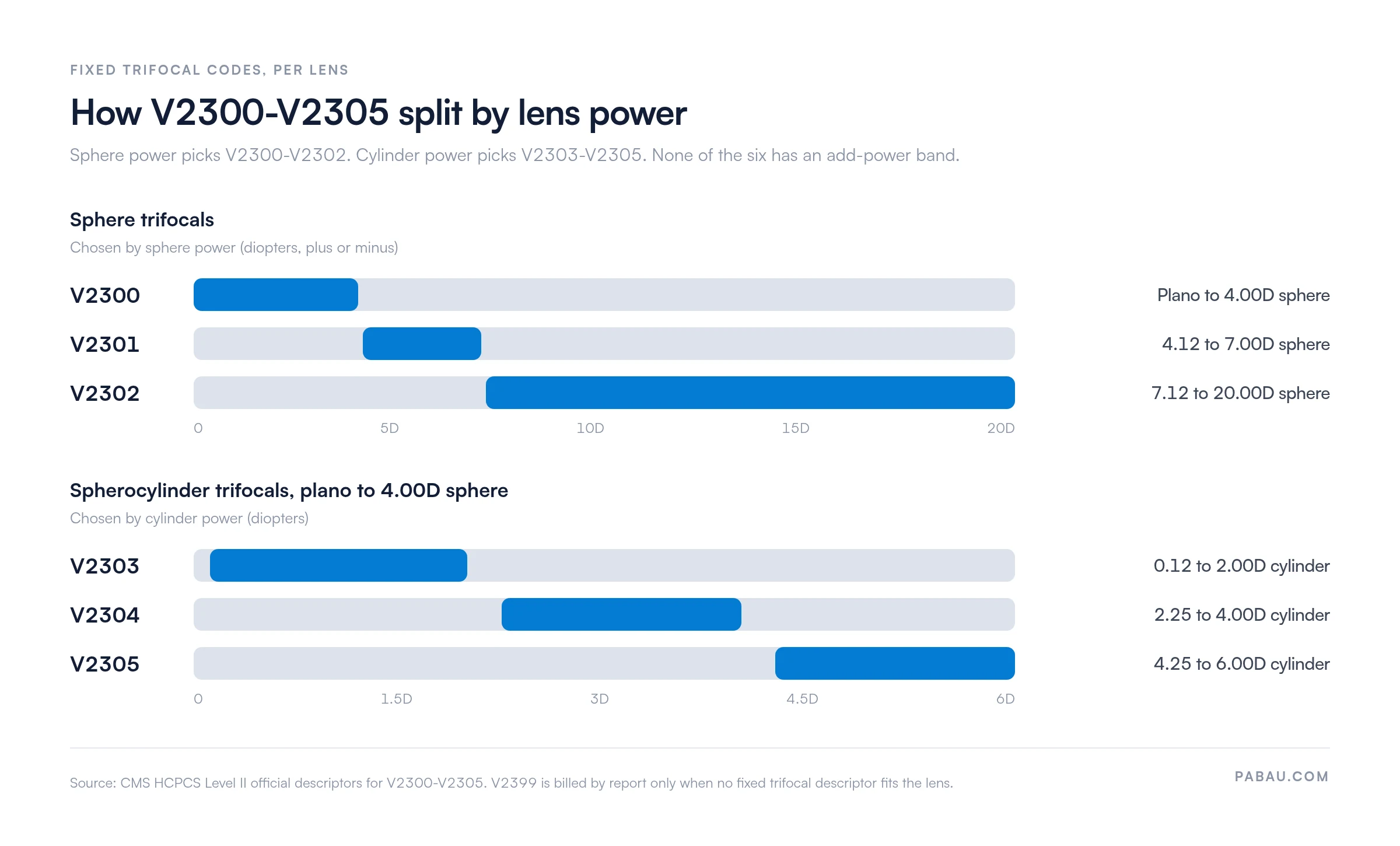
Select V2399 only when the lens design or power falls outside every fixed trifocal descriptor.
Every V2399 claim depends on a special report that survives payer scrutiny. A vague note such as “specialty lens dispensed” won’t pass. The report must explain why no standard code applied and why this lens was clinically appropriate.
The cleanest approach builds the special report into your dispensing workflow instead of writing it after the fact. Here is the step-by-step process.
Pabau’s digital forms capture prescription parameters and the dispensing rationale at the point of care. That shortens the time it takes to compile the special report, so no required detail is missing when the claim goes out.

Build a V2399 special-report template into your dispensing workflow. Give it fields for the ICD-10 diagnosis, the lens brand and model, and the prescription parameters (sphere, cylinder, axis, add, segment height). Add a free-text field explaining why no fixed trifocal code applies. Completing it at dispensing is far faster than rebuilding it after a denial.
Modifier usage for HCPCS code V2399 follows standard vision HCPCS conventions. The table below lists the modifiers most often attached to V-code lens claims and how each applies to V2399.
Modifier requirements vary by payer, so check each payer’s vision policy before submitting. Some commercial plans require RT or LT on every lens line. Others accept two units billed without a laterality modifier. A missing required modifier is one of the top denial triggers for V2399 claims.
Medicare Part B excludes routine vision care, so most spectacle lens claims, including V2399, are noncovered under traditional Medicare. The exception is the post-cataract benefit in the Medicare Benefit Policy Manual, Chapter 15, §120. It covers one pair of spectacle lenses after cataract surgery with an intraocular lens (IOL) implant, a condition called pseudophakia.
The same benefit covers aphakia, where no IOL was inserted. V2399 may be billed under either pathway when a specialty trifocal design is clinically justified for the post-surgical patient.
Outside that benefit, coverage comes from other plans, and it varies considerably by plan type.
Reimbursement for V2399 isn’t fixed nationally. Fee schedules vary by payer, MAC jurisdiction, and contract year. Use the CMS HCPCS overview and your MAC’s fee schedule tool to look up current allowed amounts, rather than relying on published estimates. Verifying insurance eligibility early confirms whether the patient’s plan covers specialty trifocals at all.
Prior authorization (PA) for HCPCS code V2399 isn’t universal. It is common enough with commercial vision plans and Medicare Advantage that skipping the check predictably generates denials. Treat every V2399 claim as potentially needing PA until you’ve confirmed the payer’s policy.
The checklist below covers the documentation elements most payers require for V2399 claims. Missing any one element is grounds for denial.
Some plans also require a letter of medical necessity (LMN). The letter should cover four points:
An LMN is distinct from the special report, but it can satisfy both requirements if it contains every element above. Keep the PA confirmation, the LMN, and the special report in the patient’s file. Compliance guidance commonly recommends retaining them for at least seven years.
V2399 denials cluster around a small set of root causes. The table below maps each common denial pattern to its likely cause and the corrective action that resolves it. Logging each one against the standard denial codes shows which fix to make first.
Tracking denials by code across your claims data exposes systemic issues faster than reviewing each denial on its own. Review V2399 denials monthly against the root causes above. For the wider trifocal code range, the AAPC HCPCS code reference is a useful lookup.
Once a month, audit every V2399 claim submitted in the prior 30 days. Filter for denials, then sort each one by the root causes in the table above. When more than 20% of denials share one root cause, fix the workflow behind it instead of correcting claims one by one.
Many optical practices keep the prescription in one system, the special report in a word processor, and the claim in a clearinghouse portal. Each handoff is a chance for the report to go missing before submission.
Pabau’s connected claims management lets billing staff attach claim notes, link the special report, and track authorization status. All of it sits in the same system used for scheduling and patient records.
The result is a V2399 claim that leaves with its report attached, so fewer lines come back denied for missing documentation.
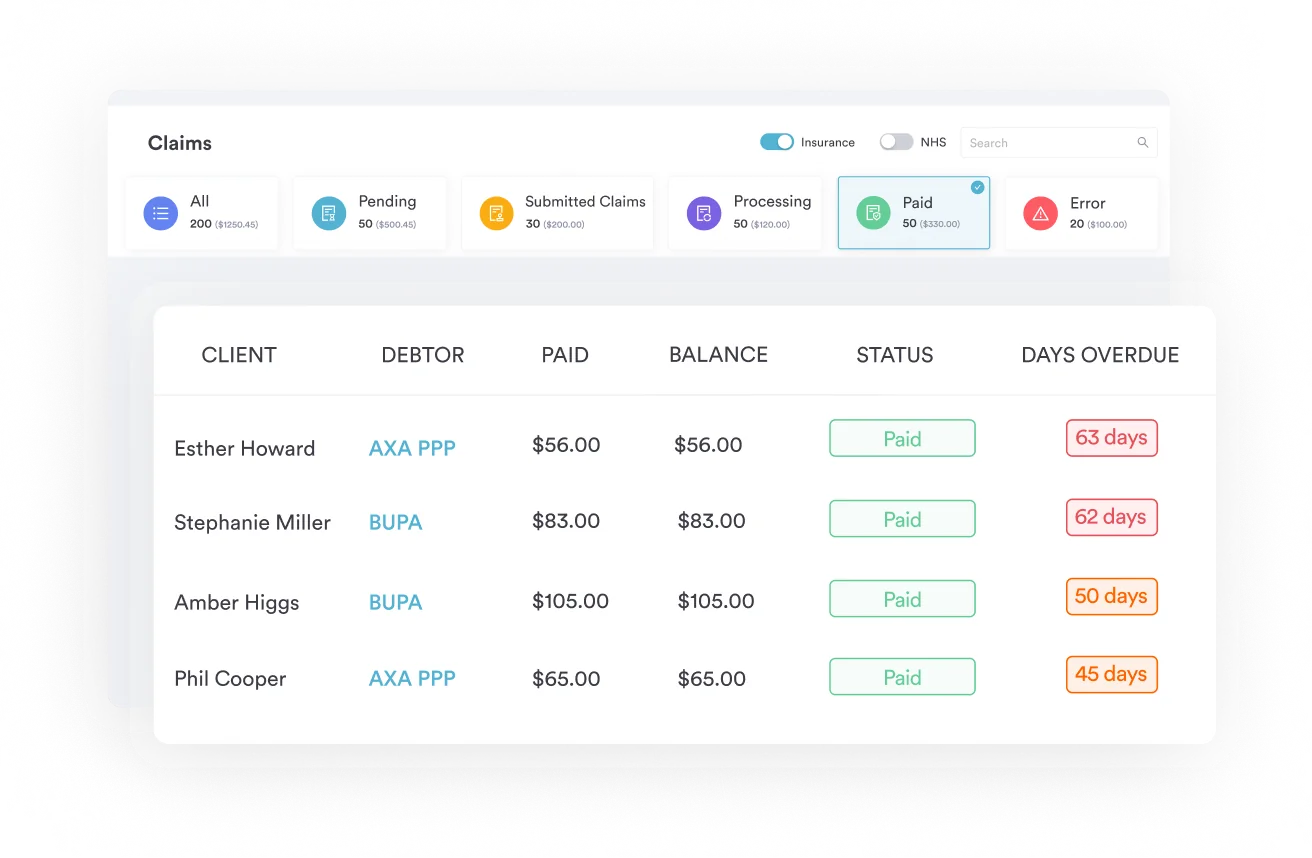

Pabau’s claims tools handle V-code entry, modifiers, and claim notes in one place. Your optical billing team submits clean V2399 claims without switching systems.

V2399 rewards the practices that settle the code before the lens is ordered. Check the fixed trifocal descriptors first, and bill V2399 only when none of them fits.
When V2399 is right, the special report decides whether the claim pays. Write it at dispensing, name the lens and the reason no standard code applies, and attach it every time. Fixing that workflow once prevents the two most avoidable denials, wrong code selection and a missing report.
Book a demo to see how Pabau keeps V2399 special reports and claims together for your optical billing team.

Need a primer on how medical billing works end to end? What is revenue cycle management explains the full claim lifecycle from eligibility verification to payment posting.
Want every V2399 claim to pass on first submission? What is a clean claim covers the fields and checks that get a claim paid without rework.
Handling a run of lens claim denials? Denial management in healthcare sets out how to work, appeal, and prevent denied claims.
Want to reduce denials across your HCPCS claims portfolio? How to build a clean superbill covers the documentation elements that keep claims out of the denial queue.
Billing V-codes for a multi-location optical practice? Medical billing compliance guidance outlines the audit and retention practices that protect against payer audits.
HCPCS code V2399 is the Level II code for a specialty trifocal lens, billed by report and per lens. It covers trifocal designs that no fixed code, such as V2300 through V2305, describes. Because it needs a written special report, use it only when a standard trifocal code can’t describe the lens.
V2399 covers specialty trifocal lenses whose design or power no fixed trifocal code describes. Examples include non-standard segment geometries, occupational trifocal designs, and hybrid designs no fixed descriptor captures. It does not cover standard sphere or spherocylinder trifocals that fit a fixed code, bifocal lenses, frames, coatings, or lens add-ons.
Medicare Part B generally doesn’t cover routine vision or spectacle lenses. The exception is the post-cataract benefit, which covers one pair of lenses after cataract surgery. It applies to pseudophakia, where an intraocular lens was implanted, and to aphakia, where none was. V2399 may be billed under that benefit when a specialty trifocal design is clinically justified. Otherwise, coverage comes from commercial vision plans or Medicare Advantage plans with an optical benefit.
Billing V2399 requires a special report explaining why no standard trifocal code applies. It must include the ICD-10 diagnosis code and full prescription parameters (sphere, cylinder, axis, add power, segment height). It also names the lens brand and model and gives a written rationale for the specialty design. Missing any of these elements is grounds for denial.
V2305 is a spherocylinder trifocal with plano to plus or minus 4.00D sphere and 4.25-6.00D cylinder, per lens. V2399 applies only when no fixed trifocal code describes the lens’s power or segment design. If V2305 fits, use it.
The most common modifiers for V2399 are RT and LT for laterality. KX confirms that medical necessity criteria are met, where the payer requires it. AR is used when a payer wants confirmation that a physician ordered the lens. GA signals that an Advance Beneficiary Notice is on file when a denial is expected. Modifier requirements vary by payer, so confirm them before submitting.
The most common V2399 denial reasons are a missing special report and billing V2399 when a fixed trifocal code applies. Others include billing Medicare outside the post-cataract lens benefit, missing or incorrect modifiers, and skipped prior authorization. A thin special report, with a vague rationale or missing prescription parameters, is the second most common cause after code selection errors.
Payer policies vary significantly. Commercial vision plans (VSP, EyeMed, Davis Vision) generally allow V2399 with an adequate special report but may apply a higher patient cost-share. Medicare Advantage plans may cover specialty trifocals under their optical benefit with prior authorization. State Medicaid programs set their own policies, and some vision fee schedules include specialty trifocal codes while others don’t. Check the plan’s optical benefit policy before billing, and for Medicaid, the state’s vision procedure code list.