CPT Code 98981: RTM Treatment Management Billing Guide
CPT code 98981: Definition and official descriptor CPT code 98981 is an add-on c...

Last Updated: Nov 9, 2026
T2021 is the HCPCS Level II code for day habilitation, waiver; per 15 minutes. It reports skill-building services for Medicaid waiver participants, delivered in a non-residential setting and billed in 15-minute units.
Day habilitation helps a participant build or keep self-help, socialization and adaptive skills. T2020 reports the same service per diem. T1019 and T1020 cover personal care, which is hands-on help with daily tasks, so neither one replaces T2021. Each state sets the rate, modifiers and prior authorization rules.
Let Pabau's smart automation suggest the right codes, reduce claim denials, and keep your practice compliant—effortlessly.
Automate repetitive tasks and focus on what matters most—your patients.
Reduce coding errors and ensure compliance with the latest regulations.
Clean claims, fewer denials, and faster reimbursements.
Powerful insights and reporting to help your practice thrive.
HIPAA compliant SOC 2 certified GDPR-compliant Trusted by 4,000+ clinics worldwide

HCPCS code T2021 reports day habilitation delivered under a Medicaid HCBS waiver, billed in 15-minute units.
Day habilitation builds or maintains self-help, socialization and adaptive skills in a non-residential setting, away from where the participant lives.
T2021 is a T-code for state Medicaid use, so traditional Medicare does not pay it.
Each state sets the rate, the required modifiers, the daily unit cap and the prior authorization rules for T2021.
Use T2020 when your state pays day habilitation per diem, and T1019 or T1020 when the service is personal care instead.
HCPCS code T2021 is the Level II code for day habilitation provided under a Medicaid waiver, billed per 15 minutes. It reports structured, non-residential programs that help a participant build or keep everyday skills. Most participants are adults with an intellectual or developmental disability.
CMS maintains the T-series for state Medicaid agencies, as its HCPCS overview explains. T2021 has been effective since October 1, 2003, and it remains active. Traditional Medicare does not pay T-codes, so the claim goes to the state Medicaid program or its managed care plan. The neighboring T-series codes are covered in our HCPCS reference for billers.
T2021 covers day habilitation, which helps a participant gain, keep or improve self-help, socialization and adaptive skills. The service takes place in a non-residential setting, separate from where the participant lives. Typical settings are a day program center and community activities run by that program.
The setting boundary causes many coding errors. Skill training inside the participant’s residence is residential or in-home habilitation in most waivers, not day habilitation. Check how your state’s waiver defines each service before you bill.
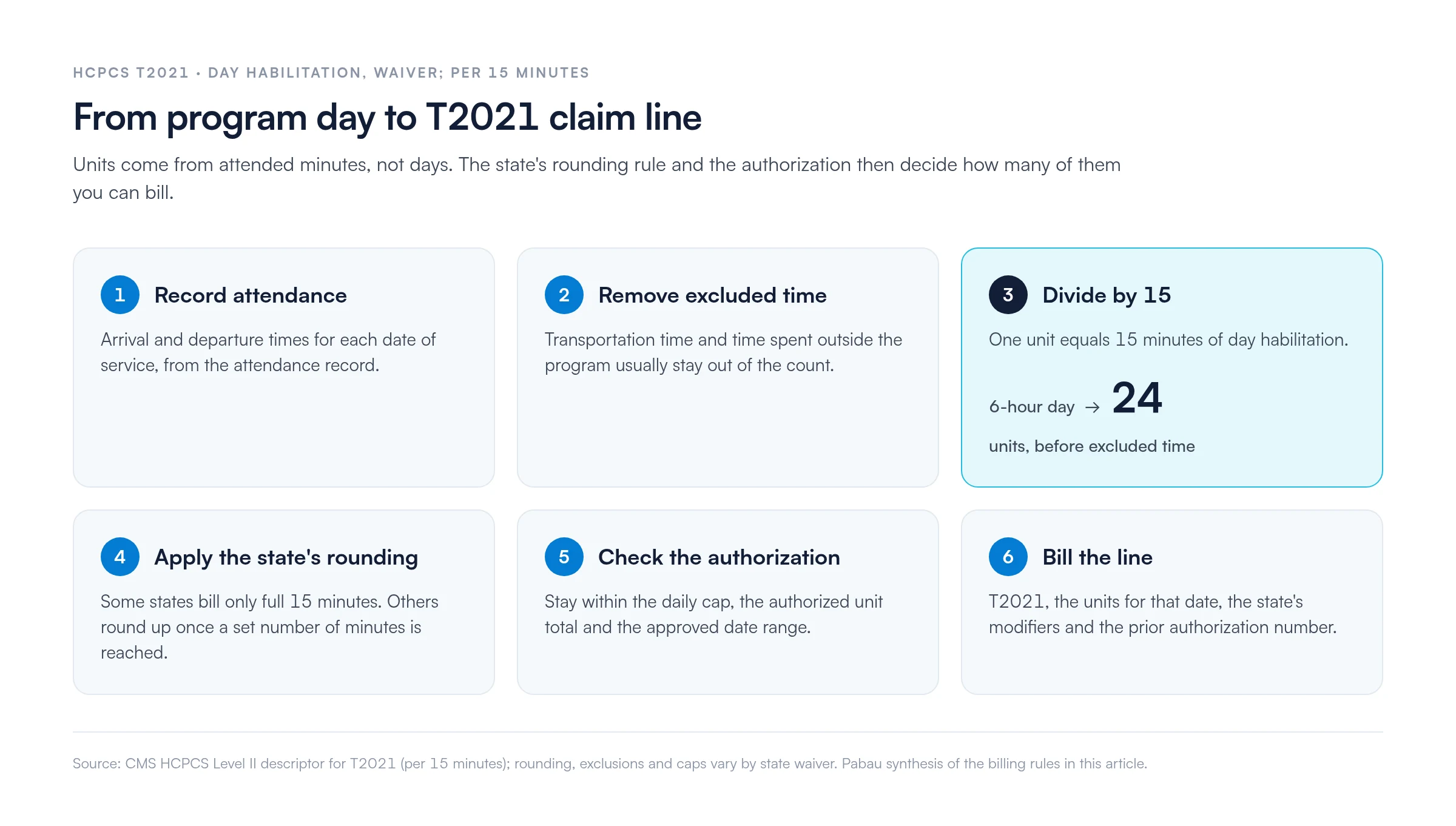
One unit of T2021 equals 15 minutes of day habilitation. Count the time the participant spends in the program, then divide by 15. A six-hour program day equals 24 units, before any time the state excludes.
States add their own unit rules on top of the descriptor:
Put in order, those rules turn a program day into a claim line in six steps.
Rates are set by each state and change with its fiscal year. Tennessee, for example, publishes T2021 rates on its TennCare rate sheet. Iowa lists the code in its intellectual disability waiver billing chart. Check your state’s current fee schedule before you quote a rate.
Before submission, compare each day’s T2021 units with the attendance record for that date. A line that bills more minutes than the participant attended is the claim most likely to deny or be recouped at audit.
T2021 is paid through Medicaid Home and Community-Based Services (HCBS) waivers approved under Section 1915(c) of the Social Security Act. Each state lists day habilitation as a waiver service. Its waiver document then defines the eligible providers, rates and limits.
When a state runs waiver services through managed care, the plan’s billing manual governs the claim. Confirm the plan accepts T2021 before you bill it. Traditional Medicare Part A and Part B do not pay T2021, because T-codes are reserved for state Medicaid use.
T2021 and T2020 both report waiver day habilitation, and the billing unit is the only difference. T1019 and T1020 report personal care, a different service with the same unit split. Match the service first and the unit second.
The service decides the code family. Day habilitation teaches or maintains skills, while personal care performs daily tasks with or for the person. The state waiver then decides the unit. If it pays day habilitation per day, report T2020, and if it pays by time, report T2021. Most states don’t allow both codes for the same participant on the same date. The AAPC’s HCPCS code lookup shows the neighboring descriptors side by side.
Modifier rules for T2021 come from the state, so no national list applies. The table shows modifiers states commonly pair with day habilitation. Confirm each one in your state’s current waiver billing manual.
A claim missing a state-required modifier usually denies for incomplete coding. Modifier rules can change with each waiver amendment, so recheck them at every renewal.
T2021 is paid by time, so the record has to prove the minutes and the skills work behind them. Assemble these items before the first claim and keep them current. Medicaid billing compliance rests on this record.
Electronic visit verification (EVV) applies only in some cases. The 21st Century Cures Act requires EVV for Medicaid personal care and home health services delivered in the home. Day habilitation in a center is not an in-home visit, so the federal rule usually does not reach it. Some states extend EVV to in-home or community habilitation, so check your state’s EVV service list.
Most states require prior authorization for T2021 through the waiver’s service planning process. The approval sets how many 15-minute units the participant can receive in a period.
T2021 denials cluster around a few preventable errors. Spotting the pattern is the start of effective denial management. The table maps each reason to a fix.
Set an authorization alert 30 days before the end date, not on the last day. Service plan renewals can take weeks, and units delivered after expiry are hard to recover. Some states allow billing under a pending renewal, so check your manual.
Day habilitation billing depends on three records agreeing: The authorization, the attendance log and the claim. In many agencies they live in separate places, and the billing team reconciles them by hand. That is where units drift past the cap or past the end date.
Pabau, our practice management and billing software, keeps the authorization and the claim on one patient record. The authorization code, dates and sessions sit on the case, with a warning when one is missing. Pabau’s claims management software then sends US claims on the CMS-1500 or 837P through Claim.MD, with eligibility checks.
Claims come from the patient record rather than from memory or a spreadsheet. Billing staff and program managers see the same authorization dates, so a renewal can start before the end date passes. For program managers without a coding background, our guide to medical billing workflows covers the claim cycle end to end.

Pabau tracks the authorization code, dates and sessions on the case, and builds the claim from the patient record. US claims then go out on the CMS-1500 or 837P through Claim.MD.

T2021 is a narrow code surrounded by state detail. Get the service right first, because day habilitation is skill-building in a non-residential setting, not personal care. Then bill in 15-minute units, within the authorized total and the daily cap.
Treat your state’s waiver manual as the final word on rates, modifiers and rounding. Re-read it at each waiver amendment, since a rule that changed last year is the one that denies this year. Book a demo to see how Pabau keeps authorizations and claims on one record for your day habilitation program.

Need to understand the broader HCPCS framework? Medical billing workflows explained covers how HCPCS Level II codes fit into the claim submission process from service delivery to payment posting.
Struggling with claim denials across your Medicaid portfolio? Denial management in healthcare outlines the most effective strategies for tracking, appealing, and preventing denied claims.
Want to keep your billing practices audit-ready? Medicaid billing compliance guidance details the documentation standards and audit triggers that affect Medicaid waiver claims.
Is the skill training happening where the participant lives? HCPCS code T2016: Residential habilitation billing guide covers the residential service that day habilitation excludes.
Billing work-readiness training instead of day habilitation? HCPCS code T2015: Hourly prevocational habilitation billing guide explains the prevocational code and its hourly units.
HCPCS code T2021 covers day habilitation provided under a Medicaid HCBS waiver, billed per 15 minutes. The service builds or maintains self-help, socialization and adaptive skills in a non-residential setting. It does not cover residential habilitation, supported employment, transportation or personal care.
Both codes report waiver day habilitation, and only the billing unit differs. T2021 bills per 15 minutes, while T2020 bills one unit per day. Your state’s waiver decides which unit it pays, and most states don’t allow both for one participant on the same date.
No. T1019 and T1020 report personal care services, which is hands-on help with daily tasks such as bathing and dressing. T2021 reports day habilitation, which teaches or maintains skills. T1019 bills per 15 minutes and T1020 bills per day.
No. T2021 is a T-code reserved for state Medicaid use, and traditional Medicare does not pay it. Day habilitation is funded through state Medicaid waiver programs, so the claim goes to Medicaid or its managed care plan.
One unit equals 15 minutes, so a six-hour program day is 24 units before any excluded time. Your state sets the daily maximum through the waiver, the service plan or the prior authorization. It also sets the rounding rule for partial units.
Usually not for center-based day habilitation. The federal EVV mandate covers Medicaid personal care and home health services delivered in the home. Some states extend EVV to in-home or community habilitation, so check your state’s EVV service list.
You need a current service authorization, a person-centered service plan and daily attendance records with arrival and departure times. Progress notes should show the skills worked on and link to the plan’s goals. Keep proof of provider enrollment and waiver eligibility for each date.