CPT Code 86160: Complement component billing and coding guide
CPT code 86160: Official descriptor and definition CPT code 86160 is defined by ...

Last Updated: Nov 26, 2026
T2017 is the HCPCS Level II code for habilitation, residential, waiver; 15 minutes. It reports residential habilitation delivered under a Medicaid Home and Community-Based Services waiver, with each unit equal to 15 minutes.
T2017 is a T-code for state Medicaid agencies, so Medicare does not pay it. Each state sets the service definition, provider qualifications, authorization rules and rate. Its sibling T2016 bills the same service per diem.
Let Pabau's smart automation suggest the right codes, reduce claim denials, and keep your practice compliant—effortlessly.
Automate repetitive tasks and focus on what matters most—your patients.
Reduce coding errors and ensure compliance with the latest regulations.
Clean claims, fewer denials, and faster reimbursements.
Powerful insights and reporting to help your practice thrive.
HIPAA compliant SOC 2 certified GDPR-compliant Trusted by 4,000+ clinics worldwide

T2017 reports residential habilitation under a Medicaid HCBS waiver, billed in 15-minute units.
The code is a Level II T-code for state Medicaid agencies, so Medicare does not pay it and each state sets the rules.
T2016 bills the same service per diem, so a state picks one structure for each waiver service, never both for the same hours.
Every unit needs dated staff notes with start and stop times, tied to goals in the person-centered service plan.
Most denials trace to units beyond the authorization, missing time records, or a modifier the state did not define.
HCPCS code T2017 is the Level II code for habilitation, residential, waiver; 15 minutes. It sits in the T-code range, which exists for state Medicaid agencies rather than Medicare. The AAPC code record for T2017 lists the descriptor and its 15-minute unit.
T-codes report services that state Medicaid programs pay for but Medicare does not. Pabau’s HCPCS code library lists the other T-codes in this range. T2017 has been in effect since October 2003. Medicare makes no payment on it, so no national fee schedule amount exists.
Treat the national descriptor as the starting point only. The state waiver document defines what the service includes, who may deliver it, and how it is paid.
Residential habilitation is support that helps a person learn, keep or improve the skills needed to live in the community. It is delivered where the person lives, such as their own home, a family home or a group home.
State waivers describe the service in their own words. The support usually falls into a few areas:
Habilitation teaches skills toward goals in the service plan. Care that only does a task for the person, with no skill goal, often belongs to a different waiver service.
T2017 is billed for people enrolled in a Medicaid Home and Community-Based Services waiver under section 1915(c) of the Social Security Act. These waivers fund community services for people who would otherwise need institutional care. Federal rules for waiver services and the service plan sit in 42 CFR 441.301.
Confirm eligibility and waiver enrollment before every service period. Strong insurance eligibility verification habits prevent a full month of units denied for a lapsed enrollment.
One unit of T2017 equals 15 minutes of residential habilitation. Count the minutes of direct service in the staff notes, then divide by 15.
Rounding rules come from the state, not from CMS. Some states pay only for completed 15-minute units. Others let a partial unit count once it passes a stated number of minutes.
Only time spent delivering the service counts. Staff travel, record keeping after the shift and time the person is away usually fall outside the billable minutes. Check the state manual for the exact exclusions.
Add the minutes for the whole day before you convert them to units. Rounding each short visit on its own can overstate the total, and auditors recalculate from the start and stop times.
T2016 and T2017 describe the same service: residential habilitation under a waiver. The difference is the unit. T2016 pays a per diem, while T2017 pays per 15 minutes.
The state waiver chooses the structure. A 24-hour group home is often paid per diem under T2016. Intermittent support in a person’s own home is often paid by the time delivered under T2017.
Never bill T2016 and T2017 for the same person on the same day for the same service hours. Check each descriptor in the current HCPCS file, or on Find-A-Code, before you add a code to your fee schedule.
A time-based code needs time-based records. Every billed unit must trace back to a note that shows the minutes and the work done. Good medical billing compliance starts with the note, not the claim.
Retention periods vary by state and program, often six to ten years. Follow the longest period that applies.
Most states authorize residential habilitation through the service plan before services start. The authorization sets the approved dates and the number of units, or hours, for the period. Case management is a separate service from residential habilitation. A state that pays targeted case management by the month bills it under T2023.
Units billed beyond the authorization deny, even when the notes support the time. Ask for a plan revision when a person’s needs change, before the extra hours are delivered.
Each state Medicaid agency or waiver program sets the T2017 rate. Rates often vary by staffing ratio, setting or level of need. Medicaid managed care plans may pay a contracted rate that differs from the state fee schedule.
Modifiers carry those rate differences on the claim. States define most of them, so the same modifier can mean different things in two states.
Download the current fee schedule and billing manual from your state Medicaid agency each year. Reconcile payments against it, a core part of revenue cycle management for waiver services.
T2017 denials follow a few patterns, and most start before the claim is built. Each billed unit has to trace back through five records, and a break at any one denies it.
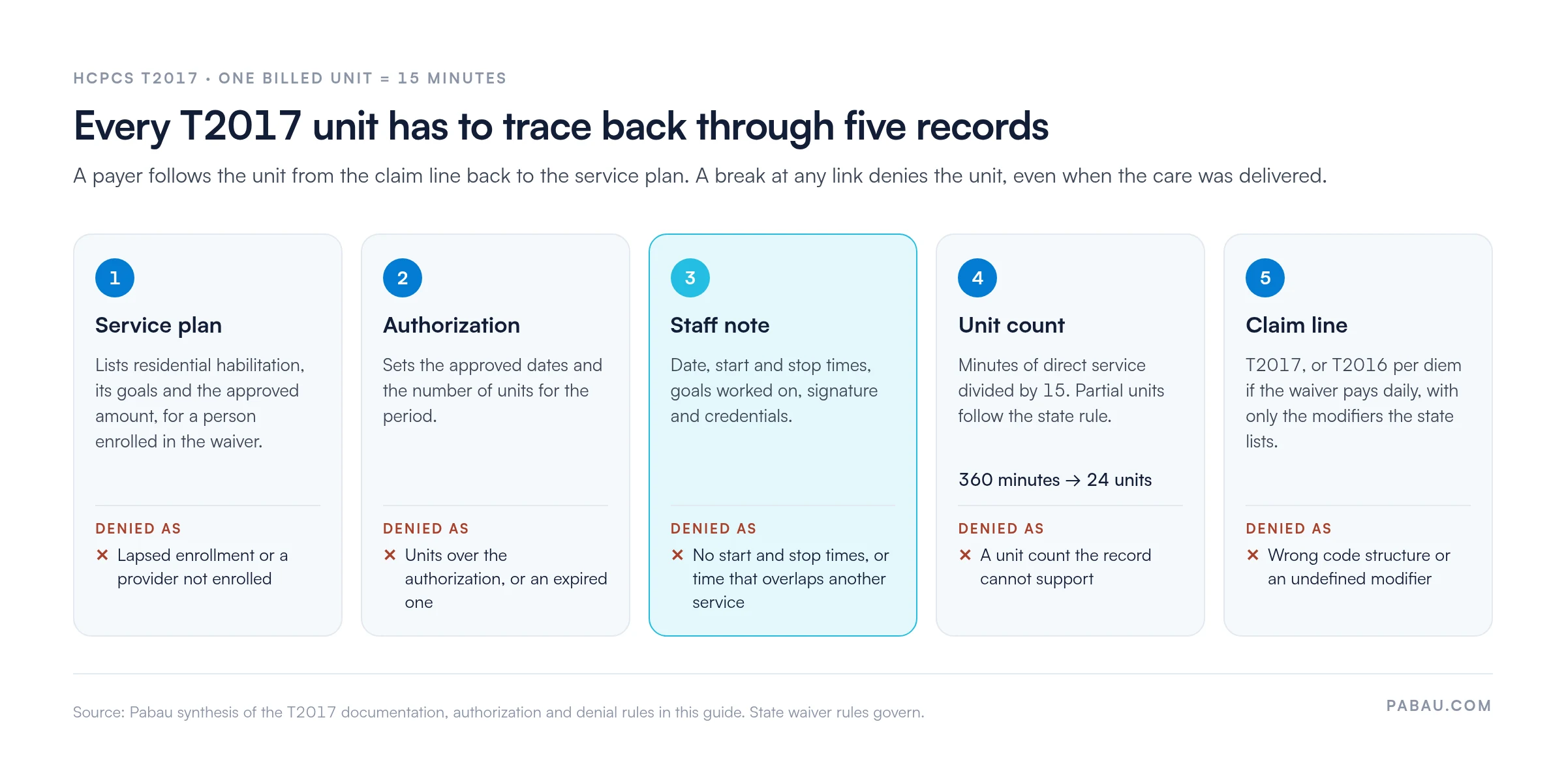
Steady denial management fixes the cause upstream so it stops repeating.
Read the adjustment reason code on the remittance first. Electronic remittance advice shows whether you need a corrected claim or an appeal. A corrected claim fixes a billing error, while an appeal contests a coverage decision.
Most of these denials disappear when the claim matches the record. The clean claim guide covers the data payers check before they process a claim.
Waiver billing depends on the authorization as much as the claim. In Pabau, a practice management platform, each person’s case holds the authorization code, the approved dates and the sessions used.
Pabau’s claims management software then submits and tracks your claims through Claim.MD in the US, where the payer is supported. State waiver programs and Medicaid managed care plans vary, so confirm each payer is on the clearinghouse list before you rely on it.
Your staff still own the unit count and the state rules. Pabau puts the authorized dates and units in front of them before each claim goes out.

Pabau tracks the authorization code, approved dates and sessions on each case. It then submits and tracks your claims through Claim.MD in the US, where the payer is supported.

T2017 is a residential habilitation code, billed by the quarter hour under a state Medicaid waiver. The national descriptor is short, and the state waiver supplies the rest.
Start with the waiver, not the code. The state defines the service, the rate, the modifiers and the rounding rule, and your notes must match them minute for minute.
Get the authorization and the staff notes right, and most T2017 denials never reach the remittance. Book a demo to see how Pabau tracks waiver authorizations and sessions on each case.

Need a framework for managing Medicaid billing denials systematically? Denial management in healthcare covers root-cause analysis and appeals workflows for recurring denial patterns.
Want to understand what a clean Medicaid claim looks like before submission? Clean claim requirements explains the data elements payers check before processing any claim.
Looking to strengthen your overall revenue cycle for Medicaid services? Revenue cycle management fundamentals walks through the end-to-end billing workflow from eligibility to payment posting.
HCPCS code T2017 covers residential habilitation delivered under a Medicaid Home and Community-Based Services waiver, billed per 15 minutes. Residential habilitation helps a person learn and keep daily living skills where they live. Each state defines the service, the qualified providers and the rate.
Both codes describe residential habilitation under a waiver. T2016 is billed per diem, while T2017 is billed per 15 minutes of service. The state waiver decides which structure applies, and a provider does not bill both codes for the same hours.
Divide the documented minutes of service by 15. Six hours of support is 360 minutes, or 24 units. The state decides how a partial unit is handled, so check the billing manual before you round.
No. T2017 is a Level II T-code created for state Medicaid agencies, and Medicare does not pay it. Coverage, prior authorization and rates come from each state Medicaid agency or waiver program.
Keep the person-centered service plan, the authorization, and dated staff notes with start and stop times. Each note needs the staff signature and credentials, the goals worked on, and the unit count. Retention periods vary by state and program, often six to ten years. Follow the longest period that applies.
Each state defines its own modifiers, usually from the U1 to UD range, to mark staffing ratio, setting or rate tier. Some states also use HQ for a group setting, or TD and TE for nursing staff. Use only the modifiers your state lists.