

HCPCS code E0198: Water pressure pad billing guide
HCPCS code E0198 is a water pad for a standard mattress HCPCS code E0198 is the ...

Last Updated: Oct 13, 2026
T2020 is the HCPCS Level II code for day habilitation, waiver; per diem.
Providers bill T2020 once per calendar day when they deliver day habilitation under an approved state Medicaid waiver. One unit equals one full day of service, not a 15-minute increment. Medicaid pays the claim and Medicare does not. Each state Medicaid agency sets its own rate, so no national fee schedule exists for T2020.
Let Pabau's smart automation suggest the right codes, reduce claim denials, and keep your practice compliant—effortlessly.
Automate repetitive tasks and focus on what matters most—your patients.
Reduce coding errors and ensure compliance with the latest regulations.
Clean claims, fewer denials, and faster reimbursements.
Powerful insights and reporting to help your practice thrive.
HIPAA compliant SOC 2 certified GDPR-compliant Trusted by 4,000+ clinics worldwide

HCPCS code T2020 covers day habilitation under a Medicaid waiver, billed per diem rather than per 15-minute unit.
T2020 is a Medicaid-only code, and Medicare does not cover day habilitation billed under T-series codes.
Documentation must include an active waiver authorization, a current person-centered plan, and qualified staff credentials.
Reimbursement rates are set by each state Medicaid agency, so no national fee schedule exists for T2020.
Practice management software like Pabau helps providers automate per diem billing, documentation capture, and denial tracking.
HCPCS code T2020 is an HCPCS Level II code in the T-series, maintained by the Centers for Medicare and Medicaid Services (CMS). T-codes cover state Medicaid and CHIP agency services that sit outside the CPT code set.
T2020 describes day habilitation delivered under an approved state Medicaid waiver. Payment is per diem, so one unit covers a full day of service rather than a single billable increment.
The T-series is distinct from CPT codes, which cover physician services. T-codes are reported only to state Medicaid programs and are not reportable to Medicare. A T2020 claim sent to a Medicare contractor is rejected outright. Per the AAPC HCPCS code reference, T2020 remains valid for 2026 under the current CMS listing.
Day habilitation services are structured programs for people with intellectual and developmental disabilities (IDD). They build daily living skills, support community participation, and work toward greater independence.
Services are delivered in group or individual settings during daytime hours, outside the person’s home. They must be authorized under an approved Medicaid home and community-based services (HCBS) waiver. What the program covers shapes what the billing record has to capture.
The service must tie back to goals in the individual’s person-centered plan. Goals missing from the plan, or not updated for the current waiver period, are a leading documentation failure in T2020 audits.
States differ in how they define day habilitation. Check your state Medicaid billing manual before billing T2020 for services that may count as supported employment or residential habilitation in your jurisdiction. When day habilitation happens at another site, the residential provider bills code T2033 as its own per diem.
T2020 is billed by Medicaid-enrolled providers who deliver day habilitation under an approved state HCBS waiver. The payer is always the state Medicaid program, or a managed care organization (MCO) contracted by the state. Medicare is never a payer for T2020.
Eligible provider types include IDD provider agencies, adult day service providers, and community rehabilitation programs enrolled in the state Medicaid program. Individual practitioners typically cannot bill T2020 on their own.
The billing entity is usually the enrolled agency, which employs or contracts the qualified direct support professionals delivering the service. Consult your state’s Medicaid provider manual for enrollment requirements, because credentialing rules differ across states.
The code applies when a full day of authorized day habilitation is delivered. One per diem unit equals one calendar day, not a fractional or partial period. Some states allow partial-day billing through a related code or modifier. Verify that before submitting a partial-day claim under T2020 alone.
T2020 has no national Medicare fee schedule. Rates are set entirely by individual state Medicaid agencies and vary widely between them. Some states administer rates directly through fee-for-service Medicaid.
Others route payment through Medicaid managed care organizations, which may negotiate rates separately from the state’s published fee schedule. The CMS Physician Fee Schedule lookup holds no T2020 data, because T-codes sit outside the Medicare RBRVS system.
To verify your current T2020 rate, check your state Medicaid agency’s published HCBS waiver fee schedule. Your MCO’s provider relations department can confirm a contracted rate that differs from it.
Rates are usually updated annually, alongside the state’s budget cycle, and are not always announced in advance. Billing last year’s rate after an update can cause an underpayment, or a balancing adjustment on a later remittance.
Modifiers for T2020 are not universal. States determine which HCPCS modifiers apply within their waiver billing rules. The modifiers below appear across state Medicaid billing manuals, but verify applicability with your state before using them on a live claim. Incorrect modifier use is a leading cause of T2020 denials.
Read the relevant waiver billing manual, or call your state agency’s provider helpline, to confirm how each modifier is used locally. Never carry modifier usage from one state’s program into another without verifying the rules independently.
Missing or incomplete documentation is the most common trigger for T2020 denials on audit. The checklist below reflects standards cited across state HCBS waiver billing manuals. Confirm the requirements with your own state program, which may add further items.
Capturing documentation at the point of service reduces the risk of a missing field. Records written as the service happens are also easier to defend on audit than notes reconstructed weeks later.
Run a monthly documentation audit on a random sample of T2020 claims before submission. Pull five to ten service records and check each one against your state’s required documentation checklist. Catching a missing PCP reference or an expired staff credential before submission is far easier than appealing the denial later.
T2020 denials cluster around a predictable set of errors, and most are preventable with the right pre-submission checks. The table below maps the most frequent denial triggers to their root causes and corrective actions.
Denial rates fall fastest when the whole Medicaid book is handled the same way. Structured denial management frameworks give you a repeatable way to track, appeal, and prevent denials by code type.
T2020 sits in a group of HCBS and habilitation codes whose plain-language descriptions overlap, which is how the wrong one gets picked. The question a biller faces is which code fits the service delivered today. The decision path below answers that, and the table after it carries the descriptors and unit types.
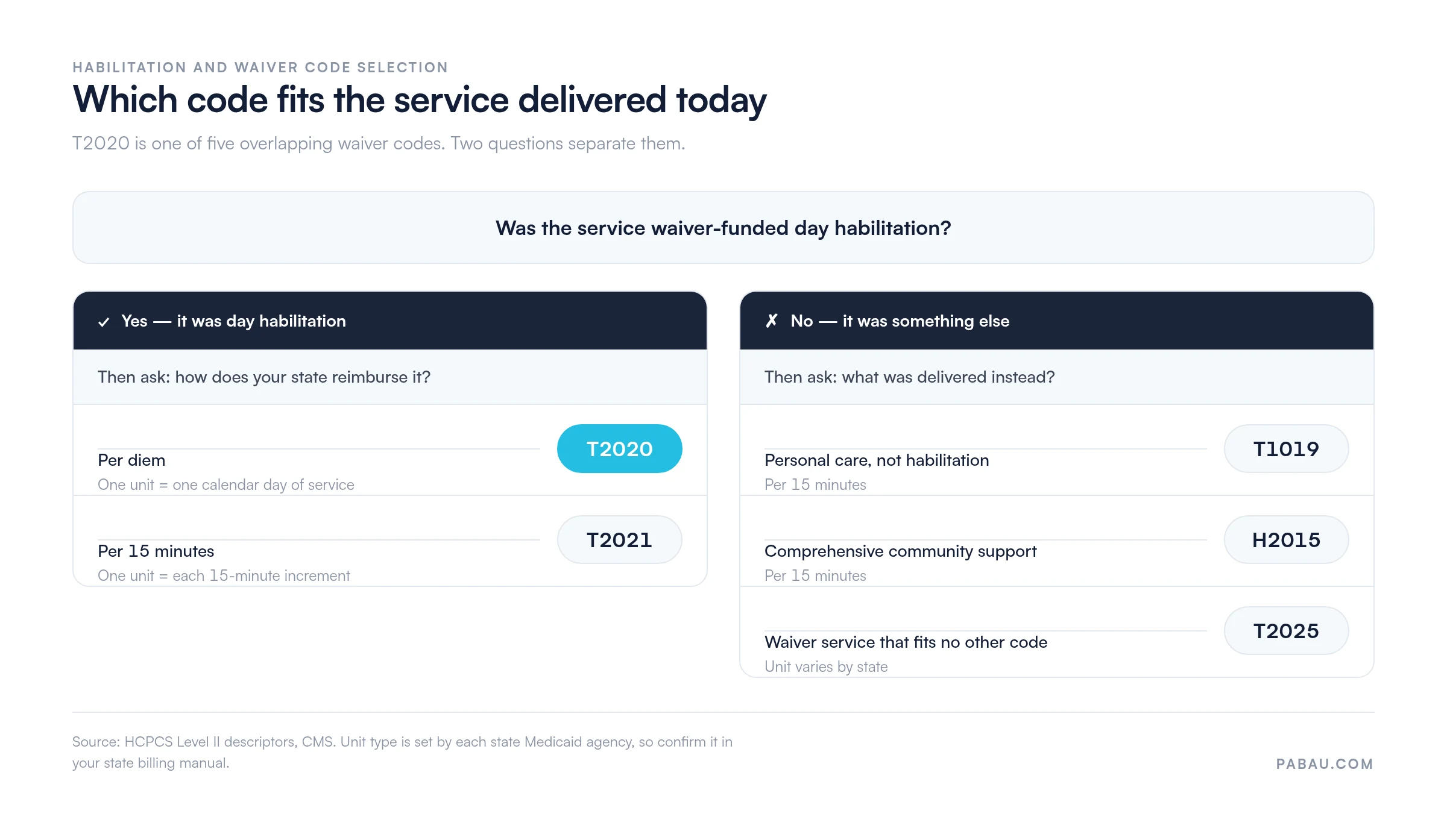
The T2020 versus T2021 choice comes up most in states migrating between billing unit systems. If your state recently moved from per-15-minute to per diem reimbursement, or the other way, confirm the transition date. Mixing the two codes inside one billing period generates systematic denials.
Day programs for medically complex children sit outside this group. Those services bill under T1025, the per diem that covers medically supervised pediatric day care.
CMS publishes the current code set in its quarterly HCPCS Level II update, which is where you confirm that a T-code is still active. Our wider HCPCS codes index covers the rest of the Level II set.
T2020 claims go to the state Medicaid program or an MCO, never to Medicare. The claim form is typically the CMS-1500 for professional billing, or a state-specific electronic claim format. Work through these steps before submission to reduce first-pass rejections.
Per diem codes make claim tracking matter more than usual. A single denied service day can represent a full day’s reimbursement, so follow each claim through submission, remittance, and payment posting.
Day habilitation billing under a Medicaid waiver has more moving parts than most code types. Per diem units, waiver authorization dates, and person-centered plan requirements all have to line up before a claim goes out. State-specific modifier rules add another check.
Practice management software like Pabau connects the documentation to the claim in one workflow. Those checks then happen before submission, rather than after a denial lands.
Pabau’s claims management software tracks claim status, captures denial reason codes, and manages resubmissions without rebuilding the paper trail each time. Agencies filing high volumes of daily per diem claims get the most from the authorization expiry flag. It stops a month of claims going out against a lapsed waiver.
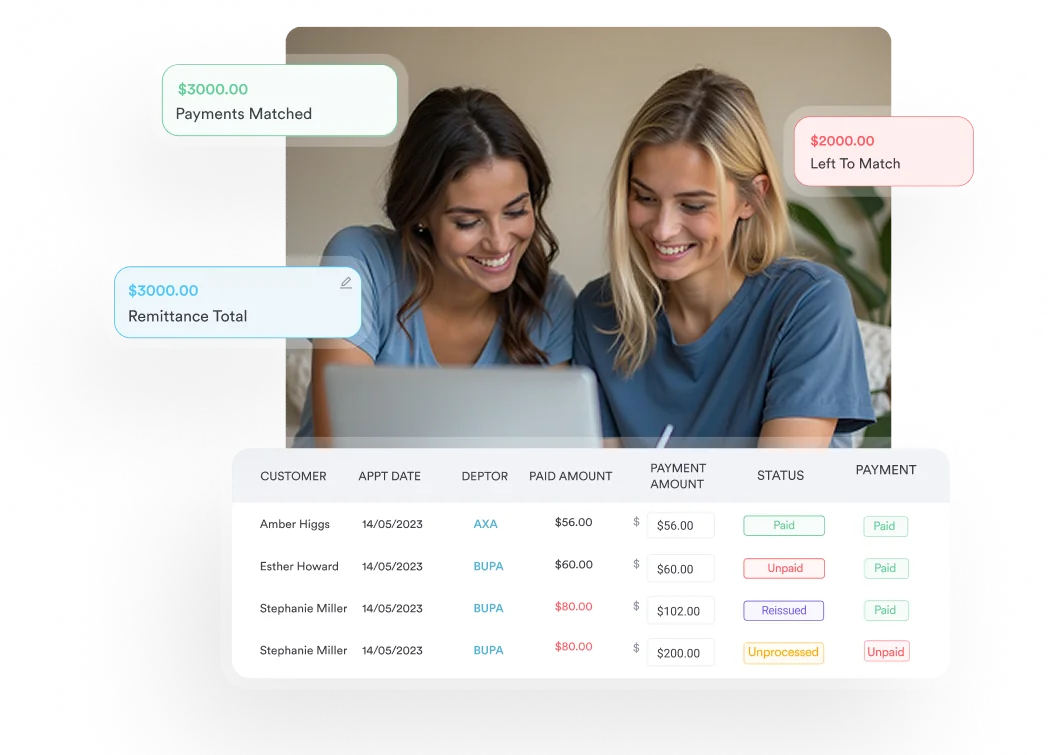
Providers serving individuals across several waiver types, or several states, gain most from centralized reporting. Seeing which codes generate denials, at what rate, and for which individuals tells a billing team where to change the process first. Pabau’s reporting surfaces that at claim level.
Set up an authorization expiry tracker for each individual on your caseload. Waiver periods vary, and some run shorter than 12 months. One lapsed authorization can void a month of T2020 claims retroactively. A 60-day advance alert leaves time to coordinate the renewal before it costs you a billing cycle.

Pabau brings per diem billing, documentation capture, and claim tracking into one place. IDD and behavioral health providers lose fewer T2020 claims to manual steps.

Two decisions govern most T2020 outcomes, and both are made by your state rather than by CMS. The state sets the rate, and the state decides whether one unit is a calendar day or 15 minutes. Confirm both in the billing manual and the code stops being the hard part.
The denials worth attention are the ones no appeal should ever have been needed for. Expired authorizations and stale person-centered plans are both visible weeks ahead. Put those renewal dates in front of the billing team and that category of denial mostly disappears.
Book a demo to see how Pabau keeps waiver authorizations, daily service records, and per diem claims in one place.

Need a structured approach to reducing claim rejections? Denial codes in medical billing explains CARC and RARC codes so you can act on remittance advice quickly.
Unfamiliar with how the clearinghouse step works? Medical claims clearinghouse guide covers how claims move from your billing system to the payer.
Billing personal care alongside day habilitation? T1019 covers personal care services in 15-minute units, with its own documentation and unit-counting rules.
HCPCS code T2020 covers day habilitation services provided under a Medicaid HCBS waiver, billed on a per diem basis. Day habilitation programs deliver structured training in daily living skills, community integration, communication, and pre-vocational skills. One billing unit equals one full calendar day of service.
T2020 is covered by Medicaid only. Medicare does not reimburse T-series HCPCS codes, and a claim submitted to a Medicare contractor for T2020 is denied. The code is funded through state Medicaid HCBS waiver programs, and reimbursement rates are set at state level.
Required documentation starts with an active Medicaid waiver authorization for the service date and a current person-centered plan that authorizes day habilitation. You also need a signed daily service record, proof of staff credentials, and confirmation of provider enrollment. Requirements vary by state, so verify them against your state Medicaid billing manual.
T2020 and T2021 both cover day habilitation under a Medicaid waiver, but T2020 is billed per diem and T2021 is billed per 15-minute unit. The correct code depends on how your state Medicaid program reimburses day habilitation. Some states use T2020 exclusively, while others use T2021 or allow both.
The most common denial reasons for T2020 are an expired waiver authorization, an outdated or missing person-centered plan, and incorrect or missing modifier codes. Billing under an unenrolled provider number and submitting duplicate claims round out the list. Most are preventable with a documentation checklist reviewed before each billing cycle.
Commonly used modifiers include HQ for a group setting and SE for a state or federally funded program. TT covers individualized service delivered to more than one patient in the same setting, and states also define their own U-series modifiers. Which modifiers are required, and what they mean, varies by state Medicaid program.



