HCPCS code T2005 – Non-emergency stretcher van transportation
Code Definition
T2005 is the HCPCS Level II code for non-emergency transportation; stretcher van.
It covers non-emergency medical transportation (NEMT) by stretcher van for Medicaid beneficiaries who must travel lying down but need no clinical care on the way. T-codes are designated for State Medicaid agencies and are not payable under Medicare fee-for-service. Most T2005 denials trace to a missing prior authorization, the wrong code from the T200x series, or incomplete trip records.
Related Information
Code range
T1000-T9999 National T codes established for state Medicaid agencies
Category
T2001-T2049 Non-emergency transportation
Code
T2005 Non-emergency transportation; stretcher van
Billable
No
Code also known as
stretcher van transport, NEMT stretcher billing, non-ambulatory patient transport
Save time. Improve accuracy. Get paid faster.
Automate coding with Pabau
Let Pabau's smart automation suggest the right codes, reduce claim denials, and keep your practice compliant—effortlessly.
T2005Non-emergency stretcher van transportationHigh match
Confidence score
98%
Why this code?
Matches patient diagnosis
Supported by clinical notes
Commonly used for this condition
Why practices choose Pabau
Save hours every week
Automate repetitive tasks and focus on what matters most—your patients.
Improve accuracy
Reduce coding errors and ensure compliance with the latest regulations.
Get paid faster
Clean claims, fewer denials, and faster reimbursements.
Grow with confidence
Powerful insights and reporting to help your practice thrive.
HIPAA compliant•SOC 2 certified•GDPR-compliant•Trusted by 4,000+ clinics worldwide
Key takeaways
HCPCS code T2005 bills non-emergency stretcher van transport for Medicaid beneficiaries who must travel lying down.
T-codes are designated for State Medicaid agencies and are not payable under Medicare fee-for-service. Each state sets its own rates, prior authorization rules, and modifiers.
Choose T2005 only after ruling out emergency, air, and clinical-care transport, and only when the patient cannot sit upright.
Common T2005 denials trace to missing prior authorization (CO-197), a missing or wrong modifier (CO-4), or the wrong code for the trip.
Pabau, the practice management platform we build, tracks prior authorization codes on each case and warns when one is missing.
HCPCS code T2005: Definition and official descriptor
HCPCS code T2005 is the HCPCS Level II code for non-emergency transportation by stretcher van. It covers Medicaid beneficiaries who cannot safely use seated transport and do not need emergency medical services. The vehicle carries a stretcher but is not staffed with paramedic or EMT personnel.
Field
Detail
Code
T2005
Official descriptor
Non-emergency transportation; stretcher van
Code set
HCPCS Level II (T-series)
Maintained by
Centers for Medicare & Medicaid Services (CMS)
Payer class
State Medicaid programs, Medicaid managed care organizations (MCOs), and CHIP, varying by state
Medicare FFS coverage
Not payable. T-codes are not payable under Medicare fee-for-service.
Billing unit
Usually per one-way trip, as set by the state program
Place of service
Varies by state, typically POS 99 (Other) or as the state Medicaid program directs
The CMS HCPCS code set designates T-series codes for use by State Medicaid agencies. CMS updates the HCPCS Level II code set every year, so check the descriptor against the current release.
What services does T2005 cover?
T2005 covers non-emergency trips where the patient must travel lying down but needs no active medical care on the way. The crew is there to handle the physical transfer, not to treat the patient.
Recumbent transport: The patient must lie flat or at a fixed recline because of a medical condition. Examples include a spinal injury, a post-surgical wound, or severe obesity that rules out a seated transfer.
Non-emergent trips only: Transport to scheduled outpatient appointments, dialysis, chemotherapy, follow-up visits, and similar covered medical services.
Medicaid-covered destination: The service at the destination must be a covered Medicaid benefit in the beneficiary’s state.
Medically necessary transport: A physician order or equivalent documentation must support a stretcher van over lower-acuity transport.
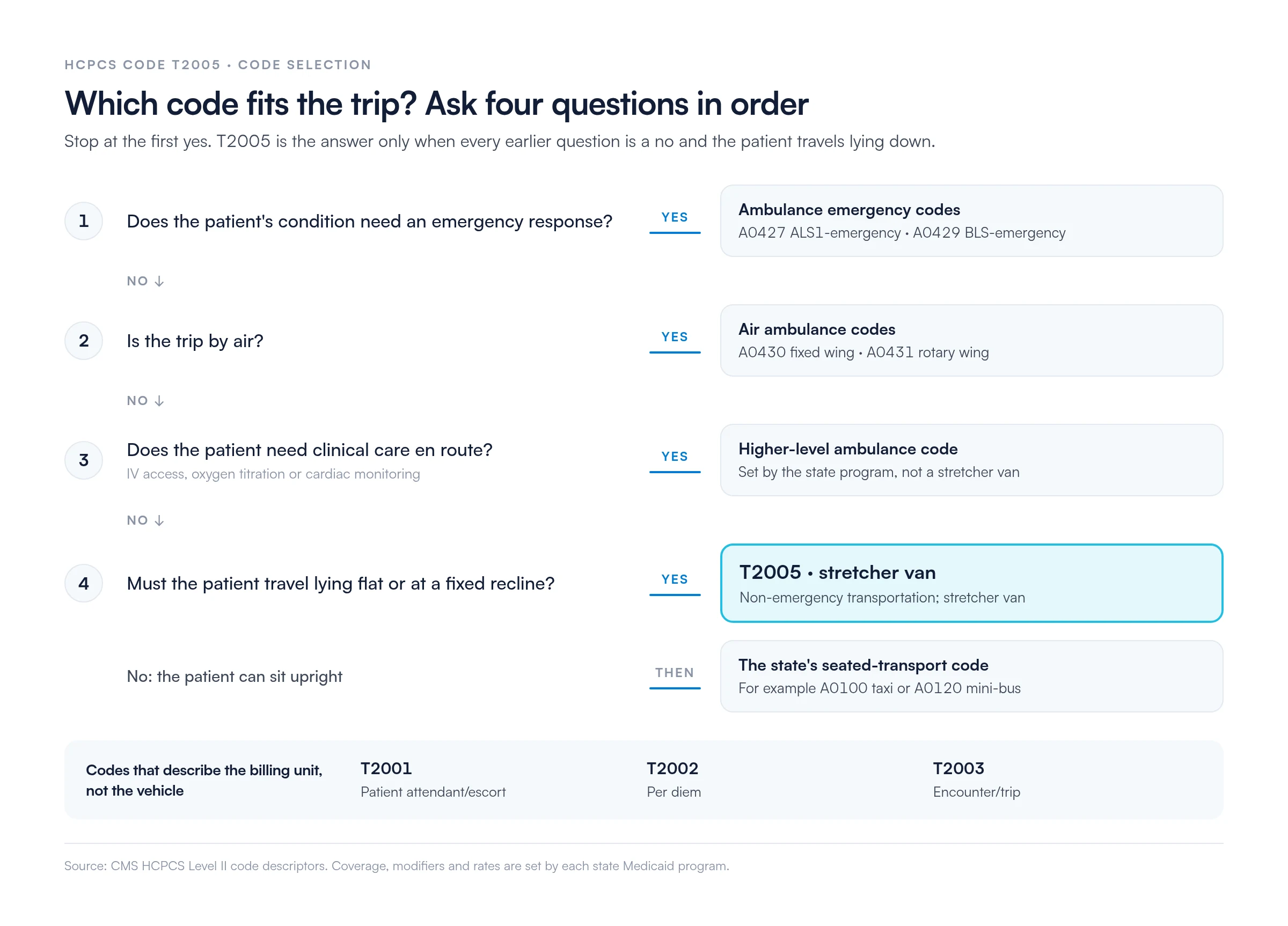
No active clinical care required: If the patient needs IV access, oxygen titration, or cardiac monitoring during transport, a higher-level ambulance code applies.
Some states cover stretcher van transport directly, and others route it through a managed NEMT broker. Check the state’s Medicaid transportation policy before billing T2005 in a new state for the first time.
What T2005 does not cover: Exclusions and limitations
T2005 is narrowly defined, and the descriptor alone does not spell out its limits. A claim outside these limits is denied, or recovered later on audit.
Emergency transport: A trip where the patient’s condition needs an emergency response belongs under ambulance codes, such as A0427 (ALS1-emergency) or A0429 (BLS-emergency), not T-codes.
Seated or ambulatory passengers: A patient who can sit upright belongs under the state’s seated-transport codes, for example A0100 (taxi) or A0120 (mini-bus).
Medicare FFS beneficiaries: T-codes are not payable under Medicare fee-for-service, so a T2005 claim to Medicare will deny. For a dually eligible beneficiary, check whether the Medicaid benefit covers NEMT.
Commercial insurance: T-codes are designated for State Medicaid agencies, and commercial payer use varies. Check the payer’s own benefit coding before you submit.
Non-medical destinations: Transport to pharmacies, non-covered services, or social errands is not billable under T2005, whatever the vehicle.
Air transport: Air ambulance has its own HCPCS codes, A0430 for fixed wing and A0431 for rotary wing. T2005 is surface transport only.
Two neighboring codes pick up most of the trips T2005 turns away. An emergency trip becomes an ambulance claim such as A0427. A patient who can sit upright fits a seated code such as A0100.
T2005 vs neighboring HCPCS transportation codes
The T200x series mixes vehicle codes with codes for the billing unit, which is why billers confuse them. The comparison below shows what each neighboring code describes and when T2005 is the better fit.
Seated travel on a commercial carrier, such as a transit pass
The patient cannot sit upright and needs a stretcher
T2005
Non-emergency transportation; stretcher van
Stretcher van, non-ambulatory patient, no clinical care en route
This is the correct code
A0100
Non-emergency transportation; taxi
The HCPCS Level II code for a seated taxi trip
The patient requires a stretcher van, not a taxi
Your state may bill the trip itself under T2003 or add an escort under T2001. The state’s NEMT manual says whether those codes sit alongside T2005 or replace it.
The deciding fact is the patient’s position during transport. If the documentation shows the patient traveled seated, T2005 is the wrong code, and the claim will likely deny or be audited for upcoding. The flow below puts the checks in the order a biller should ask them.
T2005 is the last stop, reached only when the trip is not an emergency, not by air, and needs no care en route. Descriptors from the CMS HCPCS Level II code set.
Modifiers used with T2005
Modifier requirements for T2005 are state- and MCO-specific, and no single modifier is required across all Medicaid programs. The table below covers the modifier categories programs ask for most often. Verify each one against your state’s NEMT billing manual before submission.
Modifier
Meaning
When to use
Payer notes
TF
Intermediate level of care
Some programs require TF to show the transport level falls between basic and advanced
Not universally required, so check the MCO contract
U1-U9
State-assigned modifiers
Medicaid programs use U-modifiers to track trip purpose, funding source, or population category
Required in many states, with a value and meaning that differ by state
HA
Child/adolescent program
Transport for a CHIP or youth-specific Medicaid population
Required only where the state’s CHIP program uses HCPCS T-codes
SH is not an NEMT modifier. It means second concurrent infusion therapy, so leave it off a T2005 claim unless your state’s manual assigns it a transport meaning.
Pro Tip
Before appending any modifier to T2005, download the current NEMT billing manual from your state Medicaid agency website. Many states publish a separate transportation provider manual that lists required modifiers by trip type and vehicle class. A modifier your state does not require can cause a rejection just as a missing one can.
Documentation requirements for T2005 claims
Documentation problems usually surface on post-payment review rather than at submission. Build the documentation set before the trip departs, not afterward.
Required documentation typically includes the elements below. Requirements vary by state, so the list reflects the most common standards across Medicaid programs. Your state Medicaid provider manual is the controlling authority.
Physician order for transport: A written or electronic order from the attending or prescribing clinician. It documents why the patient needs a stretcher van rather than an ambulance or seated transport.
Trip log or manifest: The pick-up address, drop-off address, departure time, arrival time, mileage, and patient name.
Prior authorization number: Where the state or MCO requires one, the PA number must appear on the claim form.
Vehicle attestation: Documentation that the vehicle was a stretcher-equipped van meeting state requirements.
Driver credentials: Evidence that the driver holds a current, state-approved NEMT certification for stretcher transport.
Patient signature or refusal: Beneficiary confirmation of the specific trip, or a documented refusal.
Diagnosis codes: ICD-10-CM codes supporting why the patient cannot use seated transport.
Prior authorization requirements for T2005
Most states require prior authorization (PA) for NEMT services billed under T2005, though the rules vary by state Medicaid program and MCO contract. Treat PA as required unless the payer confirms in writing that it is not. Verify the requirement before every trip.
Identify the authorizing entity: PA may come from the state Medicaid agency, the beneficiary’s MCO, or a managed NEMT broker. Know which entity controls it before you request it.
Submit the PA request with supporting documentation: Include the physician order, the beneficiary’s diagnosis codes, and the proposed trip details (origin, destination, date, and frequency).
Obtain the authorization number before transport: Retroactive PA is rarely approved and often needs a formal exception request. Transporting first and requesting retro-authorization frequently fails.
Confirm MCO-specific rules: MCOs in the same state may set different PA thresholds, timeframes, and renewal periods. Those differences matter most for recurring trips such as weekly dialysis transport.
Record the PA number and expiration date: Log both against the beneficiary record, and check the expiration before submitting each trip claim.
Broker-managed states add another layer. The broker may issue its own authorization separate from the MCO’s PA, or the broker’s authorization may stand in for the PA. Confirm the workflow with your state’s broker before you file the first claim.
Reimbursement rates for HCPCS T2005
There is no national fee schedule for T2005. Because T-codes are State Medicaid agency codes, each state sets its own reimbursement rate. The same stretcher van trip can pay very different amounts across state lines.
Rate source
Where to find it
Notes
State Medicaid fee schedule
Your state Medicaid agency provider portal (search “NEMT fee schedule” or “transportation fee schedule”)
Published annually, so use the current year’s version
MCO contract rate
Your signed contract with the managed care organization
The contracted rate may be higher or lower than the state fee schedule
NEMT broker rate
Your signed agreement with the state’s designated NEMT broker
Broker rates often differ from both state and MCO rates
Gives descriptor and category context but no state-specific rates
In states using a broker model, the broker sets its own network rate. It pays providers from a capitated or per-trip contract with the state. Your effective rate may be the broker’s rate rather than the state fee schedule amount, so review each contract before accepting trips.
Common claim denial reasons for T2005 and how to fix them
T2005 denial patterns are consistent across states. The table below maps the most common Claim Adjustment Reason Codes (CARCs) to their root causes and fixes. Strong denial management workflows catch these before submission rather than after remittance.
Denial / CARC
Root cause
Corrective action
CO-197
Precertification or authorization absent
Obtain the PA number, correct the claim, and resubmit with the authorization on file
CO-4
Service inconsistent with the modifier, or a required modifier missing
Verify the state’s modifier requirements, then add or correct the modifier and resubmit
CO-15
Authorization number missing, invalid, or not for this service
Resubmit with the correct PA number in the appropriate claim field
CO-97
Payment included in the allowance for another service
Check whether a companion trip was already paid, and bill each one-way trip separately
CO-18
Duplicate claim or service
Check the original claim’s status first, then send a corrected claim rather than a duplicate
CO-29
Timely filing limit exceeded
File an exception with evidence of the delay, such as a system outage, within the state’s correction window
CO-B7
Provider not certified or eligible for this service on this date
Confirm enrollment is active with the state Medicaid program, and re-enroll or update credentialing if it lapsed
A remark code (RARC) on the remittance often narrows the reason further. Our denial codes reference lists what each CARC and RARC means and how to respond.
How to bill T2005 correctly: Step-by-step claim submission
A clean T2005 claim follows the same field sequence on a CMS-1500 paper form or an 837P electronic transaction. Practice software with eligibility-checked claims management fills these fields from the record and cuts manual entry errors. Our guide to submitting a clean claim covers the field-level rules that apply across payer types.
Pabau’s claims management builds the CMS-1500 or 837P from the patient record, so the T2005 line, modifiers, and PA number go out together.
Confirm beneficiary eligibility: Verify the patient’s Medicaid coverage is active on the date of service. Then check that NEMT is a covered benefit under their program or managed care plan.
Confirm prior authorization: Retrieve the PA number and confirm it covers the trip date, origin, destination, and vehicle type (stretcher van).
Enter the correct procedure code: Use T2005 in Box 24D (CMS-1500) or the Loop 2400 SV1 segment (837P). Do not truncate or modify the code.
Apply required modifiers: Enter state-required modifiers in Box 24D alongside T2005 (CMS-1500) or in the SV1-01 modifier positions (837P). Follow the modifier sequence your state requires.
Enter the correct place of service: Use POS 99 (Other) unless your state names a different POS code for NEMT. Some MCOs require the destination’s POS code.
Link to supporting diagnosis codes: Enter ICD-10-CM codes in Box 21 (CMS-1500) and the matching diagnosis pointer in Box 24E. The diagnosis should support why the patient needed a stretcher van.
Enter units: Bill one unit per one-way trip unless your state sets another unit. Round trips need two claim lines or two separate claims, per state instructions. Where the state pays mileage separately, it goes on its own line under T2049, the stretcher van per-mile code.
Submit to the correct payer: Send the claim to the state Medicaid FFS program, the beneficiary’s MCO, or the NEMT broker, as applicable. The wrong entity usually delays payment rather than denying it outright.
Which payers accept HCPCS code T2005?
T2005 is a Medicaid code first, and most payers outside Medicaid will not process it. The PGM Billing HCPCS lookup and the NLM HCPCS API both confirm the code’s category and descriptor. Neither shows state-specific rates or coverage rules.
State Medicaid fee-for-service (FFS): The primary payer class for T2005. Coverage depends on whether the state has an active NEMT benefit that includes stretcher van transport.
Medicaid managed care organizations (MCOs): MCOs contracting with state Medicaid programs generally cover T2005 where the state benefit exists. Their PA and modifier rules may differ.
CHIP (Children’s Health Insurance Program): Coverage varies by state. Some CHIP programs use T-codes, and others use their own transportation codes, so verify before billing.
TRICARE: TRICARE coverage of NEMT is limited and program-specific. Verify against the current TRICARE Policy Manual and your regional contractor before billing T2005 to TRICARE.
Medicare FFS: T-codes, T2005 included, are not payable under Medicare fee-for-service. For a dual-eligible beneficiary, check whether Medicaid covers NEMT for their population.
Commercial insurance: T-codes are designated for State Medicaid agencies and are not payable under Medicare FFS. Commercial payer use varies, so check the payer’s own benefit coding.
How Pabau keeps T2005 claims authorized and complete
Many transport billing teams track authorization numbers in one spreadsheet and build claims in another system. When an authorization expires partway through a run of dialysis trips, the first sign is often a CO-197 on the remittance.
Pabau, the practice management platform we build, keeps the authorization on the patient’s case. The auth code, its dates, and the approved sessions sit with the record, and Pabau warns when one is missing. US claims go out as CMS-1500 or 837P through Claim.MD, with eligibility checks before submission and ERA remittances posted back.
The result is fewer T2005 claims leaving without a valid authorization. When a denial does come back, you can read it against the case that caused it.
Keep every T2005 claim authorized
Pabau tracks prior authorization codes on each case and sends CMS-1500 and 837P claims with eligibility checks, so fewer transport claims come back unpaid.
T2005 is a narrow code, and that narrowness protects the claim. Bill it only when the record shows a non-emergency trip, a patient who could not sit upright, and no clinical care on the way.
Before taking stretcher van trips for a new state or plan, settle three questions. Who issues the authorization, which modifiers does the payer require, and does mileage bill separately? That work takes an hour upfront and saves weeks of reworked claims.
Book a demo to see how Pabau keeps authorizations and claims together for your transport billing.
Continue your research
Need a full reference on medical billing basics?What is medical billing covers the end-to-end claims process from charge capture through payment posting.
Struggling with recurring claim rejections?Denial management in healthcare outlines a structured approach to tracking, appealing, and preventing common denial patterns.
Want to submit cleaner claims first time?Submitting a clean claim breaks down the field-level requirements that move claims through payer systems without manual review.
Checking your Medicaid billing against the rules?Medical billing compliance explains the documentation and audit standards payers hold claims to.
Frequently asked questions
What does HCPCS code T2005 cover?
HCPCS code T2005 covers non-emergency medical transportation by stretcher van for Medicaid beneficiaries who cannot travel seated and need no active clinical care during transport. The patient must be traveling to a Medicaid-covered medical appointment. Medical necessity for a stretcher van over a lower-acuity vehicle must be documented.
What is the difference between T2003 and T2005?
T2003 is non-emergency transportation; encounter/trip, a per-trip code some states use for NEMT whatever the vehicle. T2005 names the vehicle, a stretcher van. Use T2005 when the patient traveled on a stretcher. Use T2003 only where your state’s manual tells you to bill the trip as an encounter.
Does Medicare cover HCPCS T2005?
No. T-codes, including T2005, are not payable under Medicare fee-for-service because they are designated for State Medicaid agencies. For dually eligible beneficiaries, check whether the state Medicaid program covers the NEMT benefit for their population.
What modifiers are used with T2005?
Modifier requirements for T2005 are state- and MCO-specific. Common ones include U1 through U9 (state-assigned), TF (intermediate level of care), and HA (child/adolescent program). Verify the required modifiers in your state’s NEMT provider manual before submission.
Why is my T2005 claim being denied?
The most common causes are a missing or invalid prior authorization (CO-197 or CO-15) and a missing or incorrect modifier (CO-4). The third is the wrong code for the trip, such as T2005 billed for a patient who traveled seated. Read the CARC on your remittance advice to find the reason, and fix the root cause before resubmitting.
What documentation is required to bill T2005?
You typically need a physician order for stretcher van transport and a trip log with pick-up and drop-off addresses and times. Add the prior authorization number, a vehicle attestation, driver credentials, and the beneficiary’s signature. ICD-10-CM codes must show why seated transport is not appropriate. Requirements vary by state Medicaid program.