CPT Code 62284: Injection procedure for myelography
CPT Code 62284: official descriptor and procedure overview The American Medical ...

Last Updated: Oct 19, 2026
S0610 is the HCPCS Level II code for annual gynecological examination, new patient. It's a temporary national S-code, billed to commercial and managed care plans that accept S-codes. Established patients take S0612 instead.
Two common denial triggers are submitting it to Medicare, which does not pay S-codes, and miscoding the patient type.
Let Pabau's smart automation suggest the right codes, reduce claim denials, and keep your practice compliant—effortlessly.
Automate repetitive tasks and focus on what matters most—your patients.
Reduce coding errors and ensure compliance with the latest regulations.
Clean claims, fewer denials, and faster reimbursements.
Powerful insights and reporting to help your practice thrive.
HIPAA compliant SOC 2 certified GDPR-compliant Trusted by 4,000+ clinics worldwide

HCPCS Code S0610 covers a new-patient annual GYN exam billed to commercial payers that accept S-codes, never to Medicare.
Medicare does not recognize S0610; use G0101 and Q0091 for Medicare GYN exam and Pap collection claims.
Established patients take S0612, and S0613 covers a breast exam without pelvic evaluation.
Pair S0610 with ICD-10-CM code Z01.419 (without abnormal findings) or Z01.411 (with abnormal findings) to establish medical necessity.
Pabau’s claims management software validates claim details before submission and applies insurer-specific price lists.
HCPCS Code S0610 reports an annual gynecological examination for a new patient. It is a Level II code maintained by the Centers for Medicare and Medicaid Services (CMS).
S0610 sits in the S-series of temporary national codes, which private payers use for services that CPT does not list. Medicare does not pay S-codes, so S0610 is billed only to commercial and managed care plans that accept them.
The official descriptor for S0610 is: Annual gynecological examination, new patient. The code reports a preventive gynecological visit, typically covering the history, the examination, and counseling. S0610 itself does not define “new patient.” Many payers apply the CPT definition: no professional service from this provider, or a same-specialty provider in the group, within three years. Check the payer’s policy.
S0610 reports a new patient’s well-woman preventive visit as a single billable unit. The descriptor doesn’t list the components, so the exact scope depends on the payer’s policy. Billing the usual components separately with individual CPT codes on the same date counts as unbundling with most payers that accept S0610.
Payers commonly treat these components as part of S0610 when performed during the same visit:
S0610 is specific to new patients. Many commercial payers borrow the CPT definition of “new patient.” Under it, she has had no professional service from this provider or a same-specialty provider in the group within three years. Verify your payer’s definition before billing, since the wrong patient-type code is a common denial trigger for this code family.
Check the date of the patient’s last professional service against the payer’s new-patient definition before posting S0610. Payers differ on whether a nurse-only visit, such as a routine blood draw, makes her an established patient. Verify the payer’s policy when in doubt.
S0610, S0612, and S0613 form a three-code family covering annual GYN exams. The distinction turns on patient type (S0610 new, S0612 established) and on whether a pelvic evaluation was performed (S0613: breast exam only). Billing S0610 for an established patient is a common denial trigger.
An established patient who receives a full annual GYN exam is coded S0612. S0613 is for an annual visit limited to a clinical breast exam, with no pelvic evaluation. Abnormal findings never change the S-code. The diagnosis code carries them, with Z01.411 paired with whichever S-code fits the visit. The chart below walks through the choice in order.
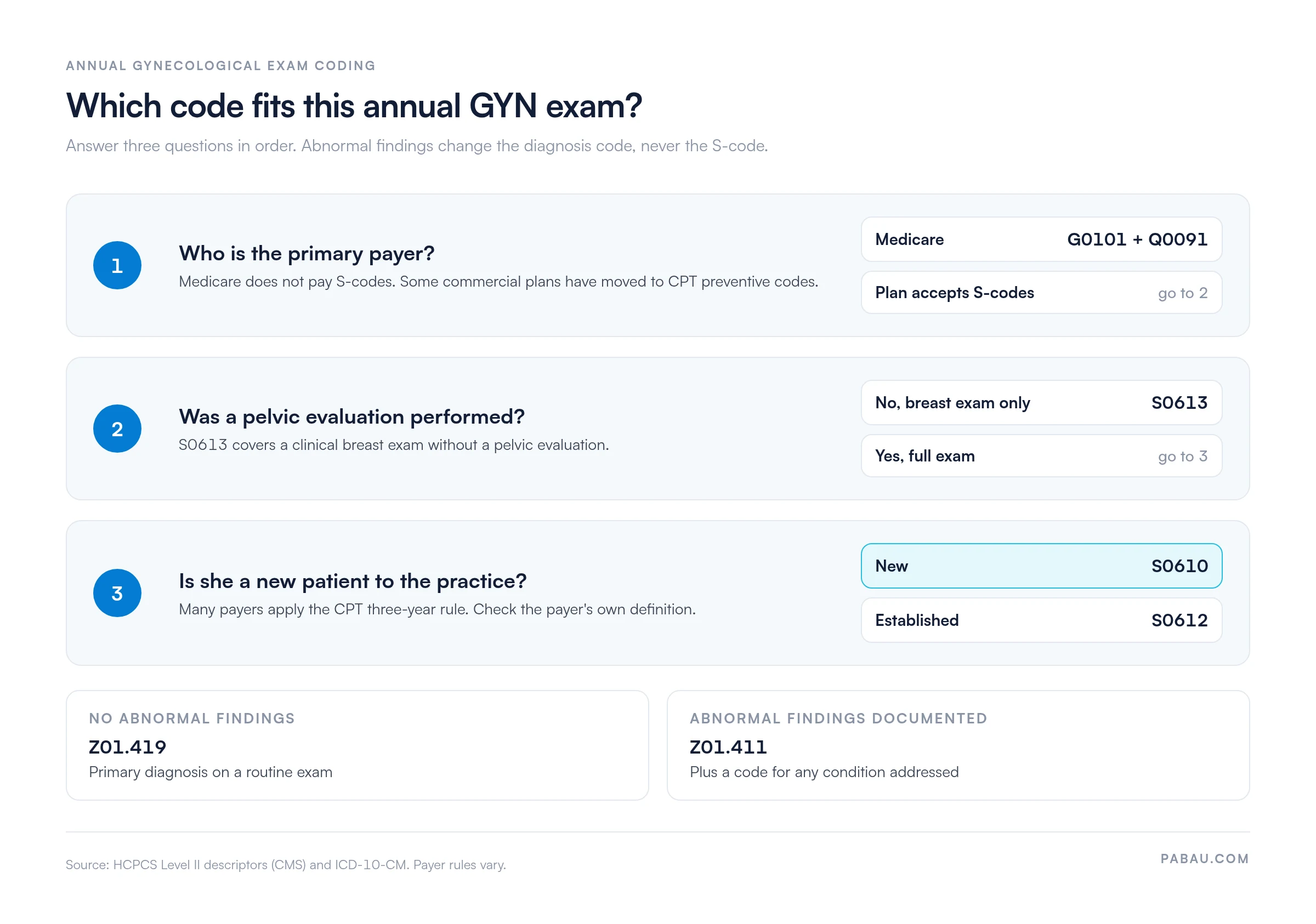
S0610 is not recognized by Medicare. Submitting it to a Medicare payer results in an automatic denial because S-codes are not on the Medicare fee schedule. For Medicare, report the screening pelvic and clinical breast examination with G0101. Report collection of the screening Pap smear and its conveyance to the lab with Q0091.
Practices billing a dual-eligible patient (Medicare primary, Medicaid or commercial secondary) must still submit G0101 + Q0091 to Medicare as the primary payer. S0610 may be submitted to the secondary plan only if that plan accepts S-codes. Always confirm the primary payer before coding.
S0610 is accepted by most commercial health maintenance organizations (HMOs) and preferred provider organizations (PPOs) that cover annual preventive gynecological exams as a plan benefit. Coverage is not universal. The following categories illustrate typical payer positions, though individual plan policies vary by state and benefit year:
OB/GYN billing teams should verify S0610 coverage annually. Benefit booklets change at plan renewal, and a payer that accepted S0610 last year may have transitioned to CPT-based preventive coding. Pabau’s claims management software validates claim details before submission and applies insurer-specific price lists.
Pairing S0610 with a diagnosis code that implies an active problem rather than a preventive encounter invites downcoding and medical necessity denials. Use Z-category ICD-10-CM codes to characterize a preventive gynecological examination correctly.
Sometimes an active problem is addressed beyond the scope of the preventive exam, such as vaginal discharge requiring treatment. Code Z01.419 or Z01.411 as the primary diagnosis and add a secondary code for the condition. A claim carrying only the condition code reads as a problem visit, which may change the benefit tier or co-pay.
In a medical necessity audit, payers look for documentation confirming a comprehensive annual GYN exam for a new patient. If an element is missing from the note, an appeal has little to stand on.
Required documentation elements for a clean S0610 claim:
A note that reads “annual exam done, pap obtained” without component documentation will not withstand a targeted audit. The record must reflect the examination in enough clinical detail that a reviewer can confirm each component was performed.
S0610 is billed without a modifier in most standard preventive visit scenarios. However, two modifier situations arise regularly in OB/GYN billing and must be handled correctly to avoid duplicate-service denials.
Place of service (POS) code 11 (office) is standard for S0610. For an exam in a hospital outpatient department or ambulatory surgery center, use the matching facility POS code. Then verify that the plan allows S0610 in a facility setting. Some plans restrict S-code preventive exams to office settings only.
Modifier 25 requires robust same-day documentation. The problem-oriented note for the separately billed E/M must stand independently from the annual exam note. If both are blended into one note, the payer will bundle the E/M into S0610 and deny the separate E/M claim.
S0610 denials follow predictable patterns, and a coding review before submission prevents many of them. The denial type decides whether the fix is a corrected resubmission or a full appeal with documentation. Pabau’s claims management software runs pre-submission validation checks and tracks claim status in one dashboard.
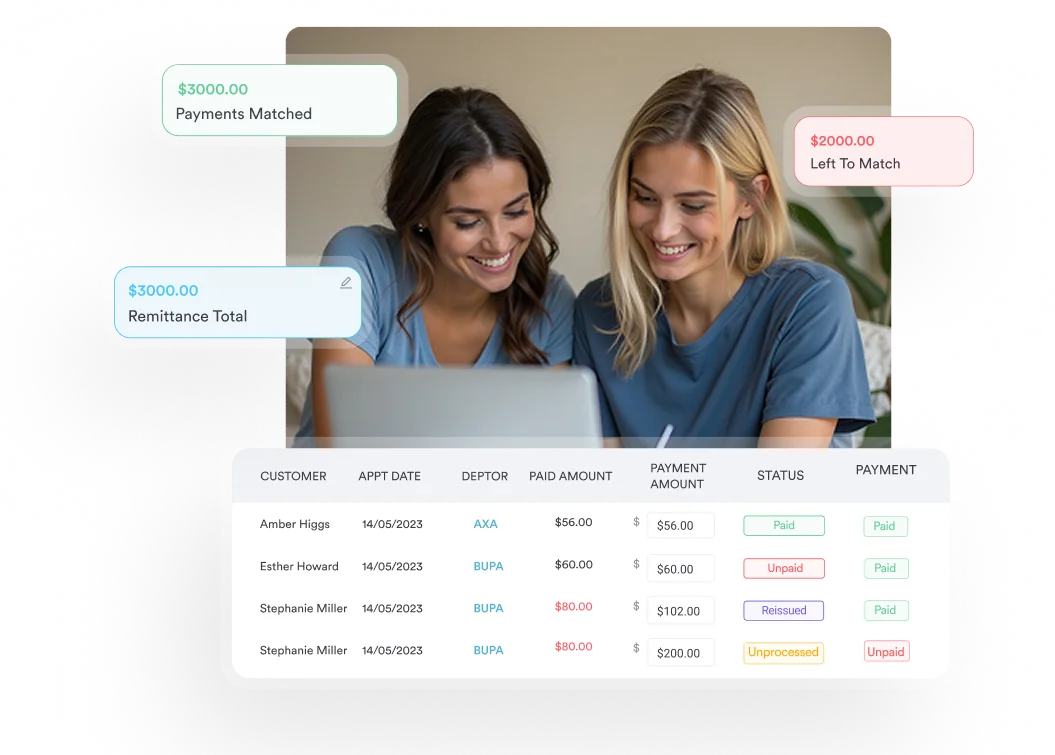
For a medical necessity appeal, attach the clinical note with the history, examination, and counseling elements highlighted. As part of denial management in healthcare, a tracking log by code and payer shows supervisors which plans need a different code before submission.
Run a monthly S0610 denial report filtered by denial reason code. If ‘patient not eligible for this service’ is the top denial, your team is likely submitting to Medicare or Medicaid plans that don’t recognize S-codes. One payer-level rule change in your billing software can eliminate an entire denial category.
Payers that accept S0610 treat the standard components of a new-patient annual GYN exam as part of it. Billing a separate pelvic or breast exam code alongside S0610 on the same date counts as unbundling and can trigger a payer edit or audit.
These are the usual same-date bundling scenarios for S0610 in commercial billing, from the AAPC’s HCPCS reference:
Review your practice’s medical billing workflows annually against current CCI edit tables. CCI edits are updated quarterly, and a code pair that was unbundleable last year may become a hard edit in the current quarter. Consulting your payer’s medical policy bulletin for S0610 is also advisable before billing any combination service.
Accurate S0610 billing starts with a complete note at the point of care. Many practices still chase missing exam details after the claim bounces. Pabau’s customizable clinical note templates can be set up to capture the documentation elements listed above.
When the history, pelvic exam, breast exam, and counseling are recorded the same way each visit, billers confirm the code without a second chart review.
Some visits add a same-day E/M service to S0610. Pabau’s forms and treatment notes let the practice document the E/M problem note and the annual exam note separately. That gives modifier 25 a note of its own to stand on.
Pabau’s claims management software validates claim details before submission and applies insurer-specific price lists. Book a demo to see how Pabau handles HCPCS billing for OB/GYN practices.

Pabau’s note templates capture each exam element, and claim checks run before submission. Your team spends less time reworking S0610 denials.

Treat S0610 as a payer decision first and a clinical one second. Confirm the primary payer and its new-patient rule before the visit, and the code choice is settled before anyone writes a note.
The trade-off is upfront admin. A coverage check at registration takes minutes, while a misrouted claim costs a resubmission cycle and weeks of delayed payment. Let the findings drive the Z-code, keep any problem visit in its own note, and the S-code rarely needs revisiting.
Pabau’s claims management software validates claim details before submission and applies insurer-specific price lists. Book a demo to see how your OB/GYN team can send annual exam claims right the first time.

Need to understand how claim denials get resolved? Denial management in healthcare covers the structured workflow for tracking, appealing, and preventing recurring payer rejections.
Want a clear picture of how medical billing works end to end? What is medical billing walks through the full revenue cycle from charge capture to payment posting.
Running a multi-provider OB/GYN practice? Pabau’s claims management software validates claim details before submission and applies insurer-specific price lists.
Seeing a breast exam without a pelvic evaluation? HCPCS code S0613 explains when the breast-exam-only annual code applies.
Coding a routine well-woman visit? ICD-10 code Z01.419 covers the diagnosis that pairs with an annual GYN exam without abnormal findings.
HCPCS Code S0610 is a Level II code for an annual gynecological examination of a new patient, billed to commercial and managed care payers. Payers typically treat the history, pelvic exam, breast exam, and counseling as part of it. Bundling of Pap collection varies by payer. Medicare does not recognize it.
No. Medicare does not pay S-codes, so the claim will be denied. For Medicare beneficiaries, use G0101 (pelvic and clinical breast examination) and Q0091 (Pap smear collection). Recode to G0101 and Q0091 instead of appealing.
Use S0610 for a new patient and S0612 for an established patient receiving the same annual exam. Many payers apply the CPT three-year rule to decide new status, so check the payer’s policy. S0613 reports an annual gynecological examination with clinical breast examination only, without pelvic evaluation.
Z01.419 (encounter for gynecological examination without abnormal findings) is the standard primary diagnosis code for a routine S0610 claim. Use Z01.411 when abnormal findings are documented. Using an active diagnosis code as the primary rather than a Z-code is a frequent denial trigger for preventive GYN claims.
Yes, but the E/M must be separately identifiable and documented. Append modifier 25 to the E/M code to show the visit addressed a problem distinct from the annual exam. The problem-oriented note must stand apart from the annual exam note. With a combined note, the payer will bundle the E/M into S0610 and deny it.
Common denial reasons include submission to Medicare (recode to G0101/Q0091, do not appeal) and the wrong patient type (recode to S0612). A missing Z-code and an E/M billed without modifier 25 also cause denials. For medical necessity denials, appeal with the clinical note highlighting each documented component. If the plan doesn’t recognize S-codes, recode to the CPT preventive E/M and resubmit a corrected claim.