CPT code 56606: Vulvar biopsy additional lesion billing guide
CPT code 56606: Official descriptor and add-on code classification CPT code 5660...

Last Updated: Nov 26, 2026
S0612 is the HCPCS Level II code for an annual gynecological examination of an established patient. The exam typically covers a pelvic and clinical breast examination, billed to commercial payers that accept S-codes.
Medicare does not pay S-codes, so a Medicare patient's exam is billed as G0101 instead. New patients take S0610, and a breast exam without a pelvic evaluation takes S0613.
Let Pabau's smart automation suggest the right codes, reduce claim denials, and keep your practice compliant—effortlessly.
Automate repetitive tasks and focus on what matters most—your patients.
Reduce coding errors and ensure compliance with the latest regulations.
Clean claims, fewer denials, and faster reimbursements.
Powerful insights and reporting to help your practice thrive.
HIPAA compliant SOC 2 certified GDPR-compliant Trusted by 4,000+ clinics worldwide

HCPCS Code S0612 covers an annual gynecological examination for an established patient, and S0610 covers the same exam for a new patient.
Medicare does not pay S-codes, and only some commercial payers recognize S0612, so check each payer’s contract and policy before billing.
Pair S0612 with a gynecological exam Z-code such as Z01.419, and add modifier 33 only where the payer’s policy asks for it.
S0612 already includes the pelvic and clinical breast exam, so billing G0101 on the same claim duplicates the exam and is generally denied.
Pabau, a practice management platform, helps practices submit and track claims and run eligibility checks through Claim.MD.
HCPCS Code S0612 is the code for an “annual gynecological examination, established patient.” It is an S-code, a temporary national code. CMS’s HCPCS Level II coding procedures describe S-codes as used primarily by private insurers and not payable by Medicare. S0612 sits in the S-code range of the HCPCS code set, alongside two related exam codes.
S0610 covers the same annual exam for a new patient. S0613 covers a clinical breast examination without a pelvic evaluation. Patient status separates S0610 from S0612, and the payer’s policy defines who counts as established. Many payers borrow the CPT rule of a professional service within the past three years.
S-codes sit outside the CPT framework. Each payer decides by contract whether it accepts them, so no S-code is universally billable.
The S0612 descriptor says only “annual gynecological examination, established patient.” Knowing what the visit includes, and what gets billed on its own, prevents unbundling errors and claim rejections.
What the S0612 exam typically includes:
Billed separately or instead:
S0612 already includes the pelvic and clinical breast exam, so billing G0101 on the same claim duplicates the exam. Payers generally deny that second code. Check the payer’s current policy before you add Q0091 to the claim.
The three HCPCS S-codes for annual gynecological exams split on two questions. Patient status separates S0610 (new) from S0612 (established), and S0613 applies when the visit is a breast exam with no pelvic evaluation.
A visit that includes a pelvic evaluation is billed as S0610 or S0612, never S0613. The decision runs in three steps, starting with the payer.
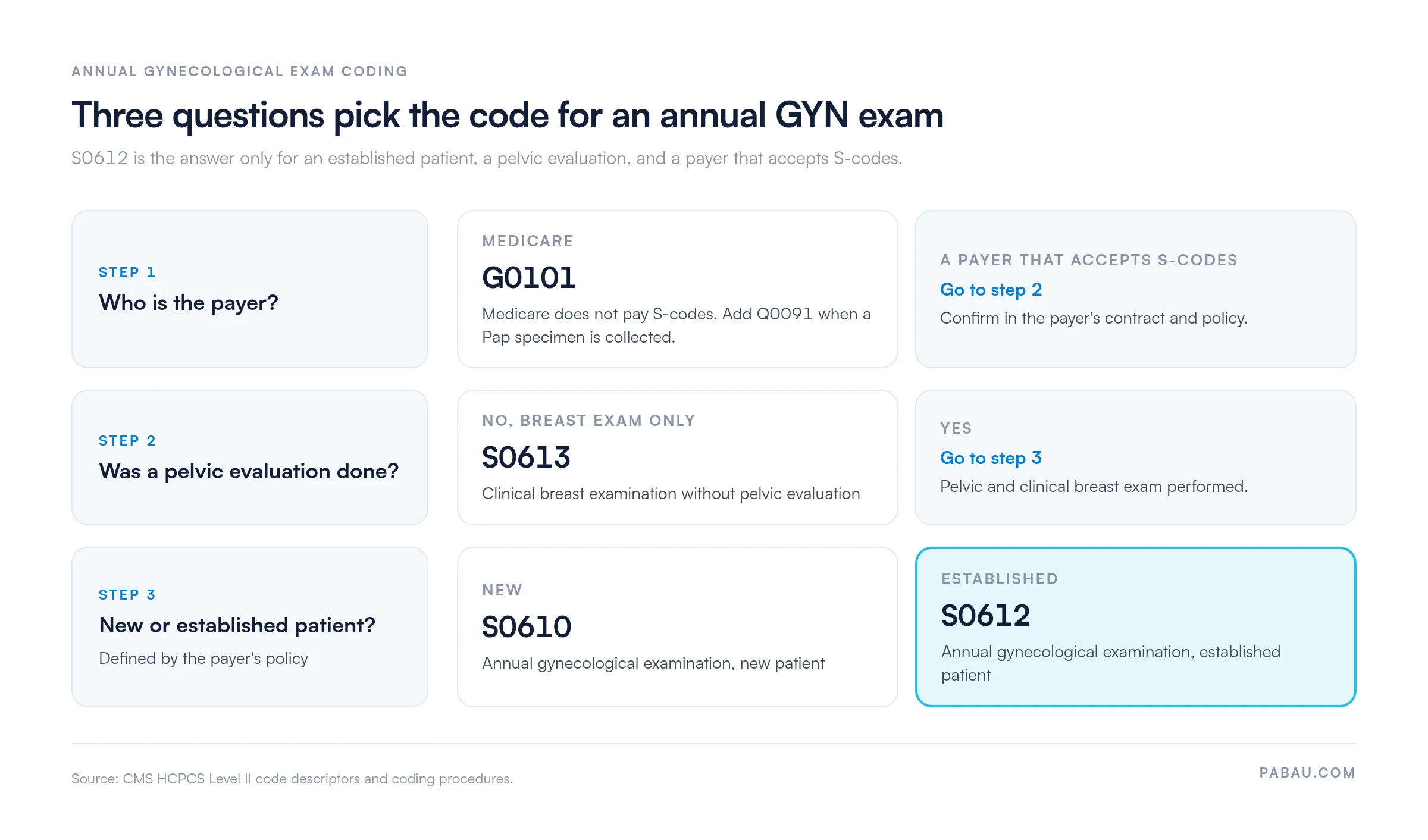
S0612 is not a universally accepted code. Its acceptance depends on the payer contract and plan type, as the table below shows. Other preventive S-codes follow the same rule, including S0622 for college physicals.
Medicare does not recognize HCPCS S-codes. They are temporary national codes in HCPCS Level II, used by private payers, and Medicare denies an S0612 claim. For a Medicare beneficiary receiving a preventive GYN exam, bill G0101 and the codes below instead.
Two modifiers come up on S0612 claims. The table shows when each applies and what the payer expects.
Where a payer asks for modifier 33, leaving it off can bill the patient a copay or deductible. The ACA makes that preventive service free of cost-sharing, so the error can end in a complaint to the insurer.
The medical record must support S0612 at the time of billing. Missing or incomplete documentation is a common cause of denial, so check these elements before the claim goes out.
Use Z-codes from Chapter 21 of ICD-10-CM for routine and preventive GYN encounters. Z01.419 is the usual anchor for an exam with no abnormal findings, and the table below lists the common pairings.
Z01.411 requires that the abnormal finding be coded separately. Leaving out the secondary code for the finding may result in a medical-necessity denial.
Three codes often come up around the same GYN visit. Only two of them belong on the same claim, and the table shows why.
When you bill Q0091 alongside S0612, document the Pap collection as a distinct activity in the encounter note. Bundling denials occur when a payer decides two services overlap and pay as one. Check the AAPC Codify HCPCS lookup to confirm current code-to-code bundling relationships before claim submission.
Run an eligibility check before each S0612 claim. Confirm the payer accepts S-codes and the annual GYN exam benefit is still unused for the plan year. A claim sent to a payer that rejects S-codes, or past the frequency limit, is a common and preventable denial.
S0612 denials follow predictable patterns. Knowing the common denial reasons lets billing staff build pre-submission checklists that catch errors before they reach the payer. A denial management workflow catches the rest.
Most commercial payers that accept S0612 limit the preventive GYN exam benefit to once per calendar year or plan year. The limit is plan-specific. It may differ between employer-sponsored plans and individual ACA marketplace plans, even when the same insurer underwrites both.
Run insurance eligibility verification at the front desk before every GYN visit to confirm the patient’s remaining benefit. When the response shows the annual benefit is used up, two options exist. Reschedule the exam for after the benefit resets, or document a problem-oriented reason for the visit and bill the appropriate E&M code.
Never submit S0612 after the plan year’s frequency limit is reached. An appeal rarely succeeds unless you can show that the payer’s own eligibility response was wrong.
The CMS Physician Fee Schedule lookup shows how Medicare treats a code. The PGM Billing HCPCS lookup tool gives a second reference for code status.
Most S0612 denials start before the claim is built. The front desk misses a used-up benefit, a biller picks S0612 for a new patient, or a Medicare patient’s exam goes out on an S-code.
Pabau’s claims management software submits and tracks claims through Claim.MD, and the eligibility check runs before the appointment. The front desk sees whether the plan still covers the annual exam, and the biller works from the payer response instead of a guess.
Checkout closes the loop at the desk. A copay, a deductible, or a self-pay balance on a non-covered exam gets invoiced and paid before the patient leaves.
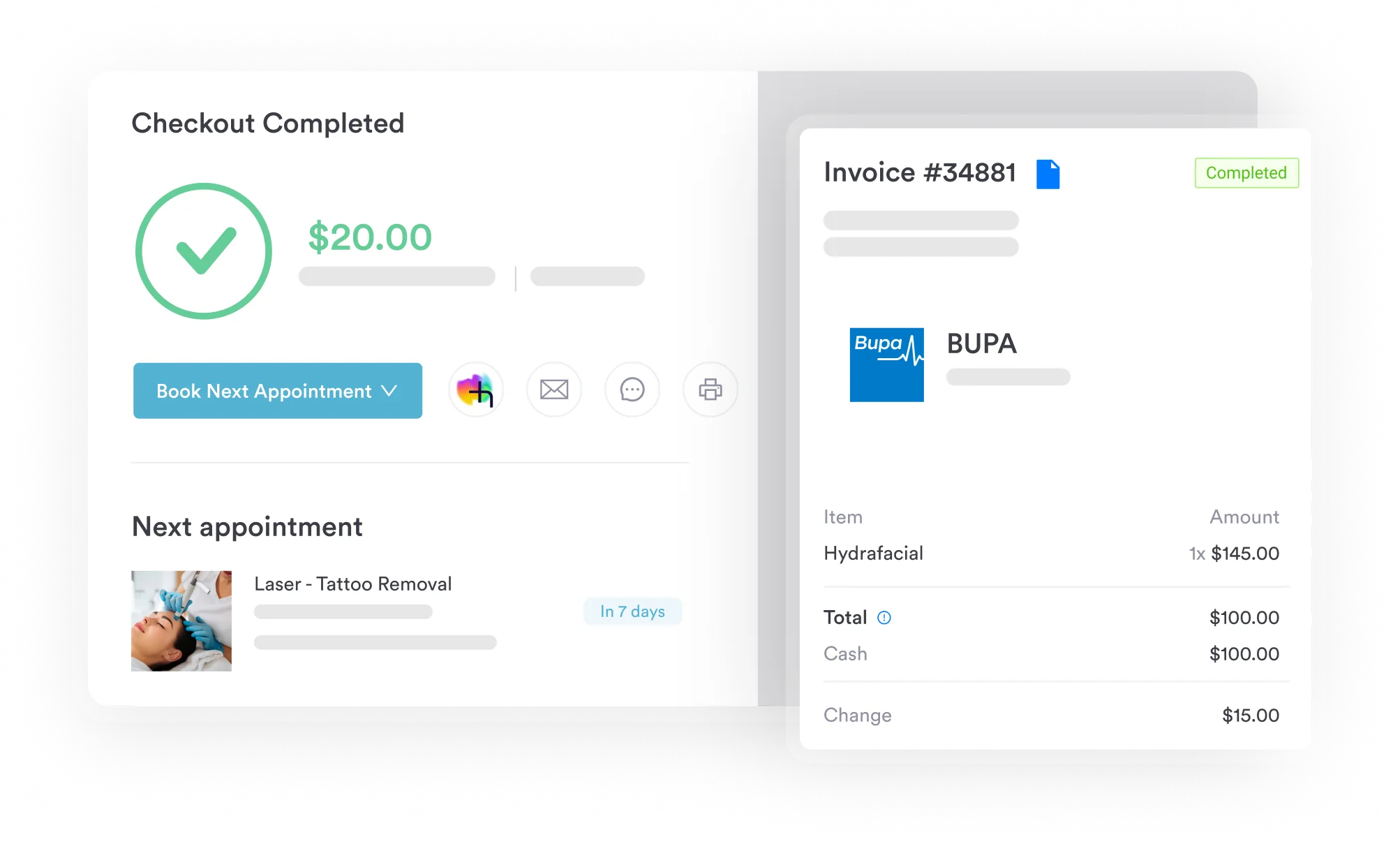

Pabau helps OB/GYN practices submit and track claims and run eligibility checks through Claim.MD. Your team confirms the annual exam benefit before the visit and collects the balance at checkout.

S0612 pays only when three facts line up: an established patient, a pelvic and breast exam, and a payer that accepts S-codes. Settle the payer question first, because a Medicare patient’s exam goes out as G0101 however well the chart is written.
The cheapest fix sits at the front desk. An eligibility check before the visit catches both the non-S-code payer and the used-up annual benefit, and those denials cost the most to chase. Keep G0101 off every S0612 claim, and treat modifier 33 as a payer rule to look up.
Book a demo to see how Pabau runs the eligibility check and the claim from the same patient record.

Seeing a patient for the first time? HCPCS Code S0610 covers the annual gynecological exam for a new patient.
Confused about clean claim standards for HCPCS submissions? Clean claim requirements explains the data elements every HCPCS claim must include before it reaches a payer.
Looking to understand the broader billing ecosystem? Revenue cycle management covers the full workflow from patient registration through payment posting.
Tracking what each patient still owes after the payer responds? Patient ledger shows how to keep charges, payments and balances in one running record.
HCPCS Code S0612 is the code for an annual gynecological examination of an established patient. The exam typically includes a pelvic examination and a clinical breast examination. It is an HCPCS Level II S-code, accepted by some commercial payers but not by Medicare.
S0610 is the annual gynecological examination for a new patient, and S0612 is the same exam for an established patient. The payer’s policy defines who counts as established, and many payers use the CPT three-year rule. Using S0612 for a new patient results in a patient-status denial.
No. Medicare does not recognize HCPCS S-codes on any claim type. For Medicare beneficiaries, bill G0101 for the pelvic and breast examination component and Q0091 when a Pap smear specimen is collected during the same visit.
Generally no. G0101 is the pelvic and clinical breast exam, and S0612 already includes both, so billing them together duplicates the exam. Payers generally deny the second code. G0101 is the Medicare alternative to S0612, not an add-on to it.
Z01.419 (encounter for gynecological examination without abnormal findings) is the most common pairing for a routine annual GYN exam. Use Z01.411 when an abnormal finding is identified and add a secondary code for the finding. Z12.4 (cervical cancer screening) is added when Q0091 is also billed for Pap collection.
Common reasons include a new patient billed as established, a payer that does not accept S-codes, and a missing or incorrect ICD-10 code. Others are an annual exam already used for the plan year, a missing modifier 25, or a missing modifier 33 that the payer’s policy requires. An eligibility check and a documentation review before submission prevent most of them.