ICD-10 Code Z86.73: Personal history of TIA
ICD-10 Code Z86.73: Definition, descriptor, and code hierarchy ICD-10 Code Z86.7...

Last Updated: Nov 20, 2026
Billable Code Specific Code
E28.2 is the billable ICD-10-CM code for polycystic ovarian syndrome. It covers a confirmed PCOS diagnosis, whatever combination of features the clinician documented.
Claims using E28.2 can be denied or audited when coders report E28.9 (ovarian dysfunction, unspecified) for a documented PCOS diagnosis. Payers may also request the cycle history, androgen results or ultrasound findings behind the diagnosis.
Let Pabau's smart automation suggest the right codes, reduce claim denials, and keep your practice compliant—effortlessly.
Automate repetitive tasks and focus on what matters most—your patients.
Reduce coding errors and ensure compliance with the latest regulations.
Clean claims, fewer denials, and faster reimbursements.
Powerful insights and reporting to help your practice thrive.
HIPAA compliant SOC 2 certified GDPR-compliant Trusted by 4,000+ clinics worldwide

ICD-10 Code E28.2 is a valid, billable code for polycystic ovarian syndrome, distinct from E28.9 (unspecified ovarian dysfunction) and E28.1 (androgen excess).
The code rests on the provider’s documented PCOS diagnosis, and recording which Rotterdam criteria were met helps when a payer requests records.
PCOS-related infertility and insulin resistance are coded separately, because E28.2 alone does not capture comorbidities such as N97.0 or E88.819.
Pabau, the practice management platform we build, sends E28.2 claims through its Claim.MD integration, with eligibility checks and ERA remittances included.
ICD-10 Code E28.2 carries the official descriptor “Polycystic ovarian syndrome” and is a valid, billable ICD-10-CM code. The CDC’s FY2027 ICD-10-CM tabular list places it in Chapter 4 (Endocrine, Nutritional and Metabolic Diseases), under parent category E28 (Ovarian dysfunction). Its code block is E20-E35: Disorders of other endocrine glands. The code has been valid for encounters since October 1, 2015.
The code uses no seventh-character extension and requires no additional specificity suffix. E28.2 appears frequently on encounter forms for reproductive endocrinology, general gynecology, and primary care visits where PCOS is an established diagnosis.
E28.2 covers confirmed polycystic ovarian syndrome, a complex endocrine disorder characterized by hormonal dysregulation, ovulatory dysfunction, and polycystic ovarian morphology. The code captures all clinical phenotypes of PCOS that meet the Rotterdam diagnostic threshold, regardless of which combination of features is present.
Included clinical presentations under E28.2 are:
E28.2 does not capture downstream comorbidities. Insulin resistance, metabolic syndrome, type 2 diabetes, infertility, and hirsutism each carry separate codes. Assign them independently when they are established diagnoses or reasons for the encounter.
The Rotterdam criteria, endorsed by the American College of Obstetricians and Gynecologists (ACOG) and the Endocrine Society, are the internationally accepted diagnostic standard for PCOS. A patient meets at least 2 of the following 3 criteria, with other causes excluded. ICD-10-CM assignment rests on the provider’s diagnostic statement, so these criteria support the diagnosis in the chart rather than gate the code.
The chart should also show that other causes were excluded. That means thyroid dysfunction (TSH), hyperprolactinemia (prolactin), and non-classic congenital adrenal hyperplasia (17-OHP in high-risk patients). Without a documented exclusion work-up, payers may question the specificity of the E28.2 assignment.
E28.2 carries no formal Excludes 1 or Excludes 2 notes in the ICD-10-CM tabular list. Its parent category E28 (Ovarian dysfunction) carries an Excludes1 note for isolated gonadotropin deficiency (E23.0) and postprocedural ovarian failure (E89.4-). Coders also need to understand the functional boundaries between E28.2 and its sibling codes to avoid under-specificity.
Key boundary rule: Once PCOS is confirmed and documented in the clinical record, reporting E28.9 instead of E28.2 is a coding error. Payers can treat the unspecified code on such a claim as under-coding and may deny it or flag it for audit.
The E28 category contains several sibling codes that are frequently confused with E28.2. The differentiator in every case is what the clinician has explicitly diagnosed and documented, as the decision path below shows.
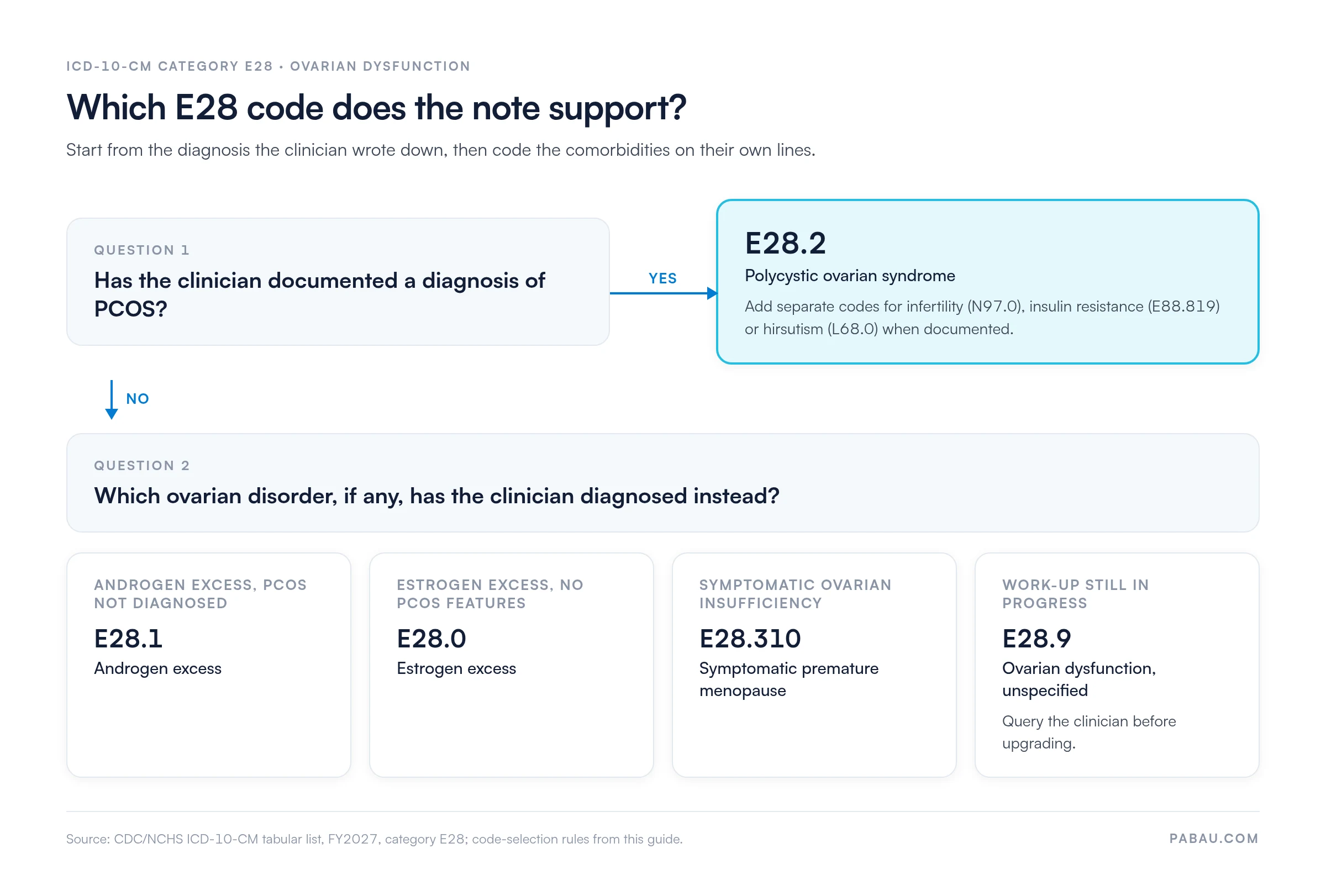
The table adds the documentation trigger that supports each code.
E28.2 rarely stands alone on a claim. Coders managing PCOS encounters should expect to assign secondary diagnosis codes for comorbidities and CPT procedure codes for the services rendered. When a PCOS patient is also pursuing fertility treatment, the encounter usually carries an infertility code alongside E28.2. Ovulation induction with follitropin beta adds a drug line under S0128. If that treatment goes on to egg retrieval, the claim also carries procedure code 76948 for the ultrasound guidance. If the retrieved eggs are then frozen, add oocyte freezing code 89337 for that step. An anti-Müllerian hormone level ordered during that work-up is billed under AMH code 82166.
Verify CPT code descriptors against the current code year before submission. CPT 76856 descriptor and bundling rules have shifted in recent AMA updates. Confirm the pelvic ultrasound code matches the modality used: 76856 for transabdominal, or 76830 (transvaginal ultrasound) when that modality is used. Also check payer LCD policies for ultrasound medical necessity when E28.2 is the primary diagnosis.
Payer requirements for E28.2 claims vary by plan year, state, and insurer, so coders should verify them directly with each payer. Most major US payers still share similar documentation expectations for PCOS-related encounters. Understanding medical billing fundamentals for endocrine diagnoses helps practices submit cleaner claims from the first attempt.
When a payer reviews an E28.2 claim, it may request:
E28.2 claims can be denied or audited when the documentation behind the code is thin or the code is less specific than the chart. These denials follow a few predictable patterns, and most are preventable with documentation discipline. Practices without structured denial management workflows tend to spot them only after repeated claim failures. The remittance codes on each rejection, decoded with a guide to medical billing denial codes, show which pattern hit.
Practices using claims management software with built-in claim scrubbing can catch code-specificity errors (like E28.9 standing in for E28.2) before transmission. The scrubbing layer flags claims where a confirmed diagnosis in the problem list does not match the specificity of the submitted code.
Documentation for E28.2 should carry enough clinical detail that an auditor reviewing the chart independently would arrive at the same diagnosis. Vague or incomplete notes are a common reason E28.2 claims fail on appeal.
The following elements should appear in every clinical note supporting an E28.2 code assignment:
Documentation is sometimes ambiguous, for example when only 1 of 3 Rotterdam criteria is clearly recorded. Submit a coding query to the treating clinician before assigning E28.2. A query response in the chart protects the assignment on audit. Using E28.9 as a placeholder while awaiting clarification is acceptable; upgrading to E28.2 based on coder inference is not.
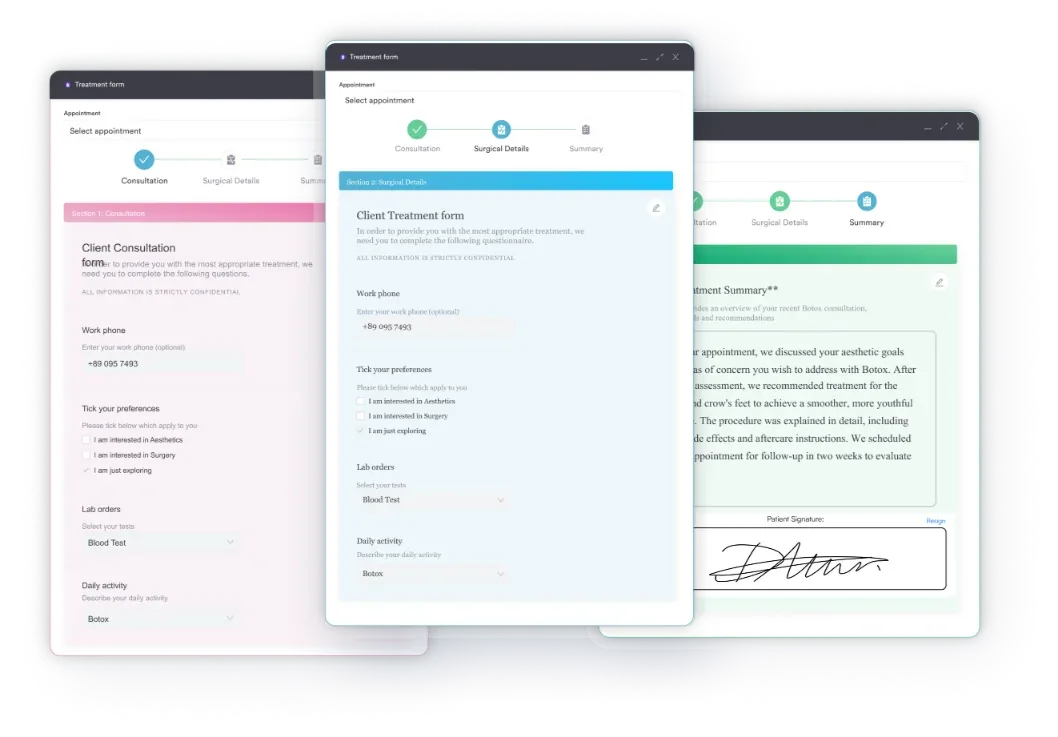
Structured digital intake forms that capture cycle history and symptom scores before the visit keep the billing record in step with the clinical encounter. For electronic submission, clean claim submission standards expect the diagnosis code to match clinical data in the chart on the date of service.
In many practices the PCOS work-up lives in one system and the claim in another. Lab values, ultrasound findings and the diagnosis statement get retyped, and the unspecified code slips through as a default.
In Pabau, the intake form, the clinical note and the claim sit on the same patient record. Practices can switch on Quest and Labcorp integrations, so testosterone and DHEA-S results import into the chart automatically.
Claims go out through Claim.MD as CMS-1500 or 837P submissions. Eligibility checks confirm coverage status before the visit, and authorization codes are tracked on the case, with a warning when one is missing. When a payer asks for records, the cycle history and lab values are already in the note.

Pabau sends E28.2 claims through Claim.MD with eligibility checks and ERA remittances, while authorization codes stay tracked on the case. See how it fits your OB/GYN or fertility practice.

Choosing E28.2 is the easy part of a PCOS claim. The code is billable and needs no extra characters. Claims succeed or fail on whether the chart holds the diagnosis statement, the supporting findings and the exclusion work-up.
Start with two checks this week. Find out which ovarian dysfunction code your EHR offers as the default, and how ultrasound reports reach the note before it is signed. Fixing both prevents more E28.2 denials than any appeal letter recovers.
Pabau ties clinical documentation to revenue cycle management, so the evidence and the claim leave the practice together. Book a demo to see how Pabau handles endocrine diagnosis coding and claim submission for your OB/GYN or fertility practice.

Need a clearinghouse for E28.2 and related endocrine claims? Pabau’s claims management software connects your practice to US payers through Claim.MD, with real-time eligibility verification and ERA processing.
Looking for denial pattern analysis across your PCOS claim portfolio? Denial management in healthcare covers how to build a systematic denial prevention and appeals workflow.
Want to understand the full revenue cycle behind ICD-10 diagnosis codes? What is revenue cycle management explains how diagnosis coding connects to claim submission, remittance, and collections.
Ordering a testosterone level for the androgen work-up? CPT code 84403 covers how total testosterone testing is billed.
Adding DHEA-S to the PCOS lab panel? CPT code 82627 covers how DHEA-sulfate testing is billed.
ICD-10 Code E28.2 is the billable diagnosis code for polycystic ovarian syndrome (PCOS). It sits in Chapter 4 (Endocrine, Nutritional and Metabolic Diseases), within the E28 Ovarian dysfunction category. It is used when the treating clinician documents a diagnosis of PCOS, usually on the Rotterdam 2-of-3 criteria.
Yes, E28.2 is a fully billable ICD-10-CM code with no additional character requirements. It can be submitted as a primary or secondary diagnosis on CMS-1500 and 837P claims for encounters where PCOS is an established diagnosis.
E28.2 (Polycystic ovarian syndrome) is used when the clinician has diagnosed PCOS. E28.9 (Ovarian dysfunction, unspecified) is used when ovarian dysfunction is suspected but not yet specifically diagnosed. Using E28.9 when PCOS is documented is a coding error and can trigger a denial.
Common CPT codes paired with E28.2 are 99213-99214 (established patient office visits, or 99203-99204 for new patients) and 76856 (pelvic ultrasound, complete). Others are 76830 (transvaginal ultrasound), 82627 (DHEA-sulfate) and 84403 (testosterone, total). The specific CPT codes depend on the services rendered at the encounter, not on the diagnosis alone.
No, E28.2 does not capture infertility. When infertility is a documented reason for the encounter, coders assign a separate N97.x code in addition to E28.2. N97.0 covers female infertility associated with anovulation.
Common denial reasons for E28.2 claims are E28.9 reported instead of E28.2 when PCOS is documented, and lab values missing from the chart. Payers also deny when the ultrasound report is absent or no linking statement connects the ordered procedures to the PCOS diagnosis.