ICD-10 Code R63.4: Abnormal weight loss
ICD-10 Code R63.4: Definition, billability, and code structure ICD-10 code R63.4...

Last Updated: Nov 13, 2026
Billable Code Specific Code
N95.1 is the billable ICD-10-CM code for menopausal and female climacteric states. It covers symptoms associated with natural, age-related menopause, such as flushing and sleeplessness, and each symptom is reported with its own additional code.
N95.1 sits in Chapter 14, block N80-N98 (Noninflammatory disorders of female genital tract), under category N95 (Menopausal and other perimenopausal disorders). It's a complete code with no child codes. An asymptomatic menopausal state is Z78.0, and symptoms of premature or artificial menopause go to E28.310 or E89.41.
Let Pabau's smart automation suggest the right codes, reduce claim denials, and keep your practice compliant—effortlessly.
Automate repetitive tasks and focus on what matters most—your patients.
Reduce coding errors and ensure compliance with the latest regulations.
Clean claims, fewer denials, and faster reimbursements.
Powerful insights and reporting to help your practice thrive.
HIPAA compliant SOC 2 certified GDPR-compliant Trusted by 4,000+ clinics worldwide

N95.1 is the billable ICD-10-CM code for symptoms of natural, age-related menopause, and it’s a complete code with no child codes.
Report each documented symptom, such as flushing or sleeplessness, as an additional code listed after N95.1.
A menopausal or postmenopausal patient with no documented symptoms is coded Z78.0, not N95.1.
N95.1’s Excludes1 note bars Z78.0, E89.41 (artificial menopause symptoms) and E28.310 (premature menopause symptoms) from the same claim.
Pabau’s claims management software keeps the menopause note, hormone labs and the claim on one patient record.
ICD-10 code N95.1 is the billable ICD-10-CM code for menopausal and female climacteric states, used for symptoms of natural, age-related menopause. It’s a complete code with no child codes, valid for FY2026 and FY2027. CMS’s FY2027 ICD-10-CM files list N95.1 as a billable code under category N95.
Two questions decide whether N95.1 is the right code. What caused the menopause, and does the note document symptoms? N95.1 fits only when menopause is natural and symptoms are documented. Each symptom then goes on the claim as an additional code. The matrix below maps each pair of answers to its code.
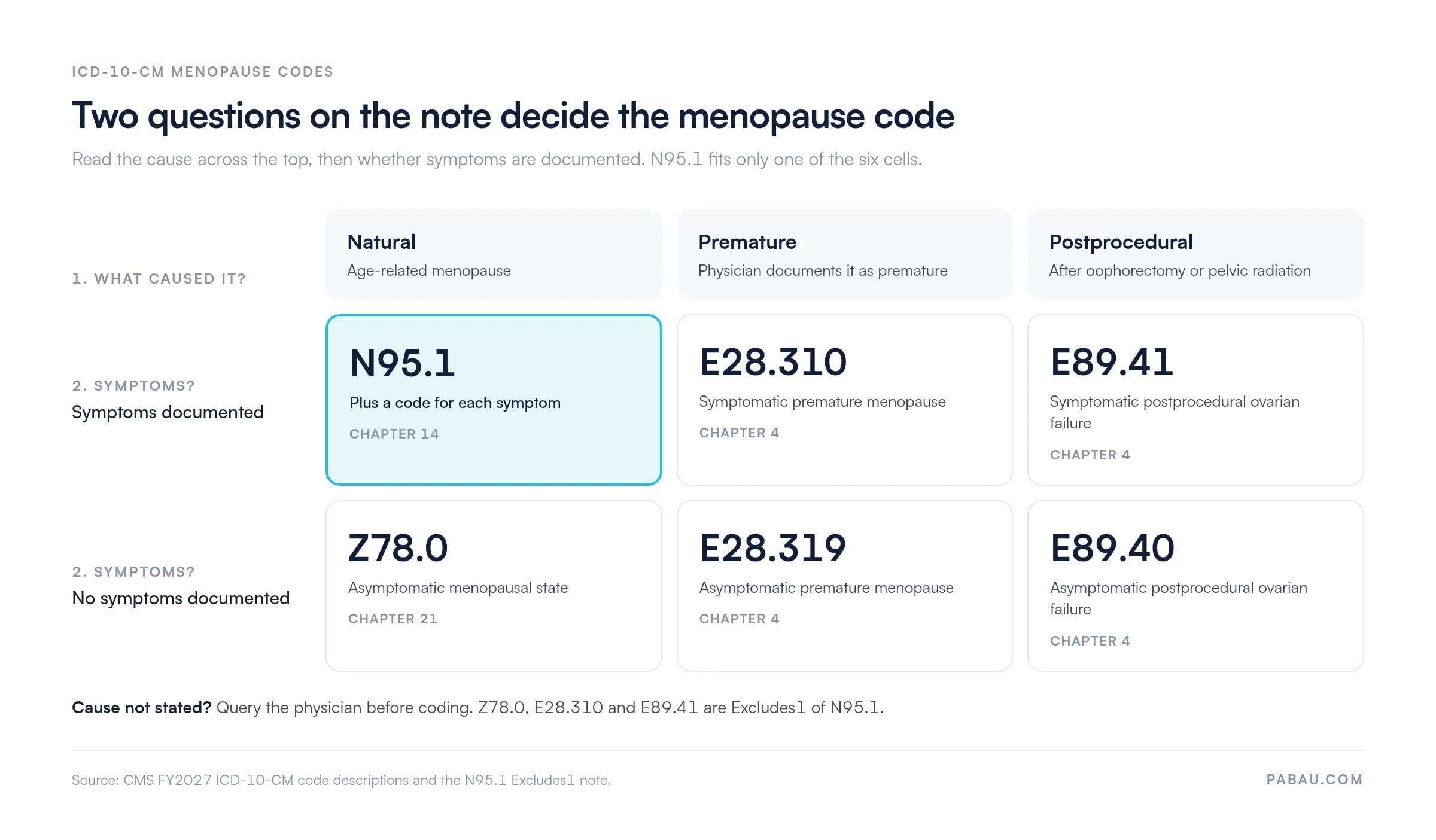
N95.1 covers symptoms associated with natural, age-related menopause. The tabular list gives flushing, sleeplessness, headache and lack of concentration as examples. It also carries an instruction to use an additional code for the associated symptoms.
So the two codes share the work. N95.1 tells the payer why the symptoms are happening, and the symptom codes tell it what they are. The alphabetic index points the same way: menopausal flushing, hot flashes and sleeplessness all lead to N95.1.
List N95.1 first and the symptom codes after it. Code only the symptoms the physician documents and links to menopause. If a symptom is mentioned but never tied to menopause, query the physician before coding it. Sleeplessness takes the most care, because G47.0 splits into three billable insomnia codes and the note decides which one applies.
N95.1 carries an Excludes1 note with three codes. Excludes1 means the two conditions are never coded together. When the excluded condition is the one documented, its code replaces N95.1.
E28.31 itself is the premature menopause subcategory, not a reportable code. Report E28.310 when symptoms are documented and E28.319 when they aren’t. Both sit in Chapter 4 (endocrine, nutritional and metabolic diseases), as does E89.4-.
The N95 category adds a broader note of its own: disorders due to artificial or premature menopause belong in E89.4- or E28.31-. N95.2 isn’t on N95.1’s Excludes1 list, so atrophic vaginitis can be reported alongside N95.1 when both are documented.
Each menopause code in this group answers the same two questions: what caused the menopause, and are there symptoms? Read both answers off the note and the grid below gives you the code.
Category N95 holds five billable codes in ICD-10-CM, and none of them has subcodes. The category header itself isn’t billable. Knowing all five keeps N95.1 off claims that belong to a sibling code.
A note that supports N95.1 states three facts: menopause, its natural cause and the symptoms it’s producing. The ICD-10-CM Official Guidelines tie code assignment to the provider’s documentation, not to the coder’s reading of the case.
N95.1 most often supports office visits and hormone labs. Each of those services is billed with its own code from the CPT code set, and N95.1 is the diagnosis that justifies it.
Three other diagnosis codes regularly travel with N95.1. They describe the context of the visit and don’t replace the symptom codes.
Run two checks on every N95.1 claim before it goes out. Is there at least one symptom code after N95.1? And is Z78.0, E28.310 or E89.41 anywhere on the same claim? Those two checks catch most coding errors in this group before a payer sees them.
Medicare and the major commercial payers accept N95.1 as a primary diagnosis for outpatient gynecology and primary care visits. Coverage varies more at the service level, particularly for HRT and hormone labs. Submitting a clean claim means checking those payer rules before billing, not after a denial arrives.
Most N95.1 denials come from a code that doesn’t match what the note says about cause or symptoms. Building denial management workflows around these five patterns stops the same denial coming back.
These five cases cover the coding calls OB-GYN and primary care teams make most often around this code. Each one turns on what the note documents about cause and symptoms. OB-GYN and primary care practices can build both questions into their menopause visit templates.
A 52-year-old established patient attends a well-woman visit. The physician documents: “Postmenopausal, last menstrual period 14 months ago. No hot flashes, night sweats or sleep problems. Counseled on bone health.”
Correct coding: Z78.0 (asymptomatic menopausal state). The note rules out symptoms, so N95.1 doesn’t apply. Z78.0 is an Excludes1 of N95.1, so the two never appear together.
A 51-year-old patient, last period 13 months ago, reports hot flashes several times a day and trouble sleeping. The physician documents: “Symptomatic natural menopause with vasomotor symptoms and insomnia. Continue HRT.”
Correct coding: N95.1 (primary), R23.2 (flushing), the G47.0- insomnia code the note supports, and Z79.890 (HRT). N95.1 has no more specific code to move to. The symptom codes carry the detail.
A 56-year-old patient on HRT attends a combined menopause and bone health review. The physician documents: “Ongoing night sweats related to menopause. DEXA shows osteoporosis, no fracture. Continue HRT.”
Correct coding: N95.1 (primary), R61 (night sweats), M81.0 (age-related osteoporosis) and Z79.890 (HRT). M81.0 is an Excludes2 of the N95 category, so it can be reported on the same claim.
A 38-year-old patient has been on HRT for six months. The physician documents: “Symptomatic premature menopause, hot flashes persisting. FSH 92. Continue HRT.”
Correct coding: E28.310 (symptomatic premature menopause) and Z79.890. N95.1 would be wrong here, because E28.310 is an Excludes1 of N95.1. Premature menopause is a Chapter 4 endocrine condition.
A 47-year-old patient had a bilateral oophorectomy three months ago. The physician documents: “Flushing and poor sleep since surgery, consistent with surgical menopause.”
Correct coding: E89.41 (symptomatic postprocedural ovarian failure). Symptoms of artificial menopause are an Excludes1 of N95.1. The E89.41 inclusion term covers flushing and sleeplessness after postprocedural menopause.
Pin the cause-and-symptoms grid to every coder’s screen: natural menopause is N95.1 or Z78.0, premature is E28.310 or E28.319, postprocedural is E89.41 or E89.40. Most errors in this group are habits, and a prompt at the point of coding breaks them faster than retraining.
In most practices, the note and the claim are built by different people on different days. The physician records symptoms and history at the visit. Later, someone at the billing desk reads that note and picks a code. When the note is vague about symptoms or cause, the pick can land on the wrong side of Z78.0 or E28.310.
Pabau, the practice management and billing platform we build, keeps the visit note, lab results and claim on one patient record. With labs switched on, FSH and estradiol results from Quest or Labcorp come back into that record automatically. The status evidence sits beside the diagnosis it supports.
Pabau’s claims management software sends US claims through Claim.MD as CMS-1500 claims, with eligibility checked before the visit. Prior authorization for HRT is tracked on the patient’s case, with a warning when an authorization code is missing. Your billing team codes from what the physician wrote, in the same place the physician wrote it.

Pabau puts the visit note, hormone lab results and the claim on one patient record. Your billing team codes from what the physician documented, and US claims reach payers through Claim.MD.

N95.1 is a narrow code with a clear rule. It’s the complete, correct code when natural menopause is producing documented symptoms, with each symptom coded beside it. Use it for an asymptomatic patient, or for premature or postprocedural menopause, and the claim no longer matches the note.
The fix sits upstream of coding. Make cause and symptoms explicit in every menopause note, then code from the grid, and Excludes1 rejections stop recurring. Book a demo to see how Pabau keeps menopause notes, hormone labs and claims on one record for your billing team.

Need to validate ICD-10-CM code accuracy before submission? Pabau’s Claim.MD clearinghouse guide explains how real-time claim validation catches ICD-10 errors before adjudication.
Building a denial recovery process for gynecology claims? Denial codes in medical billing breaks down the most common CARC codes and how to respond to each one.
Looking for clean claim submission best practices? What is medical billing covers the end-to-end billing workflow from encounter to payment posting.
Coding night sweats alongside N95.1? ICD-10 code R61 walks through the generalized hyperhidrosis code that the index sends night sweats to.
ICD-10 code N95.1 is the billable ICD-10-CM code for menopausal and female climacteric states. It covers symptoms associated with natural, age-related menopause, such as flushing and sleeplessness. Each symptom is also reported with its own additional code. N95.1 sits in Chapter 14, block N80-N98, under category N95.
No. N95.1 is a complete, billable code with no subcodes, valid for FY2026 and FY2027. Detail about the patient’s symptoms goes on the claim as separate symptom codes. Adding extra characters to N95.1 creates an invalid code that payers reject.
Premature menopause is E28.310 when symptoms are documented and E28.319 when they aren’t. Menopause after a procedure, such as bilateral oophorectomy, is E89.41 with symptoms and E89.40 without. E28.310 and E89.41 are Excludes1 of N95.1, so neither is reported with it.
Z78.0 (asymptomatic menopausal state) is the code for a postmenopausal patient with no documented symptoms. Its inclusion terms cover postmenopausal status NOS. Postmenopausal bleeding is N95.0, and postmenopausal atrophic vaginitis is N95.2.
Office visit codes 99202-99215 are the most common pairing, along with the estradiol assay (82670) and the FSH assay (83001). Z79.890 is added as a diagnosis code, not a CPT code, when hormone replacement therapy is current.
Most N95.1 denials come from a code that doesn’t match the note. The usual causes are N95.1 on an asymptomatic patient, where Z78.0 applies, or on premature or postprocedural menopause. Other causes are an Excludes1 pair on one claim, an invalid extra character, or missing LMP or FSH documentation for lab claims.