CPT code 93503: Swan-Ganz catheter billing and modifiers
CPT code 93503: Official descriptor and procedure overview In the AMA CPT code s...

Last Updated: Oct 23, 2026
S0183 is the HCPCS Level II code for prochlorperazine maleate, oral, 5 mg, an antiemetic tablet. Medicaid programs and private payers use it, but traditional Medicare Part B does not pay S-codes.
Billing S0183 to Medicare instead of Q0164 is a common reason claims are denied. Q0164 only applies when the tablet replaces an IV antiemetic during chemotherapy. Each unit equals one 5 mg tablet, so a 10 mg dose is 2 units. Below are the payer rules, diagnosis pairings and a pre-submission checklist.
Let Pabau's smart automation suggest the right codes, reduce claim denials, and keep your practice compliant—effortlessly.
Automate repetitive tasks and focus on what matters most—your patients.
Reduce coding errors and ensure compliance with the latest regulations.
Clean claims, fewer denials, and faster reimbursements.
Powerful insights and reporting to help your practice thrive.
HIPAA compliant SOC 2 certified GDPR-compliant Trusted by 4,000+ clinics worldwide

S0183 bills oral prochlorperazine maleate, 5 mg, to Medicaid and private payers, not traditional Medicare Part B.
Each unit equals one 5 mg tablet, so a 10 mg dose goes on the claim line as 2 units.
S-codes are not payable by Medicare Part B. For Medicare, use Q0164, which is limited to chemotherapy use.
Most Medicaid programs want the 11-digit NDC on the claim, and many plans set their own daily unit caps.
Common denials, such as the wrong payer, wrong units or a missing NDC, can be caught before submission.
HCPCS code S0183 is the Level II code for prochlorperazine maleate, oral, 5 mg. One unit equals one 5 mg tablet. S-codes are temporary national codes for Medicaid and private payers, not Medicare. CMS maintains the HCPCS Level II code set, and S0183’s own descriptor points Medicare claims to Q0164.
Prochlorperazine is a phenothiazine antiemetic, once sold under the brand name Compazine. Prescribers use it for nausea and vomiting, including chemotherapy-induced nausea and vomiting (CINV).
At higher doses, it also serves as an adjunct in psychotic disorders. The tablet form is what sets S0183 apart from injectable prochlorperazine, which bills under J0780.
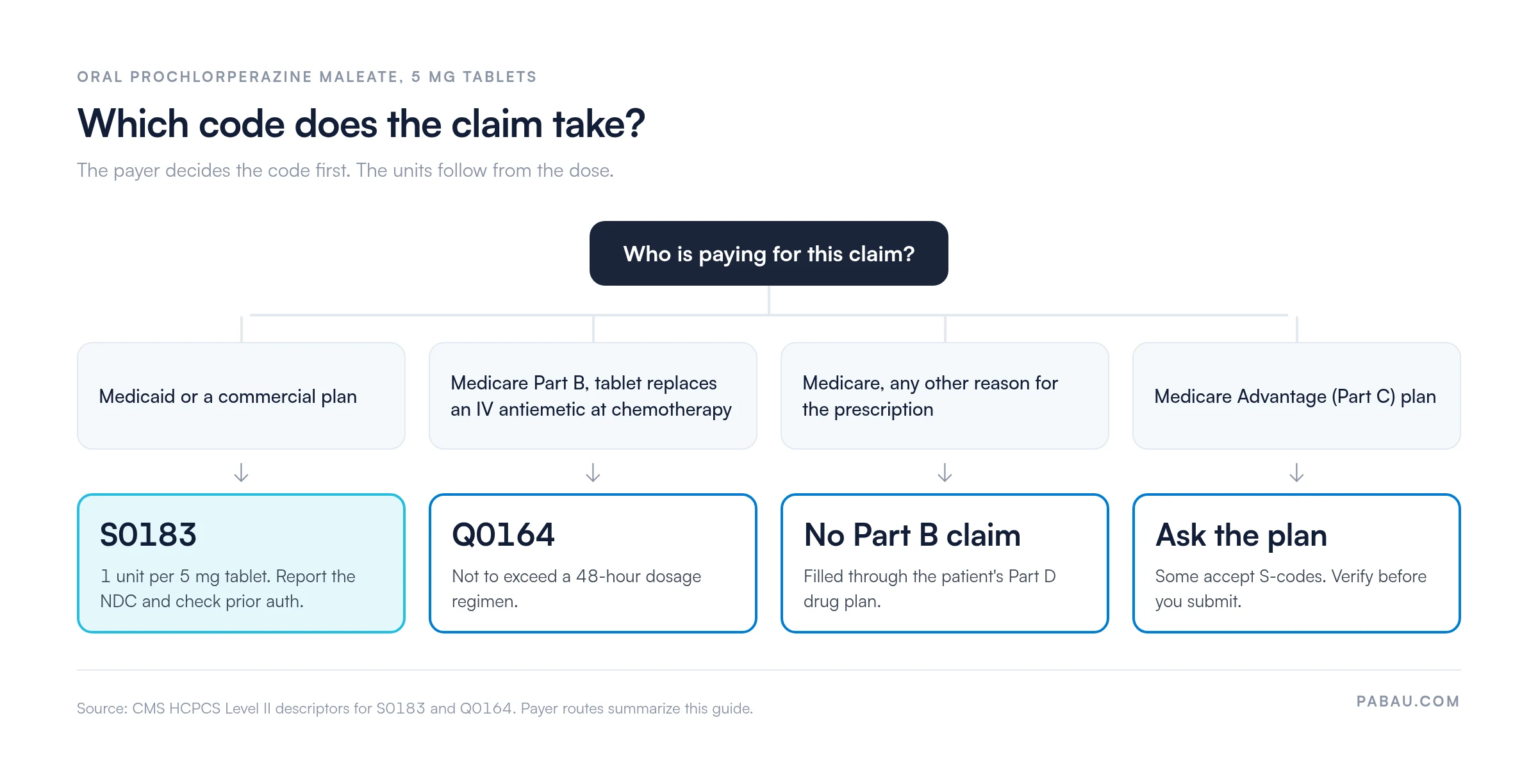
Medicaid is where S0183 does most of its work. State programs and commercial insurers recognize S-codes, while traditional Medicare Part B does not pay them. Send S0183 to a Medicare contractor and the claim comes straight back.
Coverage still varies plan by plan inside each payer type. Before your first S0183 claim to a new payer, confirm acceptance through its provider portal or an eligibility check.
Q0164 covers the same 5 mg tablet under a much narrower rule. Medicare pays it only when the tablet fully replaces an IV antiemetic at the time of chemotherapy. The regimen also can’t run past 48 hours.
Outside that window, a Medicare patient’s tablets are a Part D pharmacy claim, not a Part B claim from your practice. That leaves four routes for oral prochlorperazine, and the diagram below maps them.
Other oral antiemetics have their own S-codes. Ondansetron tablets, for example, bill under S0119, so match the drug on the order before you pick a code. Confirm current descriptors each year with the AAPC HCPCS code lookup.
The unit math is simple. Divide the prescribed dose by 5 mg, and the result is the unit count. The table covers the doses billers see most.
Many Medicaid and commercial payers also set a daily unit maximum. Each payer defines its own limit, so it differs between plans. Go over it and the line denies, even when the prescription supports the dose. Check the per-day cap in the payer’s drug policy first.
Here is where each detail goes on the claim:
A clean claim needs the code, units, diagnosis and NDC to match the prescriber’s order before it goes out.
Every S0183 claim needs a diagnosis that shows why the patient needs an oral antiemetic. The more specific the code, the easier the claim passes medical necessity review.
R11.2 is the usual pairing for a general antiemetic prescription. For CINV, code the adverse effect and the underlying cancer where the record supports both. Oncology drug policies often expect a documented cancer diagnosis, not a bare symptom code.
CMS publishes no Medicare fee schedule rate for S0183, because Medicare doesn’t pay S-codes. Your reimbursement comes from two other places.
Pull your state Medicaid drug fee schedule once a year and update the S0183 rate in your system. Payments then post against the right expected amount, and underpayments stand out.
No universal prior authorization (PA) rule applies to S0183. Medicaid managed care organizations (MCOs) are the most likely to require one, especially for chronic or high-dose use.
Some MCOs want proof that a first-line antiemetic, such as ondansetron, was tried first. State fee-for-service programs vary as well. Some list prochlorperazine as a preferred drug, and others put it on a PA tier.
Commercial payers often apply step therapy to antiemetics. A PA request usually needs the diagnosis, the treatment plan and evidence of medical necessity. Keep the superbill with the PA approval, which makes any later appeal simpler. PA rules change each plan year, so recheck them when a new benefit year starts.
Lookup sites stop at the descriptor. An audit goes further and checks the patient record behind the claim. These six items keep that record standing:
S0183 denials follow the same patterns across Medicaid and commercial payers. A structured denial management process stops them from repeating.
Log every S0183 denial by its reason code. A payer-code mismatch usually comes back as CO-16 (missing or invalid claim information) or CO-181 (procedure code invalid on the date of service). CO-4 means the code is inconsistent with the modifier, or a required modifier is missing. CO-97 means the benefit is included in the allowance for another service, so check for an extra administration code.
Each denial arrives with a claim adjustment reason code (CARC) on the remittance. Match it to the fix above, then check our medical billing denial codes guide for the less common ones.
Most S0183 trouble starts at the payer step and only shows up weeks later as a denial. By then, the remittance sits in one place while the order and the note sit in the chart.
Pabau, the practice management platform we build, closes that loop with its claims management software. It supports claim submission, ERA and denial tracking alongside patient records. In the US, claims go out through Claim.MD, with eligibility checks available before the visit.
Remittances post against each claim, so your team can see which S0183 lines paid and which need a corrected resubmission.
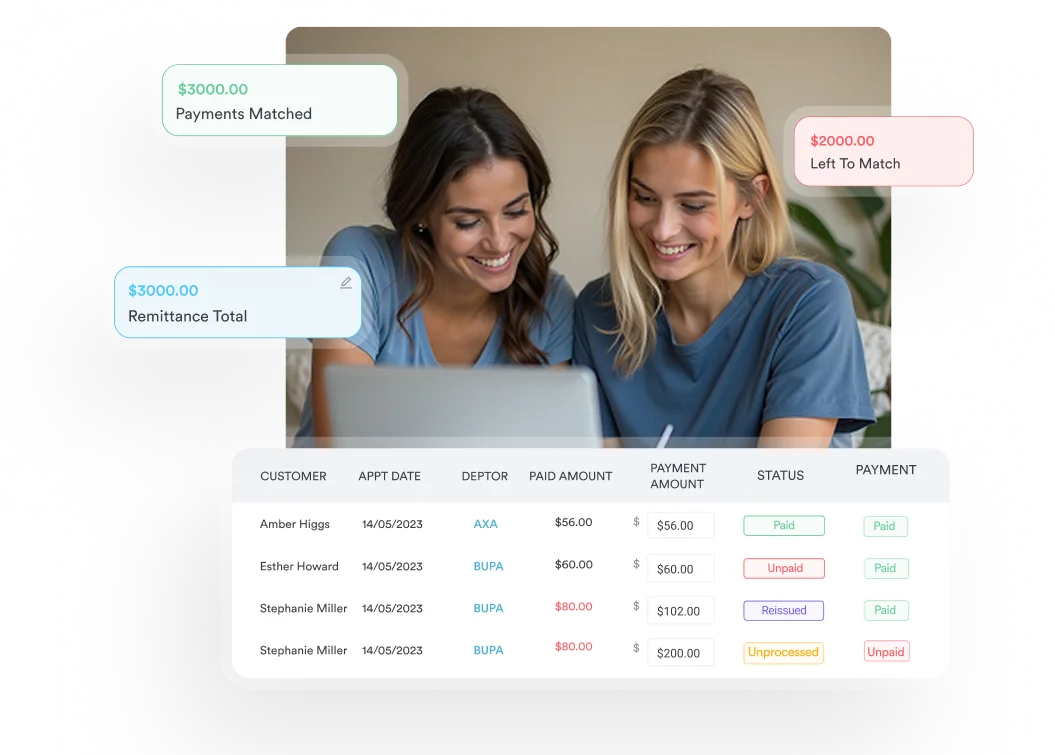

Pabau supports claim submission, ERA and denial tracking alongside patient records. Your team sees which drug claims paid and fixes the rest sooner.

Get the payer right first, and S0183 mostly takes care of itself. Medicaid and commercial plans take S0183. Medicare takes Q0164 only for the chemotherapy substitute, and no Part B code otherwise.
After that, the claim depends on details: units against the dose, the NDC and a specific diagnosis. Build the five-point check into every submission, and most of these denials get caught before they leave.
Book a demo to see how Pabau tracks claims and denials for drug codes like S0183.

Need to understand how medical billing denials work at a system level? Denial management in healthcare covers the full denial lifecycle, from reason code identification to appeals workflow.
Looking for a reference on how clean drug claims are structured? What makes a clean claim breaks down the elements that determine first-pass acceptance rates for HCPCS drug codes.
Want to see how electronic remittance data maps back to HCPCS codes? Electronic remittance advice explained covers ERA/835 file structure and how denial CARC codes relate to claim corrections.
Billing another oral antiemetic? HCPCS code S0174 for oral dolasetron walks through the same S-code payer and unit rules for a different drug.
Giving prochlorperazine by injection instead? HCPCS code J0780 for prochlorperazine injection covers dosing units and payer rules for the injectable form.
Compazine was a brand name for prochlorperazine. Its 5 mg tablets bill as S0183 for Medicaid and commercial payers. Medicare uses Q0164 only when the tablet replaces an IV antiemetic at chemotherapy. Injectable prochlorperazine bills under J0780.
Outside chemotherapy, prochlorperazine tablets usually fall under the patient’s Part D drug plan, filled at the pharmacy. Coverage depends on the plan’s formulary. That is a pharmacy claim, not a Part B claim from your practice.
No. Medicare Part B does not separately price S0183, so there is no national Medicare rate. Each state Medicaid program sets its own rate, and commercial rates come from your payer contract.
Some can. Medicare Advantage plans set their own drug and coding rules, and some accept S-codes. Check the plan’s billing policy or call provider services before you submit.
Bill 2 units of S0183, because each unit is one 5 mg tablet. Then check the payer’s daily unit cap before the line goes out.