CPT code 93503: Swan-Ganz catheter billing and modifiers
CPT code 93503: Official descriptor and procedure overview In the AMA CPT code s...

Last Updated: Oct 23, 2026
Q4134 is the HCPCS Level II code for hMatrix, an acellular dermal matrix made from donated human dermal tissue. It is billed per square centimeter as an add-on to a skin substitute application code.
From January 1, 2026, Medicare pays Q4134 as an incident-to supply at a flat national rate of $127.14 per square centimeter, adjusted by locality. Most denials trace to a missing application code, units that don't match the graft size, or a chart without proof of failed conservative care.
Let Pabau's smart automation suggest the right codes, reduce claim denials, and keep your practice compliant—effortlessly.
Automate repetitive tasks and focus on what matters most—your patients.
Reduce coding errors and ensure compliance with the latest regulations.
Clean claims, fewer denials, and faster reimbursements.
Powerful insights and reporting to help your practice thrive.
HIPAA compliant SOC 2 certified GDPR-compliant Trusted by 4,000+ clinics worldwide

HCPCS Code Q4134 describes hMatrix, an acellular dermal matrix made from donated human dermal tissue, billed per square centimeter.
Q4134 is an add-on code, so it is always reported with a skin substitute application code from CPT 15271-15278 on the same claim.
Since January 1, 2026, Medicare pays Q4134 as an incident-to supply at a flat national rate of $127.14 per square centimeter, adjusted by locality.
The JW and JZ wastage modifiers no longer apply to Q4134, and discarded graft is not billed to Medicare.
Coverage depends on your MAC. Novitas, First Coast, and CGS keep older skin substitute LCDs, while other MACs review each claim for medical necessity.
Pabau, our practice management software, keeps wound measurements, graft details, and claim status in one patient record, so each Q4134 claim goes out complete.
HCPCS Code Q4134 is the temporary Level II code for hMatrix, billed per square centimeter of graft applied. hMatrix is an acellular dermal matrix processed from donated human dermal tissue. Bacterin International launched it as a dermal scaffold for wound repair, and Bacterin is now part of Xtant Medical.
Q4134 is an add-on code, so it never stands alone on a claim. The official descriptor changed on January 1, 2026, to add the phrase “add-on, list separately in addition to primary procedure.” It is reported with an application procedure such as CPT 15271, which covers the first 25 sq cm on the trunk, arms, or legs.
The table below captures the reference data a coder needs before touching the claim form.
Q-code product assignments can change, so confirm the descriptor in the current CMS HCPCS code set before each plan year. When the invoice names a product other than hMatrix, Q4134 is the wrong code.
Medicare covers Q4134 for chronic wounds that have not healed with standard care, and the exact rules depend on the patient’s MAC. CMS withdrew the new skin substitute LCDs on December 24, 2025, days before they were due to take effect. Novitas, First Coast, and CGS kept their older skin substitute LCDs in force. Palmetto GBA, NGS, WPS, and Noridian have no skin substitute LCD, so each claim is judged on whether the graft was reasonable and necessary.
Novitas applies LCD L35041 with billing article A54117, “Billing and Coding: Application of Bioengineered Skin Substitutes to Lower Extremity Chronic Non-Healing Wounds.” Bacterin announced Novitas coverage for hMatrix in 2015 under the predecessor LCD L27549, which L35041 later replaced. Check the product list in your MAC’s billing article in the Medicare Coverage Database for the date of service, since lists change.
Wounds most often billed with Q4134 include:
Acute surgical wounds, burns, and cosmetic uses are generally not covered unless the MAC’s policy and the clinical record support an exception. Wounds with poor blood supply need documented perfusion before a graft is applied. An appeal rarely succeeds without clinical documentation created before the application.
Every unit of Q4134 on the claim represents one square centimeter of hMatrix applied to the wound. Measure the wound’s length and width in centimeters, choose the graft size that covers it, and bill the square centimeters of graft applied. A 4 cm by 4 cm wound covered with a 16 sq cm graft is billed as 16 units.
Wastage rules changed with the 2026 payment reform. Skin substitutes are now paid as incident-to supplies rather than as separately payable biologicals. The JW and JZ modifiers therefore no longer apply to Q4134, and graft trimmed away and discarded is not billed to Medicare.
Record the wound measurement, the graft size, the lot number, and a photograph where possible in the procedure note. The units on the claim must match the graft size in that note. A MAC reviewer can request the lot number and supplier invoice in an additional documentation request.
Place of service 11 (physician office) and 22 (outpatient hospital) are the usual settings, and the 2026 flat rate applies in both. Physician offices bill on the CMS-1500, and hospital outpatient departments bill on the UB-04.
Because Q4134 is an add-on code, a claim line for hMatrix without a primary application procedure on the same date is rejected. The CPT code depends on the wound’s location and its total surface area, as the grid below shows. The graft and the procedure are billed on separate lines and paid separately.
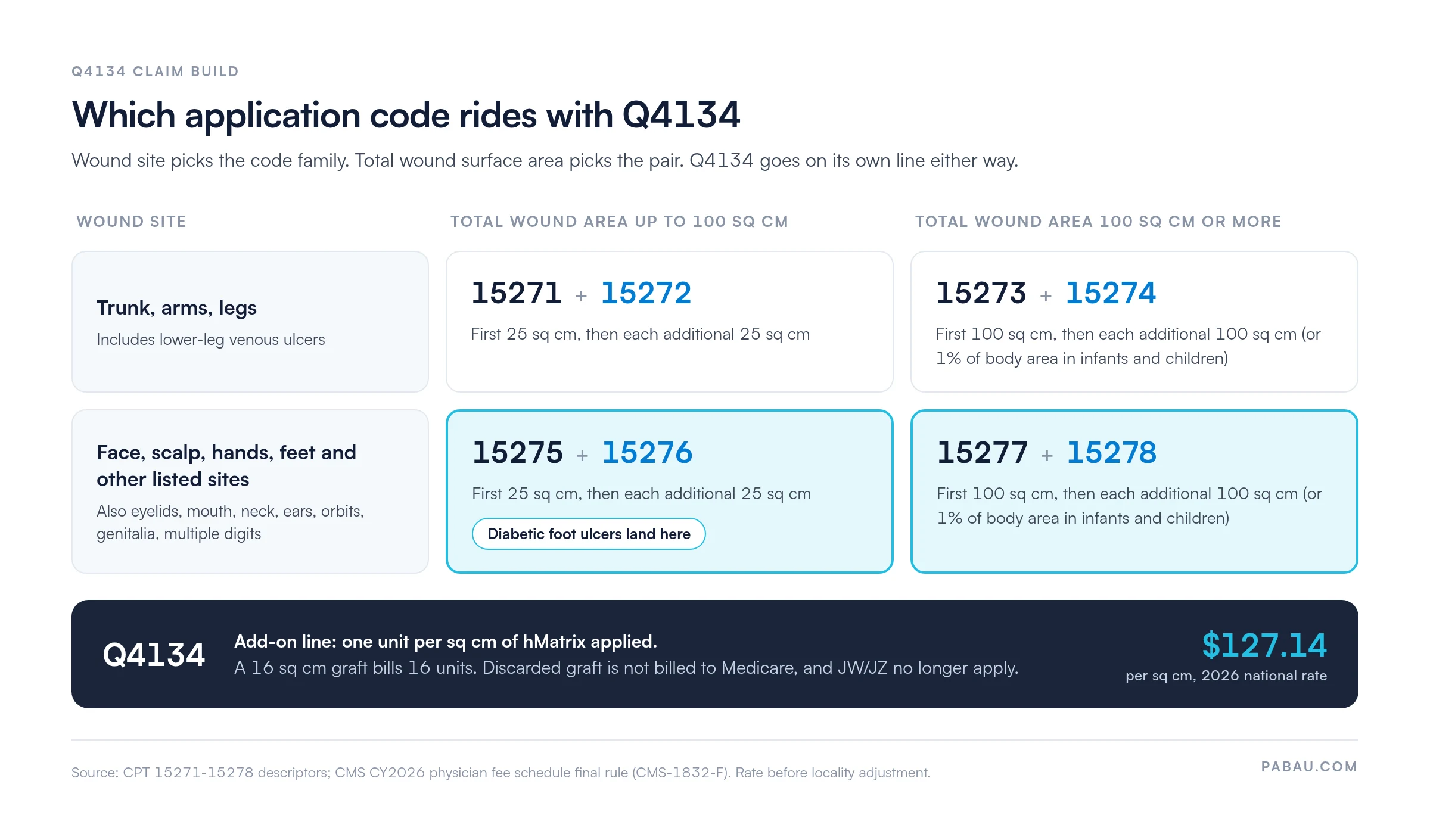
A diabetic foot ulcer is coded from the 15275-15278 range, not 15271-15274, because the foot is listed with the hands and digits. Debridement of the same wound on the same date is often bundled with the application code under NCCI edits. Check the NCCI procedure-to-procedure edits before adding a debridement line.
From January 1, 2026, Medicare pays Q4134 at a flat national rate of $127.14 per square centimeter. CMS’s CY2026 physician fee schedule final rule (CMS-1832-F) and the parallel OPPS final rule reclassified skin substitutes as incident-to supplies. The change covers products in all three FDA pathways, so the product’s regulatory category does not change its rate.
CMS first printed the rate as $127.28 and corrected it to $127.14 in November 2025. The rate is set for the full calendar year rather than updated quarterly, and manufacturers no longer report sales prices for it. The physician fee schedule adjusts it by locality, and the OPPS adjusts it by the hospital wage index.
The CMS Physician Fee Schedule look-up tool stores the rate as practice expense RVUs. Its national figure can therefore differ from $127.14 by a few cents. Use the look-up figure for your locality when you forecast payment. The worked figure below uses the national rate before any adjustment.
The application procedure is still billed and paid on its own line. Because every qualifying skin substitute now earns the same rate, the practice’s margin on hMatrix depends on its purchase price. Compare that price with your locality-adjusted rate before you reorder stock.
Medicare Advantage, commercial, and Medicaid plans set their own rates and may still ask for an invoice. Check each contract before assuming the Medicare rule applies.
Every Q4134 claim must carry ICD-10-CM codes that support a chronic wound covered by your MAC’s policy. Where Novitas, First Coast, or CGS is the MAC, the diagnosis must appear in that MAC’s billing article. Elsewhere, the codes must support medical necessity on review.
An unspecified L97 code on a claim whose record documents the site and depth invites a denial on review. Use the most specific code the record supports. For a type 2 diabetic foot ulcer, the E11.621 guide explains how to pair it with an L97 site and depth code.
Each skin substitute Q-code is product-specific, so Q4134 cannot stand in for another product’s code. The confusion risk is highest with other human acellular dermal matrices, which look and handle alike in the supply room. Since 2026 most of these codes pay the same flat rate, but billing the wrong code is still an improper claim.
Match the product name on the invoice to the code’s official descriptor before the claim goes out. When staff pull a different dermal matrix from stock, the code has to change with it. Grafix Prime and Stravix, for example, are placental tissue grafts billed under Q4133, so a dermal matrix code does not apply.
Traditional Medicare does not usually require prior authorization for Q4134, and most claims are reviewed after payment against the MAC’s policy. The exception is CMS’s WISeR model, which began in January 2026 in Arizona, New Jersey, Ohio, Oklahoma, Texas, and Washington. In those states, skin substitutes need prior authorization only where an active skin substitute LCD applies.
Medicare Advantage plans set their own rules, and many require prior authorization before any skin substitute application. Commercial payers and Medicaid programs vary by state and plan. Before the first application with any payer other than traditional Medicare:
Confirming insurance eligibility verification at intake flags missing approvals before the application date.
Build a standing authorization packet for Q4134. Include the wound photo date, wound dimensions, wound age, the conservative care log, and the planned CPT application code. Attach it to the order before the patient arrives, so the request goes out complete on the first send.
Denials on Q4134 claims cluster around a handful of predictable causes. Fixing each one in the workflow costs less than appealing it later.
When a claim is denied, look up the remittance reason code in our guide to decoding denial codes. Some denials need only a corrected claim, while others need a formal appeal. Medicare accepts a redetermination request within 120 days of the initial determination.
A Q4134 claim holds up on review only when the medical record supported it before the application. The checklist below covers what a MAC reviewer expects to see in the file.
Every item above belongs in the record before the claim leaves the practice. A short pre-claim review against this list heads off the documentation denials in the table above. It also underpins a clean claim on the first pass.
Most Q4134 errors happen when wound details move by hand from the procedure note to the claim. A coder retypes the graft size, looks up the lot number in a separate file, and checks claim status in another portal.
In Pabau, the wound measurement, graft details, and signed order sit in the patient record. Its denial-reducing claims software pulls those record details into a pre-filled claim, then submits and tracks it through Claim.MD. Supplier invoices and wound photographs can be stored against the same encounter.
The outcome is a Q4134 claim built from the note rather than from memory. When a payer asks for records, the practice answers from one file instead of three.

Pabau pulls wound measurements and graft details from the patient record into a pre-filled claim, then submits and tracks it. Supplier invoices stay with the encounter, so each Q4134 claim leaves the practice complete.

The 2026 flat rate turned Q4134 from a pricing question into a documentation job. Medicare pays the same $127.14 per square centimeter, adjusted for locality, whatever the practice paid for the graft. The risk now sits in the claim build. Each claim needs an application code alongside Q4134, units that match the graft size, and no leftover wastage modifiers.
Start with your MAC, since it decides which policy governs the claim. Then compare the adjusted rate with your hMatrix purchase price before the next order.
Pabau pre-fills each claim from the patient record, submits and tracks it, and keeps supplier invoices with the encounter. Book a demo to see how Pabau keeps wound-care claims complete from note to payment.

Billing the application procedure that goes with the graft? Our CPT 15271 guide covers the first 25 sq cm of skin substitute application on the trunk, arms, or legs.
Comparing hMatrix with another human dermal matrix? Our HCPCS Code Q4107 guide explains how GRAFTJACKET is coded and billed per square centimeter.
Getting denials with reason codes you do not recognize? Our denial codes reference maps common CARC and RARC codes to root causes and appeal routes.
Want a complete walkthrough of the medical billing process? What is medical billing explains each stage from charge capture to payment posting.
Need to understand how claim denials work across the revenue cycle? Denial management in healthcare covers the workflow from denial code to appeal.
HCPCS Code Q4134 is the temporary Level II code for hMatrix, an acellular dermal matrix made from donated human dermal tissue. It is billed per square centimeter of graft applied to a chronic wound. It is an add-on code, so it is always reported with a skin substitute application code from CPT 15271-15278.
Bill one unit per square centimeter of hMatrix applied. Measure the wound, choose a graft that covers it, and bill the graft size recorded in the procedure note. A 4 cm by 4 cm wound covered with a 16 sq cm graft is billed as 16 units. Discarded graft is not billed to Medicare from 2026.
No, not for Medicare dates of service from January 1, 2026. Skin substitutes are now paid as incident-to supplies rather than separately payable biologicals, so the wastage modifiers no longer apply. Remove JW and JZ from any skin substitute claim template built before 2026.
Medicare pays Q4134 at a flat national rate of $127.14 per square centimeter. The physician office rate is adjusted by locality, and the hospital outpatient rate by wage index. The rate is fixed for the calendar year. The application procedure is paid separately on its own line.
Traditional Medicare usually does not, except under the WISeR model in six states where an active skin substitute LCD applies. Medicare Advantage plans, commercial insurers, and Medicaid plans often do. Check each payer before the first application and keep the decision in the patient record.
No. Q4134 describes hMatrix only. Puraply AM has its own separate HCPCS code, so billing Q4134 for it is a wrong-product claim. Match the product name on the invoice to the code descriptor before submitting.