HCPCS code V5256: Digital monaural ITE hearing aid
HCPCS code V5256 covers one digital ITE hearing aid HCPCS code V5256 is the supp...

Last Updated: Oct 22, 2026
E0440 is the CCSD code for division of adhesions of turbinate of nose (and bilateral). It covers the surgical release of scar bands, called synechiae, that join a nasal turbinate to the septum or the side wall of the nose. Most surgeons divide them endoscopically through the nostril.
The descriptor already includes bilateral work, so E0440 goes on the claim once, whether the surgeon treats one side or both. Bupa classes it as a minor procedure, and UK private medical insurers usually expect pre-authorization before surgery.
Let Pabau's smart automation suggest the right codes, reduce claim denials, and keep your practice compliant—effortlessly.
Automate repetitive tasks and focus on what matters most—your patients.
Reduce coding errors and ensure compliance with the latest regulations.
Clean claims, fewer denials, and faster reimbursements.
Powerful insights and reporting to help your practice thrive.
HIPAA compliant SOC 2 certified GDPR-compliant Trusted by 4,000+ clinics worldwide

CCSD code E0440 covers surgical division of nasal turbinate adhesions, and one code covers one side or both.
Most UK private medical insurers require pre-authorization before E0440, and missing it is the leading denial cause.
J34.8 is the standard UK ICD-10 pairing, while J34.89 belongs only to the US ICD-10-CM. J34.3 applies when turbinate hypertrophy is the primary finding.
Pabau, the practice management platform we build, keeps the pre-authorization reference and clinical letters on the patient record, so each claim leaves with its evidence.
CCSD code E0440 is the UK private-healthcare code for surgical division of adhesions of the turbinate of the nose. Its descriptor explicitly includes bilateral work. The CCSD schedule places it in the ear, nose and throat chapter, alongside turbinate reduction and polypectomy codes.
Because bilateral work is included, the same code applies whether the surgeon treats one side or both in the same session. Coders don’t split E0440 into two lines for bilateral work. Several other nose codes in the full CCSD code list carry the same “(and bilateral)” wording, including nasal septum cauterization and polypectomy.
The procedure covered is adhesiolysis: The surgical release of intranasal synechiae that have formed between the turbinate and the nasal septum or lateral nasal wall. These fibrous bands narrow the nasal airway and cause chronic nasal obstruction. Surgical division restores airflow.
The Bupa CCSD code submission framework applies to E0440 the same way it applies to other ENT codes. Bupa classes E0440 as a minor procedure, and its code portal lists the insurer-specific fee and coverage details.
Division of turbinate adhesions is performed endoscopically in almost all modern ENT practice. The surgeon introduces a rigid nasal endoscope and identifies the synechia bridging the turbinate and the septal or lateral wall mucosa. The adhesion is then divided with curved scissors, a sickle knife, or a powered microdebrider. The approach is transnasal and needs no external incision.
Operative steps typically proceed as follows:
The procedure is performed under general anesthesia, or local anesthesia with sedation, depending on patient fitness and the extent of adhesions. Day-case surgery is standard. Operating time ranges from 15 to 45 minutes, depending on the number and density of adhesions.
Turbinate synechiae most commonly arise as a post-operative complication of earlier nasal surgery. Septoplasty, functional endoscopic sinus surgery (FESS), and turbinate reduction all leave raw mucosal surfaces that can touch during healing and fibrose together. The risk is highest when raw surfaces face each other across a narrow nasal passage.
Non-surgical causes are less frequent but include nasal trauma, chronic inflammatory disease (particularly atrophic rhinitis), and granulomatous conditions such as sarcoidosis. Symptoms that justify surgical intervention include:
Record each of these indicators in the clinical notes before E0440 goes on a claim. Without a pre-operative endoscopy report, insurers treat the procedure as lacking medical necessity, which is a common route to denial.
Submitting E0440 correctly takes more than entering the code. The claim package that reaches the insurer has to show clinical justification, the procedure performed, and accurate billing in one submission.
Practices using specialist claims management software can store the pre-authorization reference on the claim record. That way, a claim can’t go out without an authorization on file.
The phrase “and bilateral” in the E0440 descriptor settles the most common coding question upfront: One code covers the procedure on one side or both. Don’t list E0440 twice to show bilateral work, as most insurer systems will reject or halve the second line.
Bilateral fee rules vary by insurer. Some pay a single fee whether the work was on one side or both, and others add a bilateral loading. Check the insurer’s fee schedule before assuming bilateral work pays more. Insurer and health-trust portals, such as Healix, publish procedure-specific reimbursement rules for CCSD codes.
Every CCSD claim needs a supporting ICD-10 diagnosis code. For E0440, the right code depends on the primary clinical finding documented before surgery, and UK insurers expect it from WHO or UK ICD-10.
UK private medical insurers work from the NHS version of ICD-10, fifth edition, where the code for intranasal synechiae is J34.8. The WHO ICD-10 browser shows the same code. J34.89 is a US ICD-10-CM extension, so it belongs on a UK claim only if the insurer’s system specifically asks for ICD-10-CM.
Insurer auditors assess E0440 claims against a consistent documentation checklist. Practices that build this checklist into their clinical workflow before the procedure date avoid most denials and audit queries.
The operative report must state:
Pre-operative clinical notes must demonstrate:
Pre-authorization paperwork usually includes the clinical letter, the endoscopy report, and the proposed procedure list. Storing these documents on the patient record makes them faster to retrieve during an audit and simpler to attach to a claim.
Strong medical billing compliance processes for ENT procedures run the same documentation checklist on every case.
Build a standard E0440 documentation checklist into your ENT surgical booking workflow. Confirm that pre-authorization is on file and that the pre-operative endoscopy report is attached to the patient record. Set the operative dictation template to prompt the surgeon for laterality and surgical technique before the notes are finalized. Fixing a missing document before billing is faster than appealing a denial.
Several CCSD codes sit close to E0440 in the ENT chapter and are often selected in error. In each case, the procedure performed decides the code, and the anatomical region alone doesn’t settle it. Turbinate tissue that is trimmed or excised rather than freed from adhesions belongs under CCSD code E0420.
The CCSD technical guide sets the authoritative code hierarchy rules. Where a more specific code such as E0440 exists, it must be used in preference to a general or catch-all code. The CCSD Technical Guide (October 2025) carries the current bundling and hierarchy rules for ENT chapter codes.
One clash sits outside the CCSD schedule entirely. In the US HCPCS Level II set, E0440 is a supply code for a stationary liquid oxygen system. A lookup tool set to HCPCS returns that code instead, so confirm the coding system before you trust a search result.
Yes, E0440 can be billed in the same session as septoplasty, provided both procedures are performed and documented separately on distinct anatomical structures. Turbinate adhesion division (E0440) targets fibrous bands between the turbinate and the lateral nasal wall or septum.
Septoplasty addresses the deviated bony and cartilaginous septum. These are distinct procedures with distinct operative targets. Most insurers permit both to be claimed in the same session when the operative report clearly separates them. Where the surgeon resects septal cartilage instead of repositioning it, the operation is a submucous resection coded E0310.
Same-session billing rules vary by insurer, so check the insurer’s benefit schedule before submitting. These general principles apply across most insurers:
Bundling decisions are insurer-specific. Check them before submission, rather than discovering a bundling conflict when the remittance arrives.
Denials for E0440 cluster around five root causes. Each one has a corrective action you can build into the pre-billing workflow. Robust denial management workflows treat these causes as standing risks to check on every claim.
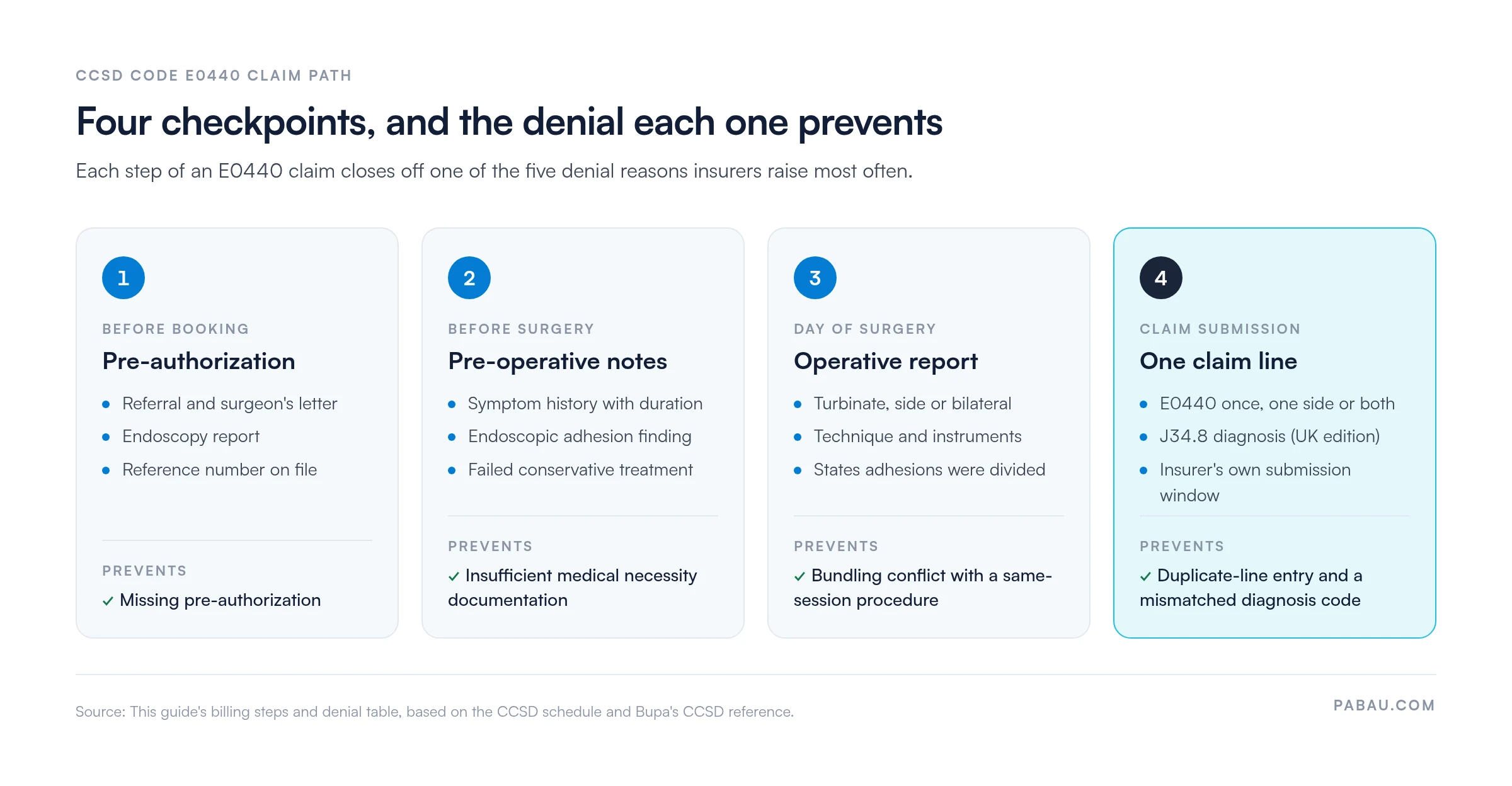
Four checkpoints in the claim path close off all five, as the diagram below shows.
UK private medical insurers reimburse E0440 against their own published fee schedules for ENT procedures. Fees change with each schedule update, so check current figures directly rather than relying on last year’s data.
Common reimbursement characteristics across insurers include:
Bupa, AXA Health, Vitality and Allianz Care each publish their own schedule, so the benefit for E0440 can differ between them. Bupa’s code search portal Vitality’s fee finder and Allianz Care’s published fee schedule let practices look up procedure-specific benefit amounts before scheduling.
An E0440 claim depends on paperwork that often sits in three places. The referral letter is in an inbox, the endoscopy report is in a shared drive, and the authorization number is on a sticky note. When an insurer queries the claim, someone has to rebuild that trail by hand.
Pabau’s claims management keeps that trail on the patient record. The pre-authorization reference sits against the appointment, and the clinical letter and endoscopy report attach to the same file. The invoice to the insurer is raised from that record too.
The result is a claim that leaves with its evidence attached. If an insurer asks for supporting documents during assessment, your team pulls them from one record instead of three systems.

Pabau keeps pre-authorization references, clinical letters and endoscopy reports on the patient record, so each CCSD claim leaves with its evidence attached. See how it works for ENT billing.

The surgery behind E0440 is short, but the claim is won or lost before the patient reaches the operating room. Secure pre-authorization with the endoscopy report attached, and most of the denial table never applies.
The one judgment call is same-session work. When E0440 sits alongside septoplasty or turbinate reduction, let the operative report do the separating, and confirm the insurer’s bundling rules before you bill both.
Book a demo to see how Pabau keeps the authorization, letters and operative notes for each CCSD claim on one patient record.

Need a CCSD billing overview for Bupa? Bupa CCSD codes guide covers Bupa-specific code structure, submission rules, and ENT procedure categories.
Billing a diagnostic nasal endoscopy? CCSD code E2500 explains how to code and document diagnostic nasolaryngopharyngoscopy for UK insurers.
Coding another procedure on the nasal septum? CCSD code E0330 covers billing for biopsy of the septum of the nose.
Want to reduce claim rejection rates across your ENT practice? Denial management in healthcare explains systematic approaches to tracking, appealing, and preventing claim denials.
Building a compliant billing workflow from the ground up? Medical billing compliance covers the documentation standards and audit-readiness practices that support clean claim submission.
CCSD code E0440 is the code for surgical division of adhesions of the turbinate of the nose, including bilateral work. It covers endoscopic (or, less commonly, open) division of intranasal adhesions between the turbinate and the nasal septum or lateral nasal wall. One code applies whether the surgeon treats one side or both in the same session.
E0440 covers division of adhesive bands between the turbinate and nearby nasal structures, and it involves no removal of turbinate tissue. Turbinectomy codes describe partial or complete removal of the turbinate itself. The operative report wording is the differentiator: “Divided adhesions” maps to E0440, while “resected turbinate tissue” maps to the turbinectomy code.
Yes, but it is billed as a single line item. The descriptor already includes “and bilateral,” so E0440 is entered once whether the adhesions were divided on one side or both. Entering E0440 twice on the same claim to reflect bilateral work will typically trigger a duplicate-claim rejection.
For UK private medical insurers, J34.8 (Other specified disorders of nose and nasal sinuses) is the standard ICD-10 pairing for turbinate adhesions. J34.89 is its US ICD-10-CM counterpart and doesn’t exist in WHO or UK ICD-10. J34.3 (Hypertrophy of nasal turbinates) applies when turbinate enlargement is the primary documented obstruction.
The five most common denial reasons are missing pre-authorization, thin medical necessity documentation, a mismatched or absent ICD-10 code, bilateral duplicate-line entry, and bundling conflicts. Thin documentation usually means the notes lack a pre-operative endoscopy report. The most effective fix is a booking workflow that requires an authorization reference before the procedure is scheduled.
In most cases, yes. E0440 (turbinate adhesion division) and septoplasty (septal correction) target distinct anatomical structures. They can be billed in the same session when both are fully documented in the operative report. Same-session rules are insurer-specific, so check the benefit schedule before submitting both codes. Some insurers require separate pre-authorization for each code in a combined session.
No bilateral modifier is needed. The E0440 descriptor already includes bilateral work, so document laterality in the operative notes instead. Assistant surgeon fees are a separate question, and they follow each insurer’s own rules for all surgical codes.