CPT code 21011: Excision of soft tissue tumor of the face
CPT code 21011: Official descriptor and procedure overview CPT code 21011, as pu...

Last Updated: Oct 8, 2026
S0174 is the HCPCS Level II code for dolasetron mesylate, oral 50 mg (for circumstances falling under the medicare statute, use q0180).
One market change shapes every claim in this guide. Anzemet and its US generics have been discontinued in the US, so S0174 now applies mostly to legacy and compounded billing.
Let Pabau's smart automation suggest the right codes, reduce claim denials, and keep your practice compliant—effortlessly.
Automate repetitive tasks and focus on what matters most—your patients.
Reduce coding errors and ensure compliance with the latest regulations.
Clean claims, fewer denials, and faster reimbursements.
Powerful insights and reporting to help your practice thrive.
HIPAA compliant SOC 2 certified GDPR-compliant Trusted by 4,000+ clinics worldwide

HCPCS Code S0174 describes dolasetron mesylate oral 50 mg, an oral 5-HT3 antagonist antiemetic sold as Anzemet.
CMS’s descriptor sends Medicare-statute circumstances to Q0180, so S0174 is not the Medicare-statute code.
Anzemet and its US generics have been discontinued, so S0174 now covers legacy and compounded claims.
S-series codes are temporary national codes for Medicaid and commercial payers, and Medicare fee-for-service generally does not reimburse them.
No national rate exists, so reimbursement comes from the plan contract or the state Medicaid schedule.
HCPCS Code S0174 is a Level II HCPCS S-series code for dolasetron mesylate, oral, 50 mg. CMS’s full descriptor carries a routing instruction inside it. Where the circumstances fall under the Medicare statute, report Q0180 instead.
The Centers for Medicare and Medicaid Services (CMS) assigns S-series codes as temporary national codes. They capture drug and service items that permanent HCPCS Level II or CPT codes do not yet cover. State Medicaid programs and commercial payers adopt them. Traditional Medicare fee-for-service largely does not.
Dolasetron mesylate is a selective 5-HT3 serotonin receptor antagonist. It blocks the serotonin receptors in the gut and the central nervous system that trigger the vomiting reflex. That makes it effective against chemotherapy-induced nausea and vomiting (CINV) and postoperative nausea and vomiting (PONV).
The drug was sold under the brand name Anzemet. Both the brand and its US generics have since been discontinued, per Drugs.com and AHFS DI. Oral dolasetron is therefore no longer a routinely dispensed product. S0174 now matters mainly for legacy claims, appeals on older dates of service, and compounded preparations.
The 50 mg oral tablet in the descriptor was given before chemotherapy or surgery as prophylaxis. Route decides the code family here. J-codes cover injectable drugs, while S-series codes were created for oral and other non-injectable administrations without a permanent code. Coders who miss that distinction sometimes report oral dolasetron under a J-code, which invites a rejection.
Two decisions settle which code goes on the claim line. The route comes first, then the payer circumstance.
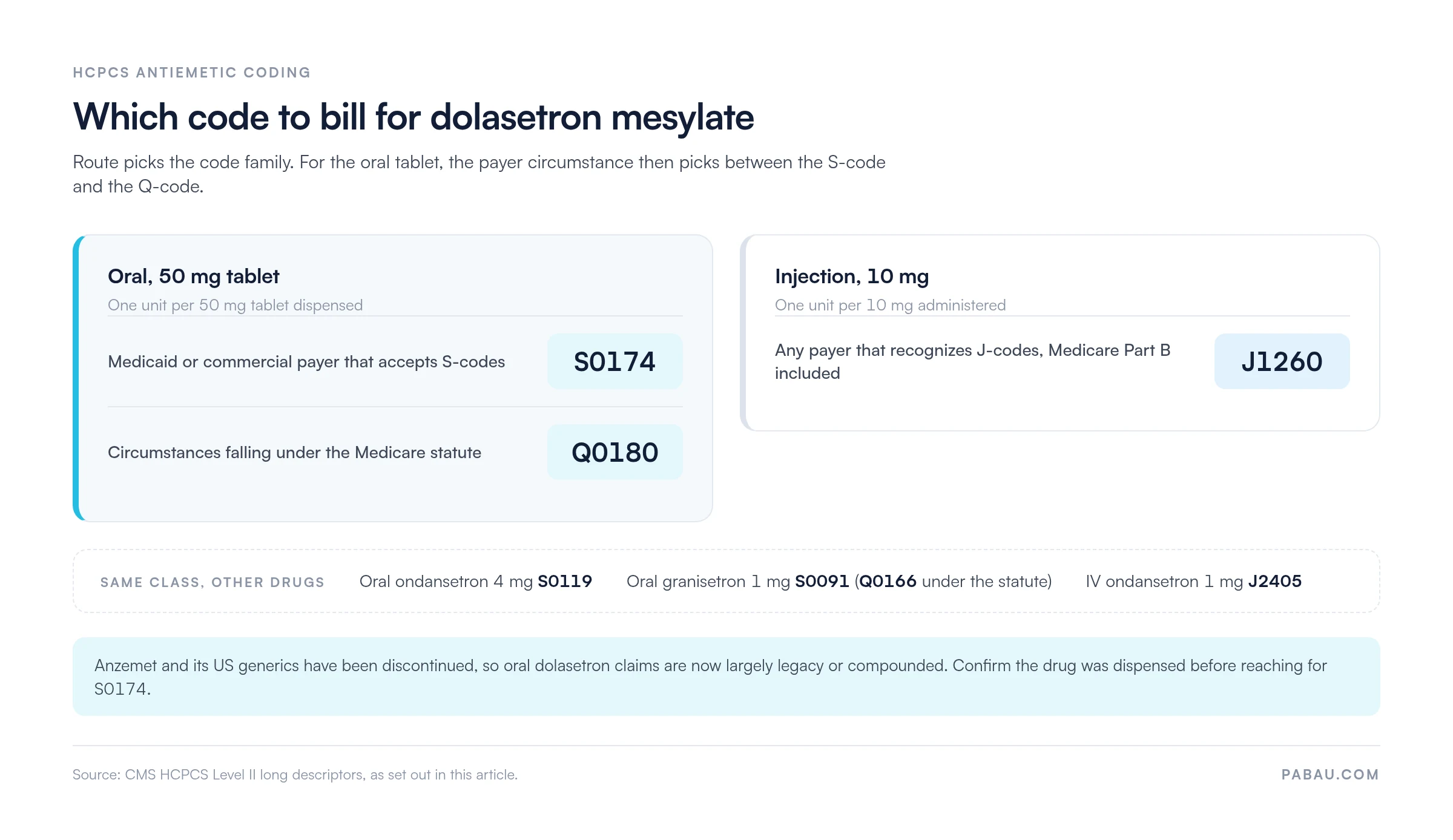
Traditional Medicare fee-for-service generally does not reimburse S-series codes. CMS designates S-codes for Medicaid and commercial payer use, so a Part B claim for S0174 usually denies without a plan-specific endorsement. Where the circumstances fall under the Medicare statute, Q0180 is the code that applies.
Medicaid coverage varies considerably by state. Many state programs cover oral antiemetics for oncology patients, but prior authorization is commonly required. Commercial payers follow their own drug formularies, so coverage is contract-driven. Run an eligibility check before dispensing, because a non-covered drug claim is far harder to fix afterward.
S0174 carries no CMS-published national fee schedule rate, because S-series codes sit outside the Medicare Physician Fee Schedule. Reimbursement is set at the payer level through plan contracts or state Medicaid fee schedules.
The CMS Physician Fee Schedule lookup tool returns no rate for S0174. State Medicaid bulletins and individual payer contracts are the only published benchmarks available.
For practices building an internal charge schedule, one common approach starts from Average Wholesale Price (AWP) or Wholesale Acquisition Cost (WAC). Add a dispensing fee on top, then negotiate reimbursement against that benchmark with each payer. Tracking each payer’s paid amounts over time gives the most reliable benchmark for a code with no national rate.
Track S0174 reimbursement separately by payer in your billing system. If one payer’s average reimbursed amount falls more than 15% below your baseline, audit the recent remittances. Silent contractual adjustments and a changed formulary tier are the two usual causes.
Billing S0174 correctly takes the right code, a supporting diagnosis, the correct place of service, and documentation that backs all three. Because the drug is discontinued, the first check is now whether oral dolasetron was genuinely dispensed on that date of service.
Coverage decisions for S-codes are made at the plan level, not the federal level. A claim that pays cleanly under one commercial contract can be denied outright under another. There is no national rule to appeal to, which is the core problem a practice manager inherits with this code.
Prior authorization is the most common gatekeeper. For Medicaid programs that cover oral antiemetics, the request usually needs the diagnosis, the chemotherapy or surgical regimen, and the prescribing provider’s NPI. Build that checklist into intake, so the request goes out before the drug is dispensed.
Denials on S0174 most often cite non-covered service, drug not on formulary, or prior authorization required. Appeal a non-covered denial with the plan’s own S-code policy in hand. Resubmit a formulary denial with a step-therapy exception, and escalate an authorization denial with the ordering oncologist’s clinical notes.
Charge capture also has to keep S0174 apart from its neighbors. A mix-up with the injectable form or a wrong unit count can trigger an audit. The discontinued status makes a recent S0174 claim more likely to be reviewed.
Every S0174 claim needs a supporting ICD-10-CM diagnosis code that justifies the antiemetic. Submitting the HCPCS code alone, with no linked diagnosis, is a primary reason these claims come back. The table below lists the codes most commonly paired with it, all drawn from the ICD-10-CM code set.
Code specificity matters. Payers often reject R11.2 when the record documents a known chemotherapy regimen, because the more specific T45.1X5A is available and expected. Confirm the clinical context with the ordering clinician before you pick the diagnosis code.
Build an ICD-10 pairing reference into your charge capture template for S0174 claims. A pre-populated dropdown of approved diagnosis codes reduces the rate of generic-code submissions and gives denial appeals a stronger evidentiary foundation.
Several HCPCS codes cover antiemetic drugs in adjacent routes or dosages. Billing an oral dolasetron claim under an intravenous code is the error most likely to end in an overpayment demand. The AAPC Codify HCPCS lookup supports crosswalk searches across the S-series and J-series antiemetic codes.
S0175 is a common mis-citation in this group. That code is flutamide, oral, 125 mg, a prostate cancer drug with no antiemetic use at all. Oral granisetron 1 mg belongs to S0091, and to Q0166 where the Medicare statute applies. Oral oncology drugs fill much of this S-series range, with chlorambucil under S0172.
When a patient moves from oral to intravenous dolasetron mid-treatment, J1260 replaces S0174 on that claim line. Document the route change in the clinical note, because auditors look for evidence that the oral route was unavailable.
If the practice switches agents rather than routes, the ondansetron injection code J2405 applies instead. That swap is common now that oral dolasetron is off the US market.
In many practices the pieces of an S0174 claim live in three places. The charge sits in the billing system, the clinical justification sits in the chart, and the authorization sits in someone’s inbox. Reconciling them after a denial takes longer than the claim is worth.
Pabau is practice management software for medical and aesthetic practices. Its claims tools for billers sit in the same record as the appointment and the clinical note. A biller attaches the HCPCS code to the patient record, with the diagnosis code and the authorization reference alongside it.
Claim statuses and denial reasons are tracked per payer, so a pattern on S-code rejections shows up as a number rather than a hunch. That matters most on a code like this one, where every plan writes its own rule and no national rate exists to argue from.

Pabau lets billers attach HCPCS codes like S0174 to the patient record, track claim status by payer, and see which denial reasons repeat. Keeping the charge and the chart together means less time reconciling after the fact.

S0174 is a narrow code that got narrower. The descriptor routes Medicare-statute circumstances to Q0180. The drug it describes is no longer marketed in the US, and no national rate exists to benchmark against.
So treat a new S0174 claim as an exception rather than a routine charge. Confirm the drug was dispensed, confirm the plan accepts S-codes, and confirm the Medicare statute does not apply. If any of the three fails, the code on the line is the wrong one.
Practices that get paid on codes like this one keep the payer-specific rules where their billers can see them. Book a demo to see how Pabau keeps drug codes, diagnoses, and claim status in one patient record.

Need a foundation in drug claim submission? Medical billing fundamentals walks through the end-to-end claim lifecycle, from charge capture to payment posting.
Dealing with payer denials on S-codes? Denial management in healthcare covers appeal strategies for common denial categories, including non-covered service and prior authorization.
Want to understand the superbill’s role in drug billing? Superbill documentation guide explains how charge capture documents support clean HCPCS drug claims.
HCPCS Code S0174 reports dolasetron mesylate, oral, 50 mg, an antiemetic used against chemotherapy-induced and postoperative nausea and vomiting. It is an S-series temporary national code adopted by Medicaid and commercial payers. Where circumstances fall under the Medicare statute, Q0180 applies instead.
No. CMS’s long descriptor for S0174 tells you to use Q0180 for circumstances falling under the Medicare statute. S0174 is the code for everyone else, mainly Medicaid and commercial plans that accept S-series codes.
No. Traditional Medicare fee-for-service generally does not reimburse S-series codes, and CMS’s own descriptor routes Medicare-statute circumstances to Q0180. Some Medicare Advantage plans cover S-codes under their formularies, so verify with the specific plan before dispensing.
S0174 represents dolasetron mesylate, oral 50 mg, sold under the brand name Anzemet. It is a 5-HT3 serotonin receptor antagonist. Anzemet and its US generics have been discontinued, so the code now covers legacy and compounded claims.
S0174 appears as an active code in 2026 HCPCS references, but CMS updates the code set every year. Check the current CMS HCPCS annual update file before billing. A code can stay active long after the drug it describes leaves the market.
S0174 covers oral dolasetron mesylate 50 mg. J1260 covers injectable dolasetron mesylate, billed per 10 mg. Route is what separates them. S-codes apply to the oral form and are used by Medicaid and commercial payers. J-codes apply to injectables and are recognized by Medicare Part B.
Use S0119 for oral ondansetron 4 mg. S0174 is specific to dolasetron mesylate, so reporting ondansetron under it is a coding error. For oral granisetron 1 mg the code is S0091, or Q0166 where the Medicare statute applies.
Submit the request before dispensing, with the diagnosis code, the chemotherapy or surgical regimen, and the prescribing provider’s NPI. Most Medicaid programs that cover the code require it for oncology antiemetics. Approval takes anywhere from same-day to several business days, depending on the state program.