CPT code 93503: Swan-Ganz catheter billing and modifiers
CPT code 93503: Official descriptor and procedure overview In the AMA CPT code s...

Last Updated: Oct 23, 2026
C7190 is the CCSD code for extracapsular cataract extraction with implant - bilateral. It covers removal of the lens nucleus intact through a large incision, with an intraocular lens implanted in each eye, when both eyes are treated.
Use C7180 when only one eye is operated on. If the surgeon used phacoemulsification instead, the correct codes are C7122 for one eye and C7125 for both eyes.
Let Pabau's smart automation suggest the right codes, reduce claim denials, and keep your practice compliant—effortlessly.
Automate repetitive tasks and focus on what matters most—your patients.
Reduce coding errors and ensure compliance with the latest regulations.
Clean claims, fewer denials, and faster reimbursements.
Powerful insights and reporting to help your practice thrive.
HIPAA compliant SOC 2 certified GDPR-compliant Trusted by 4,000+ clinics worldwide

CCSD code C7190 covers extracapsular cataract extraction with an intraocular lens (IOL) implant on both eyes. Unilateral ECCE with implant is C7180.
The operative note decides the code. If the surgeon used phacoemulsification, bill C7122 for one eye or C7125 for both eyes, not C7190.
Most UK private medical insurers require prior authorization before C7190 surgery. Whether a same-day bilateral (ISBCS) claim is accepted varies by payer.
Pabau’s claims management software checks codes, documentation and authorization references against each other before a CCSD claim goes out.
CCSD code C7190 describes extracapsular cataract extraction with intraocular lens (IOL) implant, bilateral. The CCSD schedule groups it in Chapter 4 (Eye and orbital contents), section 4.9 Lens. Its neighbors there are the unilateral counterpart C7180 and the phacoemulsification codes C7122 and C7125. The rest of the eye chapter sits in our index of CCSD codes.
Two procedure components define this code. First, the surgical technique must be extracapsular extraction (ECCE). The lens nucleus is removed intact through a large limbal incision rather than emulsified in situ. Second, an intraocular lens must be implanted into the capsular bag at the same operative episode. If either component is absent from the operative note, C7190 cannot be supported.
The code applies only when both eyes are treated. Where a single eye is operated on, the correct code is C7180.
Extracapsular cataract extraction with IOL implant involves removing the opacified lens while preserving the posterior capsule to support the implant. The procedure follows a defined sequence that must be reflected in the operative note for the claim to stand.
Surgeons choose ECCE when phacoemulsification is not appropriate. The usual reasons are:
The operative note must state the technique explicitly. Surgeons moving from the NHS to private practice sometimes find that private insurers scrutinize technique documentation more closely than NHS coding requires.
Phacoemulsification uses ultrasound energy to emulsify the lens nucleus inside the eye before aspiration through a small incision. ECCE removes the nucleus intact through a much larger incision without ultrasound.
Each technique has its own codes. Billing C7190 (ECCE bilateral) when the operative note documents phacoemulsification is a material miscoding. It typically results in denial or, on audit, a recoupment request. Coders take the technique from the operative note, whichever technique the surgeon usually favors.
The bilateral descriptor in C7190 does not automatically determine how the claim is submitted. UK private insurers distinguish between two bilateral cataract surgery approaches, and each has its own billing rules.
Immediate sequential bilateral cataract surgery (ISBCS) performs both eyes in a single operative session. Not all UK private medical insurers accept a single bilateral claim for same-day surgery under C7190. Some require two separate submissions, using C7180 for each eye. Confirm the payer’s bilateral policy in writing before the procedure.
Delayed sequential bilateral cataract surgery (DSBCS) operates on the second eye at a separate session, typically weeks after the first. Claiming C7190 across two separate dates requires clear documentation that both eyes were planned as one bilateral procedure. The second eye’s prior authorization reference must also match the original approval scope. Some payers treat the second episode as a new claim requiring fresh authorization.
Four CCSD codes cover cataract extraction with IOL implant. The differentiators are surgical technique (ECCE vs phacoemulsification) and laterality (unilateral vs bilateral). The grid below turns those two questions into a single code.
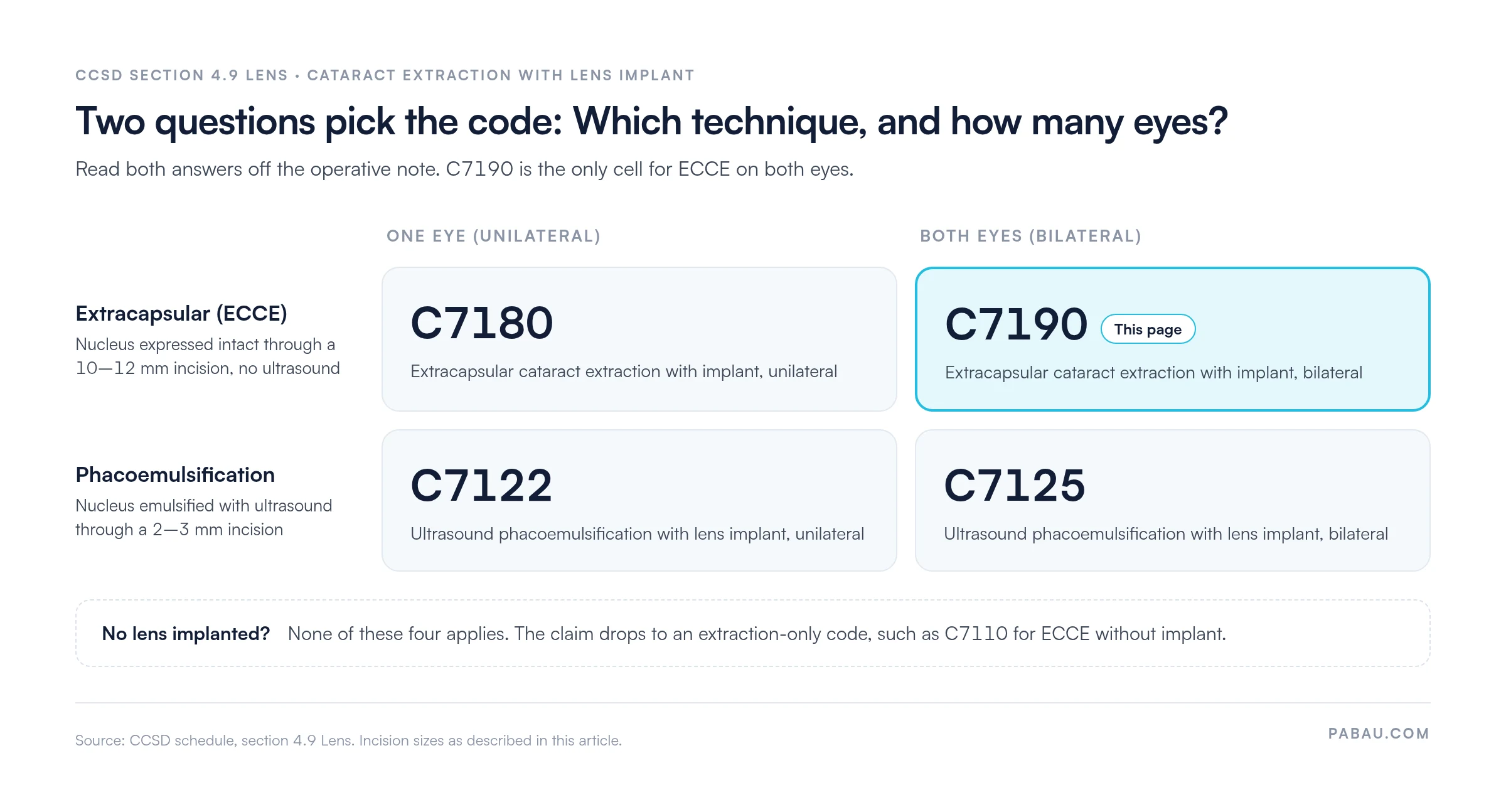
Billing phacoemulsification as C7122 or C7125 when the operative note records ECCE is a technique mismatch, and so is the reverse. Insurers cross-reference the operative note on audit, and discrepancies between the documented technique and the billed code are a recoupment trigger. The selection rule is simple: The code follows the operative note.
Most UK private medical insurers require prior authorization before bilateral cataract surgery under CCSD code C7190. The specific requirements vary by insurer and can change by policy year, so the guidance below describes the general requirement category rather than fixed rules. Always verify current requirements directly through the insurer’s provider portal before the procedure.
Failure to obtain prior authorization before submitting a C7190 claim is one of the most direct routes to automatic denial across all of these insurers. The authorization reference number must appear on the claim.
IOL cost inclusion in the C7190 fee also varies by payer. Some reimburse the lens separately as a device cost, while others include it within the procedure fee. Verify it against each payer’s schedule rather than assuming inclusion.
For Bupa’s CCSD billing structure, the Bupa CCSD billing guide covers code submission rules, invoice requirements, and the Bupa code search tool. The Bupa procedure fee schedule explains how Bupa sets and publishes its rates.
A C7190 claim is only as strong as the documentation supporting it. Missing or incomplete records are a documented denial trigger across all major UK private medical insurers. The following elements must be present before submission.
Request written payer confirmation of bilateral billing policy before scheduling ISBCS. Verbal confirmations are not sufficient for dispute resolution. Keep the written policy document with the patient’s prior authorization paperwork.
Denials of CCSD code C7190 cluster around a small number of recurring errors. Knowing them helps practices resolve claims faster and avoid repeat denials.
Some consultants work across NHS and private settings, and some insurers request OPCS-4 codes alongside CCSD codes. Both situations call for the OPCS-4 classification of extracapsular cataract extraction with IOL implantation.
OPCS-4 codes the lens insertion separately as C75.1 and sequences it before the extraction code, as the UKOA cataract coding handbook explains. The NHS Classifications Browser is the authoritative lookup for current OPCS-4 code values and their notes. Verify every code below against the current edition before use, as classification updates occur annually.
OPCS-4 codes are used in NHS HRG-based payment, not in CCSD private billing. The crosswalk matters when a consultant’s episode spans both settings. It also applies when an insurer’s clinical team asks for OPCS coding for an audit or case review.
C7190 claims tend to fail when the operative note, the authorization letter and the claim are checked in separate places. Nobody compares the technique, the laterality and the reference number side by side before submission.
Pabau keeps the clinical notes, uploaded authorization letters and invoices for each surgery on one patient record. Its claims management software lets ophthalmology teams track prior authorization references, match documents to claims and flag incomplete records before they reach the insurer.
The result is fewer resubmissions for technique or laterality mismatches. You also keep a documentation set that holds up if the insurer audits the claim months later.

Pabau helps UK private practices generate CCSD-compliant claims, track prior authorization references, and manage billing workflows. Your C7190 submissions go out with the right documentation the first time.

For C7190, the operative note is the deciding document. If it does not name ECCE, confirm both eyes and record the implanted lens, no authorization or fee schedule will carry the claim.
The practical move is to read the note before the claim is built, while a missing detail is still a quick addendum from the surgeon. Settle each payer’s bilateral policy in writing before an ISBCS list is booked, because that answer decides whether you submit one claim or two.
Book a demo to see how Pabau links operative notes, authorization references and CCSD claims for your ophthalmology practice.

Billing other CCSD ophthalmology procedures? Bupa CCSD billing guide covers code submission rules, invoice requirements, and how to use the Bupa code search portal for Chapter 4 eye codes.
Need a clear overview of Bupa’s fee structure? Bupa procedure fee schedule explains how Bupa sets and publishes CCSD rates across specialties, including ophthalmology.
Coding a bilateral phaco case instead? CCSD code C7125 covers bilateral phacoemulsification with lens implant, the code to use when the note records phaco on both eyes.
No lens implanted during the extraction? CCSD code C7110 explains extracapsular cataract extraction without implant and the documentation it needs.
Managing billing across multiple private practice specialties? Pabau’s claims management software helps private UK practices track prior authorizations, generate CCSD-compliant claims, and resolve denials before they age.
CCSD code C7190 covers extracapsular cataract extraction with intraocular lens implant performed bilaterally. It is used on UK private medical insurance claims where ECCE, not phacoemulsification, was performed on both eyes. The eyes may be treated in one session or in a planned bilateral episode, with an IOL implanted in each.
C7180 is the unilateral version: Extracapsular extraction with IOL implant performed on one eye. C7190 is the bilateral version: The same procedure performed on both eyes. Both require ECCE technique. The only difference is laterality.
C7190 applies only to extracapsular extraction (ECCE). If phacoemulsification was performed bilaterally, the correct code is C7125. The operative note determines the code. Billing C7190 when the note documents phaco is a material miscoding and a denial trigger.
Only where the insurer’s bilateral policy allows it. Some UK private medical insurers accept a single C7190 claim for immediate sequential bilateral cataract surgery (ISBCS). Others require two separate C7180 submissions on the same service date. Confirm the payer’s written bilateral policy before proceeding.
Not always. Some payers include the IOL within the C7190 procedure fee, while others reimburse the lens separately as a device cost. Do not assume inclusion: Check the specific payer’s current fee schedule or contact their provider team before submitting the claim.
AXA Health, Bupa, Freedom Health Insurance, The Exeter, and Allianz Care all operate CCSD-based fee schedules that include Chapter 4 ophthalmology codes. Each has its own prior authorization process and fee rate for C7190. Verify current rates and submission requirements directly through each insurer’s provider portal.