CPT code 93503: Swan-Ganz catheter billing and modifiers
CPT code 93503: Official descriptor and procedure overview In the AMA CPT code s...

Last Updated: Oct 23, 2026
A7300 is the CCSD code for radiofrequency (including pulsed denervation), cryoprobe or phenol for permanent lesion of named peripheral nerve +/– image guidance. It covers a procedure that deliberately destroys or disrupts a named peripheral nerve to give lasting pain relief. A temporary local anesthetic block is coded elsewhere, as A7352 or A7302.
UK private medical insurers such as Bupa, AXA Health, Aviva and Vitality pay specialists against the CCSD schedule. A7300 sits in Chapter 3 under other nerve blocks, at Intermediate 1 complexity, and the 2026 Bupa CCSD reference lists it at £245.
Let Pabau's smart automation suggest the right codes, reduce claim denials, and keep your practice compliant—effortlessly.
Automate repetitive tasks and focus on what matters most—your patients.
Reduce coding errors and ensure compliance with the latest regulations.
Clean claims, fewer denials, and faster reimbursements.
Powerful insights and reporting to help your practice thrive.
HIPAA compliant SOC 2 certified GDPR-compliant Trusted by 4,000+ clinics worldwide

CCSD code A7300 covers a permanent lesion of a named peripheral nerve by radiofrequency, pulsed radiofrequency, cryoprobe or phenol, with or without image guidance.
It is a neurolytic procedure, so a temporary local anesthetic block of the same nerve belongs under A7352 or A7302 instead.
UK private medical insurers such as Bupa, AXA Health, Aviva and Vitality pay against it. The 2026 Bupa CCSD reference lists A7300 at Intermediate 1 with a £245 fee.
Radiofrequency denervation of the knee (A7301), trigeminal branches (AA460) and spinal nerve roots (A5763 to A5766) each have their own code.
The procedure note must name the nerve, its side and the modality used, and the insurer’s pre-authorization number must match the code billed.
Pabau’s practice management software keeps the CCSD code, the procedure note and the insurer claim in one patient record.
CCSD code A7300 is the UK private healthcare procedure code for permanently lesioning a named peripheral nerve. The lesion is made with radiofrequency energy (conventional thermal or pulsed), a cryoprobe, or an injection of phenol. The official descriptor reads Radiofrequency (including pulsed denervation), cryoprobe or phenol for permanent lesion of named peripheral nerve +/- image guidance.
The code is maintained in the CCSD schedule (Clinical Coding and Schedule Development). That group is run by the UK private medical insurers Bupa, AXA Health, Aviva and Vitality. Each insurer applies its own fees and benefit rules on top of the shared descriptor.
A7300 sits in Chapter 3 of the schedule (“Spine, spinal cord and peripheral nerves”), under other nerve blocks. The 2026 Bupa CCSD reference places it in the Intermediate 1 (INTER 1) category with a £245 fee. The rest of the schedule is covered in our CCSD code library.
Three features set A7300 apart from its neighbors. The lesion is meant to be permanent, the nerve must be named, and three different modalities share one descriptor. Each feature has a direct documentation consequence.
A7300 covers four techniques across three modalities: Conventional radiofrequency, pulsed radiofrequency, cryoprobe neurolysis and phenol neurolysis. Their mechanisms differ, and so does the expected duration of nerve disruption. Some insurers look at that duration when they assess a repeat claim.
Pulsed radiofrequency does not heat nerve tissue enough to destroy it the way conventional thermal RF does. Some UK insurers treat pulsed RF differently for benefit purposes, so check the insurer’s current policy before the procedure. Name the modality explicitly in the procedure note.
A named peripheral nerve is one the procedure note identifies by its anatomical name and side. A note that refers only to “the painful area,” “periarticular nerves,” or “nerve branches” does not satisfy the descriptor.
The following peripheral nerves are commonly lesioned in UK interventional pain practice:
Spinal medial branch denervation for facet joint pain needs extra care. The paraspinal section of Chapter 3 carries neurolytic root block codes that name radiofrequency denervation and rhizolysis by spinal region. Confirm with the insurer which code it expects before you bill A7300 for spinal work.
Facet joint radiofrequency has its own codes in that paraspinal section, chosen by joint count. A5730 covers facet or sacroiliac joint radiofrequency thermocoagulation under X-ray control, including rhizolysis, for 4 to 6 joints. A session covering 1 to 3 joints is billed as A5720 instead.
The right neighboring code depends on the nerve treated and on whether the lesion is permanent. The guide below asks those two questions in order. The table after it gives each code’s full descriptor from the 2026 Bupa CCSD reference.
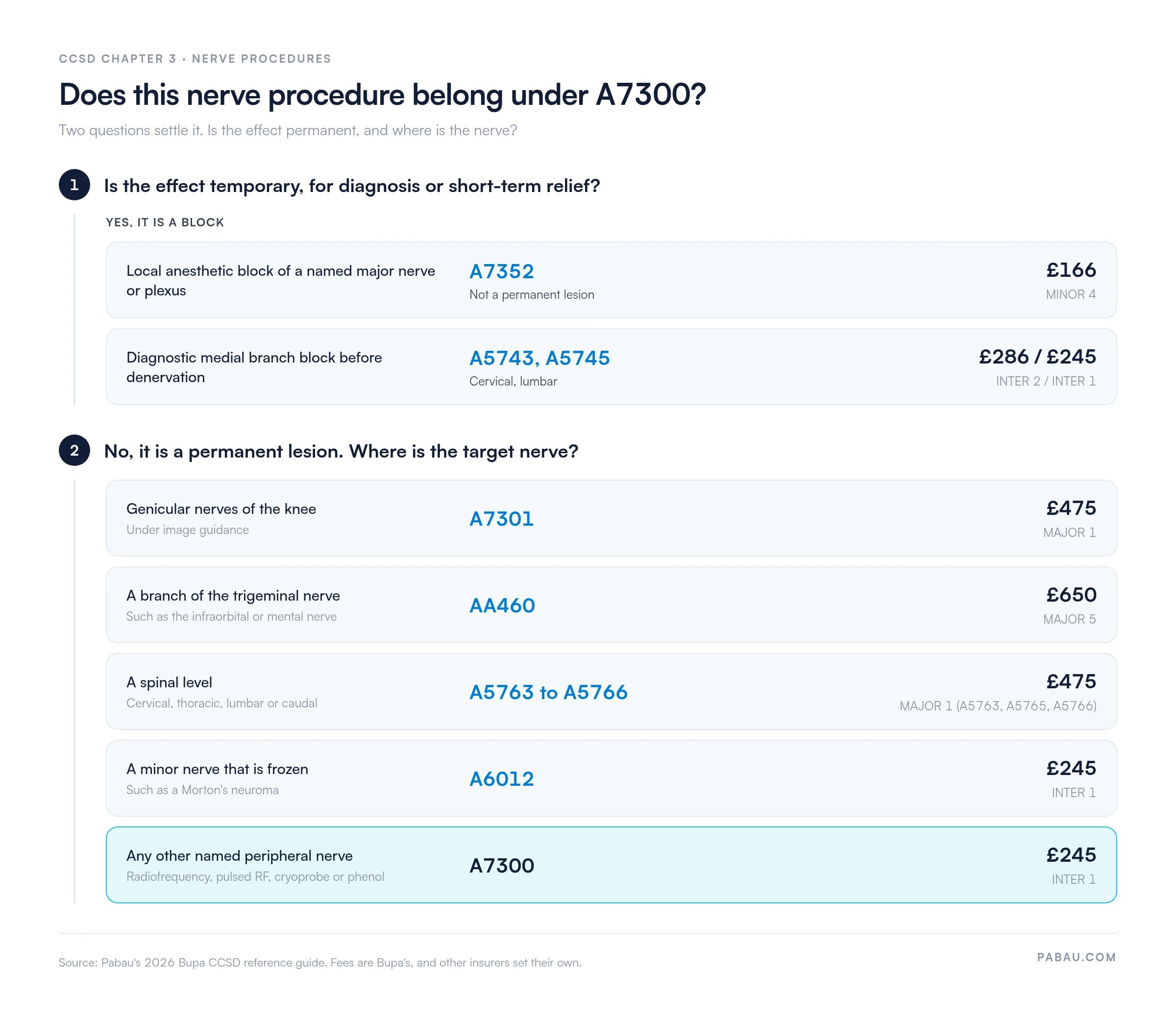
A7301 and A7300 both describe radiofrequency nerve lesioning, yet the knee code pays almost twice as much. Billing A7300 for genicular nerve ablation underclaims, and billing A7301 for another joint overclaims. Both errors show up on audit.
Trigeminal branches are carved out the same way. Destruction of a trigeminal branch by neurolytic injection, radiofrequency or cryoprobe bills under CCSD code AA460, never A7300.
Figures come from Pabau’s 2026 Bupa CCSD reference guide. Check current fees in the Bupa code search portal before you bill. Our guide to A7352 covers the local anesthetic block in more detail.
Image guidance is optional under A7300, because the “+/-” in the descriptor means the code applies with or without it. The descriptor does not say whether guidance attracts a separate fee.
That answer comes from each insurer’s own rules. CCSD descriptors that include “+/- image guidance” generally treat guidance as part of the procedure, so a separate radiology line rarely belongs on the claim. Billing one without insurer approval creates an overpayment risk and a likely audit finding.
Build a procedure-specific checklist for A7300 that captures the named nerve, side, modality, energy parameters and image guidance type in one structured form. Complete it in the procedure room before the patient leaves, because notes written later carry far greater audit risk.
A complete procedure note is the most important evidence behind an A7300 claim. It has to contain each element in the table below for the claim to survive an insurer audit.
Storing structured procedure notes in the patient’s clinical records next to the CCSD code means the evidence is ready when an insurer asks for it. Digital forms that capture procedure-specific fields at the point of care cut the risk of notes written after the fact.
UK private medical insurers expect A7300 to be authorized before the procedure takes place. The patient usually contacts their insurer for an authorization number, and the practice quotes that number on the claim. Retrospective authorization is rarely accepted.
Each insurer sets its own criteria, and pulsed radiofrequency draws the most scrutiny. Insurers typically look for the following evidence of medical necessity:
Fees differ by insurer even though the code is shared. Vitality and Healix publish online fee finders with CCSD-coded procedure fees. Bupa’s code search shows its own fee and authorization status. AXA Health and Aviva publish fee and code information through their specialist portals.
If the authorized code and the billed code differ, the claim stalls. Ask for a revised authorization before the procedure if the plan changes, for example from a peripheral nerve to the knee. Our guide to Bupa CCSD codes explains how Bupa recognizes a code and what each submission needs.
Most A7300 denials trace back to a short list of documentation and coding errors. The table below maps each one to its fix.
Many pain practices still write the procedure note in one system and raise the insurer invoice in another. The CCSD code, the named nerve and the authorization number then have to be copied across by hand.
Pabau keeps those steps inside one patient record instead. Its claims software for specialists attaches the CCSD code to the procedure, links the supporting documents and sends the claim to UK insurers through Healthcode.
The result is a claim that matches its authorization and its evidence the first time. That means fewer queries from the insurer and faster payment for the practice.

Pabau links the CCSD code, the procedure note and the imaging record to one claim, then sends it to UK insurers through Healthcode. Fewer claims come back for missing evidence.

A7300 pays only when the claim proves three facts: Which named nerve was lesioned, by which modality, and that no closer CCSD code fits. Settle those in the procedure room and agree them with the insurer at authorization. The claim then has little left to query.
Pabau helps UK pain practices bill CCSD codes from the clinical record outward, with the note, the code and the claim in one workflow. To see how it handles interventional pain billing, book a demo.

Billing a local anesthetic block instead? CCSD code A7352 covers local anesthetic blockade of a named major nerve or plexus, and how it differs from A7350 and A7302.
Billing multiple CCSD codes in one encounter? Bupa procedure codes fee schedule explains how Bupa structures chapter fees and applies unbundling rules across multi-code submissions.
Need to look up related Bupa CCSD codes? Bupa CCSD procedure codes covers the full Bupa CCSD framework, including code recognition and submission requirements.
Lesioning a cranial nerve inside the skull? CCSD code A2600 covers other intracranial destruction of a cranial nerve, away from the peripheral targets A7300 bills.
CCSD code A7300 is the UK private healthcare code for radiofrequency (including pulsed denervation), cryoprobe or phenol for permanent lesion of a named peripheral nerve. It applies with or without image guidance. Pain specialists use it to bill Bupa, AXA Health, Aviva and Vitality.
No. A7300 is a permanent neurolytic lesion of a named peripheral nerve, even though the schedule files it under other nerve blocks. A temporary local anesthetic block of a named major nerve or plexus is billed as A7352, and a continuous catheter block as A7302.
Yes. The descriptor names pulsed denervation alongside conventional radiofrequency, so both use A7300. Some UK insurers apply different benefit rules to pulsed RF. Check the insurer’s policy at authorization, and record the pulse parameters and temperature ceiling in the note.
A7300 covers the procedure with or without image guidance, as the “+/-” in the descriptor shows. Insurers generally treat guidance as part of the procedure. Confirm with the insurer before adding any separate guidance line to the claim.
Radiofrequency denervation of the knee under image guidance has its own code, A7301. The 2026 Bupa CCSD reference lists it at MAJOR 1 with a £475 fee, against £245 for A7300. Use A7301 for genicular nerve ablation.
Any anatomically named peripheral nerve qualifies, provided the procedure note records its name and side. Common targets include the occipital, suprascapular, lateral femoral cutaneous, intercostal, ilioinguinal and genitofemoral nerves. Trigeminal branches use AA460, and spinal nerve roots use A5763 to A5766.
The leading causes are an unnamed nerve, an unstated modality and image guidance claimed without records. Missing pre-authorization, a neighboring code that fits better, and repeat claims inside the insurer’s benefit period also cause denials.