

HCPCS code E0198: Water pressure pad billing guide
HCPCS code E0198 is a water pad for a standard mattress HCPCS code E0198 is the ...

Last Updated: Oct 13, 2026
J0780 is the HCPCS Level II code for injection, prochlorperazine, up to 10 mg.
Most J0780 denials trace back to three details. Units have to increase when the dose goes above 10 mg. Single-dose vial claims need either the JW or the JZ waste modifier. And the drug line needs an NDC alongside the HCPCS code.
One detail sits underneath all three. Prochlorperazine is supplied in more than one form, and only the edisylate salt is injectable. Confirm that on the vial label before the NDC reaches the claim.
Let Pabau's smart automation suggest the right codes, reduce claim denials, and keep your practice compliant—effortlessly.
Automate repetitive tasks and focus on what matters most—your patients.
Reduce coding errors and ensure compliance with the latest regulations.
Clean claims, fewer denials, and faster reimbursements.
Powerful insights and reporting to help your practice thrive.
HIPAA compliant SOC 2 certified GDPR-compliant Trusted by 4,000+ clinics worldwide

HCPCS Code J0780 covers injectable prochlorperazine up to 10 mg, a Level II J-code maintained by CMS.
Medicare Part B pays J0780 under the ASP+6% methodology, and every claim needs the NDC alongside the HCPCS code.
A dose above 10 mg needs more than one unit, so 15 mg is billed as two units of J0780.
Leaving the JW or JZ waste modifier off a single-dose vial claim is one of the most common denial triggers.
Practice management software like Pabau supports J-code entry, modifier defaults, and NDC capture at the point of care.
HCPCS Code J0780 describes the injection of prochlorperazine, up to 10 mg. It sits in the J-code series within HCPCS Level II, the set used to identify injectable drugs and biologicals. The Centers for Medicare and Medicaid Services (CMS) updates that code set every year.
Prochlorperazine (historically marketed as Compazine) is a phenothiazine-class drug used mainly as an antiemetic, and in some settings for migraine management.
Practices reach for the injectable form when a patient cannot keep an oral dose down. That happens most often in physician offices, outpatient hospital departments, and emergency departments.
The “up to 10 mg” descriptor defines the billing unit rather than a clinical maximum. A full 10 mg vial is one unit of J0780. A 5 mg dose drawn from a 10 mg vial is also one unit, plus a waste modifier.
A 15 mg dose takes two units, each covering up to 10 mg. Back the second unit with documentation that supports the higher dose, or expect medical review.
J0780 pays for the drug only. The administration is billed separately, usually with 96372.
Medicare Part B pays J0780 under the average sales price (ASP) methodology. Payment lands at ASP+6%, and CMS refreshes the figure every quarter. Check the current rate in the CMS ASP drug pricing files before you submit. The Physician Fee Schedule tool prices procedure RVUs, so it will not return a drug rate.
Prochlorperazine is a low-cost generic, so the amount per unit is small. That is different arithmetic from a high-cost drug such as J0885, where a single unit carries a much larger payment.
Where you administer it matters too. Physician office (place of service 11) and outpatient hospital (place of service 22) run on different fee schedules.
Outpatient hospital claims go through the Outpatient Prospective Payment System (OPPS). There, J0780 is often packaged into the visit APC rather than paid separately. Confirm the packaging rules with your Medicare Administrative Contractor (MAC).
Practices running high-volume injectable programs need billing software that keeps up with quarterly ASP changes. That matters most for infusion centers, where a single visit can carry several drug lines.

Modifier choice is where J0780 claims create the most rework. Leaving JW or JZ off a single-dose vial claim is a common audit finding. The J1, J2, and J3 modifiers belong to Competitive Acquisition Program billing, so applying one outside that program invites medical review.
Modifier rules are payer-specific. The JW and JZ waste requirement comes from CMS policy, so it binds Medicare claims first. Check each commercial payer’s billing guide before you carry the same modifiers onto their claims.
Practices that bill several injectable drugs, several injectable drugs, J0153 and J1364 among them, do better setting modifier defaults at the code level. Claim-by-claim entry is where modifiers go missing.
Audit your J0780 claims from the last 90 days for JW/JZ modifier compliance. CMS updated waste modifier requirements in 2023, and MACs have increasingly flagged single-dose vial claims missing both modifiers as undocumented waste. Run a query by HCPCS code and flag any line that carries no waste modifier. Send those for documentation review before the claim ages past your correction window.
Medicare requires the National Drug Code (NDC) to be reported on Part B drug claims alongside the HCPCS code.
NDC reporting identifies the specific product administered, including the manufacturer and package size, which supports pricing verification and post-payment audits. This requirement is mandated under the CMS Claims Processing Manual.
Prochlorperazine is dispensed in more than one form, and only one of them is injectable. Edisylate is the water-soluble salt used for IV and IM administration, so it is the form billed under J0780. Maleate is an oral tablet salt, because it does not dissolve in water. Suppositories use prochlorperazine base rather than either salt. Loop and segment rules in the EDI 837 format decide where a code and its modifiers are carried. The CARC denial code list is short enough to learn, and most rework traces to a handful of entries. Loop and segment rules in the EDI 837 format decide where a code and its modifiers are carried. The CARC denial code list is short enough to learn, and most rework traces to a handful of entries.
Manufacturers of prochlorperazine edisylate include Hospira and Hikma, which absorbed the West-Ward label. NDC numbers change when packaging changes, so check the current number against FDA DailyMed before billing.
Capture the NDC in the treatment record at the time of service, not later at billing. Reconstructing package details from memory turns into guesswork. The medical forms your team already completes are the natural place for that field.
Every J0780 claim needs an ICD-10-CM diagnosis code that establishes medical necessity for the injectable antiemetic. Missing or unsupported diagnosis codes are a leading reason payers deny J0780 on first submission. The diagnosis has to name the condition prochlorperazine is treating, not the injection itself.
For chemotherapy-induced nausea, carry the nausea code (R11.x) and the underlying malignancy code, with the malignancy as the primary diagnosis. Migraine management with prochlorperazine is off-label. Coverage is payer-specific, and many MACs want an Advance Beneficiary Notice (ABN) on file unless LCD criteria are met.
In the encounter note, record the symptom, its severity, and why an oral dose was not workable. That note is what supports medical necessity if the claim is reviewed after payment.
Practices that run several injection service lines, from antiemetics to IV therapy, need the same documentation habit on every encounter. Tie the clinical indication to the billed code while the patient is still in the chair. Digital forms in practice management software like Pabau capture that detail at the point of care.
Several injectable antiemetics carry their own J-code, among them J2405 and J2765. Knowing the set keeps the right code on the claim when the practice reaches for a different drug. It also keeps J0780 off lines where it does not belong.
If your practice stocks both prochlorperazine (J0780) and promethazine (J2550), keep the two apart on the claim. Both are phenothiazine antiemetics with overlapping uses, so the class is not enough to code from. Billing J2550 for a prochlorperazine dose is a coding error, even when the clinical intent matched.
The fix is a formulary that maps each drug to its own code. Practices choosing an EMR for IV therapy should check that the drug selected in the record ties straight to the HCPCS code. The mismatch then never reaches the claim.
These five patterns account for most J0780 denials, and for most of the audit exposure that follows them.
Four of those five failures share one root. The drug, the dose, and the waste are recorded in one place, and the claim is built in another.
Practices that also run IV vitamin therapy feel it most, because one visit can generate several drug lines. Pabau’s prescription management keeps the drug record and the claim line in one system, so nobody rebuilds the encounter at billing time.
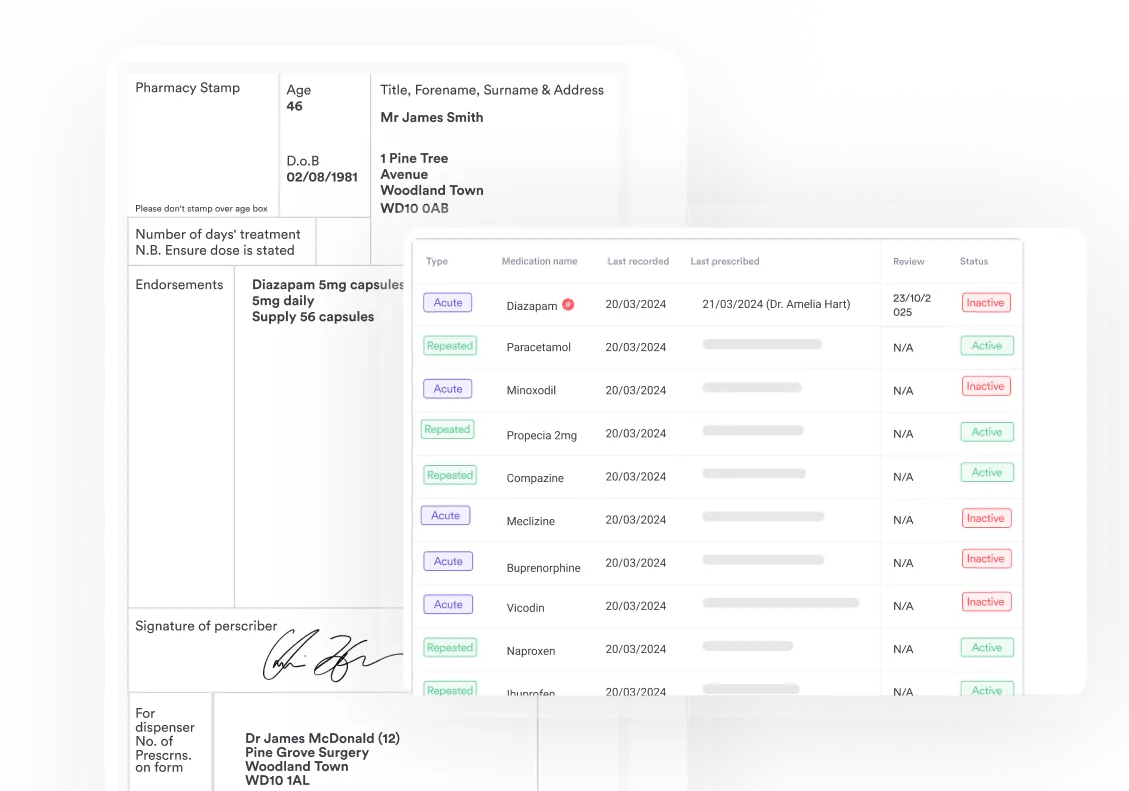
Pull your remittance advice for J0780 claims from the last six months. Filter for CO-4, CO-50, and CO-97, the three codes behind most J0780 rework. CO-4 means the modifier is inconsistent with the procedure, which usually points at a missing or conflicting waste modifier. CO-50 covers care the payer does not consider medically necessary, so a missing KX modifier or an unsupported diagnosis lands there. CO-97 instead says the drug was bundled into payment for a service already adjudicated, which happens routinely under OPPS. The first two are correctable on redetermination when the documentation is already in the chart.
J-code billing depends on three details. Your records have to show the amount drawn from the vial, the modifiers that apply, and the NDC on the label. Those details usually live in three places, and the billing team stitches them together afterward.
Pabau’s claims management module lets you attach default modifiers to each J-code in your service list. The clinical team records the drug given, and billing receives a line that is already claim-ready.
Inventory management tracks vial usage in the same system, which is the record JW and JZ compliance rests on. Practices weighing this against a clearinghouse-first setup can compare Pabau and Waystar.

Pabau supports HCPCS J-code entry, modifier application, and NDC documentation for injectable drug billing. See how it handles claims management for infusion and injection-based practices.

J0780 looks simple on paper, and the descriptor is. What costs money is treating it as just another injection line. The unit count, the waste modifier, and the NDC each have to be right, every time.
So set the rule once instead of catching it claim by claim. Build the modifier defaults into the code, capture the NDC in the treatment note, and audit last quarter’s lines before the correction window closes.
Practices billing a portfolio of J-codes gain the most here, because the same three controls carry across every drug they stock. Book a demo to see how Pabau handles J-code billing from the treatment note to the claim.

Billing another injectable drug this quarter? J0600 works through the units, modifiers, and NDC reporting for edetate calcium disodium.
Giving the dose as an IV push instead? 96374 sets out the billing and documentation rules for intravenous push administration.
Coding a cerebellar artery case? Cerebellar artery occlusion coding guide explains the distinction between I66.3 and the I63.x codes used for cerebral infarction.
Coding an aortic aneurysm too? Aortic aneurysm coding guide covers when an aortic aneurysm from another disease differs from the standard I71 code.
Reporting waste on a larger single-dose vial? J0895 sets out the unit math and waste modifiers for deferoxamine mesylate.
HCPCS Code J0780 is a Level II code that describes the injection of prochlorperazine, up to 10 mg. It is maintained by CMS under the HCPCS J-code series, which covers drugs and biologicals administered by injection in clinical settings.
The most clinically significant modifiers are JW (drug amount discarded) and JZ (zero drug discarded), which are required by Medicare on single-dose vial claims. Additional applicable modifiers include GA, GK, KX, J1, J2, J3, JB, QJ, CR, M2, and 99. Modifier applicability varies by payer.
Yes. Medicare Part B requires the National Drug Code (NDC) to be reported alongside HCPCS Code J0780 on all Part B drug claims. The NDC must be submitted in 11-digit 5-4-2 format with the quantity administered in milliliters. Missing NDC data will cause claim rejection at adjudication.
Medicare reimburses J0780 at ASP+6% (average sales price plus 6%) under Part B drug payment policy. Rates are updated quarterly by CMS. In outpatient hospital settings, J0780 may be packaged under an OPPS APC rather than paid separately; verify with your MAC.
J0780 covers prochlorperazine injection (up to 10 mg) and J2550 covers promethazine HCl injection (up to 50 mg). Both are phenothiazine-class antiemetics with overlapping clinical applications, but they are chemically distinct drugs. Always code to the drug given, not the drug class.
The most common ICD-10-CM codes paired with J0780 are R11.2 (nausea with vomiting, unspecified), R11.0 (nausea alone), R11.10 (vomiting, unspecified), and R11.11 (vomiting without nausea). For chemotherapy-related nausea, include the underlying malignancy as the primary diagnosis. Off-label migraine use (G43.x) requires payer verification and may require an ABN.



