CCSD Code S2503: Local flap repair of 9 cm² or more
CCSD Code S2503: Definition and official descriptor CCSD Code S2503 is a surgica...

Last Updated: Nov 11, 2026
S0122 is the HCPCS Level II code for an injection of menotropins, 75 IU, billed as one unit for each 75 IU administered. Menotropins, sold in the US as Menopur, is a purified human menopausal gonadotropin (hMG) with both FSH and LH activity.
Practices use it for ovarian stimulation in assisted reproductive technology (ART) cycles. Medicare does not recognize S-codes for payment, so most S0122 claims go to commercial payers. Most denials trace to a code mix-up with the follitropins, a wrong unit count or a missing prior authorization.
Let Pabau's smart automation suggest the right codes, reduce claim denials, and keep your practice compliant—effortlessly.
Automate repetitive tasks and focus on what matters most—your patients.
Reduce coding errors and ensure compliance with the latest regulations.
Clean claims, fewer denials, and faster reimbursements.
Powerful insights and reporting to help your practice thrive.
HIPAA compliant SOC 2 certified GDPR-compliant Trusted by 4,000+ clinics worldwide

HCPCS code S0122 reports menotropins injection (Menopur) in 75 IU units, so one 75 IU vial is one unit.
Menotropins is a urinary human menopausal gonadotropin with FSH and LH activity, which sets it apart from the recombinant FSH codes S0126 and S0128.
Many IVF protocols pair Menopur with a recombinant FSH, so one cycle can carry two drug lines, two NDCs and two authorized drugs.
Medicare does not recognize S-codes for payment, so S0122 goes to commercial payers, which usually require prior authorization.
Pabau, the practice management software we build, keeps the authorization code, dates and sessions on the patient’s case, with a warning when one is missing.
HCPCS code S0122 is defined as “Injection, menotropins, 75 IU” in the CMS HCPCS Level II code set. The billing unit is each 75 IU administered. The descriptor has stayed the same across HCPCS editions, so older crosswalks that map S0122 to another drug are wrong.
Menotropins is a purified human menopausal gonadotropin (hMG) extracted from the urine of postmenopausal women. It carries both follicle-stimulating hormone (FSH) and luteinizing hormone (LH) activity. The brand billed under S0122 in the US is Menopur, made by Ferring Pharmaceuticals.
S-codes are temporary national codes created for private payers, which use them where no permanent HCPCS code exists. Medicare does not pay them, so S0122 lives almost entirely on commercial claims.
S0122 covers menotropins only. The most frequent scope error is reporting Menopur under a follitropin code because both drugs sit in the same stimulation protocol.
Covered under S0122:
Not covered under S0122:
The FDA label for Menopur covers ovulatory women in an ART cycle. Ovulation induction in anovulatory patients is an off-label use in the US, so some payers will not authorize it under S0122.
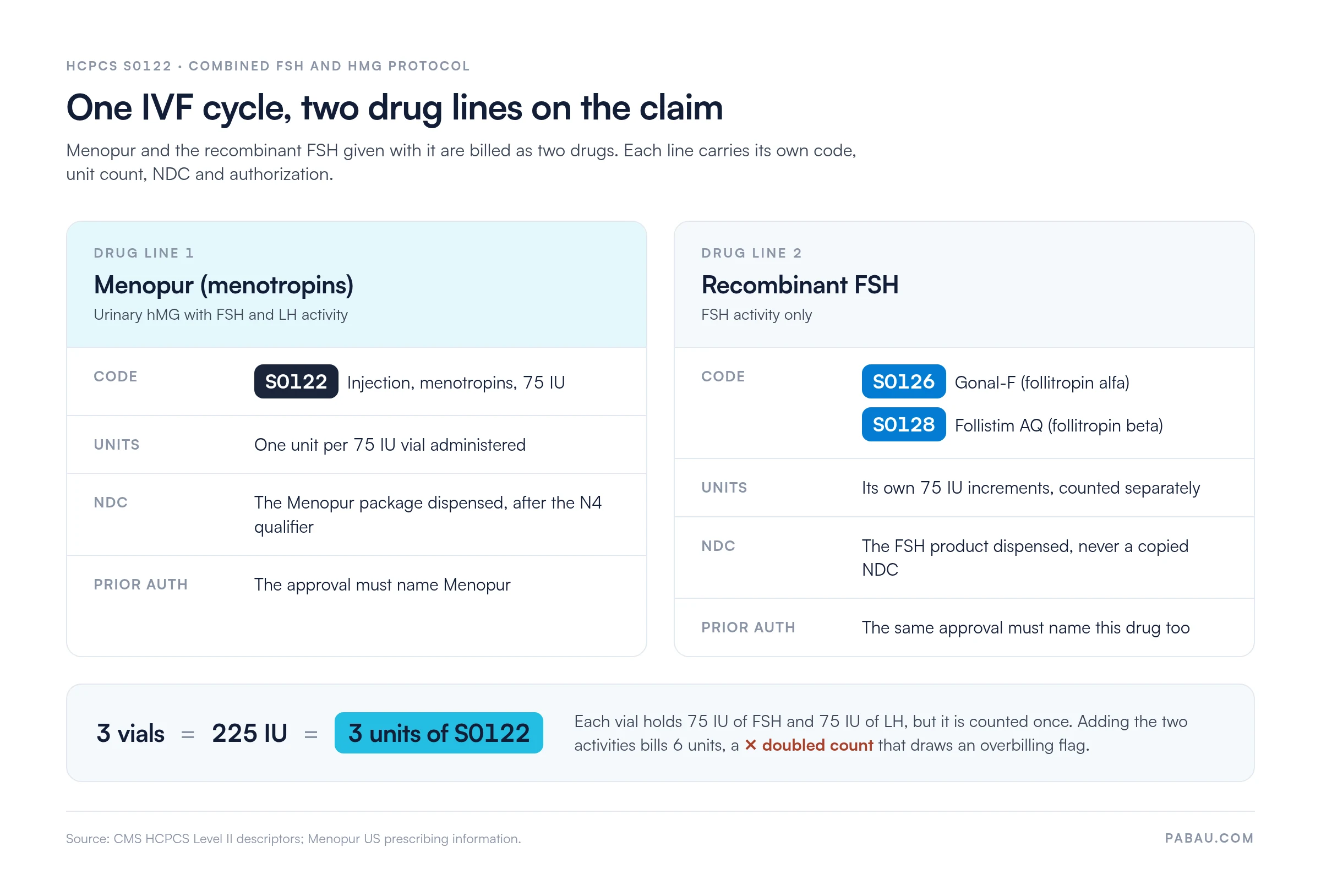
Each Menopur vial is labeled 75 IU, and each unit of S0122 equals 75 IU. Count the vials administered, not the total of FSH and LH activity. Adding the two together doubles the unit count and invites an overbilling flag.
Menopur comes as a powder that is reconstituted with sterile saline. The label allows up to six vials to be dissolved in 1 mL of diluent for a single injection. One injection can therefore carry up to 6 units, so count the vials, not the syringes.
NDC reporting: Most commercial payers require the 11-digit National Drug Code (NDC) on the line with S0122. Report it after the N4 qualifier, with the NDC quantity and unit of measure. The NDC should match the Menopur package dispensed for that encounter.
Who bills the drug: Many patients inject Menopur at home after a specialty pharmacy fills the prescription. In that case the pharmacy usually bills the drug, and the practice bills only the services it performs. Confirm the route at eligibility so the same vials are not claimed twice.
Many IVF protocols add a daily Menopur dose to a recombinant FSH such as Gonal-F or Follistim AQ. Payers treat these as two drugs, so the claim carries two separate drug lines.
An authorization issued for “gonadotropins” in general may still list only one product. Read the approval letter before the cycle starts, and request an amendment if Menopur is missing. The chart below sets the two lines side by side, with the unit count for a typical three-vial dose.
The three gonadotropin S-codes share a 75 IU billing unit, which is why they get swapped. The drug on the package decides the code, and the descriptors are distinct.
If the order or the package says Menopur or menotropins, the code is S0122. For follitropin alfa billing rules, see our guide to HCPCS code S0126. The egg retrieval and embryo transfer in the same cycle are reported with the IVF procedure codes.
Every S0122 line needs an ICD-10-CM code that supports medical necessity. Payers match the diagnosis against their covered indications for menotropins, and those usually center on ART cycles.
Use the most specific N97 subcategory the record supports. Some payers accept Z31.83 alone for ART drug claims, while others require the underlying infertility diagnosis first.
Most commercial payers manage fertility drugs closely and require prior authorization for menotropins. Published policies such as the Aetna policy on follitropins and menotropins list the criteria side by side.
Typical PA documentation:
A medical prior authorization form keeps these items in one request. Run insurance eligibility verification at cycle start, since many plans carve fertility drugs out to a separate administrator.
S0122 denials cluster around a handful of causes, and most are visible before submission. Good denial management starts by tagging each one by root cause.
Our reference on medical billing denial codes explains the remark codes these denials come back with.
In combined protocols, check that the Menopur and recombinant FSH lines each carry their own NDC before the claim goes out. A copied NDC is the quickest way to get one of the two lines denied.
Clean S0122 claims depend on chart notes that match every field on the claim line. These are the records a payer asks for in a post-payment review.
Keep the order, vial count and NDC in the same encounter note. A medical billing compliance checklist for fertility drugs lets the team confirm all three match before an auditor asks for them.
A fertility practice running combined protocols tracks two drugs, two NDCs and two authorizations for many patients at once. When that lives in spreadsheets, a missing Menopur approval often surfaces only when the remittance arrives.
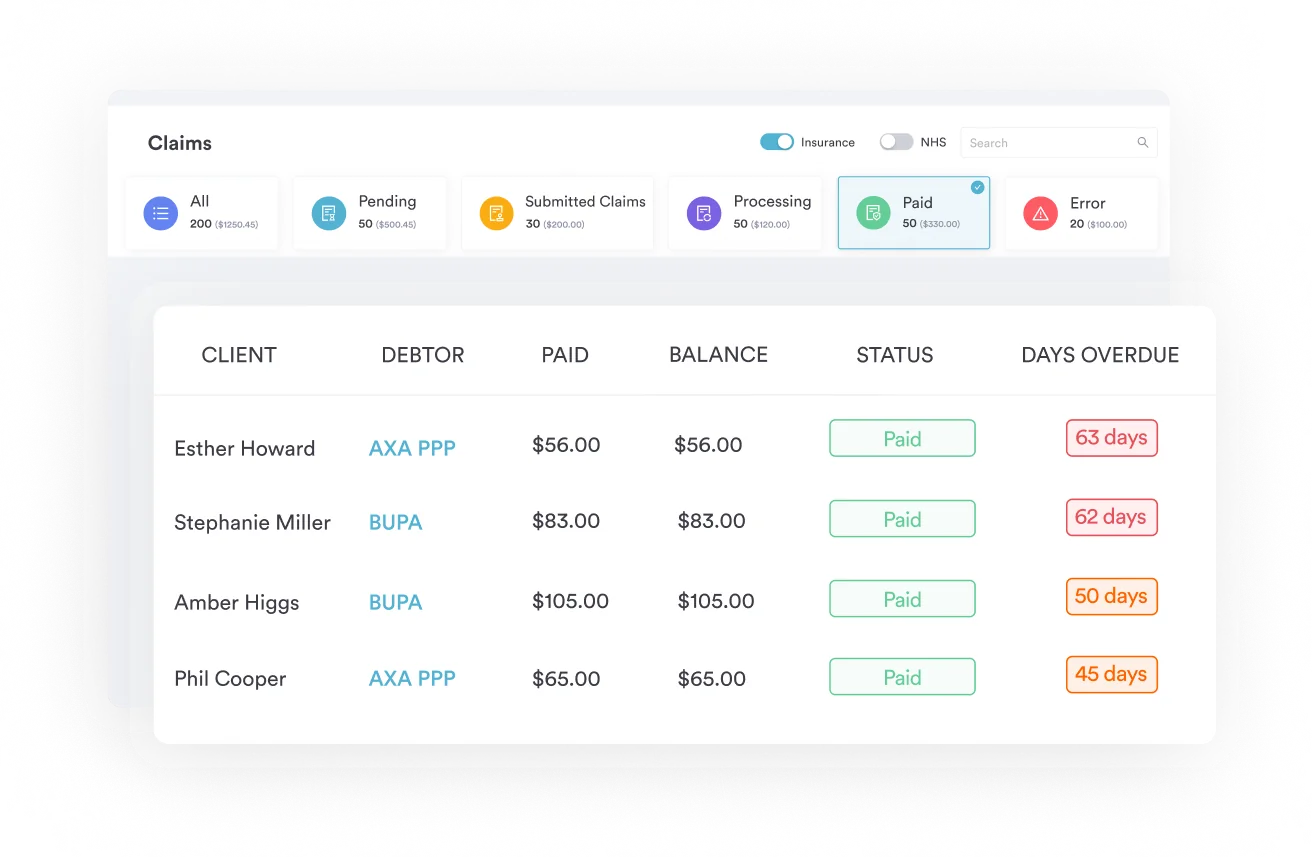
Pabau’s claims management software keeps the authorization code, dates and sessions on the patient’s case, with a warning when one is missing. US practices send CMS-1500 and 837P claims through Claim.MD, run eligibility checks and receive ERA remittances in the same system.
Stock in Pabau carries a batch number and expiry date, and the lot is recorded against the patient and the appointment. That gives the billing team the vial count and NDC for each Menopur encounter without re-keying. For a fertility practice, the chart and the claim stay in one system.

Pabau keeps the authorization code, dates and sessions on each patient’s case, with a warning when one is missing. See how it handles combined FSH and hMG protocols.

Most S0122 problems start with a mix-up between drugs, not with the code itself. Menopur is menotropins, a urinary hMG with LH activity, and it never bills under a follitropin code.
Settle three points before the first injection. The approval names Menopur, the vial count drives the units, and each drug line carries its own NDC. A few minutes at cycle start costs far less than weeks of appeals.
Book a demo to see how Pabau keeps prior authorization details on each patient’s case for fertility billing teams.

Want the claims process end to end? What is medical billing explains the path from service documentation to payment posting.
HCPCS code S0122 is the Level II code for injection, menotropins, 75 IU. Menotropins is a purified human menopausal gonadotropin with FSH and LH activity, sold in the US as Menopur. It is used for ovarian stimulation in IVF and other ART cycles.
No. Gonal-F is follitropin alfa, which bills under S0126. S0122 is only for menotropins (Menopur), and follitropin beta (Follistim AQ) bills under S0128. The drug on the package decides the code.
Bill one unit per 75 IU vial. A 225 IU dose from three vials is 3 units. Each vial carries 75 IU of FSH and 75 IU of LH activity, but you count the vial once, not twice.
Yes. Many IVF protocols combine Menopur with Gonal-F or another recombinant FSH. Report each drug on its own line with its own units and NDC, and make sure the prior authorization names both drugs.
No. S-codes are temporary national codes that Medicare does not recognize for payment. Send S0122 to commercial payers, and check state Medicaid rules separately, since most programs exclude fertility drugs.
Most commercial payers require prior authorization for menotropins. Plans usually want an infertility diagnosis, ovarian reserve testing and the stimulation protocol. Self-funded ERISA plans may exclude fertility drugs entirely, so verify the plan first.