CPT Code 62284: Injection procedure for myelography
CPT Code 62284: official descriptor and procedure overview The American Medical ...

Last Updated: Oct 19, 2026
HCPCS code S0108 covers mercaptopurine, oral, 50 mg, and one unit equals 50 mg of the drug. It's an S-code, so Medicaid and commercial plans pay it, and Medicare Part B never does. A Medicare patient's mercaptopurine runs through Part D, the pharmacy benefit, instead.
For billing staff, most S0108 denials trace back to three slips. The NDC is missing, the units don't match the milligrams dispensed, or the claim went to the wrong payer. Each one is easy to catch before submission, starting with the unit math.
Let Pabau's smart automation suggest the right codes, reduce claim denials, and keep your practice compliant—effortlessly.
Automate repetitive tasks and focus on what matters most—your patients.
Reduce coding errors and ensure compliance with the latest regulations.
Clean claims, fewer denials, and faster reimbursements.
Powerful insights and reporting to help your practice thrive.
HIPAA compliant SOC 2 certified GDPR-compliant Trusted by 4,000+ clinics worldwide

HCPCS code S0108 bills oral mercaptopurine, with one unit equal to 50 mg of the drug.
S-codes aren’t payable under Medicare Part B, so S0108 goes to Medicaid or commercial plans only.
Most Medicaid and commercial payers want the 11-digit NDC beside S0108, and a missing NDC is the top denial cause.
Off-label IBD claims need a covered K50.x or K51.x code plus a note explaining why mercaptopurine fits.
Pabau, the practice software we build, pre-fills claims from the patient record and flags empty required fields before submission.
HCPCS code S0108 reports mercaptopurine, oral, 50 mg, the thiopurine known as 6-MP and sold as Purinethol. Each unit stands for 50 mg, so the claim counts milligrams, not days or bottles.
S0108 belongs to the S-series of HCPCS Level II codes. CMS maintains the HCPCS system for drugs, supplies and services that CPT doesn’t describe. Medicaid programs and private payers use S-codes, but Medicare Part B doesn’t pay them. You can check neighboring codes in our HCPCS code library.
With the basics set, the next question is why the drug was prescribed. Two diagnoses drive nearly every S0108 claim. The FDA-approved use is acute lymphoblastic leukemia (ALL). In pediatric protocols, 6-MP is a backbone drug for maintenance therapy.
The second use is off-label. Gastroenterologists prescribe mercaptopurine as an immunomodulator for Crohn’s disease (K50.x) and ulcerative colitis (K51.x). Here, coverage depends on each payer’s medical policy. Many plans pay, but only with a clinical note that justifies the choice. Without a matching, covered diagnosis code, expect a flat denial.
Knowing when not to use S0108 saves as much rework as knowing when to use it. A wrong-payer claim gets denied, and a pattern of them can draw an audit.
Here’s the whole calculation: total milligrams dispensed, divided by 50, equals billed units. Take a patient on 75 mg daily for 30 days. That’s 2,250 mg, which works out to 45 units.
Doses that aren’t clean multiples of 50 need the payer’s rounding rule, and those rules differ. Confirm the rule before you submit, not after the denial arrives.
Units are only half of the drug line. Most Medicaid and commercial payers also want the NDC for the exact product dispensed. Report it as 11 digits in the 5-4-2 format, on the CMS-1500 or in the 837P file. A switch to another manufacturer’s product brings a new NDC, too.
Once the units and NDC are settled, the claim itself follows a fixed path. Work through it in this order, since each step leans on the one before.
The chart below maps five of those checkpoints to the denial code you’ll see if one slips.
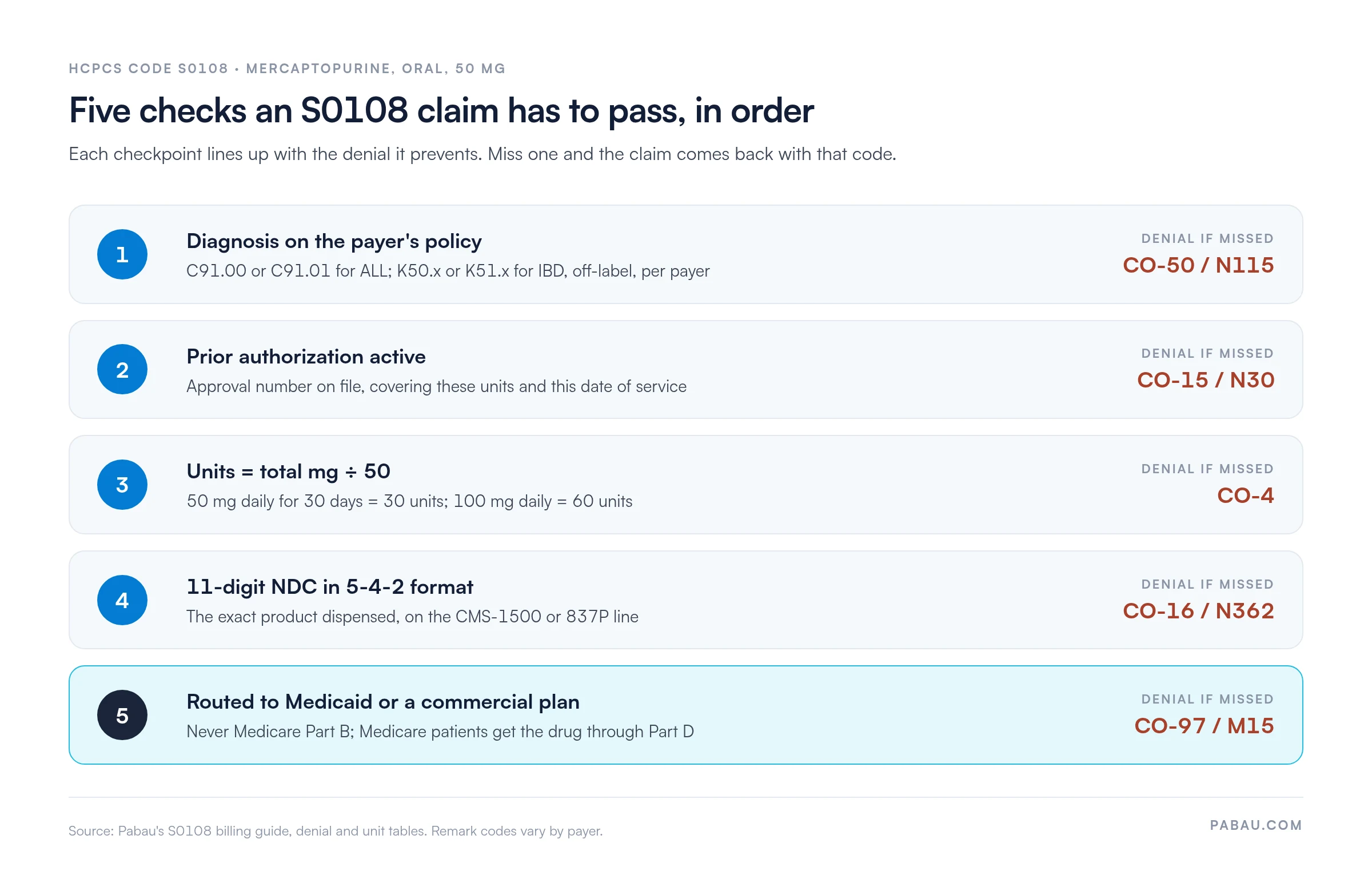
Modifier rules for S0108 change from payer to payer. Read the plan’s billing guide before you add one. A wrong modifier, or a missing required one, is an easy denial to avoid.
Expect a PA request from most Medicaid MCOs and many commercial plans. Even so, the rules vary by state and by plan. Some plans cover S0108 for IBD without PA. Others use step therapy, which means documenting that a first-line drug, such as azathioprine, failed first.
New to PA packets? Our guide to the prior authorization process walks through the workflow. For S0108, the packet usually holds these items:
Track the approval’s end date as closely as its number. Most payers treat an expired PA exactly like no PA at all.
Payers pay on the claim, but they audit on the chart. Each of these elements should sit in the patient record, ready to pull if an auditor asks.
With the chart in order, a quick front-end check catches most errors before a payer sees them. Build these six checks into your clean claim routine, and run them on every S0108 line:
S0108 has no national Medicare rate. Because Part B excludes S-codes, the Physician Fee Schedule doesn’t list them. Neither do the CMS Average Sales Price (ASP) drug pricing files. Instead, each payer sets its own rate, and the spread is wide.
For current figures, check your state Medicaid fee schedule portal. Commercial payers will send their drug fee schedule on request. Rates shift with contracts, average wholesale price (AWP) formulas and formulary tier. Refresh them every benefit year rather than trusting last year’s numbers.
Keep a written record of each payer’s coverage decision for S0108, too. Update it whenever a contract or Medicaid fee schedule changes. That habit keeps your billing compliance file current.
The same handful of errors cause most S0108 denials. Luckily, each one has a known fix. A steady denial management process turns them around quickly.
Three mistakes come up again and again on S0108 claims:
Several HCPCS codes sit close to S0108. They get mixed up most when a biller works from the drug name instead of a code lookup. Use the comparison below to confirm the code before you submit.
Mix-ups cluster in IBD billing, where one patient may take mercaptopurine, methotrexate and azathioprine over time. Check the dispensed drug and strength against the prescriber order every time. Other oral cancer drugs carry their own S-codes as well, such as S0172 for chlorambucil. The aromatase inhibitor anastrozole bills under S0170 for hormone receptor-positive breast cancer.
Hydroxyurea follows the same pattern, billed under S0176 for each 500 mg dispensed. An oncology biller handling these claims also codes antiemetics, and oral prochlorperazine bills under S0183 for chemotherapy-induced nausea.
To confirm a descriptor, use AAPC’s HCPCS code reference or PGM Billing’s HCPCS lookup.
Most billing teams check S0108 claims by hand, line by line, against a payer guide. That works until a busy week lets one missing field slip through.
Pabau’s claims management software takes some of that load. It pre-fills the claim from the patient record, so the codes attached to the visit land on the form. Built-in HCPCS and ICD-10 lookup libraries let you confirm a descriptor without leaving the claim.
Before a claim can go out, Pabau checks that required fields, such as member IDs, aren’t blank. US claims then reach Medicaid and commercial payers through Pabau’s Claim.MD integration. As a result, fewer claims bounce for a missing field. Your team keeps its time for the denials that need judgment.
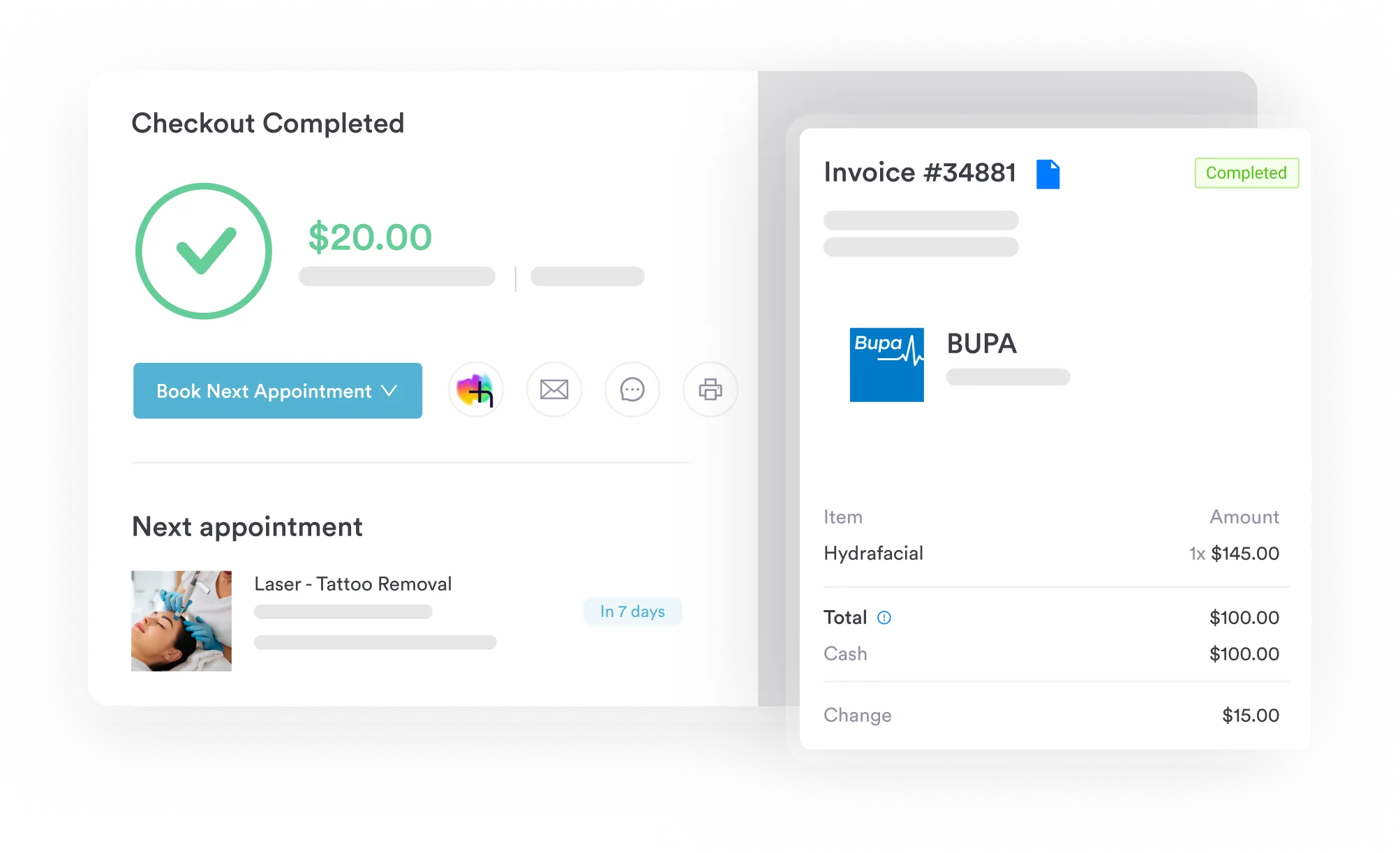

Pabau pre-fills claims from the patient record, puts HCPCS and ICD-10 code lookup inside the claim, and checks required fields. It then submits to Medicaid and commercial payers, so fewer S0108 claims come back.

S0108 rewards the billing team that does its checking up front. The code itself is simple. Its claims, though, fail on small details. A stale NDC, units counted by days or a claim sent to Part B will each bounce it.
So make the unit math and the payer route part of intake, not cleanup. Once those two are right, the rest is paperwork your chart already holds.
Pabau handles the paperwork side. It pre-fills claims from the record and holds back any claim with an empty required field. Book a demo to see how it handles your S0108 drug claims.

Billing another oral cancer drug? HCPCS code S0172 covers chlorambucil, another oral S-code billed outside Medicare Part B.
Working with oral chemo J-codes? HCPCS code J8510 walks through oral busulfan billing in 2 mg units.
Submitting drug claims electronically? 837P electronic claim filing explains the 837P transaction structure and where NDC data sits in it.
Want to reduce denial rework? Denial codes in medical billing explains the CARC and RARC codes behind drug claim denials and how to fix each.
Need a billing compliance framework? Medical billing compliance covers HIPAA transaction standards, payer audit risk and documentation for drug claims.
Yes. S0108 is a valid 2026 HCPCS Level II code and has been in effect since April 1, 2002. As a temporary national S-code, it can change in any update. Check each quarterly HCPCS release before you rely on it.
Private insurers and Medicaid programs use them. S-codes let commercial payers report drugs, services and supplies that have no national code. Medicare doesn’t recognize them for payment.
S0108 goes on a medical claim, the CMS-1500 or 837P, when the practice supplies the drug. When a retail or specialty pharmacy fills the prescription, it usually bills the pharmacy benefit by NDC instead.
No. Don’t bill S0108 for manufacturer samples or patient-assistance drug, since the practice paid nothing for it. Record the sample in the chart instead, with the lot number and dose given.
First, confirm whether the plan accepts S-codes at all, since some commercial plans don’t. If it doesn’t, ask which code it wants for oral mercaptopurine, such as J8999, and resubmit.