CCSD code H4430: Examination of rectum under anaesthetic
CCSD code H4430 pays for the examination alone CCSD code H4430 is the UK private...

Last Updated: Oct 20, 2026
B0410 is the CCSD code for transsphenoidal hypophysectomy (including total). It covers surgical removal of a pituitary lesion or the whole pituitary gland through the nose and sphenoid sinus, using a microscopic or endoscopic technique.
One code number covers partial and total resection, so no modifier is needed. UK private medical insurers expect prior authorisation before surgery and an operative note that names the transsphenoidal route.
Let Pabau's smart automation suggest the right codes, reduce claim denials, and keep your practice compliant—effortlessly.
Automate repetitive tasks and focus on what matters most—your patients.
Reduce coding errors and ensure compliance with the latest regulations.
Clean claims, fewer denials, and faster reimbursements.
Powerful insights and reporting to help your practice thrive.
HIPAA compliant SOC 2 certified GDPR-compliant Trusted by 4,000+ clinics worldwide

CCSD code B0410 covers transsphenoidal hypophysectomy, including total pituitary removal, under one code number. No separate code is needed for partial versus complete resection.
Both microscopic and endoscopic transsphenoidal approaches map to B0410, because the CCSD schedule codes the procedure rather than the instrument technique.
Virtually all UK PMIs (Bupa, AXA Health, Aviva, Vitality, WPA) require prior authorisation before B0410 surgery. Claims submitted without it are routinely rejected in full.
The operative note must name the transsphenoidal route and the extent of resection, or the claim risks a downcode or a medical necessity review.
Pabau, the practice management platform we build, keeps the authorisation, operative note and insurer invoice for each B0410 episode on one patient record.
CCSD code B0410 is defined by the CCSD schedule as “Transsphenoidal hypophysectomy (including total).” The parenthetical “including total” is load-bearing: It confirms one code number covers both partial resection of a pituitary lesion and complete removal of the gland.
Coders do not need a modifier or a second code to show the extent of resection, because B0410 covers the full spectrum. The code sits in the B-series of the full CCSD code list, which groups operations on the pituitary, pineal, thyroid and other endocrine glands. Insurer fee schedules list it in their brain, cranium and intracranial organs chapter.
The “transsphenoidal” qualifier specifies the surgical corridor: Access is gained through the nasal passage and sphenoid sinus to the sella turcica. No craniotomy is involved, and that distinction matters because the CCSD uses separate codes for transcranial approaches to pituitary and parasellar pathology.
Under the Bupa CCSD procedure codes and other insurer schedules, the transsphenoidal route is a prerequisite of B0410. A claim for a transcranial (pterional or subfrontal) approach to a pituitary tumour needs a different B-series code. That code is B0100, which covers open hypophysectomy through a craniotomy.
Transsphenoidal hypophysectomy is performed with the patient supine and the head in slight extension. The surgeon reaches the sphenoid sinus by the endonasal route (directly through the nostril) or the sublabial route (through the upper gum). The sphenoid bone is then drilled to open the pituitary fossa.
The CCSD schedule does not distinguish between microscopic and endoscopic transsphenoidal surgery at the code level. Both instrument techniques map to B0410. A claim for an entirely endoscopic binostril approach codes identically to a traditional microscope-assisted sublabial case. Applying a different code on the basis of endoscopic technique alone produces an incorrect claim.
An intraoperative cerebrospinal fluid (CSF) leak is a recognised complication, caused when the diaphragma sellae is breached during tumour removal. If the repair required a distinct, separately documented operative intervention (such as a formal skull base reconstruction), that work may be separately codeable. Standard intraoperative leak management forming part of the primary closure is bundled into B0410.
B0410 is submitted for any clinical indication that results in surgical removal of pituitary or parasellar tissue via the transsphenoidal route. The table below maps the principal diagnoses to their corresponding ICD-10 codes, which must accompany the claim.
A note on prolactinomas: Medical management with dopamine agonists (cabergoline or bromocriptine) is the first-line treatment. Most insurers require documented evidence of failed or intolerable medical therapy before authorising B0410 for a prolactinoma. A claim submitted without this evidence is frequently denied as elective surgery without adequate medical necessity justification.
Understanding the bundling rules for B0410 prevents both underclaiming and unbundling violations.
The most common unbundling error is a separate claim for “nasal endoscopy” or “sphenoid sinus exploration.” Both are access steps of the transsphenoidal approach, integral to B0410, and cannot be split off as additional claims.
When sphenoid sinus surgery is the operation itself rather than the route in, it carries its own code, E1500. On a B0410 episode the sphenoid is only the corridor, so that code does not apply.
Coders working through the B-series meet several codes that sit close to B0410, such as B0610 for excision of the pineal gland. The Vitality Health fee guidelines and most insurer portals reflect the CCSD’s procedure-based structure, where approach and technique determine the applicable code. The following decision table covers the most common confusion points.
A B0410 claim is only as strong as its supporting documentation. In UK private practice billing, the operative note is the most scrutinised document at the claim review stage. Insurers are entitled to request it, and a vague or incomplete note is the most common trigger for a medical necessity review or downcode.
The operative note must explicitly state:
Additional documents commonly required by UK PMIs include:
Auditing documentation completeness before claim submission reduces the risk of post-service denials for missing operative notes or hormone results.
B0410 is classified as major neurosurgery by UK private medical insurers, and virtually all of them require prior authorisation before the procedure takes place. A claim submitted without valid prior authorisation is typically rejected in full, with the patient potentially liable for the surgeon’s fee.
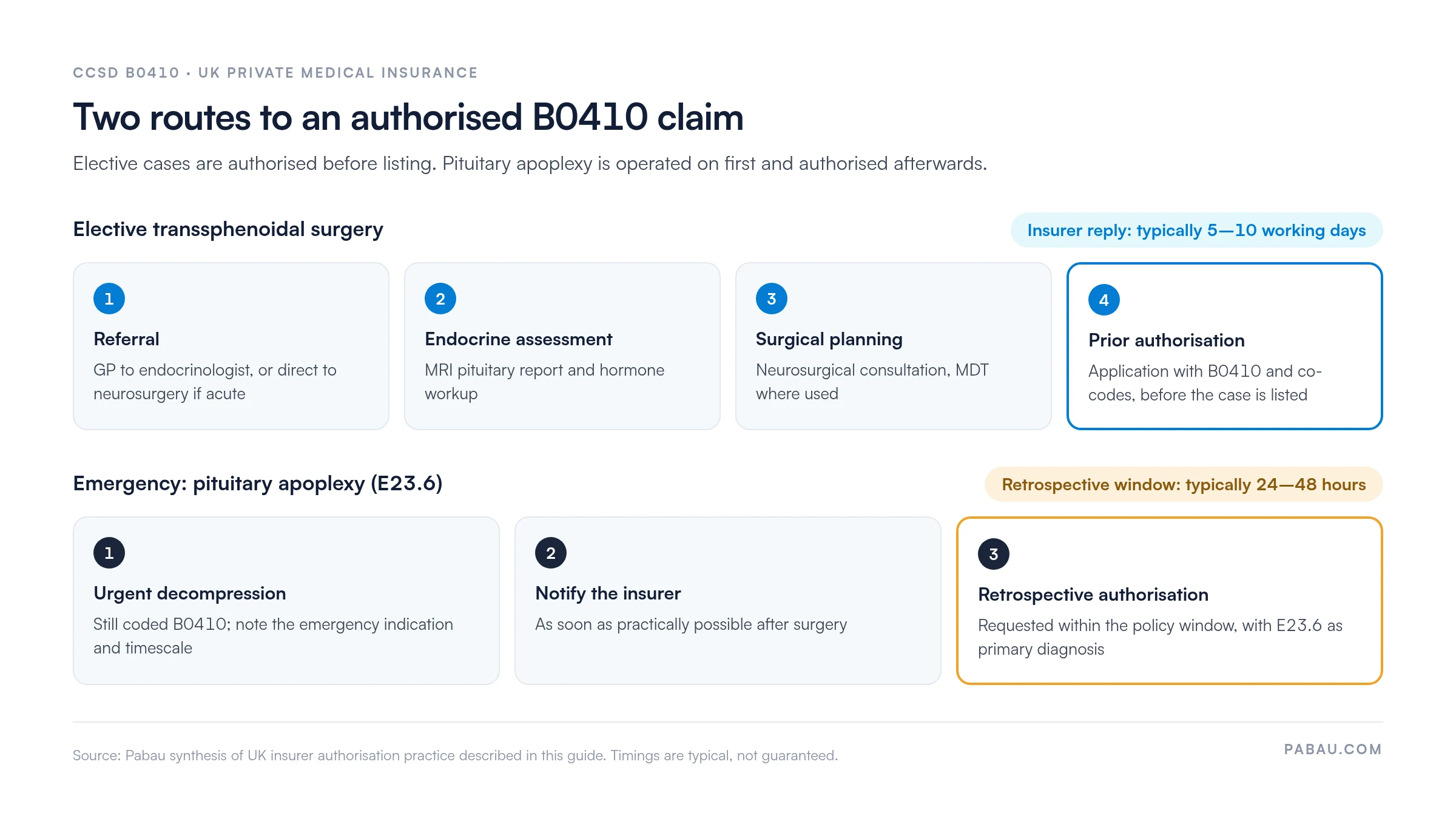
The standard referral pathway for prior authorisation runs in four steps:
For surgeons moving from NHS work to private practice billing, this multi-step process is one of the first adjustments.
The insurer’s authorisation team typically requires:
Authorisation timeframes vary by insurer. Bupa and AXA Health typically respond within 5–10 working days for elective neurosurgery. Emergency cases (pituitary apoplexy) follow an expedited pathway. The surgeon still notifies the insurer as soon as practically possible and obtains retrospective authorisation within the policy window, usually 24–48 hours after the procedure.
The pathway below sets the elective and emergency routes side by side.
A complete pituitary surgery episode typically generates claims from multiple providers. The Aviva fee schedule and other UK insurer schedules distinguish clearly between the surgeon’s fee (B0410), the anaesthetist’s fee, and ancillary services. Each provider bills independently.
B0410 denials follow recognisable patterns, and each has a specific correction pathway. The Healix fee schedule and most insurer billing rules describe the grounds for rejecting a neurosurgical claim. The table below pairs the most frequent reasons with the matching response.
Effective denial management depends on the original claim trail. Authorisation reference numbers, submission dates, operative note versions and insurer correspondence should all be stored and retrievable against the episode. Dedicated claims tools for surgeons keep that record in one place, so an appeal starts from the file.
Before submitting a B0410 claim, run a documentation checklist: Confirm the operative note states the transsphenoidal route and extent of resection. Verify the ICD-10 code matches the confirmed intraoperative diagnosis. Check that the prior authorisation reference number is recorded and current. Catching these three items before submission removes the most common denial triggers for transsphenoidal hypophysectomy claims.
B0410 applies in two procedural scenarios that require additional documentation and insurer communication beyond the standard elective pathway.
Pituitary apoplexy is a haemorrhagic or ischaemic infarction of a pituitary adenoma. It presents as a neurosurgical emergency with sudden-onset severe headache, visual deterioration, and hypopituitarism. Where urgent transsphenoidal decompression is indicated, B0410 is still the correct code. The billing pathway differs in three respects:
Re-do transsphenoidal surgery, for residual tumour after an incomplete first resection or for recurrent adenoma, is coded with B0410 like the primary procedure. The CCSD schedule does not currently require a distinct modifier for revision procedures in this code family. Insurers may still request additional documentation:
Some insurer policies require a separate prior authorisation for revision surgery even where the same surgeon performed the original procedure. Confirm the patient’s current policy terms before listing the revision procedure.
Where repeat transsphenoidal surgery still fails to control Cushing’s disease, bilateral adrenalectomy is the recognised rescue option. Done laparoscopically, that operation is coded B2223, and insurers want the failed pituitary operative note before authorising it.
On many neurosurgical teams, a B0410 episode lives in several places at once. The authorisation reference sits in an insurer email, the operative note in a hospital system, and the invoice in a spreadsheet.
Pabau pulls that episode onto one patient record. The referral letter, MRI report and operative note sit in the patient file beside the appointment. The invoice is raised against the insurer from the same record, and each claim is tracked until payment lands.
When an insurer queries the route or the extent of resection, the evidence is already attached to the episode. Your team answers the query from the record and gets back to the next case.

Pabau supports UK private practices with CCSD claim tracking, documentation audit trails, and the workflow tools neurosurgical billing staff need to keep B0410 claims clean.

B0410 is one of the simpler codes to select and one of the easier ones to lose money on. Selection turns on a single question: Was the route transsphenoidal? Payment turns on paperwork that has to exist before the claim goes out.
So move the checklist earlier, to the point the case is listed. Confirm authorisation before a theatre date is booked, and make sure the operative note names the route and the extent of resection. Then match the ICD-10 code to the histology. The cost is a few minutes per case, set against a surgeon’s fee that can be rejected in full.
Book a demo to see how Pabau keeps the authorisation, operative note and insurer invoice for every B0410 episode on one record.

Billing multiple CCSD codes on the same episode? Bupa CCSD procedure codes covers how Bupa applies its fee schedule to the most common CCSD surgical codes, including unbundling rules.
Coding a neighbouring endocrine procedure? CCSD code B0610 covers excision of the pineal gland, another B-series operation billed to UK insurers.
Billing a diagnostic neurosurgery case? CCSD code A0400 walks through brain biopsy billing for UK insurers.
Need to manage claims across a multi-surgeon private practice? Claims management software built for UK private practices supports CCSD claim tracking, denial logging, and insurer correspondence in one place.
CCSD code B0410 is the Clinical Coding and Schedule Development code for transsphenoidal hypophysectomy (including total). It covers removal of the pituitary gland or a pituitary lesion through the sphenoid sinus, whether the resection is partial or complete.
No separate code is needed. Both microscopic and endoscopic transsphenoidal approaches map to B0410, because the CCSD schedule codes by procedure rather than by instrument technique.
The most common pairings are D35.2 (benign neoplasm of pituitary gland) for non-functioning adenomas and E24.0 (pituitary-dependent Cushing’s disease) for ACTH-secreting adenomas. E22.0 (acromegaly) covers GH-secreting adenomas. Use the most specific code available, such as E24.0 rather than E24.9 for confirmed pituitary-origin Cushing’s disease.
The most frequent denial reasons are: Missing or expired prior authorisation, and an operative note that omits the transsphenoidal route or extent of resection. Other common triggers are a mismatched or non-specific ICD-10 code and unbundling flags, where access components such as nasal endoscopy are billed separately.
Yes, for the overwhelming majority of UK PMI policies. B0410 is classified as major neurosurgery, and Bupa, AXA Health, Aviva, Vitality, and WPA all require prior authorisation before the procedure. Emergency cases (pituitary apoplexy) follow a retrospective notification pathway. Insurers still expect notification, typically within 24–48 hours of the emergency surgery.
Yes. The anaesthetist bills anaesthesia under a separate CCSD anaesthesia code, and it is never included in a surgical code. The neurophysiologist bills intraoperative neurophysiology monitoring (IONM) under their own CCSD code, which typically needs a separate prior authorisation request.